Salt & Tar: Ep.362- OUT of the WATER Survey
For Garrett Newkirk and Ruth Bucher of Salt & Tar, taking on a classic wooden vessel is never a simple financial transaction—it is an intimate forensic study in traditional shipwrighting and mechanical resilience. Having spent years hand-building their 35-foot wooden vessel, Rediviva, from raw forest timber, the couple faced an unexpected expansion of their maritime journey: evaluating Victoria, an elegant 1975-built wooden sailing yacht. In wooden boat terminology, fifty-one years on the water is remarkably young, but taking on a second timber hull demands meticulous due diligence before taking on legal ownership.
With permission from the listing broker to spend their inaugural night aboard, the shipwrights embarked on a high-stakes survey weekend culminating in a vital haul-out. From discovering a seized propeller shaft brake that threatened to cancel the haul-out to navigating a smoky four-mile engine transit and roasting live shipworms with a blowtorch on the boatyard hardstand, Garrett and Ruth documented the practical knowledge and calm troubleshooting required to evaluate a legacy wooden hull.
First Night Aboard and the Shipwright’s Scratch Test
Checking out of their shoreside hotel, the couple packed pillows, bedding, and basic provisions down to the marina slip for their first overnight stay in Victoria’s main salon. While Ruth prepared the salon berths—noting with a laugh that the dense settee cushions felt like sleeping on solid rock—Garrett initiated an exhaustive tactile inspection of every exposed timber member he could reach inside the hull.
To assess the structural integrity of historical wood without invasive drilling, Garrett demonstrated a time-honored shipwright technique: the fingernail scratch test. By dragging a firm scratch across bare timber frames and planking, an experienced shipwright feels subtle acoustic vibrations through the grain, instantly discerning whether the core wood remains dense or has turned porous from hidden rot or freshwater seepage. Garrett systematically checked the bilge framing, knees, and ceiling planks, confirming that the interior timbers remained remarkably dense throughout.
Crisis at the Keel: Freeing the Seized Conical Shaft Brake
The following morning brought sudden mechanical tension. With an early appointment booked at a boatyard four nautical miles southeast, Garrett uncovered a critical issue: the mechanical propeller shaft brake was completely seized around the shaft log. Because the couple did not yet legally own Victoria, brokerage rules dictated that an independent licensed skipper, Captain Wolf, was en route from San Diego to command the vessel, accompanied by deckhand Mario and yacht broker Ben. Operating the marine engine with a seized shaft brake risked catastrophic damage to the transmission.
Garrett examined the brake assembly, which featured a spring-loaded collar and lever arm actuating an internal conical sleeve against a matching cone fixed to the propeller shaft with cork friction pads. Unlike mechanical transmissions that can be locked in reverse under sail, hydraulic marine transmissions lose fluid pressure when the engine stops, leaving the shaft free to freewheel. Prolonged freewheeling under sail can overheat hydraulic gears without circulating oil, while causing excessive wear on stuffing boxes and cutless bearings. The shaft brake prevents freewheeling, but steel-on-steel corrosion had frozen the conical sleeves tight.
Applying penetrating oils like WD-40 was strictly out of the question because contaminating the cork pads would destroy their braking friction. Calling broker Ben to obtain permission for more forceful mechanical intervention, Garrett carefully manipulated the lever arm and tapped the housing. Through patient leverage, he popped the conical sleeve free without scarring the shaft or damaging the cork lining, averting a costly mechanical breakdown before the delivery crew arrived.
First Diesel Startup and the Four-Mile Boatyard Transit
With the shaft brake operational, Garrett checked fluids, hoses, and raw-water connections before turning the starter key. The diesel engine fired cleanly on the very first turn, rotating a left-handed propeller with a deep, rhythmic exhaust note. Watching systems awaken without protest gave the shipwrights immense confidence in the prior owner’s mechanical care.
Captain Wolf took the helm alongside deckhand Mario and broker Ben as lines were cast off for the short journey across the bay. Underway, Captain Wolf accelerated Victoria up to 7 knots, which quickly caused a haze of white smoke and exhaust vapor to fill the salon. Garrett immediately inspected the engine space. Recognizing that the cold engine had been pushed too hard too quickly, the captain throttled back to an easy 5.5 knots at lower RPMs. The haze cleared promptly, confirming it was simply exhaust condensation burning off the dormant manifold rather than an oil or coolant breach.
Travelift Haul-Out and Sounding the 1975 Timber Hull
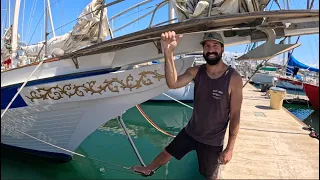
Hailing the boatyard on VHF channel 71, Captain Wolf aligned Victoria with the haul-out slip, and the yard crew backed the vessel stern-first into the travelift slings. As the massive lift hoisted the boat into the air, Garrett and Ruth caught their first unobstructed view of Victoria’s full underwater lines, her varnished transom, and hand-carved gold lettering.
With a strict one-hour survey window on the clock, Garrett and Ruth began systematically sounding the hull. Equipped with a small survey hammer and screwdriver handles, Garrett methodically tapped along the garboard strakes, hood ends, and butt joints across both port and starboard sides. In timber surveying, solid wood rings with a sharp, resonant tone, while hidden rot, moisture pockets, or loosened fasteners yield a dull, hollow thud. To their relief, the 1975 hull planking rang clear and bright, exhibiting remarkably tight seams and zero structural distortion.
Fire on the Hardstand: Torching Teredo Shipworms in the Rudder
While the hull’s primary teak planking showed no signs of marine infestation, the survey revealed active shipworms (Teredo navalis) burrowed into the wooden rudder. Because rudders frequently utilize different timber species and endure turbulent water flow that scours away bottom paint, they represent the most vulnerable timber element on any wooden hull.
To eradicate the live mollusks without performing invasive wood surgery on a boat they did not yet own, Garrett retrieved a handheld blowtorch from the forward cabin. By carefully applying focused heat directly into the worm holes without charring the timber, he roasted the worms deep within their tunnels until the moisture sizzled. Once the worms were neutralized, Ruth applied underwater sealant compound over the entry holes and exposed grain, creating an effective barrier to protect the timber until a comprehensive bottom refit could be scheduled.
Custom Franken-Zincs and Splashing Back
Before splashing back, the shipwrights addressed galvanic protection. The bronze rudder gudgeons exhibited heavily wasted zincs, and the propeller shaft was missing an anode entirely. Garrett wire-brushed the bronze hardware down to clean metal, visited the boatyard chandlery, and modified a standard replacement block by cutting it in half to assemble a custom “Franken-zinc” array fitted perfectly to the rudder hardware.
Nine hundred dollars lighter for the survey haul-out, Victoria was lowered back into the water, resting easily in her element. Navigating back to the slip under afternoon sunshine, Garrett and Ruth reflected on an exceptionally successful survey. With sound planking, a healthy engine, and clear remediation plans for the rudder, the shipwrights prepared to finalize their ownership and welcome Victoria into the Salt & Tar fleet.
| Component / Inspection Area | Survey Observation & Condition | Remedy & Shipwright Action Taken |
|---|---|---|
| Hull Planking & Fasteners | 1975 timber construction; passed sounding survey with bright acoustic tone. | No structural soft spots or loose butt joints; hull sound below waterline. |
| Propeller Shaft Brake | Conical sleeve and cork pads seized on shaft from long dormancy. | Mechanically freed without penetrating oil; preserved cork friction pads. |
| Inboard Marine Diesel | Started on first crank; produced cabin exhaust haze when pushed to 7 knots. | Throttled back to 5.5 knots; haze cleared as condensation burned off manifold. |
| Rudder Assembly & Wood | Active Teredo shipworm entry holes discovered in non-teak rudder timber. | Treated with blowtorch heat to cook live worms; sealed with protective compound. |
| Galvanic Protection (Zincs) | Gudgeon zincs heavily wasted; missing propeller shaft collar anode. | Bronze wire-brushed clean; installed new and custom-cut “Franken-zincs” on rudder. |
| Haul-Out Logistics | Stern-first travelift sling lift; 1-hour survey window; $900 yard invoice. | Hull survey verified fair asking price; cleared vessel for ownership purchase. |
Frequently Asked Questions
Garrett and Ruth hauled out Victoria, a classic 1975-built wooden sailing yacht that they are in the process of purchasing alongside their custom schooner Rediviva.
Garrett scratches bare interior wood with a fingernail to feel acoustic vibrations through the grain, discerning whether the timber core remains dense or has turned porous from fungal decay.
Hydraulic transmissions lose fluid pressure when the engine stops and can be damaged by freewheeling under sail, but running the engine while the shaft brake is frozen tight would severely damage transmission components.
When the skipper accelerated Victoria to 7 knots, exhaust condensation burned off the dormant manifold and entered the cabin; throttling back to 5.5 knots at lower RPMs allowed the haze to clear naturally.
Garrett used a handheld blowtorch to gently heat the worm entry holes in the rudder, cooking the live Teredo mollusks inside their tunnels before sealing the holes with an underwater barrier compound.
A Franken-zinc refers to modifying commercial sacrificial anode blocks by cutting them in half or re-drilling them to fit irregular bronze gudgeons or rudder hardware when exact replacement sizes are unavailable.
Book a trip where this was filmed — near San Diego

Support Salt & Tar
At WeBoating.com, we profoundly acknowledge the unwavering dedication that Salt & Tar invests in crafting each and every video or voyage. Their passion for delivering exceptional ocean content shines through every frame, and it's a labor of love that deserves your attention.
We invite you to watch their captivating videos here and actively engage with their content, including their social media links above. Liking, commenting, and sharing their work goes a long way in fueling their creative fire.
We're also inviting you to explore the gear, sponsorships, and boat partnerships highlighted in the "Salt & Tar: Ep.362- OUT of the WATER Survey" video description, or directly on YouTube. By engaging with these offerings or purchasing services and items, you directly support Salt & Tar, their collaborators, and the brands they're associated with.
To ensure you never miss an offshore update, consider visiting their official YouTube Channel to subscribe, like, and join their community directly.
If you have any feedback, corrections, or additional information about Salt & Tar or their videos, please use the comment form below to share your thoughts with us.
Thank you for being a part of our community and supporting the creators we cherish. Your time and support truly matter!
The next step on our road to owning Victoria. We start the engine for the first time, we haul out to survey the hull, and we feel her move through the water for the first time. Quite a few firsts! First night on board too.
Thanks for watching!
p.s. I try and reply to as many comments as I can but we are still so so busy so please do not take it personally 💕
Much love!!!
REFIT FUND: https://www.paypal.com/paypalme/saltandtar
https://saltandtar.org/
https://www.patreon.com/saltandtar ----- pledge per episode
https://www.paypal.com/paypalme/saltandtar --------- one-time donation
You can also support the project and sport some of our merchandise:
https://www.bonfire.com/store/saltandtarswag/
Also, thank you for watching/tolerating the ads. They really help us out financially. We can\'t control what ads (that typically depends on your \"cookies\" i.e. your internet history) but it\'s an easy free way to support the project and buy more parts for the boat. Thanks everybody :)
Music featured:
Epidemic Sound- referral link below
https://share.epidemicsound.com/9srkjx
WANT some Thixo for yourself? Use our link and get a 5% discount with TotalBoat:
https://www.totalboat.com/saltandtar
Code:03WHEXTEYFCA
The dinghy is from CLC, Chesapeake Light Craft, the Tenderly 10 design:
https://clcboats.com/shop/boats/wooden-sailboat-kits/tenderly-dinghy.html
Salt & Tar
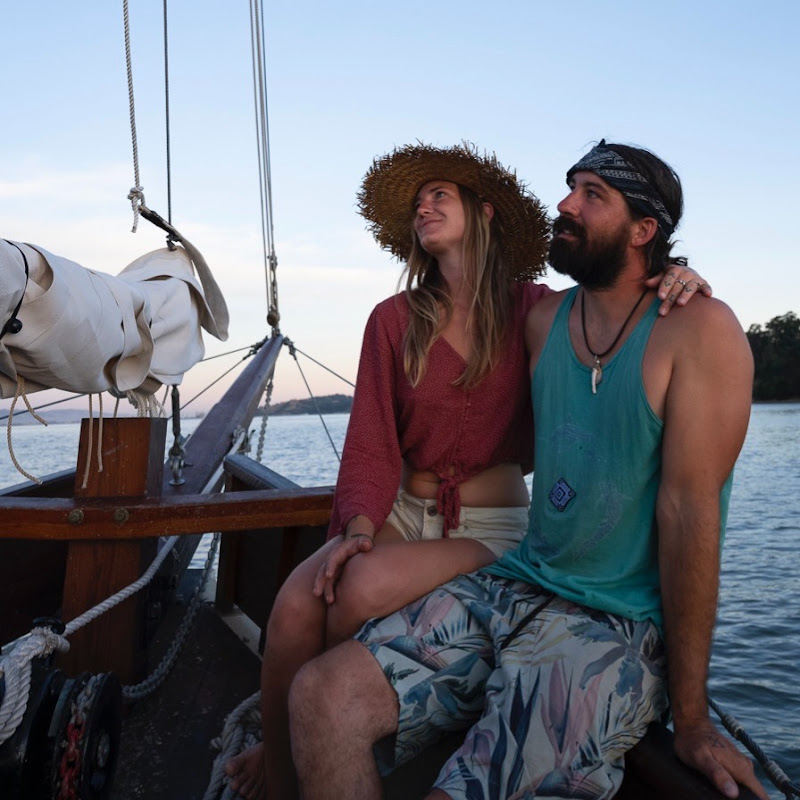
Garrett and Ruth Jolly: The artisans behind Salt & Tar, currently double-planking their 35ft wooden ketch, Rediviva, for the next phase of their Pacific expedition.
Channel Information:
Social Media Links:
Salt & Tar: Ep.362- OUT of the WATER Survey Location
- San Diego Bay Boatyard Hardstand, San Diego, California, USA (32.7157,-117.2285)
Latest Episodes from Salt & Tar
Explore the most recent voyages. Subscribe to the channel to never miss an update!
Salt & Tar: Ep.364- New Heights
Going aloft for the first time on Victoria, finding leaks, and more cleaning. Her rigging is 30 years old and probably the biggest project she requires. The deck leaks are mainly due to the hardware needing to be rebed. Next week we are back to Rediviva ;) Thanks for watching! p.s. I try and reply...
Salt & Tar: Ep.363- The Boat is Ours!
Taking possession of Victoria in Ensenada, Garrett and Ruth Jolly scrub the interior joinery and disconnect troubling bilge bonding wires to halt wood delignification along the Monel keel bolts and stuffing box.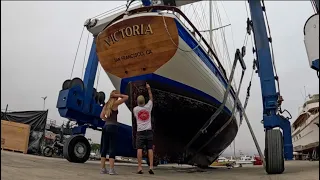
Salt & Tar: Ep.362- OUT of the WATER Survey
Garrett and Ruth of Salt & Tar haul out the classic wooden yacht Victoria for a pre-purchase survey, freeing a seized shaft brake and torching shipworms.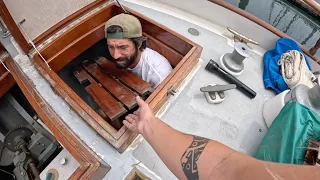
Salt & Tar: Ep.361- IN-THE-WATER Survey
Garrett and Ruth Jolly of Salt & Tar travel from Puerto Peñasco to Ensenada, Mexico, conducting an in-the-water marine survey of Victoria, a classic William Garden Porpoise wooden cruising ketch.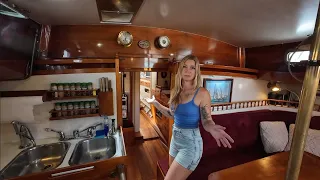
Meet Victoria – Tour of our William Garden ‘Porpoise’ built by Robin Fung in 1975
Garrett and Ruth of Salt & Tar explore Victoria, an offshore 42-foot William Garden Porpoise ketch built by Robin Fung in 1975 from Burmese teak, ipil, and yakal, powered by a Perkins 4.236 diesel engine.