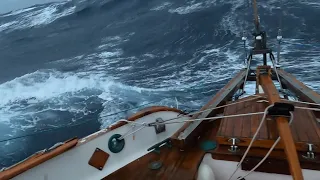
EP#451 How Mighty Sparrow got Her Name
In the vast, unforgiving theater of high-latitude blue-water sailing, few vessels command the raw respect accorded to the Open 40 ocean racer Mighty Sparrow. Brought vividly to life through the maritime chronicles of Sailing Into Oblivion, the vessel represents a singular fusion of cutting-edge naval architecture and timeless nautical heritage. Skipper James Burwick has guided this carbon-fiber thoroughbred through the most perilous corridors of the Southern Ocean, yet the genesis of her name traces not to cold polar charts, but to the sun-drenched roadsteads of the Caribbean, where calypso rhythms and island brotherhood laid the bedrock for a lifetime of extreme seamanship.
Maritime naming traditions have long straddled the boundary between superstition and spiritual covenant. When a sailor chooses a totem, they invoke an energy meant to sustain them through screaming gales and the bone-deep exhaustion of solo voyaging. In the case of Mighty Sparrow, the moniker bridges two worlds: the defiant cultural genius of Trinidadian calypso icon Slinger Francisco—known worldwide as The Mighty Sparrow—and the remarkable endurance of the common sparrow, an unassuming bird capable of traversing boundless migratory flyways through sheer tenacity. Refitted and rechristened in the British Virgin Islands, the yacht shed an unwanted identity to carry a name forged in respect, island camaraderie, and ocean survival.
The Calypso Heritage and Caribbean Maritime Lineage
When James Burwick of Sailing Into Oblivion took helm of the celebrated Open 40 known today as Mighty Sparrow, he understood that extreme Ocean Voyaging through the Southern Ocean demands both flawless technical design and profound moral Seamanship. Yet the vessel did not always possess a moniker worthy of the globe’s wildest oceans. Arriving in the British Virgin Islands during the initial stages of offshore preparation, the transom bore the cumbersome and pretentious name Cyrano—an ornate tribute that felt hopelessly out of place amidst the unfiltered realities of blue water.
Working at Bitter End Yacht Club in Leverick Bay and the North Sound of Virgin Gorda during the late 2000s, Burwick managed a watersports fleet alongside veteran West Indian captains including Captain Bernie, Michael, Terry, and Javon. Overcoming cultural divides in the hillside taverns of The Bond above Gun Creek required genuine humility, cold Schaefer beers, and attuning to the authentic pulse of the islands. That bridge was forged through Calypso music, where the electrifying recordings of The Mighty Sparrow—such as Saltfish and Jean and Dinah—reigned supreme.
Burwick shared Sparrow tunes with Captain Bernie from portable speakers on warm tropical evenings, discovering common ground in the music’s wit and resilience. When Tortola boatman Sam Talbett asked what new identity should replace Cyrano, Burwick’s alternative notion of christening her Freight Train gave way to unanimous support for the Calypso King. Eighty percent tribute to island solidarity and twenty percent homage to a small bird’s epic seasonal migration, the vessel became forever christened Mighty Sparrow.
Open 40 Naval Architecture and Extreme Ocean Performance
The maritime design philosophy celebrated by James Burwick on Sailing Into Oblivion establishes the Mighty Sparrow Open 40 as a masterwork of high-latitude Ocean Voyaging, engineered to conquer the Southern Ocean through uncompromising Seamanship. Unlike traditional heavy-displacement cruising hulls relying on sheer mass to survive breaking seas, the Open 40 class was developed to maximize hydrodynamic planing downwind. Built from pre-impregnated carbon fiber over structural Nomex honeycomb and PVC foam cores, the platform pairs featherlight displacement with immense torsional stiffness.
Central to the Open 40’s extraordinary performance is the hydraulic canting keel. Pivoting up to forty degrees to windward via heavy-duty hydraulic rams, the high-tensile steel fin swings a multi-ton lead bulb outboard. This dynamic ballast generates colossal righting moment without burdening the hull with deadweight, allowing the vessel to carry full sail area while remaining powerfully upright under severe aerodynamic loads.
To compensate for lateral leeway when the keel is canted out of vertical alignment, twin retractable asymmetric carbon daggerboards are fitted forward of the mast. When powered up on a reach, the leeward foil generates hydrodynamic lift, preventing drift. Paired with transverse water ballast tanks pumping 750 liters of seawater to windward, the skipper can fine-tune hull trim. Below decks, a Spartan interior with carbon ring frames, watertight bulkheads, and minimalist pipe berths prioritizes rapid damage control over comfort.
Crucible of the Roaring Forties, Cape Horn, and the Agulhas Current
The ocean trials chronicled by James Burwick within Sailing Into Oblivion prove that the Mighty Sparrow Open 40 was born for the tempestuous rigors of high-latitude Ocean Voyaging, where survival in the Southern Ocean hinges upon iron Seamanship. South of the fortieth parallel, unobstructed westerly gales generate monstrous swells measuring twelve to fifteen meters. In these ferocious corridors, the yacht’s broad transom and twin balanced kick-up rudders allow her to surf down breaking rollers at over twenty knots without broaching.
Off the southern coast of South Africa, the yacht encountered the treacherous collision of the warm, four-knot Agulhas Current and gale-force southwesterly fronts. The resulting square, vertical seas subject carbon composite structures to violent deceleration and structural pounding. Rounding Cape Horn into the Drake Passage demanded relentless ice vigilance, dodging semi-submerged growlers in horizontal sleet where carbon spars and Dyneema standing rigging bore loads exceeding twenty metric tons.
Mastering these conditions required disciplined sleep management. Burwick maintained strict polyphasic sleep intervals of twenty to thirty minutes, resting in offshore foul-weather gear on a gimballed pipe cot. Waking instantly to changes in hull pitch or autopilot alarms, the skipper continually trimmed the solent jib and mainsail reefs, walking the tightrope between record velocity and structural disaster.
Mighty Sparrow Open 40 Technical Specifications and Scantlings
Detailed forensic records analyzed by James Burwick on Sailing Into Oblivion reveal how the Mighty Sparrow Open 40 establishes unprecedented structural benchmarks for solo Ocean Voyaging across the Southern Ocean through advanced naval Seamanship. The following engineering table outlines the primary dimensions, hydraulic parameters, ballast capacities, and scantling specifications that define this legendary ocean racing platform.
| Engineering Category | Technical Specification | Functional Rationale |
|---|---|---|
| Vessel Class & Design | Open 40 Canting-Keel Monohull | High-latitude solo racing and oceanic speed record platform |
| Hull Construction | Pre-preg Carbon Fiber / Nomex Honeycomb | Maximum stiffness with ultra-lightweight displacement |
| Principal Dimensions | LOA: 12.19 m (40.0 ft) | Beam: 4.25 m (13.9 ft) | Optimized for high-speed surfing and broad-reaching stability |
| Draft & Center of Gravity | 3.20 m (10.5 ft) Keel Centered | Deep lead bulb providing exceptional self-righting dynamic |
| Canting Keel Mechanics | ±40° Cant via Dual Hydraulic Rams | Dramatic righting moment increase without deadweight penalty |
| Lateral Lift Foils | Twin Asymmetric Carbon Daggerboards | Counteracts leeway drift and generates weather lift |
| Water Ballast System | 2 x 750 Liters (Port / Starboard) | Dynamic transverse trim control in changing gale conditions |
| Spar & Rig Scantlings | Fractional Sloop / Carbon-Fiber Mast | Engineered to endure 65-knot Antarctic storm gusts |
| Steering & Rudders | Twin Transom-Hung Balanced Rudders | Full directional control at extreme heel angles and surfing speeds |
| Damage Control Architecture | 3 Watertight Bulkheads & Escape Hatches | Guarantees reserve buoyancy following high-speed impact |
The Enduring Totem of High-Latitude Voyaging
The nautical legacy examined by James Burwick throughout Sailing Into Oblivion demonstrates that the Mighty Sparrow Open 40 transcends mere mechanical metrics, transforming high-latitude Ocean Voyaging across the Southern Ocean into a study of human Seamanship. A boat’s name is not a passive decorative label; it serves as a psychological totem that anchors a mariner during the darkest night watches. Amidst screaming gales and towering seas, the memories of Caribbean warmth, laughter at The Bond, and Calypso music provide an indispensable mental lifeline.
That profound bond between solo mariner and vessel highlights the reality of extreme voyaging. Solitude in far southern latitudes strips away pretense, leaving only the fundamental dialogue between human determination and ocean force. The modest sparrow, braving transcontinental migrations across turbulent skies, mirrors the quiet resilience needed to traverse great oceans. By carrying that name across tens of thousands of miles, the vessel honors both the musical genius of The Mighty Sparrow and the untamed spirit of blue-water exploration.
Frequently Asked Questions
To provide clear technical and historical clarity on the maritime achievements documented by James Burwick on Sailing Into Oblivion, the following reference details how the Mighty Sparrow Open 40 mastered extreme Ocean Voyaging throughout the Southern Ocean through innovative design and seasoned Seamanship.
The vessel was renamed from Cyrano by James Burwick while working at Bitter End Yacht Club in the British Virgin Islands. The name is an 80% tribute to Trinidadian calypso legend The Mighty Sparrow (Slinger Francisco), whose songs bonded the skipper with local boat captains, and 20% homage to the sparrow’s immense migratory endurance.
An Open 40 is a specialized 40-foot carbon-composite offshore racing yacht engineered for singlehanded oceanic passage making. Featuring a wide planing transom, canting keel, and ultralight displacement, it planes downwind at speeds exceeding 20 knots in circumpolar gale corridors.
The canting keel employs a high-tensile steel fin with a heavy lead bulb that swings up to 40 degrees to windward via hydraulic rams. This increases righting moment dramatically without adding deadweight, keeping the boat upright and maximizing sail-carrying power.
James Burwick navigated Mighty Sparrow through high-latitude passages across the Roaring Forties, rounding the Cape of Good Hope off South Africa, traversing the southern Indian Ocean, rounding Cape Horn in Chile, and making landfall in deep-sea hubs such as Cape Town and Mauritius.
Solo skippers maintain strict polyphasic sleep schedules, napping for 20 to 30 minutes at intervals while fully suited in offshore gear. Autopilot alarms and radar target warnings awaken the skipper to adjust sail trim and monitor structural loads during severe gale fronts.
Crucial safety equipment includes multiple watertight crash bulkheads, twin SOLAS immersion survival suits, dual high-capacity bilge pumps, a dedicated transom escape hatch, a 406 MHz EPIRB, satellite trackers, and an offshore liferaft housed in an exterior deployment bustle.
Following her iconic high-latitude passages and circumnavigations across the globe’s Great Capes, Mighty Sparrow remains an active maritime legend, undergoing periodic refits and serving as an authoritative benchmark for solo naval architecture and extreme blue-water voyaging.
Support Sailing Into Oblivion
At WeBoating.com, we profoundly acknowledge the unwavering dedication that Sailing Into Oblivion invests in crafting each and every video or voyage. Their passion for delivering exceptional ocean content shines through every frame, and it's a labor of love that deserves your attention.
We invite you to watch their captivating videos here and actively engage with their content, including their social media links above. Liking, commenting, and sharing their work goes a long way in fueling their creative fire.
We're also inviting you to explore the gear, sponsorships, and boat partnerships highlighted in the "EP#451 How Mighty Sparrow got Her Name" video description, or directly on YouTube. By engaging with these offerings or purchasing services and items, you directly support Sailing Into Oblivion, their collaborators, and the brands they're associated with.
To ensure you never miss an offshore update, consider visiting their official YouTube Channel to subscribe, like, and join their community directly.
If you have any feedback, corrections, or additional information about Sailing Into Oblivion or their videos, please use the comment form below to share your thoughts with us.
Thank you for being a part of our community and supporting the creators we cherish. Your time and support truly matter!
Help Support this Channel with the following links, Thanks for listening!
Support this Channel on Patreon: https://www.patreon.com/sailingintooblivionpodcast
Starlink Referral Link: https://starlink.com?referral=RC-DF-13132545-72429-94
Help fund my next adventure here: https://gofund.me/6df0fb45
One Time Donations Via PayPal and Venmo: https://www.paypal.com/paypalme/JeromeRand
Venmo: https://account.venmo.com/u/sailingintooblivion
Amazon Wishlist: https://www.amazon.com/hz/wishlist/ls/33F36RF315G8V?ref_=wl_share
Children's Book: https://a.co/d/1q2Xkev
Sailing Into Oblivion Children's Audio Book: Audible.com
Sailing Shirts: https://www.bonfire.com/store/sailing-into-oblivion/
Books: https://a.co/d/eYaP10M
Reach out to the Show: https://www.sailingintooblivion.com/podcasts
Total Boat 5% discount code: https://www.totalboat.com/?sca_ref=9803393.xY85BaEnxZ
Sailing Into Oblivion
Discover the world-proven resilience of Jerome Rand as he documents his 271-day solo non-stop circumnavigation aboard his Westsail 32, Mighty Sparrow.
Channel Information:
Social Media Links:
EP#451 How Mighty Sparrow got Her Name Location
- Cape Town Port & Waterfront Marina Basin, Western Cape, South Africa (-33.905,18.423)
- Port Louis Harbor & Yacht Basin, Mauritius (-20.16,57.5)
Latest Episodes from Sailing Into Oblivion
Explore the most recent voyages. Subscribe to the channel to never miss an update!
Round the World Sailing Route @sailingwithphoenix
Help Support this Channel with the following links, Thanks for listening! Support this Channel on Patreon: Starlink Referral Link: Help fund my next adventure here: One Time Donations Via PayPal and Venmo: Venmo: Amazon Wishlist: Children's Book: Sailing Into Oblivion Children&#...
Round the World Route for @Sailing_With_Phoenix Q&A
Today we will be talking about the route and all the challenges to make it safely around the world.
EP#451 How Mighty Sparrow got Her Name
James Burwick explores the legendary Open 40 racing yacht Mighty Sparrow on Sailing Into Oblivion, recounting extreme Southern Ocean voyaging, canting keel design, and the cultural spirit behind the vessel's iconic name.