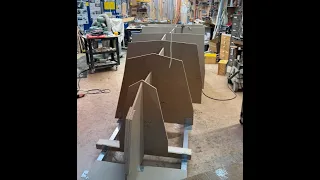
Scarfing , butt joint, to Save Divinycell.
In the coastal town of Västervik, Sweden, surrounded by the granite archipelagos of the Baltic Sea, 87-year-old solo navigator and micro-cruiser naval architect Sven Yrvind continues the slow, deliberate assembly of his latest ocean-going vessel. Working single-handedly in his modest industrial workshop, the legendary Swedish mariner—famed for rounding Cape Horn in a self-built 5.9-meter boat during the southern winter of 1980—is constructing a 5.6-meter (18-foot 4-inch) double-ended micro-cruiser engineered specifically for the extreme conditions of the Southern Ocean. With a beam of just 1.45 meters (4 feet 9 inches), a three-masted unstayed lugger rig carrying 9 square meters of total working sail, and an unconventional bow daggerboard foil, the vessel embodies Yrvind’s lifelong philosophy that smaller, properly proportioned craft offer superior structural resilience and survivability in high latitudes.
At the structural foundation of this expedition cruiser is a composite sandwich matrix constructed from thick, high-density Divinycell closed-cell structural PVC foam bonded with Swedish Nils Malmgren (NM) epoxy. Unlike production boatyards that utilize female tooling, automated CNC cutting beds, and vacuum-infusion lines, Yrvind executes the entire construction process by hand over temporary wooden station molds. Every sheet of structural foam must be shaped, beveled, and faired with exacting precision to create a monolithic, unsinkable hull shell capable of enduring violent wave impacts and pitch-poling rolls in the Roaring Forties on his planned voyage to Dunedin, New Zealand.
As the hull planking progresses through the lower strakes, Yrvind confronts two pivotal challenges in composite foam fabrication: joining structural core panels through precision scarfing while eliminating material waste, and reconciling the rigid geometry of wooden building frames with the natural elastic curve of the foam core. By examining how structural PVC behaves under flexural tension, how offcuts can be salvaged through flat butt joints, and why an elastic fairing curve takes precedence over rigid mathematical frame contact, Yrvind demonstrates the practical naval architecture principles that govern high-latitude small craft engineering.
Structural Foam Engineering: The Role of Divinycell in High-Latitude Hulls
In high-latitude expedition boatbuilding, the selection of core material dictates both the ultimate survival threshold of the vessel and the daily habitable environment of the solo sailor. Sven Yrvind relies exclusively on Divinycell H-grade closed-cell structural PVC foam, an aerospace- and marine-certified core material manufactured by DIAB in Sweden. Divinycell H-grade is specifically engineered to deliver an exceptional strength-to-weight ratio, high dynamic impact absorption, and outstanding resistance to fatigue under cyclic wave loading. When sandwiched between interior and exterior skins of multiaxial fiberglass cloth saturated with high-modulus epoxy, the structural foam functions as a continuous shear web, separating the load-bearing laminate faces.
From a mechanical engineering perspective, sandwich construction exploits the principle of the section modulus. By increasing the thickness of the Divinycell core while maintaining relatively thin outer composite skins, the moment of inertia increases exponentially with negligible weight penalties. For a 5.6-meter micro-cruiser navigating the Roaring Forties, where breaking crests can violently slam against the hull sides, this thick sandwich core prevents catastrophic buckling and localized oil-canning. The closed-cell morphology of Divinycell ensures that even if an outer fiberglass laminate is punctured by floating debris, sea ice, or rock shoals, the foam will not absorb moisture or allow water migration throughout the hull structure.
Beyond structural load transmission, the thick Divinycell core provides vital thermal insulation. In sub-Antarctic waters where ambient sea temperatures hover near freezing, uninsulated hulls rapidly accumulate condensation, soaking provisioning stores and precipitating dangerous hypothermia for a solo sailor. The low thermal conductivity of closed-cell PVC foam creates a completely insulated living capsule. Furthermore, the immense volume of buoyant foam incorporated throughout the hull shell and internal bulkheads renders Yrvind’s craft inherently unsinkable, providing positive reserve buoyancy that far exceeds the total displacement of the loaded vessel and its internal water ballast.
Scarfing Versus Butt Joints: Core Joining Dynamics and Geometry
When planking a compound-curved canoe hull with flat sheets of Divinycell, individual core panels must be spliced longitudinally to span the full 5.6-meter length of the vessel. In composite core engineering, the method used to join these foam sections directly influences stress distribution throughout the hull skin. During this construction phase, Yrvind undertakes the demanding task of cutting and bonding 18 precision scarf joints across the hull strakes. Rather than relying on simple square butt cuts on the active hull curves, scarfing requires shaving the matching ends of the foam sheets at a shallow, continuous bevel slope.
The mechanical necessity for scarfing structural core panels lies in shear stress distribution. If structural foam sheets are joined with a vertical butt joint along a curved surface undergoing multi-axial flexural bending, the abrupt transition creates a localized stress concentration—effectively an internal hinge line where shear stresses cannot be smoothly transferred between adjacent panels. By tapering the mating foam faces at a scarf ratio (typically between 8:1 and 12:1), the bonded surface area is expanded tenfold. When saturated with Nils Malmgren epoxy paste, the long diagonal scarf joint creates a continuous shear web that matches the mechanical elongation and tensile strength of the native foam core, eliminating hard spots that could trigger laminate delamination under severe sea loads.
“So, friends, now these pieces are scarfed. And now we got everything… But it’s quickly done and then we put up the finish again.”
Sven Yrvind
While structural hull strakes demand the structural continuity of beveled scarf joints, Yrvind adopts an entirely different approach for remnant foam cutoffs. High-performance Divinycell is an expensive, high-specification structural core material, and Yrvind operates under strict resource conservation, having allocated four primary sheets for the hull sides. Rather than discarding the irregular triangular and rectangular offcuts trimmed from the sheerline and topsides, Yrvind salvages every usable piece by gluing them together end-to-end using flat butt joints on the workshop floor.
To execute these flat salvage butt joints, Yrvind lays a sheet of polyethylene release plastic across the flat concrete floor of his Västervik workshop. The Divinycell offcuts are squared off, coated with catalyzed NM epoxy along their mating edges, and pressed tightly together end-to-end. Mechanical clamps are applied to maintain lateral alignment, while static ballast weights are set on top of the panels to hold them perfectly planar against the floor. Because these salvaged offcut assemblies will be used in low-stress flat bulkheads or internal furniture modules where exterior glass laminates carry the primary bending loads, the simpler butt joint provides more than adequate structural integrity while reducing composite material waste to nearly zero.
The Fair Line Over Rigid Geometry: Splines, Gaps, and Hull Physics
Once the scarfed Divinycell strakes are cured and pre-shaped, Yrvind returns them to the building jig to verify their alignment across the temporary wooden form frames. Positioned along the longitudinal axis, the scarfed core strake reveals a minor dimensional variation at one edge. With the practical adaptability of an experienced shipwright, Yrvind shifts the entire panel slightly forward along the building jig, compensating for the missing margin and ensuring that adequate material remains for subsequent perimeter beveling and chine fairing.
During this dry-fitting trial, a notable visual detail emerges: at one of the station molds, the Divinycell foam does not make direct physical contact with the wooden frame, leaving a visible gap beneath the panel. In conventional amateur boatbuilding, such a gap is frequently perceived as an error to be corrected immediately by applying heavy C-clamps, screw dogs, or mechanical levers to force the foam core flush against the station frame. Yrvind, however, firmly rejects mechanical coercion, making a deliberate naval architecture decision to leave the gap untouched and allow the foam to follow its natural curve.
“Someone noticed that it doesn’t touch here. It’s like a gap here. Well, I think she got a nice and fair curve. So, I leave it like that. Well, after all, it’s me who designed this. I know when I see in reality. And if the shape of the Divinycell likes to have this shape, well, I’m not going to force them into something else. Otherwise, I could do the clamp here, you know. Force it in a bit. But I will give it liberty.”
Sven Yrvind
This decision underscores a foundational tenet of yacht design: the primacy of the fair elastica curve over localized lofting tolerances. When an elastic material such as a wooden batten or a thick sheet of closed-cell PVC foam bends freely in space, it naturally distributes bending moments evenly along its length, forming a curve of minimum strain energy. Temporary wooden building frames, cut from drawings or full-size lofting offsets, inevitably contain minor millimeter-level drafting errors or thermal distortions. If a builder forces a stiff composite core against an imperfect station frame with mechanical clamps, they introduce intense localized pre-stress into the foam matrix. When the temporary frames are eventually removed after laminating, these trapped internal stresses can release, creating unfair hollows, localized bumps, or laminate distortion.
Hydrodynamically, an unfair hollow or flat spot along the forward run of a displacement hull induces premature boundary layer separation and localized pressure drops. For a heavy displacement vessel sailing at low speeds with only 9 square meters of working canvas, flow separation increases form drag and diminishes pointing ability. By granting the Divinycell core ‘liberty’ to follow its natural fair line, Yrvind ensures that the resulting hull skin presents a smooth, continuously developing curvature to the incoming water flow, minimizing laminar disturbance and hydrodynamic resistance.
Internal Reinforcement and Drag Reduction: The 50×50 mm Corner Radius
Having established the longitudinal fairing of the hull strakes, Yrvind directs his attention to the transition seams where the hull bottom meets the topsides and interior structural bulkheads. To further minimize hydrodynamic drag, Yrvind plans to round the exterior chines and bilge transitions, creating a generous external radius rather than a sharp, angular corner. However, grinding a radius onto the outside corner of a sandwich hull inevitably removes structural core material, thinning the foam at the exact apex where impact resistance and shear strength are most critical.
To overcome this structural limitation, Yrvind devises an internal reinforcement technique using solid structural foam blocks. On the interior surface of the seam, Yrvind bonds an additional 50 mm by 50 mm (50×50 mm) strip of Divinycell directly along the chine joint. By laminating this 50×50 mm foam fillet to the inside face of the hull skin, Yrvind effectively doubles the total core thickness at the corner. This supplemental material provides an ample structural buffer, allowing him to carve and fair a sweeping external radius on the outside hull face without sacrificing minimum core thickness or structural integrity.
- Boundary Layer Optimization: A rounded bilge radius prevents turbulent vortex shedding along hard chines, allowing water to follow the hull buttocks with minimal viscous drag.
- Wetted Surface Reduction: Softening the turn of the bilge decreases the total perimeter of the underwater cross-section, reducing wetted surface area at displacement speeds.
- Laminate Consolidation: Heavy fiberglass cloth wraps smoothly around a continuous radius, preventing resin-rich voids and air bubbles that commonly form in sharp 90-degree composite corners.
- Impact Cushioning: The reinforced 50×50 mm internal foam block acts as an energy-absorbing shock buffer in the event of grounding or collisions with floating sea ice.
To execute this joint, Yrvind dismounts the pre-fitted strake from the building jig and returns it to his workbenches. Using hand tools and routing templates, he carves relief recesses along the interior edges of the foam panel, shaping a precise bedding pocket to receive the 50×50 mm Divinycell strip. Once coated with thickened NM epoxy and clamped under uniform pressure, this composite reinforcement integrates seamlessly into the hull core, creating a monolithic structural junction ready for heavy glass laminates.
Epoxy Chemistry and Ambient Night Cures: Nils Malmgren NM Formulations
The structural integrity of any composite sandwich construction depends entirely on the adhesive bond between the PVC foam core and the resin matrix. Throughout the construction of his 5.6-meter cruiser, Yrvind utilizes marine epoxy systems manufactured by Nils Malmgren AB (NM), a Swedish chemical specialist based in Ytterby renowned for formulating high-specification industrial and maritime epoxies. Unlike standard polyester or vinylester resins, which can shrink up to 8% during curing and suffer from brittle matrix failure, NM epoxy formulations exhibit negligible volumetric shrinkage, high tensile elongation, and exceptional secondary bonding characteristics to closed-cell PVC foam.
Working in the temperate climate of Västervik, Sweden, Yrvind orchestrates his daily workshop workflow around the chemical kinetics of the epoxy system. During daylight hours, Yrvind focuses on physical cutting, dry-fitting, edge beveling, and clamping setups. Once the Divinycell strakes and offcut assemblies are aligned, the two-part NM epoxy resin and amine hardener are mixed in precise stoichiometric proportions, thickened with thixotropic silica and microballoons to prevent sag, and applied generously to the joint faces. Clamps and static weights are positioned, after which Yrvind steps away, allowing the chemical cross-linking of the polymer chains to occur undisturbed overnight at ambient workshop temperatures.
“Now, I go back home to do some more designing. In the meantime, the epoxy works. The epoxy works during the night time. And tomorrow should be dry. So, a good thing.”
Sven Yrvind
This evening transition from manual composite fabrication to theoretical naval architecture reflects Yrvind’s lifelong synthesis of craft and intellect. While the NM epoxy undergoes slow, exotherm-controlled polymerization on the workshop floor, Yrvind returns to his home study to work on mathematical hull calculations, displacement distributions, center-of-effort balance for his three-masted lugger rig, and stability curves for the bow daggerboard. By aligning resin cure cycles with design analysis, Yrvind maintains steady, calculated progress toward his Southern Ocean expedition without exposing wet laminates to premature mechanical vibration or handling stress.
Technical Specifications and Hull Engineering Parameters
The construction methods and hydrodynamic principles implemented in Yrvind’s Västervik workshop combine extreme structural durability with minimalist resource consumption. The technical specifications below summarize the key naval architecture metrics, composite materials, and joinery parameters governing the 5.6-meter Southern Ocean cruiser.
| Engineering Metric | Technical Specification |
|---|---|
| Vessel Designation | 5.6-Meter High-Latitude Micro-Cruiser |
| Naval Architect & Builder | Sven Yrvind (Västervik, Sweden) |
| Length Overall (LOA) | 5.60 meters (18 feet 4 inches) |
| Beam Maximum | 1.45 meters (4 feet 9 inches) |
| Hull Architecture | Double-ended displacement canoe form with fair elastic core curvature |
| Structural Core Material | Divinycell H-grade closed-cell structural PVC foam |
| Core Conservation Allocation | Four primary structural sheets for hull sides with zero-waste scrap recycling |
| Laminating & Bonding Resin | Nils Malmgren (NM) structural marine epoxy system |
| Active Hull Strake Joinery | 18 precision bevel-scarfed transitions (tapered shear distribution) |
| Salvaged Offcut Joinery | Flat end-to-end butt joints clamped and weighted on floor release film |
| Chine & Bilge Reinforcement | 50 mm × 50 mm Divinycell structural fillet insert for external radius fairing |
| Lateral Plane Appendage | Retractable forward bow daggerboard for tracking and drift control |
| Rig Configuration | 3-masted unstayed lugger rig (9.0 m² total working sail area) |
| Primary Ballast System | Internal freshwater drinking ballast tanks (350+ liters, replaced with seawater) |
| Intended Expedition Passage | Solo high-latitude Southern Ocean voyage to Dunedin, New Zealand |
| Workshop Coordinates | Västervik, Kalmar County, Sweden (57.7577° N, 16.6370° E) |
Frequently Asked Questions
Sven Yrvind cuts precision bevel scarfs on Divinycell hull strakes because curved hull panels undergo continuous flexural bending and wave slamming. A simple butt joint creates a severe stress concentration and internal hinge line, whereas a tapered scarf joint distributes shear loads across a large bonded surface area, matching the natural tensile and shear strength of the structural PVC foam.
When an observer noted a gap between the Divinycell core and a wooden station mold, Yrvind chose to leave it untouched rather than forcing it with clamps. The elastic foam naturally formed a fair curve of minimum strain energy. Forcing the stiff core against a slightly misaligned frame would introduce permanent pre-stresses, resulting in unfair hydrodynamic hollows or bumps that increase skin drag at sea.
Yrvind bonds 50 mm by 50 mm Divinycell inserts along the inside chine seams to create extra core thickness at the hull transitions. This allows him to carve a generous external radius on the outside hull corner without compromising minimum sandwich core thickness. The rounded chine reduces wetted surface area, prevents flow separation, and softens turbulent vortex shedding.
To conserve his allocated four sheets of Divinycell, Yrvind collects offcuts from the sheerline and topsides, trims them square, and glues them end-to-end using butt joints on the flat workshop floor over polyethylene plastic sheeting. Clamped laterally and pressed flat with weights while Nils Malmgren epoxy cures overnight, these recycled panels are reused in flat internal bulkheads and furniture.
Sven Yrvind uses structural marine epoxy systems manufactured by Nils Malmgren AB (NM) in Ytterby, Sweden. NM epoxy formulations are selected for their negligible cure shrinkage, superior moisture resistance, high adhesive shear strength to closed-cell PVC cores, and ability to achieve a reliable room-temperature cure overnight in unheated Scandinavian workshops.
Support Sven Yrvind
At WeBoating.com, we profoundly acknowledge the unwavering dedication that Sven Yrvind invests in crafting each and every video or voyage. Their passion for delivering exceptional ocean content shines through every frame, and it's a labor of love that deserves your attention.
We invite you to watch their captivating videos here and actively engage with their content, including their social media links above. Liking, commenting, and sharing their work goes a long way in fueling their creative fire.
We're also inviting you to explore the gear, sponsorships, and boat partnerships highlighted in the "Scarfing , butt joint, to Save Divinycell." video description, or directly on YouTube. By engaging with these offerings or purchasing services and items, you directly support Sven Yrvind, their collaborators, and the brands they're associated with.
To ensure you never miss an offshore update, consider visiting their official YouTube Channel to subscribe, like, and join their community directly.
If you have any feedback, corrections, or additional information about Sven Yrvind or their videos, please use the comment form below to share your thoughts with us.
Thank you for being a part of our community and supporting the creators we cherish. Your time and support truly matter!
This Youtube channel is about me Sven Yrvind. I am87 year and 5 months old dyslectic solo sailor.
I am building a Divinycell and NM-epoxy high-latitude cruiser.
She is 5.6 meter 18 feet 4 inches long. Her beam is 1.45 meter. She is a three masted lugger with a total sail area of 9 square meter. She has a bow daggerboard. I am planning a cruise in the Southern Ocean to Dunedin NZ.
Subject to change.
Often the 22th every month I do a resume of the project.
I have an illustrated book with good reviews on Amazon. https://www.amazon.se/s?k=yrvind&crid=1549D6PR18BUJ&sprefix=%2Caps%2C112&ref=nb_sb_ss_recent_1_0_recent
If you’re interested in contributing to my experiments links are below.
https://www.paypal.com/donate/?hosted_button_id=53X8NVEA22MBL
Swish 0706200550
Also please subscribe - even if you are not interested in sailing.
For more see Yrvind.com

Sven Yrvind
At 86, Sven Yrvind is still pushing the limits of small-boat design. Discover the philosophy and technical grit behind his 'Exlex' series.
Channel Information:
Social Media Links:
Scarfing , butt joint, to Save Divinycell. Location
- Sven Yrvind Workshop, Vu00e4stervik, Sweden (57.7577,16.637)
Latest Episodes from Sven Yrvind
Explore the most recent voyages. Subscribe to the channel to never miss an update!
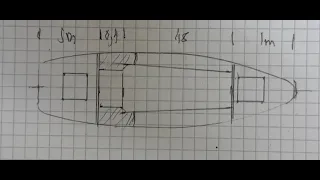
Exlex X – Experimental.
Sven Yrvind pauses construction on his ocean cruiser in Västervik to build Exlex X, a 4.2m experimental plywood model to test plow rudders, movable lead ballast, and capsize-proof surge chamber ventilation.
Scarfing , butt joint, to Save Divinycell.
In Västervik, Sweden, solo sailor Sven Yrvind scarfs Divinycell structural foam strakes, bonds offcuts with NM epoxy, and explains why elastic hull fairing takes precedence over rigid frame molds on his 5.6m Southern Ocean micro-cruiser.
Four Sheets of Divinycell for the Hull Sides – I Think That’s Enough.
In his Västervik workshop, 87-year-old solo ocean voyager Sven Yrvind skins the hull sides of his 5.6m cruiser with four Divinycell foam sheets, demonstrating butt-to-butt epoxy scarfing and zero-waste construction for the Southern Ocean.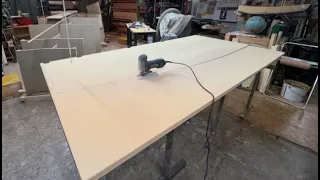
Nervously Cutting the Divinycell Sheets.
At age 87, Swedish navigator Sven Yrvind cuts and thermoforms Divinycell foam sheets for the compound bow curves of his 5.6m ocean micro-cruiser in Västervik, Sweden.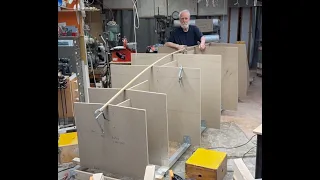
Trying to Get the Sheerline Right.
At 87, Swedish voyager Sven Yrvind fairs the sheerline across nine mold stations for his 5.6m ocean micro-cruiser in Västervik, Sweden, optimizing reserve buoyancy.