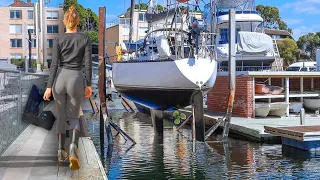
Oops, Prop’s Not Meant to Be Up Here…What Went Wrong?
Sheltered inside Canoe Bay at Fortescue Bay while 40-knot gales blow offshore along eastern Tasmania, Simon and Soph aboard Slim & Soph – Sailing Nakama encounter an urgent mechanical crisis. After rounding Tasman Island to resume their northward lap along the east coast of Tasmania, the crew dropped anchor in the tree-lined cove to wait out heavy weather and dive for crayfish along the rocky shore. Suiting up to inspect a recently replaced sail drive boot below the waterline, Simon makes an alarming discovery: the vessel’s propeller securing nut has completely backed off its threads.
With the securing nut spinning freely by hand, the propeller was moments away from detaching under motor and falling into the ocean. Simon unthreads the remaining hardware underwater and passes the propeller up onto the deck of their 34-foot cruiser, leaving Nakama immobilized in a tight anchorage subject to heavy overhead gusts.
Discovering a Loose Propeller in Canoe Bay
The dive began as a routine check of recent maintenance. Weeks earlier, Nakama had visited a boatyard to replace the sail drive boot after the protective rubber seal sheared off from the hull. Diving into the cold water to confirm that the replacement seal held firm, Simon found the boot intact. However, clearing away light weed growth from the lower unit revealed a critical failure on the propulsion shaft.
Simon noticed that the central locking bolt was protruding unusually far from the hub assembly: “Oh, the little Allen key that goes through the center of the nut looks like it’s further out than it should be. I’ll just put my finger on it.” When he touched the securing nut, the entire assembly rotated without resistance: “Whoa, it just free spun.” Without tension holding the propeller against the shaft taper, the hardware was teetering on complete loss. As Simon noted, “That was a matter of like hours, if not minutes, from falling off when we motored.”
Recognizing the imminent danger of losing the propeller on the seabed, Simon backed off the hardware underwater and handed the propeller up to Soph on deck. Working underwater in Canoe Bay was cold, but the shallow anchorage offered one reassurance: dropped tools could be recovered. When Simon dropped his crayfish measuring gauge during the dive, he located it on the bottom and brought it back aboard.
Rushed Boatyard Maintenance and the Greased Nut
Examining the parts on deck revealed the root cause of the failure. During their previous haulout, removing the propeller had required days of heavy labor after the assembly seized onto the shaft. Seeking to avoid a similar ordeal in the future, Simon applied grease to the shaft threads before installing the securing nut, omitting the necessary threadlocker.
Reflecting on the decision, Simon admitted the mistake: “Definitely shouldn’t have put grease on it.” The lubricant allowed engine vibration to back the nut off the shaft under load. The oversight had been compounded by demanding schedules in the yard. While reassembling the propulsion system, Simon was completing an oral university examination for his law studies amidst boatyard clutter and an uninstalled windlass. While he passed the exam, the divided focus contributed to the maintenance error.
Underwater Reinstallation with Fixtech and Epoxy Putty
With Nakama unable to motor and 40-knot winds outside the bay, the crew needed a durable underwater repair. Nakama’s shaft lacked a cross-drilled hole for a safety wire. Simon turned to chemical locking agents capable of curing submerged: “Done a bit of research. We’ve got some Fixtechs, which is meant to seal underwater, and I’m just going to put a little bit on the thread”
Coating both the shaft threads and the securing nut with Fixtech sealant, Simon dove below the hull to slide the propeller back onto the shaft and tighten the primary nut. To create an additional barrier against back-off, the crew prepared underwater-curing epoxy putty. Simon called up to the deck: “If you could pass me the tube of epoxy putty.” Mixing the compound, he packed the putty directly over the Allen bolt head to prevent backward rotation.
Waiting Out Gale Shifts and Catching Fish at Anchor
With the propulsion hardware curing below the waterline, the crew settled into Canoe Bay to wait out incoming weather. The basin proved remarkably calm, sheltered by large gum trees along the shore. Soph described the spot as “probably one of my favorite anchorages in a while.” Nakama remained steady while waiting out a 30 to 40 knot southerly followed by a 30 to 40 knot northerly shift outside the bay, with the wind generator barely spinning in the cove.
During the stay, Soph fished from the cockpit while Chilli the cat kept watch. Soph landed a small barracuda, requiring Simon’s help with pliers to unhook the catch, followed by two energetic Australian salmon. The catches were returned to the water, allowing the crew to cook fresh crayfish harvested from the bay.
The 30-Nautical-Mile Passage to Maria Island
Once the gale cleared and the adhesives cured, Nakama weighed anchor to continue north toward Maria Island. Soph detailed the route: “Maria Island is a 30 nautical mile trip from Canoe Bay, about 6 hours.” The run brought shifting conditions. Sailing along high coastal cliffs, descending downdrafts delivered gusts between 4 and 7 knots before fading into a calm glass-out offshore.
With the wind dropping, the crew motor-sailed across flat water. Soph used the smooth transit to complete university work on her laptop, pausing when a trolling line caught floating seaweed that felt like a strike. Approaching Maria Island, the crew entered clear blue coastal waters, noting the contrast with the dark tannin-stained waters of western Tasmania.
Anchoring at Maria Island and Cruising Reunions
Nakama entered the anchorage at Maria Island in calm weather, sounding 7 meters of water depth as Simon steered into position, calling out 20 meters to the drop point. Securing the anchor into sand, the crew spotted cruising friend Max Onditshool. Max had sailed his catamaran solo overnight from Hobart, arriving at 10:30 in the morning. The sailors had previously shared anchorages across the Great Australian Bight and Esperance in South Australia.
Shortly after anchoring, another vessel arrived carrying channel patrons who had sailed down from New South Wales. The shared anchorage provided a welcome chance to catch up with friends, verify the propeller fix, and explore Maria Island.
Tasmanian Passage and Technical Summary
| Log Metric | Measurement | Source Context |
|---|---|---|
| Offshore wind gusts | 40 knots | Recorded outside Fortescue Bay shelter |
| Canoe Bay to Maria Island | 30 nautical miles | Coastal passage length along east coast |
| Passage time | 6 hours | Underway transit time motor-sailing |
| Water depth at approach | 7 meters | Clear water depth at final anchorage |
Frequently Asked Questions
During a previous boatyard haulout, grease was mistakenly applied to the propeller shaft threads instead of threadlocker after days of struggling to remove a seized nut, allowing engine vibration to loosen the assembly.
Simon applied Fixtech underwater-curing sealant to the shaft and nut threads, torqued the assembly back on, and packed underwater epoxy putty over the central Allen bolt head as a secondary mechanical barrier.
While 40-knot gales blew offshore and the crew waited out 30 to 40 knot southerly and northerly shifts, Canoe Bay remained calm behind dense gum trees with little wind reaching the water.
The 30-nautical-mile passage took approximately 6 hours, featuring cliff-line gusts between 4 and 7 knots followed by offshore glass-out conditions requiring motor-sailing.
They reunited with solo catamaran sailor Max Onditshool, who had sailed overnight from Hobart arriving at 10:30 in the morning, and welcomed visiting channel patrons sailing from New South Wales.
Water adventures in Australia
Support Slim & Soph - Sailing Nakama
At WeBoating.com, we profoundly acknowledge the unwavering dedication that Slim & Soph - Sailing Nakama invests in crafting each and every video or voyage. Their passion for delivering exceptional ocean content shines through every frame, and it's a labor of love that deserves your attention.
We invite you to watch their captivating videos here and actively engage with their content, including their social media links above. Liking, commenting, and sharing their work goes a long way in fueling their creative fire.
We're also inviting you to explore the gear, sponsorships, and boat partnerships highlighted in the "Oops, Prop’s Not Meant to Be Up Here…What Went Wrong?" video description, or directly on YouTube. By engaging with these offerings or purchasing services and items, you directly support Slim & Soph - Sailing Nakama, their collaborators, and the brands they're associated with.
To ensure you never miss an offshore update, consider visiting their official YouTube Channel to subscribe, like, and join their community directly.
If you have any feedback, corrections, or additional information about Slim & Soph - Sailing Nakama or their videos, please use the comment form below to share your thoughts with us.
Thank you for being a part of our community and supporting the creators we cherish. Your time and support truly matter!
At first glance, nothing looked suspicious, but looking closer Slim noticed something...Our boat propeller is now on deck and it’s incredible how vulnerable we feel in a tight anchorage with gusts of 40 knots blowing overhead, without the ability to manoeuvre quickly if we needed to. So, what on earth has happened?
Enjoying the episodes? Becoming a Patron enables us to ensure the continuity of Slim & Soph - Sailing Nakama. A little goes a long way to keep this production alive. With very little free time between uni and the boat, Patreon enables us to focus on creating and posting videos rather than pouring beers at our local. Thank you for your generosity https://www.patreon.com/sailingnakama
Make a one-off donation as you please if subscriptions aren't your thing. Let's keep ticking nautical miles and boat jobs off! https://www.paypal.com/donate?hosted_button_id=C6M8FAYZ5K2ZS
Check out our store here 😊 https://slimandsophsailingnakama.com/
FOLLOW US ON INSTAGRAM:
https://www.instagram.com/sailingnakama/
AND FACEBOOK:
https://www.facebook.com/sailingnakama
Chapters:
00:00 What led us to this
01:15 How'd this happen
03:43 Deconstructing to fix the problem
04:47 The mistake we made
06:43 How to solve this underwater
10:31 For good measure
12:41 Soph's caught a big one!
15:44 New day, new island
17:35 We're hooking!
19:26 Fish or?
21:24 New anchorage, old friends!
Slim & Soph - Sailing Nakama
From university studies to the Roaring Forties. Join Slim and Soph as they navigate the remote Tasmanian wilderness aboard their Duncanson 34, Nakama, in 2026.
Channel Information:
Social Media Links:
Oops, Prop’s Not Meant to Be Up Here…What Went Wrong? Location
- Canoe Bay, Fortescue Bay, Tasmania, Australia (-43.1269,147.9553)
- Maria Island, Tasmania, Australia (-42.6358,148.0849)
- Tasman Island, Tasmania, Australia (-43.2387,148.0028)
Latest Episodes from Slim & Soph - Sailing Nakama
Explore the most recent voyages. Subscribe to the channel to never miss an update!
The Door just Opened! We Slept in a Prison from the 1800’s (A Scallop Mission)
Slim and Soph venture across to Maria Island for an icy scallop dive before the winter season closes, braving freezing waters and spending the night inside historic 1825 convict cells in Darlington.
Oops, Prop’s Not Meant to Be Up Here…What Went Wrong?
Sheltering from 40-knot gales in Fortescue Bay, Simon and Soph discover their propeller nut is free-spinning. Slim dives to execute an underwater propeller repair with Fixtech and epoxy putty before making the 30-mile passage to Maria Island.
Is Tasmania the World’s Most Underrated Sailing Destination?
Slim and Soph round Tasman Island and Cape Pillar aboard SV Nakama, navigating 4-meter swells off the Tasman Peninsula before sheltering behind Canoe Bay's shipwreck breakwater.
We Sailed to the World’s Largest Prison Island
Slim and Soph depart Hobart aboard their 34-ft sailboat Nakama, completing an eight-and-a-half-hour passage across Storm Bay and around Cape Raoul to anchor in Ladies Bay at Port Arthur, Tasmania.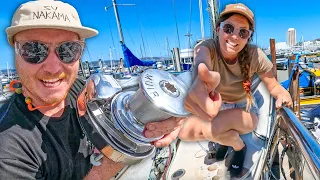
Another Day Another Project, Stuck in the Yard
Halted in a Hobart boatyard by a detached sail drive boot gasket, Slim and Soph seize the hardstand haulout to complete a custom Muir windlass installation aboard their Duncanson 34, Nakama.