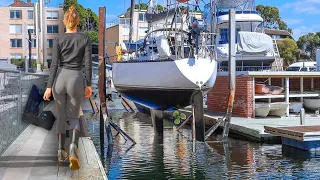
Another Day Another Project, Stuck in the Yard
Hauling a cruising vessel onto the hardstand for a second haulout within a brief period is an exasperating reality of boat maintenance, particularly when prompted by a small strip of rubber. In Hobart, Tasmania, Slim and Soph find their progress halted after the newly fitted sail drive boot gasket detached shortly after their shakedown sail aboard Slim & Soph – Sailing Nakama. With the final leg of their Australian circumnavigation in sight—standing 915 nautical miles from their original departure point—the unexpected haulout pauses passage planning. Rather than treating the yard stay as lost time, the mariners utilize their time on the hardstand to undertake a comprehensive ground tackle overhaul on their 34-foot sloop.
Emergency Haulout in Hobart and Deconstructing the Legacy Windlass
The immediate catalyst for hauling out was a failed rubber boot around the sail drive leg, which peeled away following recent antifouling work. Returning to the boatyard hardstand represented an unwanted expense, yet it provided stable access to address a persistent operational liability on the foredeck: a failing anchor windlass. Before the haulout, the original winch had deteriorated past the point of dependable service. As Slim observed during disassembly: “It was like death by a thousand cuts with this poor poor old thing.” The metal housing exhibited pervasive pitting, corrosion, and severe gear wear across its working edges.
The retired unit had ceased functioning as an autonomous mechanical retrieval tool. Instead of pulling chain from the seabed under load, it merely provided minimal mechanical assistance, forcing the crew to haul heavy ground tackle by hand. As Slim noted, “It never even really lifted the chain all on its own. It was more of an assist.” With recurring electrical failures compounding the fatigue of manual retrieval in cold southern anchorages, the crew removed the decommissioned hardware down to bare fiberglass, clearing the bow for modern equipment.
Selecting and Dry-Fitting the Muir Storm VRC 850
To replace the worn equipment, the crew selected a Muir Storm VRC 850 vertical windlass manufactured locally in Hobart. Opting for a vertical configuration allows the electric drive motor and gearbox to remain protected beneath the deck within the anchor locker, preserving working space on the forward deck of the compact vessel. In contrast to horizontal winches that house mechanical drives on the exposed deck, the vertical arrangement ensures clean foredeck clearance while offering versatile line handling.
The VRC specification designates a vertical reversing configuration equipped with both a chain gypsy and an independent warping capstan. The capstan drum operates separately from the gypsy, allowing the crew to handle mooring lines or control dock lines independently of the anchor rode. The unit accommodates smooth rope-to-chain transitions and incorporates a manual emergency override socket operable with a standard winch handle, resolving a critical vulnerability present in their previous setup.
| Component or metric | Specification or value | Operational role aboard Nakama |
|---|---|---|
| Vessel length | 34 feet | Monohull hull approaching the completion of an Australian circumnavigation |
| Voyage distance remaining | 915 nautical miles | Distance left to close the loop on their continental route |
| Deck windlass model | Muir Storm VRC 850 | Vertical reversing winch with chain gypsy and line-handling capstan |
| Marine adhesive sealant | Fixtech 15 | Bedding sealant securing the mounting plate and winch to the foredeck |
Fabrication of the Marine Plywood Mounting Base and Deck Sealing
Installing the Muir unit required reconciling the flat base of the winch with the curved camber of the foredeck. Rather than cutting into the structural fiberglass skin to create a recessed mounting shelf, the crew elected to fashion an external mounting pad out of marine plywood. Using a factory template supplied by the manufacturer, Slim marked the chain pipe and fastener locations, cutting new deck penetrations with a hole saw while aligning with existing bolt holes wherever practical.
Drilling revealed an internal core within the deck laminate. To prevent moisture ingress from migrating into the structural deck sandwich, the mariners coated the newly exposed boreholes with epoxy resin, applying the liquid barrier by hand into tight clearances. Meanwhile, crafting the mounting block demanded iterative wood shaping using a jigsaw and grinder. The crew carved and shaped the timber base to contour closely against the uneven deck profile, establishing a level upper platform for the winch base without compromising deck integrity. Once dry-fitted and confirmed, the wooden mounting pad was sealed with epoxy and painted with protective topcoats.
Resealing the Sail Drive Boot and Splashing the Hull
While epoxy and paint cured on deck, work turned to the primary reason for the haulout: the detached sail drive gasket. Slim prepared the lower hull substrate, applied sealant compound to the rubber boot, and seated the flexible gasket securely around the sail drive leg. After the adhesive bond cured, the crew applied fresh antifouling paint over the boot perimeter and the surrounding hull section.
Completing the underwater mechanical work culminated in reinstalling the marine propeller. With all below-waterline fittings verified and coated, the boatyard crane hoisted the vessel back into the water for splash day. Moving from the hardstand back to the marina berth relieved haulout fees while permitting the final mechanical and electrical connections to proceed afloat.
Bedding, Cabling, and Testing the Foredeck Winch System
Afloat at the dock, installation shifted to mechanical bedding and electrical integration. Slim coated the pre-cut gasket with sealant and applied Fixtech 15 across the base where the mounting block bonds to the deck. Bolting down the deck unit secured the upper assembly, while the below-deck drive motor was aligned into position and locked securely with a retaining pin and structural bolt.
Electrical wiring demanded a thorough overhaul due to salt-induced terminal corrosion. Guided by advice and specialized electrical tooling borrowed from their friend Liam, Slim trimmed back degraded cables and applied new crimp terminals using a hydraulic crimper. To prevent fine wire strands from fraying during insertion, Slim applied a clever assembly technique using a retained wire insulation collar before crimping each heavy terminal lug. After installing the helm power switch and energizing the circuit, the crew engaged the control switch.
The motor turned smoothly and silently without electrical arcing or mechanical chatter. After feeding anchor chain into the gypsy, the crew tested mechanical chain retrieval under realistic tension. “That is a dream. It is so nice and quiet,” Slim remarked after witnessing the quiet retrieval. Eliminating manual retrieval transformed their bow operations, as Slim noted: “Definitely beats putting on the gloves and heaving.” With both the underwater hull and the ground tackle fully operational, the crew concluded their stay in Hobart, prepared to cast off lines and complete their voyage around Australia.
Frequently Asked Questions
The crew hauled out on the Hobart hardstand because their newly installed rubber sail drive boot gasket detached shortly after a shakedown sail following underwater maintenance.
The original windlass suffered from severe metal pitting, corrosion, and recurring electrical failures, functioning only as an assist rather than retrieving ground tackle under load.
Built in Hobart, the Muir Storm VRC 850 is a vertical reversing windlass featuring an independent chain gypsy and capstan drum, rope-to-chain transition capability, and manual override via a winch handle.
Instead of cutting into the deck skin, the crew fabricated a custom mounting base from marine plywood, shaping and grinding the wood to hug the deck curvature and sealing exposed deck core with epoxy.
The crew applied Fixtech 15 marine adhesive sealant on the gasket and mounting base to ensure a watertight installation on the foredeck.
Support Slim & Soph - Sailing Nakama
At WeBoating.com, we profoundly acknowledge the unwavering dedication that Slim & Soph - Sailing Nakama invests in crafting each and every video or voyage. Their passion for delivering exceptional ocean content shines through every frame, and it's a labor of love that deserves your attention.
We invite you to watch their captivating videos here and actively engage with their content, including their social media links above. Liking, commenting, and sharing their work goes a long way in fueling their creative fire.
We're also inviting you to explore the gear, sponsorships, and boat partnerships highlighted in the "Another Day Another Project, Stuck in the Yard" video description, or directly on YouTube. By engaging with these offerings or purchasing services and items, you directly support Slim & Soph - Sailing Nakama, their collaborators, and the brands they're associated with.
To ensure you never miss an offshore update, consider visiting their official YouTube Channel to subscribe, like, and join their community directly.
If you have any feedback, corrections, or additional information about Slim & Soph - Sailing Nakama or their videos, please use the comment form below to share your thoughts with us.
Thank you for being a part of our community and supporting the creators we cherish. Your time and support truly matter!
As the finish line gets closer, our progress has come to a halt, we are stuck in the boat yard! We thought we were back underway, but the last thing we expected to bring us back here, brought us back here. That's boat for you...So while we're back in boat project mode and in between fixing the sail drive seal, we're taking on the installation of a new Muir anchor winch. Check our Muir here https://muir.com.au/ Made in Tasmania!
Enjoying the episodes? Becoming a Patron enables us to ensure the continuity of Slim & Soph - Sailing Nakama. A little goes a long way to keep this production alive. With very little free time between uni and the boat, Patreon enables us to focus on creating and posting videos rather than pouring beers at our local. Thank you for your generosity https://www.patreon.com/sailingnakama
Make a one-off donation as you please if subscriptions aren't your thing. Let's keep ticking nautical miles and boat jobs off! https://www.paypal.com/donate?hosted_button_id=C6M8FAYZ5K2ZS
Check out our store here 😊 https://slimandsophsailingnakama.com/
FOLLOW US ON INSTAGRAM:
https://www.instagram.com/sailingnakama/
AND FACEBOOK:
https://www.facebook.com/sailingnakama
Chapters:
00:00 What's going on
02:32 Starting with deconstruction
05:57 Yard projects
08:04 Anchor winch specs
10:48 Don't want to jinx it but progress looks good
12:50 Our masterpiece
16:55 Winding up to splash
18:46 The final grind
22:58 You bloody beauty!

Slim & Soph - Sailing Nakama
From university studies to the Roaring Forties. Join Slim and Soph as they navigate the remote Tasmanian wilderness aboard their Duncanson 34, Nakama, in 2026.
Channel Information:
Social Media Links:
Another Day Another Project, Stuck in the Yard Location
- Hobart Boatyard Hardstand, Tasmania (-42.898,147.348)
- River Derwent Anchorage, Hobart (-42.885,147.34)
- Muir Marine Windlasses Facility, Hobart (-42.925,147.335)
Latest Episodes from Slim & Soph - Sailing Nakama
Explore the most recent voyages. Subscribe to the channel to never miss an update!

The Door just Opened! We Slept in a Prison from the 1800’s (A Scallop Mission)
Slim and Soph venture across to Maria Island for an icy scallop dive before the winter season closes, braving freezing waters and spending the night inside historic 1825 convict cells in Darlington.
Oops, Prop’s Not Meant to Be Up Here…What Went Wrong?
Sheltering from 40-knot gales in Fortescue Bay, Simon and Soph discover their propeller nut is free-spinning. Slim dives to execute an underwater propeller repair with Fixtech and epoxy putty before making the 30-mile passage to Maria Island.
Is Tasmania the World’s Most Underrated Sailing Destination?
Slim and Soph round Tasman Island and Cape Pillar aboard SV Nakama, navigating 4-meter swells off the Tasman Peninsula before sheltering behind Canoe Bay's shipwreck breakwater.
We Sailed to the World’s Largest Prison Island
Slim and Soph depart Hobart aboard their 34-ft sailboat Nakama, completing an eight-and-a-half-hour passage across Storm Bay and around Cape Raoul to anchor in Ladies Bay at Port Arthur, Tasmania.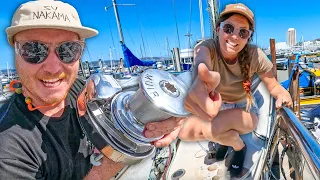
Another Day Another Project, Stuck in the Yard
Halted in a Hobart boatyard by a detached sail drive boot gasket, Slim and Soph seize the hardstand haulout to complete a custom Muir windlass installation aboard their Duncanson 34, Nakama.