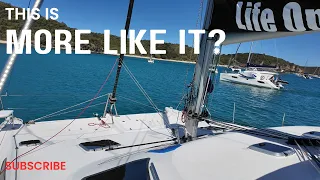
Anchored at the World’s Largest Sand Island — Platypus Bay, Fraser Island | Life On The Hulls 462
Sailing across Hervey Bay toward the western shoreline of K’gari, Ross Boardman and Janet dropped the sails on Synergy just as gusts reached 30 to 35 knots off Arch Cliff. The crew of Life On The Hulls had departed the rolling anchorage at Wathumba Creek earlier that morning, steering their 42-foot scratch-built catamaran south along Platypus Bay in search of protected, shallow water. The earlier passage across the bay had delivered rapid progress, with the multihull reaching 8 to 9 knots in 18 to 20 knots of offshore breeze, and maintaining 6 to 7 knots even after tucking two reefs into the mainsail.
Before dropping down to Arch Cliff, the crew observed the demanding tidal dynamics of Wathumba Creek. The inlet dries out significantly during low water, leaving only a narrow section maintaining approximately 1 meter of depth. A Sea Wind 1160 was spotted working its way through the shallow channel at high tide. After taking their tender up into the creek to inspect the shallows, Ross and Janet retreated quickly as the outgoing tide began racing seaward. Moving south into the lee of Fraser Island offered a far calmer setting to settle the catamaran.
Dropping Anchor off Arch Cliff
Reaching the anchorage off Arch Cliff provided immediate relief from the heavy conditions blowing across open water. Despite persistent 30-knot winds blowing over the island, the high cliffs created a calm pocket along the shoreline. Ross steered the catamaran into just 2 meters of clear water over clean sand, where the seabed remained clearly visible down to 4 meters depth.
The crew was relieved to find flat conditions after a turbulent night to the north. As Ross remarked while looking out over the flat surface: “We’ve got like 30 knot winds and it’s pretty sheltered in here, thank God.”
Along the beach at Arch Cliff, a freshwater creek discharges directly into Platypus Bay. The creek water carries a rich amber hue, stained dark by leaf tannin filtering through K’gari’s massive sand freshwater aquifer. The geological mechanism stores vast quantities of rainwater within the dunes, steadily discharging through coastal creeks into the sea. Janet and Ross waded through the waist-deep stream, noting the stark contrast between the cool freshwater run-off and the warm saltwater bay.
Social Cruising and Scratch-Build Milestones
The anchorage at Arch Cliff also provided an opportunity to catch up with fellow sailors Rob and Sandy aboard their Tartan 41 monohull. The two crews had initially met two months earlier and spent three to four weeks loosely travelling together down the Queensland coast. With Rob preparing to sail south toward Redland’s Marina to haul out near where the Delos catamaran build was underway, the crews gathered aboard Synergy for an evening of shared food and mahjong.
Cruising on Synergy marks the culmination of nine years of direct shipwright labor for Ross, who scratch-built the modified Oceanic Design 86 catamaran using epoxy resin and foam cores. Sailing the completed vessel down the coast with Janet brought the long build effort into perspective. As Ross recounted: “Janet looked at me and she said, you must be so happy to actually sail something that you built. And she’s right. The joy and the satisfaction has been just next level.”
Janet humorously pointed out the practical contrast between boat building and liveaboard cruising: “You’re not covered in resin. There’s no resin in your hair.” For Ross, relaxing aboard a functional vessel in calm water replaced the grueling factory routine of grinding fiberglass and handling sticky laminates.
Acoustic Phenomena: Humpback Whale Song Through the Hulls
Platypus Bay and the wider waters of Hervey Bay serve as an essential nursery ground for humpback whale mothers and calves resting during their annual migration. During their stay at Arch Cliff, the crew experienced an extraordinary acoustic encounter while resting below deck at night.
Inside the forward head, where the catamaran’s solid composite surfaces and bulkheads were devoid of soft furnishings, underwater whale songs resonated directly into the interior. At first, Janet wondered whether the deep sounds were caused by tension on the anchor bridle lines. Stepping into the head compartment confirmed that the hull skin was acting as a massive acoustic sounding board for whale communication echoing through the bay.
The crew listened intently to the alternating guttural rumbles and high-pitched calls echoing through the laminate. Reflecting on the encounter the following morning, Janet noted the rarity of the experience: “That song last night coming through the hull of the boat, I mean how many people get to do that?” For two consecutive nights, the calls filtered clearly through the boat’s hulls while Synergy rested securely at anchor.
Climbing the Arch Cliff Sand Dunes
Going ashore on K’gari offered a closer examination of the world’s largest sand island. Rising directly behind the beach at Arch Cliff is a massive sand dune reaching approximately 100 meters in height. Intrigued by earlier groups ascending the face, Ross and Janet set out to climb the steep slope, which angled upward at roughly 70 degrees.
The ascent required climbing on hands and knees through the soft sand. Janet utilized Ross’s deep footprints as makeshift steps to gain traction on the near-vertical incline. Reaching the crest rewarded the crew with sweeping panoramic views across Platypus Bay, where humpback whales could be seen surfacing in the distant blue water. Getting back down proved much faster than the climb, with both crew members sliding down the slope through the powdery sand.
Walking along the coastal strip revealed unique environmental features specific to K’gari. Patches of dark coffee rock—compressed sand formations formed over millennia—lined sections of the waterline, crumbling easily when handled. Fresh dingo tracks were visible pressed into the damp sand alongside four-wheel-drive tire ruts, indicating animals that had roamed the beach during the preceding hours.
Key Navigational and Environmental Observations
| Passage parameter | Recorded metric and condition |
|---|---|
| Maximum wind gust when dropping sail | 30 to 35 knots off Arch Cliff |
| Synergy sailing speed across bay | 8 to 9 knots in 18 to 20 knots of breeze |
| Synergy speed under two reefs | 6 to 7 knots |
| Arch Cliff anchorage water depth | 2 meters over sand with 4 meters visibility |
| Massive sand dune dimensions | 100 meters elevation at 70 degrees incline |
| Watermaker freshwater output | 130 to 140 liters per hour during transit |
| Wide Bay Bar passage forecast | 0.6 meter swell with zero wind |
| Shakedown cruise elapsed duration | 4 months completed toward 6 months planned |
Motoring South Down the Great Sandy Strait
After spending three nights anchored off Arch Cliff, weather forecasts indicated a calm window opening up to make passage to the south. Ross summarized their operational philosophy when navigating coastal waters: “What happens when you see a weather window? You make tracks.”
With the wind falling light, the crew raised the pick and initiated a three-and-a-half-hour motor transit toward Kingfisher Bay and Gary’s Anchorage inside the Great Sandy Strait. Motoring provided an ideal opportunity to catch up on shipboard domestic tasks and utility management. Ross switched on the onboard watermaker, producing 130 to 140 liters per hour of fresh water to top off the storage tanks while the engines replenished the battery banks and Janet ran the washing machine.
As Synergy entered the shipping channels, whale watching catamarans and recreational pleasure craft were encountered standing off groups of humpback whales. Modern maritime regulations require vessels to maintain a 300-meter standoff distance from the mammals. Ross reflected on the historical transformation over the past 30 to 50 years, noting how commercial whaling had given way to strict wildlife protection and environmental stewardship along the coast of Australia.
The crew maintained steady progress southward, eyeing a planned crossing of the Wide Bay Bar in five to six days. With forecasts indicating conditions dropping to 0.6 meters of swell and virtually zero wind, the passage promised a safe exit toward Moreton Bay ahead of Synergy’s scheduled haulout in three weeks.
Frequently Asked Questions
Synergy anchored in 2 meters of clear water over sand at Arch Cliff, where water visibility extended down to 4 meters depth.
Underwater whale calls resonated directly through Synergy’s solid composite hull laminate, creating clear acoustic vibrations audible inside the forward head and cabin.
Wathumba Creek is extremely shallow and largely dries out at low tide, leaving only a 1-meter-deep channel that requires careful timing around high water.
Coffee rock is a geological formation of semi-consolidated, compressed sand stained by organic matter that crumbles easily when handled.
The crew monitored a forecast predicting a calm weather window with 0.6 meters of swell and zero wind to ensure a safe bar crossing.
Book a trip where this was filmed — near Gold Coast
Support Life On The Hulls
At WeBoating.com, we profoundly acknowledge the unwavering dedication that Life On The Hulls invests in crafting each and every video or voyage. Their passion for delivering exceptional ocean content shines through every frame, and it's a labor of love that deserves your attention.
We invite you to watch their captivating videos here and actively engage with their content, including their social media links above. Liking, commenting, and sharing their work goes a long way in fueling their creative fire.
We're also inviting you to explore the gear, sponsorships, and boat partnerships highlighted in the "Anchored at the World’s Largest Sand Island — Platypus Bay, Fraser Island | Life On The Hulls 462" video description, or directly on YouTube. By engaging with these offerings or purchasing services and items, you directly support Life On The Hulls, their collaborators, and the brands they're associated with.
To ensure you never miss an offshore update, consider visiting their official YouTube Channel to subscribe, like, and join their community directly.
If you have any feedback, corrections, or additional information about Life On The Hulls or their videos, please use the comment form below to share your thoughts with us.
Thank you for being a part of our community and supporting the creators we cherish. Your time and support truly matter!
We cross into Hervey Bay and make our way up the sheltered western shore of K’gari (Fraser Island) to Platypus Bay — a vast, shallow sweep of turquoise on the quiet side of the world’s largest sand island. We drop the pick off Wothumba Creek, about as remote and beautiful as the Queensland coast gets.
Ashore and all around us, K’gari shows its wild side: rainforest growing straight out of the sand, dingoes that are the purest strain left on Australia’s east coast, and giant mobile dunes slowly burying the forest behind them. We settle into the anchorage, soak up Platypus Bay, then point Synergy onward toward Inskip Point.
Thanks for coming along with us. If you’re enjoying the journey, hit subscribe and let us know in the comments — have you anchored at K’gari (Fraser Island)?
❤️ Support the channel on Patreon: https://www.patreon.com/lifeonthehulls
🎥 Subscribe: https://www.youtube.com/c/LifeOnTheHulls
Chapters
0:00 Intro
0:15 Where we’re headed — Platypus Bay, K’gari
4:17 Along the Fraser Island shore
6:34 Anchored in Platypus Bay
9:34 Exploring the anchorage
14:44 The dingoes of K’gari
15:08 The world’s largest sand island
17:15 Leaving Platypus Bay
21:05 Until next time
#sailing #catamaran #liveaboard #kgari #fraserisland #platypusbay #cruising

Life On The Hulls
Ross and Janet: The Australian boat-building masters who spent 9 years crafting their 42ft custom composite catamaran, now launching into a life of Pacific exploration.
Channel Information:
Social Media Links:
Anchored at the World’s Largest Sand Island — Platypus Bay, Fraser Island | Life On The Hulls 462 Location
- Arch Cliff Anchorage, K'gari (-25.115642,153.126433)
- Wathumba Creek, K'gari (-24.953092,153.239293)
Latest Episodes from Life On The Hulls
Explore the most recent voyages. Subscribe to the channel to never miss an update!
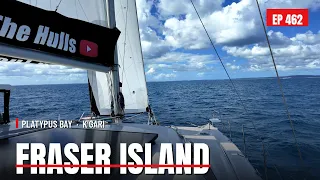
Anchored at the World’s Largest Sand Island — Platypus Bay, Fraser Island | Life On The Hulls 462
Synergy cruises the sheltered western shore of Fraser Island to Platypus Bay and Arch Cliff, where Ross and Janet anchor in shallow waters, climb towering sand dunes, and listen to humpback whale songs through the catamaran's composite hulls.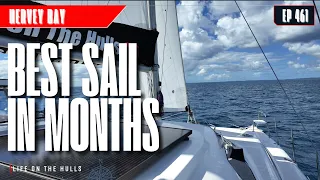
Synergy Stretches Her Legs – Best sail in months Ep462
Ross and Janet navigate catamaran Synergy from Pancake Creek to Burnett Heads and across Hervey Bay to Platypus Bay, logging their fastest beam-reach sail in months.
Sailing Past Gladstone’s Giant Industry to Pancake Creek | Life on the Hulls 460
Ross and Janet motor Synergy through the Curtis Island Narrows and slam through rough wind-against-tide chop off Gladstone Harbour before reaching shelter at Pancake Creek.
Possibly the Clearest Water in Australia? — Then the Southerly Hit Ep459
Ross and Janet navigate remote Pearl Bay in the Shoalwater Bay military zone, test their desalinator underway, weather a 40-knot southerly at Great Keppel Island, and tackle rough head seas across Keppel Bay.
Leaving Our Mark at the Percy Islands | The Famous A-Frame Ep 458
Life On The Hulls sails custom catamaran Synergy to Middle Percy Island in Queensland, Australia, navigating West Bay tides to place their mark at the historic A-Frame.