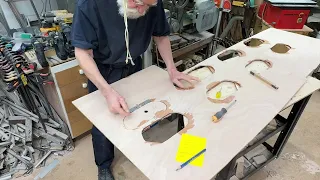
Twin Keels? No, Something Better!
In his Västervik workshop, Swedish sailor and boatbuilder Sven Yrvind sets aside an earlier dual-fin hull setup to begin laminating a reinforced wooden keel shoe on his small plywood test boat. After reviewing the practical realities of ramp launching and road transport, Yrvind identified major drawbacks with his previous arrangement. “The idea with twin keels was a big mistake,” he explains while preparing the wooden stock on the shop floor. He observed that twin keels made the craft “difficult to put it on a trailer. Difficult to launch from a ramp,” especially if one hopes to avoid submerging trailer wheel bearings in salt water.
Laminating the Plywood Keel Shoe
To establish a durable backbone along the hull centerline, Yrvind turned to multiple timber laminations. “This is going to be five layers of 9 mm plywood,” he explains as he sets the initial strips in place. With hundreds of kilograms of internal lead ballast already positioned inside the boat, Sven expressed caution regarding the concentrated stresses on the hull structure, noting the physical effort required to lift the ballast back and forth during building adjustments.
After joining the initial two laminates to achieve an 18 mm solid base, Yrvind noted that the timber gained sufficient thickness to accept mechanical screws for securing subsequent sheets. He carefully inspected the joints for uniform adhesive squeeze-out along the seams, noting that while the resin squeeze was lighter in certain sections, the bond line remained decent before allowing the assembly to cure.
Keel Specifications and Bottom Armor
Beyond the wooden laminates, Yrvind planned heavy metal protection to shield the keel bottom during dry-outs and slipway handling. A wide metal runner strip provides structural rigidity across the lowest contact surfaces of the vessel.
| Structural part | Dimension | Role |
|---|---|---|
| Plywood core | 5 layers of 9 mm plywood | Main laminated keel shoe structure |
| Combined base thickness | 18 mm reached after initial laminates | Solid purchase for mechanical fasteners |
| Metal runner plate | 4 mm thick, 30 cm wide 316 stainless steel | Grounding and slipway bottom armor |
For this hull, Yrvind prepared a 4 mm thick strip of 316 stainless steel measuring 30 cm (1 ft) wide. “And that should be a big, strong support for the bottom,” he remarked, highlighting its value when the boat dries out on tidal shores or rests on a slipway ramp. Sourcing bronze runner stock remains challenging locally, as he noted: “It’s kind of difficult here in Sweden. It’s a stainless steel country.” While waiting between glue curing stages, Sven keeps his steady workshop cadence of running, eating, and uploading before returning to attach the remaining plywood layers.
Frequently Asked Questions
Sven found twin keels difficult to launch from a boat ramp and awkward to load onto a trailer without wetting the wheel bearings.
The keel shoe is built from five layers of 9 mm plywood, providing 18 mm of base thickness after two layers to receive screws for subsequent laminations.
Sven plans a 4 mm thick, 30 cm wide strip of 316 stainless steel to support the hull bottom during ramp haul-outs and beach groundings.
Support Sven Yrvind
At WeBoating.com, we profoundly acknowledge the unwavering dedication that Sven Yrvind invests in crafting each and every video or voyage. Their passion for delivering exceptional ocean content shines through every frame, and it's a labor of love that deserves your attention.
We invite you to watch their captivating videos here and actively engage with their content, including their social media links above. Liking, commenting, and sharing their work goes a long way in fueling their creative fire.
We're also inviting you to explore the gear, sponsorships, and boat partnerships highlighted in the "Twin Keels? No, Something Better!" video description, or directly on YouTube. By engaging with these offerings or purchasing services and items, you directly support Sven Yrvind, their collaborators, and the brands they're associated with.
To ensure you never miss an offshore update, consider visiting their official YouTube Channel to subscribe, like, and join their community directly.
If you have any feedback, corrections, or additional information about Sven Yrvind or their videos, please use the comment form below to share your thoughts with us.
Thank you for being a part of our community and supporting the creators we cherish. Your time and support truly matter!
This Youtube channel is about me Sven Yrvind. I am 87 and a half years old dyslectic solo sailor.
I am building a plywood test boat for a Divinycell and NM-epoxy high-latitude cruiser.
She will be about 4.8 meter 15 and a half feet long. Her beam will be 1.3 meter. She is a two masted lugger with a total sail area of 6 square meter. She will have no rudder but will be steered by adjustable fins. I am planning a cruise in the Southern Ocean to Dunedin NZ.
Subject to change.
Often the 22th every month I do a resume of the project.
I have an illustrated book with good reviews on Amazon. https://www.amazon.se/s?k=yrvind&crid=1549D6PR18BUJ&sprefix=%2Caps%2C112&ref=nb_sb_ss_recent_1_0_recent
If you’re interested in contributing to my experiments links are below.
https://www.paypal.com/donate/?hosted_button_id=53X8NVEA22MBL
Swish 0706200550
Also please subscribe - even if you are not interested in sailing.
For more see Yrvind.com

Sven Yrvind
At 86, Sven Yrvind is still pushing the limits of small-boat design. Discover the philosophy and technical grit behind his 'Exlex' series.
Channel Information:
Social Media Links:
Twin Keels? No, Something Better! Location
- Västervik Workshop (57.7577,16.637)
Latest Episodes from Sven Yrvind
Explore the most recent voyages. Subscribe to the channel to never miss an update!
Vertical Dividers.
This Youtube channel is about me Sven Yrvind. I am 87 years an 7 months old dyslectic solo sailor. I am building a plywood test boat for a Divinycell and NM-epoxy high-latitude cruiser. She will be about 4.4 meter or 14 feet and 6 inches long, the beam 1.36 meter, 4 feet 6 inches. She is a two m...
Monthly Update and Overview Nov 2026.
This Youtube channel is about me Sven Yrvind. I am 87 years an 7 months old dyslectic solo sailor. I am building a plywood test boat for a Divinycell and NM-epoxy high-latitude cruiser. She will be about 4.4 meter or 14 feet and 6 inches long, the beam 1.36 meter, 4 feet 6 inches. She is a two m...
Installing the middle piece.
This Youtube channel is about me Sven Yrvind. I am 87 and a half years old dyslectic solo sailor. I am building a plywood test boat for a Divinycell and NM-epoxy high-latitude cruiser. She will be about 4.4 meter or 14 feet and 6 inches long, the beam 1.36 meter, 4 feet 6 inches. She is a two mas...
Alternativ ways of securing the latches.
In his Västervik workshop, Sven Yrvind troubleshoots hatch alignment and tests alternative mechanisms for securing boat latches, experimenting with 1 mm sheet metal springs and rubber shock cords.
Fillits in the living area.
Sven Yrvind lays epoxy fillets along the interior living area of his test boat in Västervik, crafting custom rubber washers to secure cabin fittings.