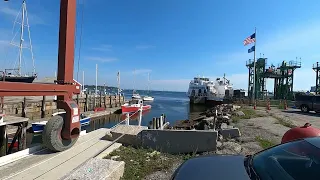
Hauling Your Boat Out Made Easy, EP#450
The annual transition from open water to dry-dock hardstand marks a critical milestone in a voyager’s calendar. Aboard his Westsail 32 Mighty Sparrow, solo circumnavigator Jerome Rand—host of Sailing Into Oblivion—brings deep voyaging perspective and hands-on boatyard expertise to the haul-out ritual. Managing mobile boat hoists and staging cruising yachts each autumn, Rand demystifies a process that routinely triggers anxiety for vessel owners facing narrow slips and overhead machinery.
Whether navigating tight marina slips along Portsmouth, Hampshire, England, or preparing for autumn gales rolling across the United Kingdom Solent, orchestrating an efficient haul-out depends on proactive seamanship, clear communication with yard staff, and methodical mechanical preparation. Approaching the haul-out as a structured masterclass in yacht survey empowers mariners to safeguard their hulls, running gear, and propulsion systems against winter degradation.
The Mechanics and Sling Positioning of the Boatyard Haulout Slip
Executing a seamless boatyard haulout demands meticulous preparation before entering the lift well, a principle demonstrated by solo circumnavigator Jerome Rand of Sailing Into Oblivion when navigating commercial slipways across Portsmouth, Hampshire, England, and the tidal reaches of the United Kingdom Solent.
Approaching a narrow Travelift well requires understanding how hydrodynamics and windage interact with heavy bulkheads. Long-keeled vessels often exhibit pronounced propeller walk and sluggish directional response in reverse. Rand advises skippers to practice low-speed maneuvering in open fairway basins well before haul-out morning. Deck preparation is equally vital: long bow and stern dock lines must be cleated and coiled ready to heave so yard staff can handline the hull if cross-currents pin the yacht or an auxiliary diesel falters.
Crucially, fenders must be retrieved inboard onto the deck prior to entering the slipway. Hanging fenders catch in synthetic hoisting slings, displacing balanced lift geometry. Correct sling placement is paramount for underwater safety: straps must never bear on propeller shafts, P-bracket struts, cutless bearings, or delicate acoustic transducers. Providing the lift operator with photographs of the vessel in slings from prior seasons eliminates guesswork and guarantees that lifting straps land directly beneath reinforced structural bulkheads.
Rigging De-Tensioning and Mast Unstepping Protocols
Preparing standing rigging and spars for crane extraction during an autumn boatyard haulout requires structured unstepping discipline, as highlighted by Jerome Rand of Sailing Into Oblivion while servicing deep-draft cruising vessels throughout Portsmouth, Hampshire, England, and the United Kingdom Solent maritime hub.
Cruising yachts with deep keels must be hoisted high in the Travelift to clear seawall coping. On mobile boat hoists, tall masts or standing rigging can foul the machine’s overhead crossbeam. Skippers must verify whether the headstay, backstay, or a ketch’s mizzen boom must be disconnected to grant vertical clearance. When unstepping the mast entirely for winter storage, stripping all sails, booms, and rigid vangs before the crane arrives prevents dockside bottlenecks.
Delicate masthead wind indicators and anemometers should be removed to avoid snagging crane cables. Down below, internal electrical wiring buses powering VHF coaxial cables, masthead tricolors, and spreader lights must be labeled and unplugged at junction panels before upward tension is applied. Turnbuckle cotter pins (split pins) should be extracted with diagonal cutters and bagged in cockpit cubbies. Skippers must never reuse distorted split pins; fresh stainless cotter pins provide essential rig security.
Keel Blocking Dynamics and Hardstand Jackstand Safety
Once hoisted clear of the fairway, the structural integrity of a yacht during a boatyard haulout rests entirely on ground support, an exacting standard emphasized by Jerome Rand of Sailing Into Oblivion during hardstand operations in Portsmouth, Hampshire, England, facing stormy gusts off the United Kingdom Solent.
A vessel on the hardstand relies on the principle that the keel bears 100 percent of vertical deadweight. The keel must settle firmly on solid oak or hardwood blocking laid across level, unyielding grade. Blocking stacks must be broad-based with adequate timber thickness to prevent crushing or point-loading the keel bottom. Jackstands (screw stands) are designed exclusively to maintain lateral equilibrium, never to support vertical tonnage.
Proper jackstand placement requires positioning screw pads squarely against reinforced structural bulkheads rather than hollow, unsupported fiberglass hull sections that could flex under load. Crucially, opposing pairs of jackstands must be tied together beneath the keel using heavy safety chains cinched taut to prevent outward kick-out during coastal gales. Immediately after blocking, the yard crew must pressure-wash the hull while marine growth remains wet, stripping barnacles and slime before they cure rock-hard against the gelcoat.
Comprehensive Out-of-Water Hull and Running Gear Survey
The immediate hours following a boatyard haulout present an crucial diagnostic window for underwater gear, a critical phase detailed by Jerome Rand of Sailing Into Oblivion as cruising hulls dry out in Portsmouth, Hampshire, England, sheltered along the United Kingdom Solent.
With the hull elevated on hardstand blocking, the skipper gains rare access to inspect components that remain submerged all season. Through-hull fittings and seacocks must be audited inside and out. External thru-hulls should be inspected for dezincification—revealed by pink, brittle bronze—and galvanic pitting. Ball valves and seacocks must be exercised through their full range of motion, lubricated, and verified for free operation before freezing temperatures arrive.
Propulsion running gear warrants precise physical measurement. Grasping the propeller shaft firmly near the strut reveals any radial play in the rubber cutless bearing flutes; play exceeding manufacturer limits requires immediate bearing replacement. The propeller must be examined for blade cavitation and shaft anode depletion. Sacrificial zincs on shafts, propeller nuts, and hull plates must be replaced if consumed beyond 50 percent mass. Finally, shaking the rudder blade detects wear in lower pintles, gudgeons, or self-aligning bearings before winter lay-up.
Antifouling Surface Preparation and Bottom Paint Systems
Applying protective barrier coats and bottom antifouling following a boatyard haulout requires diligent surface prep and strict environmental management, methods championed by Jerome Rand of Sailing Into Oblivion across boatyard facilities in Portsmouth, Hampshire, England, and the United Kingdom Solent.
Effective bottom paint application is 90 percent preparation and 10 percent rolling. Once the hull is pressure-washed and dried, crews must scrape away flaking paint and calcified barnacle bases. Sanding should be performed with random orbital sanders connected to HEPA vacuum extraction or via wet-sanding to eliminate toxic biocide dust. The entire bottom should then receive a thorough solvent dewaxing wipe to eliminate grease, exhaust soot, and waterline scum.
Hard-modified epoxy antifouling provides an ultra-durable finish ideal for high-speed cruising. Multi-season ablative copolymer paints wear away progressively as water flows across the hull, preventing thick paint buildup over successive seasons. Application must only proceed when temperatures are at least five degrees above the dew point, and skippers should coordinate with yard staff to relocate jackstand pads to coat unpainted contact patches before spring launch.
Marine Engine Winterization and Bilge Preservation Protocols
Protecting auxiliary propulsion from freeze damage during a boatyard haulout involves thorough cooling winterization, an indispensable autumn routine outlined by Jerome Rand of Sailing Into Oblivion for vessels laid up around Portsmouth, Hampshire, England, and the United Kingdom Solent.
A frozen engine block or ruptured heat exchanger can turn a winter layup into an total loss. Raw-water cooling systems must be flushed with non-toxic propylene glycol antifreeze. After warming the diesel so the thermostat opens, close the raw-water seacock and route an intake hose into a container of antifreeze. Running the engine until pure colored antifreeze discharges out the exhaust transom protects heat exchangers, raw-water pumps, and waterlift mufflers from freezing.
Fuel systems require proactive stabilization before cold weather induces condensation inside tanks. Filling diesel tanks to 95 percent capacity reduces humid air head-space, while quality biocide and fuel stabilizer treat fuel chemistry against microbial bug growth. Domestic plumbing circuits must be drained, water heaters bypassed, and potable antifreeze pumped through all faucets and head discharge loops. Bilges should be sponged dry, and continuous passive ventilation maintained to prevent mildew formation across interior teak joinery.
Boatyard Haulout and Preventive Maintenance Reference Table
To synthesize critical operational procedures for cruising skippers undertaking a boatyard haulout, Jerome Rand of Sailing Into Oblivion provides a comprehensive reference matrix based on field-tested standards across Portsmouth, Hampshire, England, and the United Kingdom Solent.
| Operational Phase | Inspection Checklist | Technical Standards |
|---|---|---|
| Travelift Entry | Fenders inboard; dock lines ready; engine warm. | Prevent sling snagging; retain line steering control. |
| Sling Alignment | Verify underwater profile; mark transducers and shaft. | Provide photos to operator; avoid hoisting on shafts. |
| Keel Blocking | Position oak timbers level on grade under full keel. | Keel carries 100% deadweight; timbers prevent crush. |
| Jackstand Staging | Place pads under internal bulkheads; chain pairs. | Never place pads on unsupported panels; chains stop kick-out. |
| Running Gear | Inspect seacocks, cutless play, rudder, and zincs. | Replace zincs eroded over 50%; check bronze for dezincification. |
| Antifouling | Scrape loose paint; vacuum sand; roll ablative paint. | Observe dew point; shift stands to coat contact patches. |
| Diesel Care | Flush raw-water circuit with antifreeze; add biocide. | Verify open thermostat; fill fuel tank to 95% capacity. |
| Plumbing & Bilge | Drain domestic circuits; dry bilges; ventilate cabin. | Bypass water heaters; maintain airflow to prevent mold. |
Frequently Asked Questions
To assist cruising skippers navigating the boatyard haulout season, Jerome Rand of Sailing Into Oblivion answers critical technical questions drawn from commercial yard management and offshore passage preparation across Portsmouth, Hampshire, England, and the United Kingdom Solent.
Cruising sailboats in temperate waters should undergo a haul-out every 12 to 24 months. Annual haulouts are standard in cold northern regions, allowing crews to inspect underwater running gear, replace zinc anodes, refresh antifouling paint, and winterize mechanical systems before severe freezing conditions arrive.
Fenders must be brought on deck because hanging fenders catch between the hull and synthetic lifting slings. When hoisting begins, a trapped fender jams against lifelines while displacing the balanced hoisting geometry required to lift the yacht safely.
Skippers should provide photographs showing the boat suspended in slings during previous haulouts and share them with the lift operator. Marking hull indicators guides operators to place straps under structural bulkheads while staying clear of propeller shafts, strut bearings, and thru-hull transducers.
Grip the propeller shaft near the strut or stern tube and apply alternating vertical and lateral force. Any discernible clicking or movement in the rubber fluted sleeve indicates excessive play. Clearance exceeding 0.015 inches requires bearing replacement to prevent shaft vibration under power.
The keel must carry 100 percent of the vertical gravitational load on seasoned timber blocking. Jackstands provide lateral balance only; screw pads must align squarely beneath internal bulkheads. Opposing jackstand pairs must be chained together beneath the keel to prevent outward slippage during winter storms.
Warm the engine so the thermostat opens, close the raw-water intake seacock, and feed non-toxic propylene glycol marine antifreeze into the raw-water pump. Run the engine until bright, undiluted antifreeze discharges from the transom exhaust, shielding heat exchangers and waterlift mufflers from freeze damage.
Support Sailing Into Oblivion
At WeBoating.com, we profoundly acknowledge the unwavering dedication that Sailing Into Oblivion invests in crafting each and every video or voyage. Their passion for delivering exceptional ocean content shines through every frame, and it's a labor of love that deserves your attention.
We invite you to watch their captivating videos here and actively engage with their content, including their social media links above. Liking, commenting, and sharing their work goes a long way in fueling their creative fire.
We're also inviting you to explore the gear, sponsorships, and boat partnerships highlighted in the "Hauling Your Boat Out Made Easy, EP#450" video description, or directly on YouTube. By engaging with these offerings or purchasing services and items, you directly support Sailing Into Oblivion, their collaborators, and the brands they're associated with.
To ensure you never miss an offshore update, consider visiting their official YouTube Channel to subscribe, like, and join their community directly.
If you have any feedback, corrections, or additional information about Sailing Into Oblivion or their videos, please use the comment form below to share your thoughts with us.
Thank you for being a part of our community and supporting the creators we cherish. Your time and support truly matter!
Today we get into a few top tips for the haul-out season for all you boat owners that dread the end of the season's most stressful day. Just a few things that I think will make life a little easier for all parties involved in getting your boat safely from the water to dry land
Colin's Westsail 32 listing: https://www.facebook.com/share/19jXG6oUaZ/
Help Support this podcast with the following links, Thanks for listening!
Support this Podcast on Patreon: https://www.patreon.com/sailingintooblivionpodcast
Starlink Referral Link: https://starlink.com?referral=RC-DF-13132545-72429-94
Help fund my next adventure here: https://gofund.me/6df0fb45
One Time Donations Via PayPal and Venmo: https://www.paypal.com/paypalme/JeromeRand https://account.venmo.com/u/sailingintooblivion
Amazon Wishlist: https://www.amazon.com/hz/wishlist/ls/33F36RF315G8V?ref_=wl_share
Children's Book: https://a.co/d/1q2Xkev
Sailing Into Oblivion Children's Audio Book: Audible.com
Sailing Shirts: https://www.bonfire.com/store/sailing-into-oblivion/
Books: https://a.co/d/eYaP10M
Reach out to the Show: https://www.sailingintooblivion.com/podcasts
Total Boat 5% discount code: https://www.totalboat.com/?sca_ref=9803393.xY85BaEnxZ

Sailing Into Oblivion
Discover the world-proven resilience of Jerome Rand as he documents his 271-day solo non-stop circumnavigation aboard his Westsail 32, Mighty Sparrow.
Channel Information:
Social Media Links:
Hauling Your Boat Out Made Easy, EP#450 Location
- Solent Marine Staging & Boatyard Fairway, Hampshire, England (50.8,-1.11)
- Portsmouth Harbour Fairway, United Kingdom (50.795,-1.105)
Latest Episodes from Sailing Into Oblivion
Explore the most recent voyages. Subscribe to the channel to never miss an update!
Round the World Sailing Route @sailingwithphoenix
Help Support this Channel with the following links, Thanks for listening! Support this Channel on Patreon: Starlink Referral Link: Help fund my next adventure here: One Time Donations Via PayPal and Venmo: Venmo: Amazon Wishlist: Children's Book: Sailing Into Oblivion Children&#...
Round the World Route for @Sailing_With_Phoenix Q&A
Today we will be talking about the route and all the challenges to make it safely around the world.
EP#451 How Mighty Sparrow got Her Name
Help Support this Channel with the following links, Thanks for listening! Support this Channel on Patreon: Starlink Referral Link: Help fund my next adventure here: One Time Donations Via PayPal and Venmo: Venmo: Amazon Wishlist: Children's Book: Sailing Into Oblivion Children&#...
October 8th Ocean Sailors Update @Sailing_With_Phoenix Rutherfort, GGR and Weather
James Burwick examines offshore telemetry, heavy weather tactics, and Golden Globe Race voyaging across the North Atlantic for the Ocean Sailors Fleet.
Insane Satisfaction!
Help Support this podcast with the following links, Thanks for listening! Support this Podcast on Patreon: Starlink Referral Link: Help fund my next adventure here: One Time Donations Via PayPal and Venmo: Amazon Wishlist: Children's Book: Sailing Into Oblivion Children's Aud...