Our 52ft Sailboat's Annual Weigh-In & 3D Scan - Ep. 509 Ran Sailing
Finishing the companionway entrance on the 52-foot custom sailing yacht Ran III required precise joinery in the workshop at Sun Hill Farm. Johan Hammarlund squared and leveled the door threshold, shaping a solid piece of teak to fit the cockpit bulkhead on the vessel documented on RAN Sailing. After checking the dimensions against the composite frame, he planed the teak timber, shaped the edges with a router, and sanded the piece smooth.
To mount the door hinges and latch hardware into the composite framing, Johan programmed cutting paths on a handheld Shaper CNC router. The digital tool cut exact mortises directly into the door structure, eliminating the manual chiseling typically needed for marine hardware. Inspecting the dry-fitted hinges and latch plates, Johan emphasized the efficiency of digital routing:
“it saves so much time and it gets really accurately done”
With the frame dry-fitted into the cockpit aperture, the bare door weighed 6 kilos. Once fitted with safety glazing and locking hardware, the total door weight is projected to reach between 10 and 12 kilos. Outside the workshop barn, early winter weather prompted farm preparations. Johan installed carbide studs into the utility vehicle tires to maintain traction during snow plowing without needing tire chains, and staked snow marker poles along the farm road bordering the fields.
Dual-Jack Lift and Hull Weigh-In Strategy
With the companionway components fitted, attention shifted to measuring the current mass and balance of the 52-foot hull. Before positioning any lifting equipment, Johan cleared all tools, timber scraps, and portable equipment out of the interior to eliminate tare weight. Measuring the hull at this stage provided an essential check on weight accumulation since the deckhouse structure and stern extensions were completed.
To conduct the weigh-in, Johan positioned two load cells rated at 5 tons each beneath the hull supports, paired with bottle jacks rated at 5 tons on the top cap and 2.5 tons at the lifting toe. Rather than attempting to elevate the entire yacht simultaneously on four load cells, he lifted and weighed each end sequentially, first raising the aft section and then the forward section. Addressing online critics who questioned the validity of sequential weighing, Johan clarified the physics of the setup:
“gravity don’t know if it’s a load cell supporting the other end of the boat or if it’s just a box”
Lifting the stern approximately 10 mm on an 8-meter span between cradle supports introduces an angular shift that affects the balance by less than 10 kilos, an inconsequential variance on a multiton structure. When lowered onto the load cells, the aft section registered 2,980 kilos gross. Subtracting the 120-kilo wooden cradle box yielded a net aft structural weight of 2,860 kilos. Lateral readings showed 1,451 kilos on the port scale and 1,529 kilos on the starboard scale, an 80-kilo variance caused by a 7 to 8 mm leveling difference and internal cabinetry structure.
Moving the jacks forward, the bow section registered 1,786 kilos gross. Deducting the 80-kilo forward cradle box confirmed the forward hull weight. Combining the forward and aft measurements established a total bare hull weight of 4,566 kilos. Comparing this figure against naval architecture calculations showed substantial reserve capacity:
“we have 16,100 kilos roughly to play with to reach the design displacement”
Tracking the Longitudinal Center of Gravity Shift
The weigh-in enabled Johan to recalculate the yacht’s longitudinal center of gravity (LCG) and compare it against earlier milestones. During the previous hull weigh-in conducted in July 2025, the bare structure weighed 3,462 kilos. In the intervening construction period, the addition of the composite deckhouse and the stern extension added approximately 1,100 kilos of structural material, bringing the current total to 4,566 kilos.
Plotting the new LCG line along the hull revealed that the center of gravity had migrated roughly 40 cm aft compared to the July 2025 position. The LCG currently sits aft of the longitudinal center of buoyancy (LCB). In naval architecture, proper trim requires that the finished yacht’s LCG and LCB align precisely on the design waterline once rigging, machinery, fuel tanks, freshwater, and cruising gear are installed.
Documenting this 40 cm aft shift provides critical guidance for upcoming interior installations. If equipment placement causes the center of gravity to drift too far toward the stern, Johan noted that the balance can be corrected by shifting internal lead ballast forward inside the steel keel cavity during fabrication.
3D Infrared Keel Recess Scanning and Cold-Floor Setback
With the hull already supported on the bottle jacks, Johan raised the entire boat roughly 30 cm off the concrete floor to scan the keel recess. Ran III features a structural keel recess along the centerline where a custom steel keel will eventually bolt to the composite hull. Because the keel represents a significant financial investment fabricated by an outside contractor, verifying the exact curvature of the hull recess against engineering models was essential before placing the manufacturing order.
Johan applied photogrammetry coded targets, retro-reflective markers, and calibrated scale bars along the bottom of the hull to prevent digital drift across the 5-meter scanning area. However, operating beneath the hull presented unexpected technical hurdles. Working late into the evening during the first frost of autumn, the 30 cm clearance between the workshop floor and the hull proved insufficient for the infrared 3D scanner’s focal length. Angling the scanner prevented the sensor from capturing enough reference markers simultaneously, causing tracking failures:
“technology like this can be really helpful, but when it’s not working the way you want it to yeah, it can really pull your hair out”
Reviewing the frustrating evening in the workshop, Malin observed the toll of the freezing conditions:
“you felt that you almost got hypothermia when you were lying on your back down on the floor”
Template Curvature Validation and Keel Fabrication Interface
Rather than risking measurement errors beneath the restricted hull clearance, Johan pivoted to scanning the full-scale wooden template of the keel recess. This physical timber template had been constructed while the bare hull rested upside down during early hull planking, capturing the true contour of the keel mounting plane.
Positioning the template on workbenches allowed ample focal clearance and optimal lighting. The infrared 3D scanner captured the full length without tracking loss. Analyzing the point-cloud data revealed a radius of curvature of 64 meters along the template. Comparing this digital scan directly to the 3D CAD design drawings confirmed that the physical curve matched the computer model with lengthwise tolerance under half a millimeter across the nearly 5-meter piece:
“when I’m comparing that to the 3D drawing it’s exactly the same radius and I can’t see that there is really any difference at all”
With the 64-meter radius confirmed, the next construction phase involves building a drilling template for the keel bolts. While the hull remains elevated 30 cm, Johan plans to drill the keel bolt penetrations through the reinforced hull bottom. This will ensure that the cutting files provided to the steel fabricator correspond with the pre-drilled bolt pattern. Two candidate fabricators have been identified to manufacture the steel keel structure.
| Boat weight or dimension metric | Measured value | Build context and technical method |
|---|---|---|
| **Current hull weight** | 4,566 kilos | Combined net measurement recorded on load cells after deducting cradle boxes |
| **July 2025 hull weight** | 3,462 kilos | Previous hull weigh-in prior to installing deckhouse and stern extension |
| **Added structural weight** | 1,100 kilos | Weight added to hull structure between July 2025 and autumn milestone |
| **Design displacement target** | 16,100 kilos | Total calculated displacement limit when fully loaded for blue-water cruising |
| **Keel recess radius** | 64 meters | Infrared 3D scan of physical template matching CAD design geometry |
Frequently Asked Questions
Johan weighed the 52-foot hull to determine total weight gain following the installation of the deckhouse and stern extension, and to calculate how far the longitudinal center of gravity shifted.
The bare hull weighed 4,566 kilos net, measured by summing the forward and aft load cell readings after deducting the wooden cradle boxes.
The hull gained approximately 1,100 kilos over the 3,462-kilo baseline from July 2025, shifting the longitudinal center of gravity roughly 40 cm aft.
The 30 cm clearance between the hull and workshop floor was too tight for the infrared scanner’s minimum focal distance, preventing the camera from capturing enough photogrammetry markers simultaneously while shooting at an angle.
Johan scanned the full-scale wooden template of the keel curve on a workbench, confirming a 64-meter radius that matched the CAD design drawings within half a millimeter of tolerance.
Support RAN Sailing
At WeBoating.com, we profoundly acknowledge the unwavering dedication that RAN Sailing invests in crafting each and every video or voyage. Their passion for delivering exceptional ocean content shines through every frame, and it's a labor of love that deserves your attention.
We invite you to watch their captivating videos here and actively engage with their content, including their social media links above. Liking, commenting, and sharing their work goes a long way in fueling their creative fire.
We're also inviting you to explore the gear, sponsorships, and boat partnerships highlighted in the "Our 52ft Sailboat's Annual Weigh-In & 3D Scan - Ep. 509 Ran Sailing" video description, or directly on YouTube. By engaging with these offerings or purchasing services and items, you directly support RAN Sailing, their collaborators, and the brands they're associated with.
To ensure you never miss an offshore update, consider visiting their official YouTube Channel to subscribe, like, and join their community directly.
If you have any feedback, corrections, or additional information about RAN Sailing or their videos, please use the comment form below to share your thoughts with us.
Thank you for being a part of our community and supporting the creators we cherish. Your time and support truly matter!
Support our production and join the RAN Sailing crew ~ get in direct contact with us, livestreams and meetups: https://www.patreon.com/ransailing
This week we have an extra long episode ready for you. And it's a technical one where we weigh the boat again and do a 3D scan of the keel plate.
We are a Swedish family who have sailed the world since 2016 while sharing the adventures here on YouTube. While we are still sailing, our main focus now a days is building RAN III, a 52 ft sailboat that we are building from scratch. We post a new episode every Friday so make sure to subscribe and hit the bell to be the first to know when there is a new episode!
MERCH: https://ransailingstore.com/
Sustainable shirts, tees, bags and more in 100% organic cotton, designed by us!
PRODUCTS & CAMERA GEAR: https://www.amazon.com/shop/ransailing
We have collected some of the products we use in our cruising life and video making in our Amazon shop. If you buy any of the items from our shop, we get a small "ka-ching" in our cruising kitty (no extra cost for you). Thank you so much and thank you to Amazon Influencer program.
CONNECT WITH US
- Website: http://ransailing.se
- Instagram: http://www.instagram.com/ransailing
- Facebook: http://www.facebook.com/ransailing
Music credits: http://www.epidemicsound.com
Love,
Malin, Johan & Vera
RAN Sailing
Discover the incredible journey of RAN Sailing as Malin, Johan, and Vera trade global horizons for a barn in Sweden to build their custom 52-foot RAN III.
Channel Information:
Social Media Links:
Our 52ft Sailboat's Annual Weigh-In & 3D Scan - Ep. 509 Ran Sailing Location
- Sun Hill Farm, Skåne, Sweden (59.4762392,13.3392076)
Latest Episodes from RAN Sailing
Explore the most recent voyages. Subscribe to the channel to never miss an update!
Building the Supports for Our Carbon Fiber Hatches – Ep 512 Ran Sailing
Support our production and join the RAN Sailing crew ~ get in direct contact with us, livestreams and meetups: We go to Amsterdam to visit Metstrade, the world's biggest show for boat equipment and gear, Back home, winter has arrived and it's so cold to work on the boat. But we laminate ...
Four Years Building Our Dream Sailboat: Looking Back & Looking Ahead – Ep. 511 Ran Sailing
Johan and Malin celebrate four years of building RAN III from scratch, reviewing interior joinery, composite deckhouse lamination, and stern extensions while planning upcoming keel fabrication.
Carbon Fiber Hatches Are Here! Building a 52ft Sailboat Ourselves – Ep. 510 Ran Sailing
Johan Hammarlund and Malin Löf winterize their stable workshop and install flush carbon deck hatches on their custom 52ft yacht RAN III in Sweden.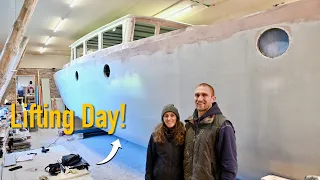
Our 52ft Sailboat’s Annual Weigh-In & 3D Scan – Ep. 509 Ran Sailing
Johan Hammarlund conducts an annual weigh-in on the 52ft sailboat Ran III, calculating hull balance shifts and scanning the keel recess template at Sun Hill Farm.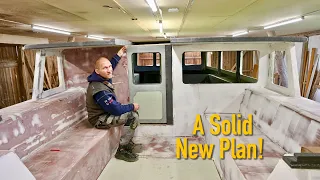
Our Sailboat Is Getting a Real Door! – Ep. 508 Ran Sailing
Johan and Malin craft a custom companionway door and hatch sliders for their 52-foot sailboat RAN III, machining Delrin runners and laminating 19 mm Coosa composite board with PET foam infill at Sun Hill Farm in Sweden.