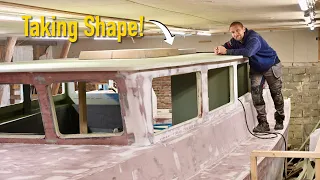
Making an Entrance! Our 52ft Sailboat Gets a Sliding Hatch - Ep. 507 Ran Sailing
Inside the boatyard barn, the crew of RAN Sailing mounted a floating snowplow blade to prepare for the winter months and cleaned outdoor teak furniture with linseed oil soap. With four years of construction invested into building their 52-foot sailboat, RAN III, shifting autumn weather refocused daily work inside the deckhouse on the primary sliding companionway entrance.
Abandoning the Curved Roof Cutout
Johan Hammarlund planned to use the fiberglass cutout section removed from the deckhouse roof to make the sliding hatch, hoping to save labor. Upon inspecting the piece on the workbench, he discovered the panel had warped out of flat:
“Yeah, my initial plan from yesterday didn’t go according to plan.”
Because the skewed roof piece would not slide true along tracks, Johan discarded it and built a new core using rigid PET foam bordered with cedar:
“So, I’ll have PT foam in the middle and use cedar along the perimeter.”
Johan rounded the outer cedar edges so the fiberglass cloth could drape smoothly over the lateral overhangs under vacuum.
Cold-Weather Bulkhead Tabbing in the Cabin
A sharp temperature drop brought 5° C conditions into the unheated barn workshop, chilling the air and thickening the epoxy resin. Inside the boat, Malin Löf set up a laminating station on the salon sofa to tab bulkheads to the deckhouse ceiling while Johan prepped the main saturation table:
“It’s so cold today. I think we had 5° C this morning. It’s really big shift in the air. It’s much more damp and raw.”
The cold made epoxy difficult to saturate into the glass cloth. Malin worked overhead in tight corners where small fiberglass patches fought gravity:
“as I’ve said many times, it’s always harder to do short pieces.”
Malin completed the structural tabbing before leaving for her weekly jiu-jitsu class with Vera, looking forward to future dinners in the completed salon.
Vacuum Bagging the Companionway Hatch
Johan prepared the vacuum lamination schedule for the sliding hatch, using two layers of 600 g biaxial fiberglass cloth on each side of the PET foam and cedar core to ensure high rigidity beneath the boom.
Johan saturated the fiberglass plies, positioned the core, added the outer glass layers, and sealed the assembly under peel ply, release film, breather felt, and a vacuum bag. To counteract 5° C workshop temperatures, he used fast hardener, an overhead infrared heat lamp, and heavy blankets. Upon unbagging, the breather felt showed slight resin oversaturation caused by the cold resin’s higher viscosity during wet-out.
Framing and Shaping the Protective Hatch Garage
Johan next built the companionway garage, a protective housing over the deckhouse opening. Working with cedar required breathing masks to prevent respiratory irritation from fine wood dust and natural tannins. He assembled the cedar framework using a Domino machine and clamps.
To give the garage a sleeker profile on the roof, Johan reduced the internal PET foam thickness from 25 mm down to 15 mm. He then routed the outer cedar edges to soften the profile and make the housing less boxy.
Rapid Garage Layup Under Heat Lamps
Johan applied lessons from the cold hatch lamination to the garage. With ambient temperatures around 10° C, he set epoxy jugs on an electric heat tray, ran infrared lamps on the glass and table, and warmed interior cloth with an electric fan heater inside the boat.
Using fast hardener, Johan laminated two layers of 600 g biaxial fiberglass across the outer framework in just over an hour, leaving the part under electric heat blankets overnight.
Dry-Fitting and Companionway Engineering
Johan unbagged and test-fitted the sliding hatch and garage on the deckhouse roof. The assembly demonstrated strong rigidity capable of supporting crew weight beneath the boom while handling sails.
Final assembly will incorporate sliding tracks, internal drainage channels, and a cam-action seal against the vertical companionway doors:
“there is still lots of details to work out here. But I think this is a good start.”
Companionway Construction Specifications
| Assembly Component | Structural Material and Core | Fabrication and Layup Details |
|---|---|---|
| Sliding Companionway Hatch | PET foam core framed with cedar perimeter | 2 layers of 600 g biaxial glass per side |
| Companionway Hatch Garage | PET foam core reduced from 25 mm to 15 mm | Domino-joined cedar frame with routed edges |
| Shop temperature shifts | 5° C morning drop during initial hatch layup | 10° C shop temperature during garage layup |
| Vessel hull and build duration | 52 ft custom performance cruising sailboat | 4 years of scratch construction completed |
Frequently Asked Questions
The composite cutout removed from the deckhouse roof had warped and was not flat, which would have prevented the companionway hatch from sliding smoothly along future tracks.
When workshop temperatures dropped to 5° C, the epoxy resin thickened significantly, slowing fabric saturation and requiring infrared heat lamps, warming trays, and faster hardener to cure properly.
The sliding hatch is constructed with a PET foam core framed by cedar along the perimeter, laminated on both sides with two layers of 600 g biaxial fiberglass cloth under vacuum.
Johan reduced the foam core thickness from 25 mm down to 15 mm to lower the overall profile of the garage on the deckhouse roof, making the structure sleeker and less boxy.
Cedar contains potent natural acids, tannins, and oils that create extremely fine dust during milling, which can cause severe respiratory irritation and allergic reactions.
Support RAN Sailing
At WeBoating.com, we profoundly acknowledge the unwavering dedication that RAN Sailing invests in crafting each and every video or voyage. Their passion for delivering exceptional ocean content shines through every frame, and it's a labor of love that deserves your attention.
We invite you to watch their captivating videos here and actively engage with their content, including their social media links above. Liking, commenting, and sharing their work goes a long way in fueling their creative fire.
We're also inviting you to explore the gear, sponsorships, and boat partnerships highlighted in the "Making an Entrance! Our 52ft Sailboat Gets a Sliding Hatch - Ep. 507 Ran Sailing" video description, or directly on YouTube. By engaging with these offerings or purchasing services and items, you directly support RAN Sailing, their collaborators, and the brands they're associated with.
To ensure you never miss an offshore update, consider visiting their official YouTube Channel to subscribe, like, and join their community directly.
If you have any feedback, corrections, or additional information about RAN Sailing or their videos, please use the comment form below to share your thoughts with us.
Thank you for being a part of our community and supporting the creators we cherish. Your time and support truly matter!
Support our production and join the RAN Sailing crew ~ get in direct contact with us, livestreams and meetups: https://www.patreon.com/ransailing
The sliding companionway hatch is going in and we build the garage as well!
We are a Swedish family who have sailed the world since 2016 while sharing the adventures here on YouTube. While we are still sailing, our main focus now a days is building RAN III, a 52 ft sailboat that we are building from scratch. We post a new episode every Friday so make sure to subscribe and hit the bell to be the first to know when there is a new episode!
MERCH: https://ransailingstore.com/
Sustainable shirts, tees, bags and more in 100% organic cotton, designed by us!
PRODUCTS & CAMERA GEAR: https://www.amazon.com/shop/ransailing
We have collected some of the products we use in our cruising life and video making in our Amazon shop. If you buy any of the items from our shop, we get a small "ka-ching" in our cruising kitty (no extra cost for you). Thank you so much and thank you to Amazon Influencer program.
CONNECT WITH US
- Website: http://ransailing.se
- Instagram: http://www.instagram.com/ransailing
- Facebook: http://www.facebook.com/ransailing
Music credits: http://www.epidemicsound.com
Love,
Malin, Johan & Vera

RAN Sailing
Discover the incredible journey of RAN Sailing as Malin, Johan, and Vera trade global horizons for a barn in Sweden to build their custom 52-foot RAN III.
Channel Information:
Social Media Links:
Making an Entrance! Our 52ft Sailboat Gets a Sliding Hatch - Ep. 507 Ran Sailing Location
- Sun Hill Farm Boatyard (59.4762392,13.3392076)
- Skåne Farm Workshop (59.4765,13.3395)
Latest Episodes from RAN Sailing
Explore the most recent voyages. Subscribe to the channel to never miss an update!
Building the Supports for Our Carbon Fiber Hatches – Ep 512 Ran Sailing
Support our production and join the RAN Sailing crew ~ get in direct contact with us, livestreams and meetups: We go to Amsterdam to visit Metstrade, the world's biggest show for boat equipment and gear, Back home, winter has arrived and it's so cold to work on the boat. But we laminate ...
Four Years Building Our Dream Sailboat: Looking Back & Looking Ahead – Ep. 511 Ran Sailing
Johan and Malin celebrate four years of building RAN III from scratch, reviewing interior joinery, composite deckhouse lamination, and stern extensions while planning upcoming keel fabrication.
Carbon Fiber Hatches Are Here! Building a 52ft Sailboat Ourselves – Ep. 510 Ran Sailing
Johan Hammarlund and Malin Löf winterize their stable workshop and install flush carbon deck hatches on their custom 52ft yacht RAN III in Sweden.
Our 52ft Sailboat’s Annual Weigh-In & 3D Scan – Ep. 509 Ran Sailing
Johan Hammarlund conducts an annual weigh-in on the 52ft sailboat Ran III, calculating hull balance shifts and scanning the keel recess template at Sun Hill Farm.
Our Sailboat Is Getting a Real Door! – Ep. 508 Ran Sailing
Johan and Malin craft a custom companionway door and hatch sliders for their 52-foot sailboat RAN III, machining Delrin runners and laminating 19 mm Coosa composite board with PET foam infill at Sun Hill Farm in Sweden.