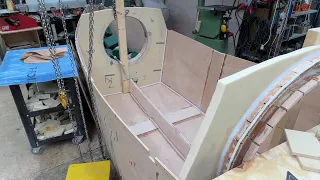
More molds up.
Inside his Västervik workshop, Sven Yrvind fastens structural uprights while setting up station molds for his ocean-going cruiser. Erecting the timber forms along the building jig requires careful positioning so each station remains secure and accurately aligned.
Staggered Supports Across the Centerline
To casual observers looking along the timber frame, the alternating uprights might look irregular. However, Yrvind notes that this arrangement is deliberate:
“some people think I do it crooked, but it’s not”
The fastening screws require clearance on either side of the centerline. By shifting the supports from side to side in an alternating pattern, screws can be driven into both flanks without colliding:
“the supports has to be staggered as you can see”
Driving fasteners into alternating flanks keeps the framework balanced. One bracket sits slightly to port and the next sits slightly to starboard, establishing rigid anchors along the central axis while maintaining a true reference line down the hull.
Doubling Material for Fair Seams
At the joints between mold sections, Yrvind installs reinforced timber thickness. Leaving extra material provides working tolerance for final fairing before applying hull planking:
“we’re going to shape it later to get a good seam”
With only two holes remaining to be fastened, the structural skeleton nears completion. The wooden molds establish the lines for a cruiser measuring 5.6 meters (18 feet 4 inches) in length with a beam of 1.45 meters. Designed as a three-masted lugger with 9 square meters of sail area and a bow daggerboard, the craft utilizes Divinycell foam and NM-epoxy for high-latitude sailing toward Dunedin, New Zealand.
Frequently Asked Questions
The upright supports are staggered from side to side across the centerline so screws can be driven into both flanks without colliding, preserving accurate alignment.
The boat measures 5.6 meters (18 feet 4 inches) long with a beam of 1.45 meters, rigged as a three-masted lugger carrying 9 square meters of sail area.
Adding double thickness at the joints provides extra material so the timber can be planed and shaped later to produce a clean, fair seam.
Book a trip where this was filmed — near Queenstown

Support Sven Yrvind
At WeBoating.com, we profoundly acknowledge the unwavering dedication that Sven Yrvind invests in crafting each and every video or voyage. Their passion for delivering exceptional ocean content shines through every frame, and it's a labor of love that deserves your attention.
We invite you to watch their captivating videos here and actively engage with their content, including their social media links above. Liking, commenting, and sharing their work goes a long way in fueling their creative fire.
We're also inviting you to explore the gear, sponsorships, and boat partnerships highlighted in the "More molds up." video description, or directly on YouTube. By engaging with these offerings or purchasing services and items, you directly support Sven Yrvind, their collaborators, and the brands they're associated with.
To ensure you never miss an offshore update, consider visiting their official YouTube Channel to subscribe, like, and join their community directly.
If you have any feedback, corrections, or additional information about Sven Yrvind or their videos, please use the comment form below to share your thoughts with us.
Thank you for being a part of our community and supporting the creators we cherish. Your time and support truly matter!
This Youtube channel is about me Sven Yrvind. I am87 year and 5 months old dyslectic solo sailor.
I am building a Divinycell and NM-epoxy high-latitude cruiser.
She is 5.6 meter 18 feet 4 inches long. Her beam is 1.45 meter. She is a three masted lugger with a total sail area of 9 square meter. She has a bow daggerboard. I am planning a cruise in the Southern Ocean to Dunedin NZ.
Subject to change.
Often the 22th every month I do a resume of the project.
I have an illustrated book with good reviews on Amazon. https://www.amazon.se/s?k=yrvind&crid=1549D6PR18BUJ&sprefix=%2Caps%2C112&ref=nb_sb_ss_recent_1_0_recent
If you’re interested in contributing to my experiments links are below.
https://www.paypal.com/donate/?hosted_button_id=53X8NVEA22MBL
Swish 0706200550
Also please subscribe - even if you are not interested in sailing.
For more see Yrvind.com
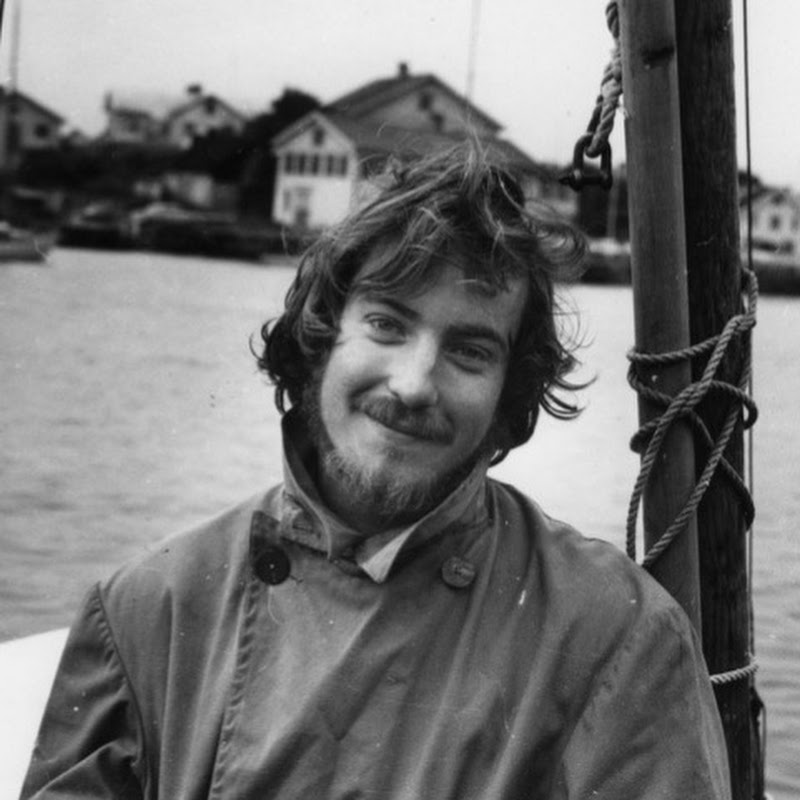
Sven Yrvind
At 86, Sven Yrvind is still pushing the limits of small-boat design. Discover the philosophy and technical grit behind his 'Exlex' series.
Channel Information:
Social Media Links:
More molds up. Location
- Västervik Workshop (57.7577,16.637)
- Dunedin Destination Port (-45.8788,170.5028)
Latest Episodes from Sven Yrvind
Explore the most recent voyages. Subscribe to the channel to never miss an update!
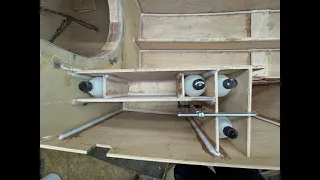
More small compartments on the development boat.
Sven Yrvind works in his workshop to optimize the interior of his development boat, focusing on water bottle capacity and redesigning the dining and sleeping areas.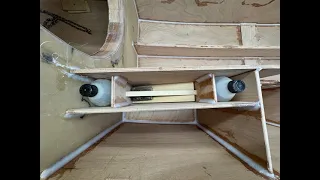
Another Wall for the Water Bottle Storage.
Sven Yrvind works on the Oceanic XLX prototype, crafting a specialized storage area for water bottles and provisions using plywood and fumed silica epoxy.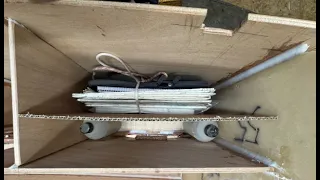
A Divider Between the Charts and Water Bottles.
Sven Yrvind returns to his workshop in the snow to install a custom wooden divider on the Exlex, ensuring a clean separation between paper charts and water bottles.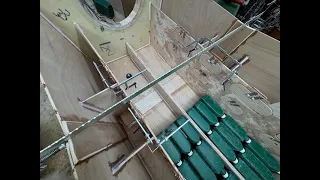
Vertical Dividers.
Sven Yrvind fits vertical subdivisions inside his 4.4-meter plywood test boat in Västervik, stiffening the hull structure and establishing interior storage layout for his high-latitude cruiser.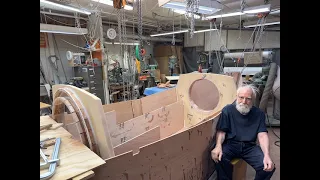
Monthly Update and Overview Nov 2026.
In his workshop on New Year's Eve, Sven Yrvind shortens his plywood test boat to 4.4 meters, loads 18 water jugs for ballast, and details his route to Dunedin and rudderless steering fins.