First Butt Joint and Her Length.
Solo mariner Sven Yrvind bends and clamps the initial plywood hull sheets in his Västervik workshop, constructing a test boat for a high-latitude cruiser. Maneuvering long sheets of plywood without assistance presents immediate physical hurdles inside the shop.
Working alone requires heavy mechanical tension on each panel. As Sven notes, it is “tricky to do it just by one man,” relying on clamps to draw the stiff plywood against the frame bit by bit. When drawing a tight bend, the force required can cause slips. Sven admits, “I put the clamp close then put all my force on it. And then what happened? I fell down.” Even after taking a knock during the fall, he recovers to continue bending the timber.
Scribing and Fairing the Hull Lines
With the side panel drawn close, Sven inspects the contact tolerances along the hull. Measuring the gap, he finds roughly 3 cm touching forward and 2 cm of contact aft. To achieve an even profile, he marks the overlap, trims away the excess 3 cm, and fair the curve.
Using a flexible wooden batten, Sven springs a fair line across the length of the wood to establish a clean contour. After scribing the curvature, he cuts the profile using a German hand saw. Because the hull design features identical left and starboard sides, completing the initial curve allows him to copy the exact template directly to the opposite panel.
Mirroring Panels and Panel Lofting Math
Because the hull rests upside down on the workshop floor, Sven takes care when labeling the mirrored pieces. Setting the opposite side on the inverted jig, he notes that “negative starboard must be port” and marks the panel accordingly before tracing the final outline.
Using standard 122 cm plywood sheets, Sven finds that his calculated curves fit neatly across the stock with minimal waste. As he explains, “two sheets on each side. But, in fact, this was just pure luck,” with the panels overlapping cleanly along the hull stations.
Mathematical scaling produced a similar match along the bottom. Applying a scaling factor of 0.913 to his lines, Sven arrived at a bottom beam dimension of 610 mm. When doubled across the centerline, the total width equals exactly 122 cm—matching standard sheet widths without requiring extra cuts.
Measuring Hull Length and Making the First Butt Joint
With the side panels lofted, Sven stretches his measuring tape along the centerline to verify the hull dimensions. The longitudinal measurement comes to 4,647 mm, with an additional 6 cm margin on the dimension side.
Sven brings the side sections together, reporting that the “first pieces of plywood are joined. Butt joint. Just to make it simple.” Here at the bow, he decides to “leave a gap here in the front, you know, to make it give a bit more volume” when meeting oncoming waves at sea. Once the bow and stern framing are secured, the build will advance to installing the bottom planking and applying protective glass fiber cloth over the experimental hull.
Frequently Asked Questions
The joined hull measures 4,647 mm in length with an additional 6 cm margin, while the bottom beam measures 610 mm.
Sven connects the plywood side panels using simple butt joints, using two standard 122 cm sheets on each side.
Sven scaled down the bottom dimensions using a factor of 0.913, resulting in a 610 mm bottom beam that aligns with standard 122 cm plywood sheet widths.
Sven leaves a forward gap at the stem to provide additional buoyant volume when the experimental vessel meets oncoming waves at sea.
Support Sven Yrvind
At WeBoating.com, we profoundly acknowledge the unwavering dedication that Sven Yrvind invests in crafting each and every video or voyage. Their passion for delivering exceptional ocean content shines through every frame, and it's a labor of love that deserves your attention.
We invite you to watch their captivating videos here and actively engage with their content, including their social media links above. Liking, commenting, and sharing their work goes a long way in fueling their creative fire.
We're also inviting you to explore the gear, sponsorships, and boat partnerships highlighted in the "First Butt Joint and Her Length." video description, or directly on YouTube. By engaging with these offerings or purchasing services and items, you directly support Sven Yrvind, their collaborators, and the brands they're associated with.
To ensure you never miss an offshore update, consider visiting their official YouTube Channel to subscribe, like, and join their community directly.
If you have any feedback, corrections, or additional information about Sven Yrvind or their videos, please use the comment form below to share your thoughts with us.
Thank you for being a part of our community and supporting the creators we cherish. Your time and support truly matter!
This Youtube channel is about me Sven Yrvind. I am 87 and a half years old dyslectic solo sailor.
I am building a plywood test boat for a Divinycell and NM-epoxy high-latitude cruiser.
She will be about 4.8 meter 15 and a half feet long. Her beam will be 1.3 meter. She is a two masted lugger with a total sail area of 6 square meter. She will have no rudder but will be steered by adjustable fins. I am planning a cruise in the Southern Ocean to Dunedin NZ.
Subject to change.
Often the 22th every month I do a resume of the project.
I have an illustrated book with good reviews on Amazon. https://www.amazon.se/s?k=yrvind&crid=1549D6PR18BUJ&sprefix=%2Caps%2C112&ref=nb_sb_ss_recent_1_0_recent
If you’re interested in contributing to my experiments links are below.
https://www.paypal.com/donate/?hosted_button_id=53X8NVEA22MBL
Swish 0706200550
Also please subscribe - even if you are not interested in sailing.
For more see Yrvind.com

Sven Yrvind
At 86, Sven Yrvind is still pushing the limits of small-boat design. Discover the philosophy and technical grit behind his 'Exlex' series.
Channel Information:
Social Media Links:
First Butt Joint and Her Length. Location
- Västervik, Sweden (57.7594,16.6385)
Latest Episodes from Sven Yrvind
Explore the most recent voyages. Subscribe to the channel to never miss an update!
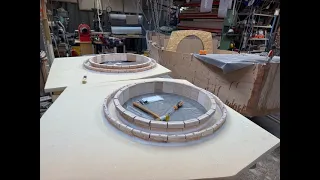
The Outer Coaming and Fiberglassing the Inner One.
Sven Yrvind fits the outer spray skirt coaming and laminates fiberglass onto the inner coaming in his workshop, refining his rope attachment setup and filleting the joint defenses.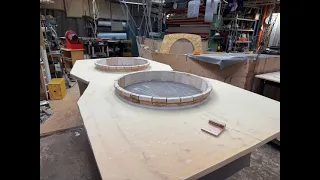
Starting the Inner of Two Spray Skirt Coamings.
Sven Yrvind works in his workshop cutting and fitting inner and outer spray skirt coamings, detailing kerf measurements and fiberglass reinforcement.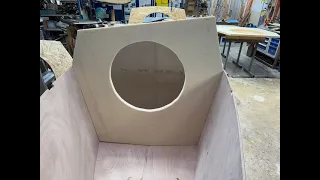
Cutting the Divinycell Bulkheads.
In his Västervik workshop, Sven Yrvind shapes composite bulkheads and constructs rounded hatch coamings with dual spray protection for his compact ocean cruiser, verifying hull symmetry and deck crown alignment.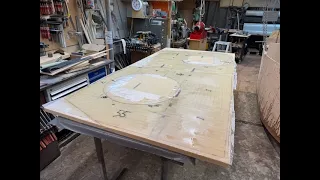
Laminating the Two Bulkheads.
Sven Yrvind numbers and lays out fiberglass cloth before laminating two bulkheads with epoxy resin in his Västervik workshop for his 4.5-meter high-latitude cruiser test boat.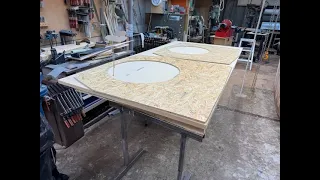
Starting the Two Divinycell Bulkheads.
In his Västervik workshop, Sven Yrvind lays out two test bulkheads inside a plywood mockup, adjusting semicircular access cutouts and planning insulated Divinycell sandwich bulkheads for his upcoming ocean cruiser.