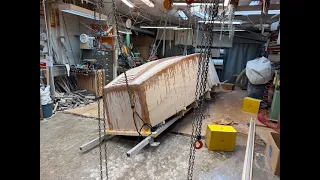
21 May 2024 Closing stem and stern
Hello friends! Today we’re going to dive into a fundamental aspect of boat maintenance – closing off the ends of our vessel.
Closing Boat Ends with Stem and Stern
Join Sven Yrvind as he walks us through sealing both the back (stern) and front (stem) of a boat, showcasing his expert techniques.
The Stem
First, let’s focus on the stem. Sven begins by pointing out that he has removed any peep lights or similar apertures, making sure every part is sealed for a watertight closure.
The Stern
Next, we move to the stern. Here, he’s sealing it off with epoxy resin temporarily held in place by screws before proceeding to shape and secure it further.
Adding Protective Components
To offer even more protection, he introduces the use of crash boxes and divel pieces. These are strategically placed to reinforce both ends of the boat effectively.
Final Steps
The process is completed with a layer of epoxy around these additional components, not only sealing but also preparing them for better integration with the boat’s body.
Key Takeaways
- Seal both stem and stern of your boat using epoxy resin.
- Add crash boxes for reinforcement at the ends.
- Utilize divel pieces to secure and protect the vulnerable areas.
To sum up, sealing the ends of your boat effectively not only ensures water tightness but also enhances the overall structure. Sven Yrvind’s method provides an insightful approach to maintaining your vessel in top condition. Remember these techniques when performing your next maintenance routine.
Support Sven Yrvind
At WeBoating.com, we profoundly acknowledge the unwavering dedication that Sven Yrvind invests in crafting each and every video or voyage. Their passion for delivering exceptional ocean content shines through every frame, and it's a labor of love that deserves your attention.
We invite you to watch their captivating videos here and actively engage with their content, including their social media links above. Liking, commenting, and sharing their work goes a long way in fueling their creative fire.
We're also inviting you to explore the gear, sponsorships, and boat partnerships highlighted in the "21 May 2024 Closing stem and stern" video description, or directly on YouTube. By engaging with these offerings or purchasing services and items, you directly support Sven Yrvind, their collaborators, and the brands they're associated with.
To ensure you never miss an offshore update, consider visiting their official YouTube Channel to subscribe, like, and join their community directly.
If you have any feedback, corrections, or additional information about Sven Yrvind or their videos, please use the comment form below to share your thoughts with us.
Thank you for being a part of our community and supporting the creators we cherish. Your time and support truly matter!
This Youtube channel is about me an 85 year old dyslectic solo sailor building a 5.6 meter long, 1.2 meter beam twin keel ocean going high latitude cruiser.
If you’re interested in contributing to my experiments links are below.
https://www.paypal.com/donate/?hosted_button_id=53X8NVEA22MBL
Swish 0706200550
Also subscribe
For more see Yrvind.com
Sven Yrvind
At 86, Sven Yrvind is still pushing the limits of small-boat design. Discover the philosophy and technical grit behind his 'Exlex' series.
Channel Information:
Social Media Links:
Latest Episodes from Sven Yrvind
Explore the most recent voyages. Subscribe to the channel to never miss an update!
Cutting the Divinycell Bulkheads.
This Youtube channel is about me Sven Yrvind. I am 87 and a half years old dyslectic solo sailor. I am building a plywood test boat for a Divinycell and NM-epoxy high-latitude cruiser. She will be about 4.5 meter or 14 feet and 9 inches long, the beam 1.36 meter, 4 feet 6 inches. She is a two mas...
Laminating the Two Bulkheads.
This Youtube channel is about me Sven Yrvind. I am 87 and a half years old dyslectic solo sailor. I am building a plywood test boat for a Divinycell and NM-epoxy high-latitude cruiser. She will be about 4.5 meter or 14 feet and 9 inches long, the beam 1.36 meter, 4 feet 6 inches. She is a two mas...
Starting the Two Divinycell Bulkheads.
This Youtube channel is about me Sven Yrvind. I am 87 and a half years old dyslectic solo sailor. I am building a plywood test boat for a Divinycell and NM-epoxy high-latitude cruiser. She will be about 4.5 meter or 15 feet and 9 inches long, the beam 1.36 meter, 4 feet 6 inches. She is a two mas...
The Space Allocation for the Three Compartments Is Settled.
This Youtube channel is about me Sven Yrvind. I am 87 and a half years old dyslectic solo sailor. I am building a plywood test boat for a Divinycell and NM-epoxy high-latitude cruiser. She will be about 4.8 meter 15 and a half feet long. Her beam will be 1.3 meter. She is a two masted lugger with...
Finding the Best Bulkhead Positions.
In his workshop, Sven Yrvind adjusts bulkhead positions on his plywood test boat, reallocating internal bay spacing, marking the waterline, and calculating hull displacement.