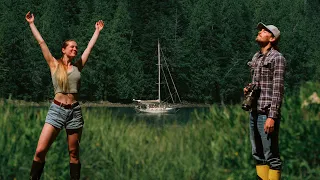
Searching For The Hermit of the Goose Group
Cruising southward along the labyrinthine coast of British Columbia aboard their restored 1982 Cape George 36 cutter, Magic Carpet II, Maya Eliza and Aladino Rovegno of Sailing Magic Carpet venture out to the western fringes of the Central Coast. Having departed Prince Rupert on a long-distance voyage bound ultimately for Mexico, the couple has spent weeks navigating at an unhurried pace through remote inlets, natural hot springs, white-sand beaches, and historic abandoned canneries.
After enduring two consecutive weeks of cold rain and relentless southerly headwinds, the weather finally breaks as Magic Carpet II reaches the Goose Group—an isolated cluster of low-lying islands exposed to the full fetch of the open Pacific Ocean. Beyond its white-sand beaches and clear anchorages, the archipelago holds a unique place in Pacific Northwest maritime folklore as the former base camp of Bill Davidson, the legendary nomadic wilderness paddler known across the coast as Kayak Bill.
Navigating the Goose Group Archipelago on the Outer Coast
Unlike the tightly packed islands of the Inside Passage that are sheltered by narrow channels and steep fjord walls, the Goose Group sits on the outer western edge of Queen Charlotte Sound. Here, the ocean swell and weather systems roll in directly off the Pacific. The archipelago takes its name from a series of bird-themed islands: Goose Island, which forms the largest landmass, Gosling Island tucked immediately behind it, Swan Island, and Duck Island.
With sunshine streaming through the bronze portholes of Magic Carpet II after a fortnight of gray squalls, Aladino and Maya drop their Rocna anchor in the lee of the islands. While the anchorage offers serene, turquoise conditions under high pressure, the low elevation and exposed geography make it clear how fiercely winter gales sweep across the group when North Pacific storms make landfall.
| Expedition Element | Specific Details |
|---|---|
| Crew & Channel | Maya Eliza & Aladino Rovegno (Sailing Magic Carpet) |
| Primary Vessel | Magic Carpet II — 1982 Cape George 36 cutter (built by Cape George Marine Works, Port Townsend, WA) |
| Shore Tender | Custom-built Scout 10 dinghy (constructed by Aladino from a Duckworks kit) |
| Voyage Leg | Prince Rupert to the Central Coast (Goose Group, Gosling Island, and onward toward Rivers Inlet) |
| Historical Subject | Bill Davidson (“Kayak Bill”, 1940s–2003), 28-year nomadic coastal hermit of British Columbia |
| Key Literary Sources | Keith Webb’s Requiem for Kayak Bill (Sea Kayaker) & Philip Lopate’s The Art of the Personal Essay |
Ashore on Gosling Island: Tracing Kayak Bill’s Base Camp
Launching their custom-built Scout 10 dinghy, Aladino and Maya row ashore on Gosling Island to explore the shoreline where Kayak Bill maintained his primary base camp before his death on the island in 2003. Although another sandy beach lies on the northern tip of Gosling Island, Aladino and Maya select a more sheltered cove that provides superior protection from both northerly and southerly storm winds—reasoning that an experienced coastal survivor would have favored the same natural lee.
More than two decades of temperate rainforest growth and winter storm surge have erased almost all human footprints. Following a faintly trampled deer trail into the dense cedar and hemlock interior, the couple spots a lone fruit tree, an old weathered plastic water jug near the treeline, and a minuscule hatched bird eggshell smaller than a fingertip resting on the moss. Pushing through the thick underbrush, they emerge on the opposite shore of Gosling Island with an unobstructed view across the sound toward Calvert Island.
The Discipline and Survival Craft of Kayak Bill
While exploring Gosling Island and relaxing aboard Magic Carpet II, Maya shares historical research on Kayak Bill, drawing extensively from writer Keith Webb, who retraced Bill’s coastal paddles shortly after his passing in Requiem for Kayak Bill. Raised in a Calgary orphanage during the 1940s, Bill first fled into the wilderness as a young boy running away from the institution—an early crucible in which solitude and total self-reliance became synonymous with safety and freedom.
Before spending 28 years living as a nomadic hermit along the British Columbia coast, Bill was an accomplished rock climber known for tackling long, high-consequence routes. When he transitioned to the sea, he brought the same methodical rigor to wilderness paddling:
- Extreme Payload Capacity: Bill traveled between remote island camps in an unusually large expedition kayak. In one surviving journal entry, he recorded loading 180 kilograms (nearly 400 pounds) of food, leaving just 1 centimeter of freeboard above the sea surface.
- Rehearsed Seamanship: He paddled alone without a life jacket or distress beacon in waters where rescue was nonexistent. Friends on the coast noted that he routinely rehearsed his exact footfalls on rocky beaches before carrying his heavy kayak ashore and practiced packing and repacking his hull repeatedly before every multi-month journey.
- Zero Margin for Error: As Keith Webb observed, a single slip on wet seaweed resulting in a dislocated shoulder, a glancing blow from an axe, or paralytic shellfish poisoning would have been fatal; Bill’s survival across nearly three decades rested entirely on his solitary discipline and immaculate camp organization.
- Biannual Resupply: Like nearly all coastal hermits, Bill was not entirely detached from civilization, paddling into coastal towns once or twice a year to purchase bulk staple provisions.
A Summer 2026 Encounter with a Living Coastal Hermit
The visit to Gosling Island prompts Maya to recount a deeply personal experience from earlier in the summer of 2026—an encounter with a living, elderly hermit residing in an undisclosed corner of the British Columbia coast. Out of respect for his privacy and active choice to live off-grid, Maya withholds his name and exact coordinates while detailing the seamanship and emotional weight of the visit.
Earlier in the season, coastal friends had entrusted Maya and Aladino with a bundle of handwritten “love letters” to deliver to the aging hermit, mentioning that he had a fondness for sweets. As Magic Carpet II approached the remote coordinates, Maya baked a batch of fresh brownies for the delivery. However, when they arrived on scene, strong winds were piping up and the local bathymetry offered no secure anchorage where they could safely leave the Cape George 36 unattended.
To manage the conditions safely, the crew split their duties:
- Vessel Watch & Satellite Relay: Aladino remained aboard Magic Carpet II to tend the boat in the gusty conditions while maintaining real-time contact via Starlink with the friends who had provided the coordinates.
- Kayak Reconnaissance & VHF Link: Maya launched alone in her kayak carrying the brownies, the letters, and a mobile handheld VHF radio to stay in constant voice contact with Aladino.
Navigating a confusing shoreline where the coordinates initially appeared empty, Maya finally located the hermit’s hidden shelter. She called out his name repeatedly, only to be met with complete silence and zero sign of movement. Standing alone outside the remote cabin far from Magic Carpet II, Maya was struck by the sobering possibility that the elderly man might have passed away inside.
Relaying her concern to Aladino over the handheld VHF, Aladino messaged their friends via Starlink and received a crucial piece of advice: the hermit was profoundly deaf, and a polite knock would never wake him. Instructed to pound as hard as possible, Maya hammered on the side of the structure with a closed fist until the elderly resident emerged, having been fast asleep.
Warm, welcoming, and delighted by both the brownies and the unexpected visitor, the elderly hermit explained that his eyesight had deteriorated too far to read the correspondence himself. Maya sat with him and read the love letters aloud, sharing a lively conversation before paddling back to Aladino aboard Magic Carpet II. Reflecting on the realization that the man could no longer easily travel to town on his own and would likely spend his final days in that remote cabin, Maya noted that rather than viewing his situation as tragic, he was living—and would eventually pass—entirely on his own terms, surrounded by the wilderness coast he loved.
Philosophical Perspectives: Solitude vs. Community at Sea
As cool evening air settles over the Goose Group—conditions Aladino finds chilly for diving due to the wind chill, though Maya considers the sunny days and crisp nights ideal for cooking in the galley—Maya turns to an anthology aboard Magic Carpet II: The Art of the Personal Essay, compiled by Philip Lopate. Reading through the book’s thematic section on solitude alongside authors such as Henry David Thoreau, Joan Didion, E.B. White, Virginia Woolf, and Robert Louis Stevenson, she highlights two contrasting arguments that mirror the tension cruisers experience between remote self-sufficiency and human connection:
“Wilderness is the element in which we live, encased in civilization, as a mollusk lives in his shell in the sea.” — Wendell Berry
Where Wendell Berry suggests that stepping outside the protective shell of civilization allows people to perceive the natural world—and themselves—with greater clarity, 18th-century essayist Samuel Johnson offers a sharp counterpoint:
“He that never compares his notions with those of others readily acquiesces in his first thoughts, and very seldom discovers the objections which may be raised against his opinions.” — Samuel Johnson
For Maya and Aladino, full-time liveaboard cruising along the British Columbia coast sits squarely between those two poles—valuing the quiet self-reliance of remote anchorages like the Goose Group while cherishing the community of family, friends, and fellow mariners. With their stay in the Goose Group complete, the crew of Magic Carpet II prepares to weigh anchor and set course for Rivers Inlet, a legendary Central Coast fjord renowned for its historic fishing lodges and salmon waters.
Frequently Asked Questions
The Goose Group is an exposed outer-coast archipelago on the Central Coast of British Columbia at the northern edge of Queen Charlotte Sound, consisting of Goose Island, Gosling Island, Swan Island, and Duck Island.
Kayak Bill (Bill Davidson) was a former rock climber who lived as a nomadic wilderness hermit along the British Columbia coast for 28 years. He used Gosling Island in the Goose Group as his primary base camp until his death there in 2003.
According to his journals and writer Keith Webb’s account in Sea Kayaker magazine, Kayak Bill paddled an oversized kayak and once recorded loading 180 kilograms (nearly 400 pounds) of food, leaving only 1 centimeter of freeboard above the water.
Maya Eliza and Aladino Rovegno sail Magic Carpet II, a 1982 Cape George 36 traditional cutter built in Port Townsend, Washington, and use a custom-built Scout 10 dinghy constructed by Aladino from a Duckworks kit.
Support Sailing Magic Carpet
At WeBoating.com, we profoundly acknowledge the unwavering dedication that Sailing Magic Carpet invests in crafting each and every video or voyage. Their passion for delivering exceptional ocean content shines through every frame, and it's a labor of love that deserves your attention.
We invite you to watch their captivating videos here and actively engage with their content, including their social media links above. Liking, commenting, and sharing their work goes a long way in fueling their creative fire.
We're also inviting you to explore the gear, sponsorships, and boat partnerships highlighted in the "Searching For The Hermit of the Goose Group" video description, or directly on YouTube. By engaging with these offerings or purchasing services and items, you directly support Sailing Magic Carpet, their collaborators, and the brands they're associated with.
To ensure you never miss an offshore update, consider visiting their official YouTube Channel to subscribe, like, and join their community directly.
If you have any feedback, corrections, or additional information about Sailing Magic Carpet or their videos, please use the comment form below to share your thoughts with us.
Thank you for being a part of our community and supporting the creators we cherish. Your time and support truly matter!
Read Keith Webb's excellent article about following in the wake of Kayak Bill: https://seakayaker.org/kayak-bill-requiem/
Order a copy of "The Northern Voyage" book in hardcover! https://sailing-magic-carpet.myshopify.com/products/the-northern-voyage-hardcover-book?variant=52297183461557
Our channel is made possible by you! Check out our Patreon account to get access to weekly real time updates (during boat season), early access to the videos, and maybe even surprise handwritten letters delivered to your mailbox. Patrons are what keep this channel alive! https://www.patreon.com/user?u=13249792
Buy handmade, woodblock print, Magic Carpet t-shirts that we carved with a local artist! https://salvagedcollective.com/products/sailing-magic-carpet-tee?variant=42177359282253
Magic Carpet II is a Cape George 36, built in Port Townsend, WA in 1982. Her hull and ballast were built by Cape George Marine Works, and the rest was finished by the original owner.
Check out our website to learn more about us: https://sailingmagiccarpet.com/
If you’d like to support us but patreon isn’t your thing, you can make a one time donation via PayPal, and we will send you many thanks in return!! https://www.paypal.me/aladinorovegno
PRODUCTS WE USE A LOT: (affiliate links marked with a *)
*MUSICBED: Most of the beautiful music we use in our videos comes from MusicBed. If you want to start making YouTube videos and you need a music licensing website, I highly recommend MusicBed. I find their music to be much higher quality than others. https://fm.pxf.io/DWKZRn
ROCNA ANCHOR: Supplied by CMP Group. https://shop.cmpgroup.net/en-ca/collections/original-rocna
VALLON SUNGLASSES: We love the Heron Ocean glasses for blocking light from all sides. https://www.vallon.com/
OUR DINGHY: This is a dinghy that Aladino built using a kit supplied by Duckworks Boat Builder's Supply in Port Townsend, WA. The design is a Scout 10. https://duckworks.com/plans-kits/kits-and-packages/scout/
*TOTALBOAT: Amazing epoxy, epoxy fillers, primer, etc. Using this link will give you 5% off! https://www.totalboat.com/magiccarpet
EPIFANES PAINT: High quality paint and varnish. Both Magic Carpet I and Magic Carpet II are both finished entirely with Epifanes products, inside and out. https://www.epifanes.com/introduction
*ALADINO'S WORK PANTS: https://gtly.ink/ltMFKBUSO
SIA SANDPAPER: high quality swiss sandpaper that won't flake or leave an uneven finish: www.sia-abrasives.com.
TO BUY SIA SANDPAPER IN CANADA: https://jjscanada.ca/product-category/brand/brand-sia-abrasives/
CAPE GEORGE MARINE WORKS: the boatyard where our boat was built. Located in Port Townsend WA, they do high quality work on traditional style boats. They can also build new boats to order. https://capegeorgecutters.com/
COOLBLUE FRIDGE by TECHNAUTICS: an excellent air cooled marine refrigeration unit. https://www.cruiserowaterandpower.com/coolblue-refrigeration-systems/
Check out Maya’s music on Spotify and iTunes!
SPOTIFY:
https://open.spotify.com/artist/3ypa1AKDFqSOP6Cg2GX53p?si=SLM8H6ZPR4CXyDtaqVDWGA
iTUNES:
https://music.apple.com/ca/artist/maya-eliza/1518186756
We are on instagram at @SailingMagicCarpet
Color graded with Phantom Luts by Joel Famularo
Our email address is for business inquiries only, please! If you do have a business inquiry or other proposition, please email us at SailingMagicCarpet (at) gmail.com
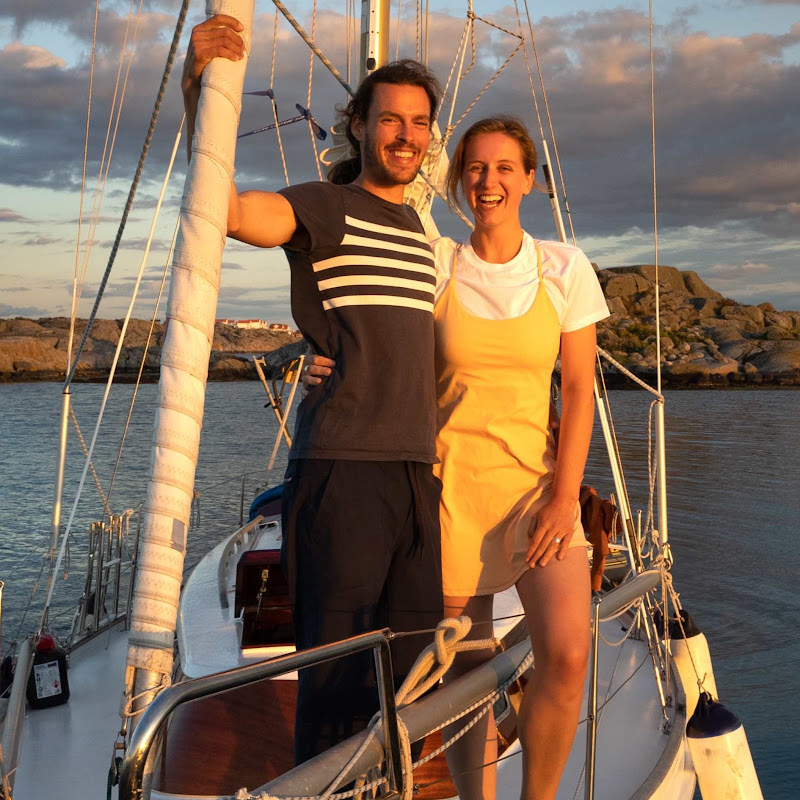
Sailing Magic Carpet
Maya and Aladino: The professional boatbuilder and artist duo who restored a 'crane-drop' Cape George 36, currently navigating the rugged wilderness of British Columbia.
Channel Information:
Social Media Links:
Searching For The Hermit of the Goose Group Location
- Goose Group, Queen Charlotte Sound, British Columbia, Canada (51.9685,-128.435)
- Gosling Island, Goose Group, British Columbia, Canada (51.921,-128.462)
- Calvert Island, Central Coast, British Columbia, Canada (51.65,-128)
- Prince Rupert, British Columbia, Canada (54.315,-130.3208)
- Rivers Inlet, Central Coast, British Columbia, Canada (51.55,-127.6)
Latest Episodes from Sailing Magic Carpet
Explore the most recent voyages. Subscribe to the channel to never miss an update!
Searching For The Hermit of the Goose Group
Sailing south from Prince Rupert aboard their restored Cape George 36, Magic Carpet II, Maya and Aladino reach British Columbia's remote Goose Group to explore Gosling Island and trace the legacy of legendary wilderness paddler Kayak Bill.
We’re Starting to Lose Our Minds
Order a copy of "The Northern Voyage" book in hardcover! Our channel is made possible by you! Check out our Patreon account to get access to weekly real time updates (during boat season), early access to the videos, and maybe even surprise handwritten letters delivered to your mailbox. ...
An Old Map Leading Us To Hotsprings…
Order a copy of "The Northern Voyage" book in hardcover! Our channel is made possible by you! Check out our Patreon account to get access to weekly real time updates (during boat season), early access to the videos, and maybe even surprise handwritten letters delivered to your mailbox. ...
A Mysterious Presence on this Northern Island
Order a copy of "The Northern Voyage" book in hardcover! Our channel is made possible by you! Check out our Patreon account to get access to weekly real time updates (during boat season), early access to the videos, and maybe even surprise handwritten letters delivered to your mailbox. ...
Sailing Northern Canada | Alone and at Peace
Order a copy of "The Northern Voyage" book in hardcover! Our channel is made possible by you! Check out our Patreon account to get access to weekly real time updates (during boat season), early access to the videos, and maybe even surprise handwritten letters delivered to your mailbox. ...