Keeping cool in Grenada | Ep113
The anchor breaks free from the mud of Scotland Bay, Trinidad, as the sun drops behind the western headlands. After spending a month in the boatyard completing refit work, the crew of Sailing Fair Isle aims their bow north toward Grenada. Preparing for the overnight passage aboard their Hans Christian 48 ketch, returning to open sea brings immediate relief. As Steve reflects while coiling lines on the foredeck, “it’s nice to just be out and back on the boat because a month or so in the yards a bit much.” The passage requires traversing 80 nautical miles across an open ocean channel, where wind and equatorial current intersect.
Timing the departure for dusk allows the heavy double-ender to cross the channel under cover of darkness and make landfall in daylight. With an estimated boat speed of 7 knots, the passage should place them off the southern coast of Grenada around daybreak. Strong tidal ripples sweep past the headlands outside the bay, requiring careful maneuvering while setting the mainsail before confronting the open Caribbean swells.
Offshore Passage and Equatorial Current
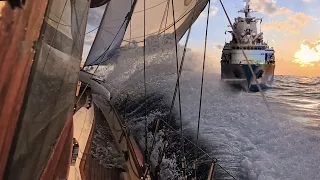
Clearing the sheltered leeward waters of Trinidad brings an immediate change in sea state. An ocean swell marches from the beam, pushed by an easterly breeze blowing 20 knots. Broad reaching under working sail, Fair Isle tracks steadily at 7 knots, parting the dark chop. Ocean passages along this stretch of the Caribbean demand constant vigilance at the helm. A stubborn equatorial current sets westward at up to 3 knots, pinching the yacht toward the west and requiring steady helm correction to maintain course.
While off watch below, the crew completes preliminary entry administrative tasks. Grenada operates under the online SailClear customs system, allowing skippers to submit crew manifests, vessel details, and border declarations prior to arrival. With the digital filing completed mid-channel, the paperwork process at the destination port promises to be swift, eliminating the bureaucratic delays often encountered throughout the islands.
As dawn breaks over the horizon, the silhouette of Grenada rises ahead, but the approach brings sudden squalls. A localized storm front sweeps over the southern headlands, bringing driving rain and gusts reaching 30 knots. Despite the sudden drenching, the squall rapidly clears to reveal a full rainbow arching over the southern bays. Fair Isle rounds the point and navigates into Prickly Bay, finding a crowded fleet of cruising boats swinging at anchor. The crew maneuvers into a gap and lowers the bower anchor into 5 meters of sand.
| Passage metric | Recorded observation | | — | — | | Passage distance | 80 nautical miles | | Breeze speed | 20 knots | | Vessel speed | 7 knots | | Westward current | 3 knots | | Squall wind peak | 30 knots | | Prickly Bay depth | 5 meters | | Customs clearance | 10 minutes |
Once the hook sets firmly, Steve dinghies ashore to the customs office at the head of the bay. Thanks to the advance submission through SailClear, official check-in takes only 10 minutes at the customs dock, marking a smooth entrance into the country.
Hatch Ventilation and Electrical Upgrades
Tropical temperatures in Prickly Bay climb rapidly under the morning sun, presenting an immediate ventilation challenge. Frequent rain squalls roll across the anchorage, forcing crews to dog down deck hatches to prevent soaked berths. Closing the forward hatches turns the interior into an oven. To solve the problem without buying specialized canvas scoops, Steve devises a practical deck solution: “I had a bright idea just before we left I’ve got the solar panel propped up.” By positioning a rigid solar panel over the open forehatch, air flows freely through the forward cabin while rain runs off the panel edges.
With ventilation secured, attention shifts to electrical efficiency. The yacht relies on a Starlink satellite terminal for offshore weather routing and communication. Operating the communication terminal previously required running the large shipboard inverter. Turning on the main inverter required descending into the hot engine room because replacement remote controls were not backward-compatible with older units. Running a high-capacity inverter purely to drive a low-wattage satellite router caused excessive battery drain.
Steve installs a dedicated Victron Phoenix inverter to serve the communication system exclusively. The compact unit converts battery storage to alternating current with high efficiency, bypassing the main inverter entirely. During the initial wiring attempt, Steve pulls power from a secondary switch panel, but the unit flashes an error indicator. Troubleshooting the circuit, he decides to rewire the installation properly. He runs heavier DC supply cables directly to the primary distribution panel, inserts an inline circuit breaker, and crimps ferrule terminals onto every lead, noting that he “hates having bare wires in grub screws.” Once wired with dedicated heavy conductors, the status light switches to solid green, delivering clean power and allowing remote control directly from the main cabin switchboard.
Touring Inland Plantations by Scooter
With shipboard maintenance under control, the crew rents a scooter to explore the mountainous interior of Grenada. Two-wheeled transport provides natural airflow on steep mountain grades while traveling along winding island roads. The first inland destination is the Tri-Island chocolate facility, where the team investigates traditional cacao processing.
At the plantation, guides demonstrate the anatomy of the cacao tree. Cacao pods grow directly from the trunk and major branches rather than outer twigs, changing color toward deep red and gold as they ripen. Opening a freshly harvested pod reveals white pulp encasing the raw seeds. The plantation guide instructs visitors on sampling the raw fruit: “so suck on it it tastes just like a lychee.” The mucilage offers a light, sweet flavor without the bitterness associated with roasted cacao.
The processing floor demonstrates careful sorting. Workers sort dried beans by hand on wooden sorting tables, separating whole, plump beans from flat, cracked, or insect-damaged seeds. Quality unblemished beans are reserved for dark chocolate, while flawed seeds are diverted for commercial cocoa powder or cosmetic cocoa butter. Roasting broken beans alongside intact ones would cause scorched flavors and bitter chocolate.
Following the cacao tour, a scooter ride through lush mountain valleys leads to a freshwater river pool. Swimming in the cool mountain water provides relief from tropical heat before continuing north along the coast.
Traditional Rum Distillation at River Antoine
Continuing north brings the crew to River Antoine Estate, an estate that has produced organic rum for centuries. Judy and Steve had visited the facility 25 years earlier while filming a television documentary on organic agricultural trade, and returning aboard their own cruising boat brings a sense of continuity. While the estate once exported organic bananas, shifting economics led management to concentrate entirely on sugarcane spirits.
The facility operates as an authentic living museum of industrial water power. Approximately 90 percent of the sugarcane milled on site is cultivated directly on the surrounding estate, with the remaining 10 percent supplied by independent local farmers. Cane stalks pass through heavy crushing rollers powered entirely by a massive water wheel fed by the Antoine River. The extracted cane juice flows directly to boiling rooms, while the leftover fibrous cane bagasse is dried and fed into brick furnaces to fuel the evaporation cauldrons.
Fermentation relies entirely on natural processes. Fresh cane juice sits in open wooden vats for 8 days, fermenting solely with wild airborne yeast without artificial chemicals or cultured additives. As the distillery guide explains during the tour, “whenever you drink Rivers rum you get no headaches no hangovers.” The fermented wash is then boiled in wood-fired copper pot stills and condensed into raw, clear spirit.
The distillery produces two variations of its traditional spirit. The domestic standard is bottled at 75 percent ABV, a fiery spirit favored by locals. For international distribution, the distillery bottles a diluted version at 69 percent ABV. This specific strength was established after international air transport regulations prohibited liquids exceeding 70 percent alcohol on commercial passenger flights. Sampling the spirit straight from the still requires determination. Judy cautions, “it is not a sipping rum you have to go for it.” Tasting the 75 percent spirit delivers an intense, warming flavor that Judy notes: “God that’s amazing isn’t it it’s like it’s not even in your mouth.”
Craft Brewing and Anchorage Reflections
Returning south toward Prickly Bay, the crew stops at West Indies Beer to explore Grenada’s burgeoning craft brewing scene. For decades, the local beer market was dominated by standard commercial lagers. As the head brewer explains, “we at West Indies beer we came in and kind of just blew that completely out of the water.” The independent brewery maintains 22 distinct beers and ciders on tap, ranging from fruit ciders to heavy dark ales.
The brewhouse sources traditional ingredients, including UK Fuggle hops and East Kent Golding varieties, combining them with roasted dark barley malt. Standing alongside the mash tun, the brewer explains his passion for complex craft recipes: “this is what I should have been doing for years.” Among the most popular pours is Black Rock, a robust dark porter-style ale registering 8.3 percent ABV that has found favor in traditional local rum shacks alongside imported spirits. Judy samples a crisp mango cider brewed on site, appreciating the contrast with the fiery cane spirits encountered earlier in the day.
Reflecting on life in Grenada, the crew ponders the curious local food supply. Despite mountain soil that yields giant avocados, finding fresh green vegetables in local village markets proves challenging. A trip to a local grocery store yields only 3 imported lemons priced at 2 dollars each, highlighting the import dependencies of island life. Steve continues his search for International Woodskin varnish across local chandleries to finish coating the exterior teak brightwork.
Anchored safely in Prickly Bay with shipboard power optimized and cruising grounds thoroughly explored, Fair Isle prepares to spend another two weeks in southern Grenada before continuing their northward journey through the Caribbean.
Frequently Asked Questions
Fair Isle completed an 80 nautical mile overnight passage from Scotland Bay, Trinidad, across the open channel to Prickly Bay on the southern coast of Grenada.
Clearance took only 10 minutes at the customs hut on the dinghy dock because the crew completed arrival forms online in advance using SailClear.
Steve installed a dedicated Victron Phoenix inverter wired directly to the main distribution panel with heavy-gauge cables to efficiently power the Starlink terminal.
Sugarcane is crushed using heavy rollers driven by a water wheel on the Antoine River, fermented for 8 days with wild airborne yeast, and distilled in copper pot stills.
The 69 percent ABV rum is produced for export because international airline regulations prohibit carrying liquids stronger than 70 percent alcohol on commercial aircraft.
Book a trip where this was filmed — near Grenada

Support Sailing Fair Isle
At WeBoating.com, we profoundly acknowledge the unwavering dedication that Sailing Fair Isle invests in crafting each and every video or voyage. Their passion for delivering exceptional ocean content shines through every frame, and it's a labor of love that deserves your attention.
We invite you to watch their captivating videos here and actively engage with their content, including their social media links above. Liking, commenting, and sharing their work goes a long way in fueling their creative fire.
We're also inviting you to explore the gear, sponsorships, and boat partnerships highlighted in the "Keeping cool in Grenada | Ep113" video description, or directly on YouTube. By engaging with these offerings or purchasing services and items, you directly support Sailing Fair Isle, their collaborators, and the brands they're associated with.
To ensure you never miss an offshore update, consider visiting their official YouTube Channel to subscribe, like, and join their community directly.
If you have any feedback, corrections, or additional information about Sailing Fair Isle or their videos, please use the comment form below to share your thoughts with us.
Thank you for being a part of our community and supporting the creators we cherish. Your time and support truly matter!
The Caribbean cruising adventure begins! Trinidad was lovely, but it's more a place that sailors go to work on their boats than it is a full on cruising destination. So our night sail up to Grenada marked the start of our Caribbean cruising we felt.
The seas get clearer and more blue as we sail North and we have some interesting weather too!
We found some surprising and very interesting attractions in land by hiring a scooter for a couple of days, always fun! and we're really enjoying exploring the bays on the South coast which are well set up for cruisers, if a little crowded at times in the anchorages.
-------------------------------------------------------------------------------------------------------------------
PLEASE DO SUBSCRIBE - IT COSTS YOU NOTHING AND HELPS US OUT WITH THE YOUTUBE ALGORITHM
--------------------------------------------------------------------------------------------------------------------
PATREON:
We couldn't make these videos without the support of you, our patrons. You are our first line of feedback, our team, our support and our friends. We are really grateful and it means we can keep the videos coming! If you would like to join us you get to see (and comment on, which really helps us) the current videos with no ads at all before they get released to the public. There are also lots of extra videos available on Patreon and you can contact us directly on board. Ask us anything! We have regular ZOOM sessions and a WhatsApp group where we talk about boats, passages and life onboard. Join us!
https://www.patreon.com/sailingfairisle
-----------------------------------------------------------------------------------------------------------------------
Sailing Fair Isle
Steve and Judy: The veteran BBC filmmakers navigating the globe aboard their Hans Christian 48, Fair Isle, blending broadcast-quality storytelling with blue-water grit.
Channel Information:
Social Media Links:
Latest Episodes from Sailing Fair Isle
Explore the most recent voyages. Subscribe to the channel to never miss an update!
Hiding from storms behind Croatian islands | Ep182
Steve and Judy cruise Fair Isle along the Croatian coast in November, sheltering behind islands from 40-knot bura gales, exploring empty ancient ports, and preparing for an open-water crossing to Venice.
Custom boat tour from Pacific Shipyards
Step aboard the 24-meter custom motor yacht Nomad of London at Porto Montenegro with Steve and Judy from Sailing Fair Isle, examining its twin John Deere diesels, DMS Magnus rotor stabilizers, bespoke residential galley, and Dutch steel engineering.
We Just Made It: Sailing Into Porto Montenegro
Steve and Judy sail Fair Isle across the southern Adriatic to Porto Montenegro on tight fuel reserves, complete a 9-mile mountain hike to Kotor, and tour the custom yacht Nomad of London.
Which bike for your boat?
Steve and Judith test Brompton folding bikes aboard Fair Isle, comparing lightweight titanium T Lines in Barcelona with rugged electric G Lines at the Annapolis Boat Show to find the ultimate bike for dinghy landings and cruising life.
Why we fly halfway around the world for the Annapolis boat show | Ep180
Steve and Judy travel to Annapolis to evaluate cruising sailboats, tenders, hybrid propulsion, and electrical safety systems before facing an unexpected medical visit.