ABSOLUTE SAILBOAT PORN: Looking at my dream sailboat
Fresh off a 19-day Atlantic crossing from Bermuda aboard his Scepter 36 sailboat, Michael Potts of Sailing EV arrives in Ponta Delgada Marina on the island of São Miguel in the Azores. Walking down the pontoons, he inspects the offshore fleet gathered in the harbor, examining an array of long-distance cruising designs ranging from production cruisers to high-end bluewater yachts.
Dockside Walk in Ponta Delgada Marina
The docks hold a diverse gathering of ocean-crossing vessels, including an Oceanis 50, a classic ketch-rigged vessel, an extensive solar-array-equipped schooner, and a Lagoon 450F catamaran. Potts also passes a Hallberg-Rassy hailing from Stockholm, another vessel registered in Sarasota, Florida, and an Amel Super Maramu center-cockpit ketch. Continuing down the pier, he observes an Amel 58 and a series of bluewater builds, including Queen Bee II.
Further along the pontoon, Potts examines two high-end Oyster yachts: an Oyster 595 named Zenobia, equipped with distinctive deck saloon windows and a towering mast, positioned near an Oyster 625. Observing the construction standard, deck layout, and bluewater outfitting of the Oyster 595, Potts notes that the design represents an aspirational benchmark for circumnavigators and long-distance cruisers seeking global range in complete comfort.
Catamaran Sail Trim and Pointing Technique
Along the quay, Potts meets up with Greg aboard Ability, a Nautitech 46 Fly catamaran that sailed in company on the ocean passage. Reflecting on their performance during the crossing, Potts notes that Ability was able to point exceptionally well upwind, holding angles that his monohull struggled to match in the prevailing conditions.
Greg explains that they were able to sail efficiently up to 45 degrees apparent wind angle, noting that “so that’s pretty good for a cat.” When Potts asks how to get a cruising catamaran to point effectively without stalling out, Greg details the fundamental differences between monohull and multihull trimming. He explains that a sailor must “have to point a cat like you’re footing off on a monohull.” Instead of pinching or trimming sails dead-flat, multihull sails require active flow across the foils.
Discussing the catamaran’s square-top mainsail and genoa setup, Greg emphasizes that choking the main down turns the head into an aerodynamic stall. To maintain boat speed and minimize leeway, he advises: “You’ve got to lift the boom just a little bit that sheet and you’ve got to create a twist so you get that open at the top.” By twisting off the head of both the square-top mainsail and the headsail, the rig unloads excess drag, accelerates flow across the foil, and allows the catamaran to carry speed higher into the wind.
Contrasting the experience of offshore catamarans with monohulls, Greg describes living aboard Ability as akin to living in a floating condo that moves between ports: “You know what’s the trip? I feel like we’re in a condo in a city. I mean, you come out of this condo and you’re in different cities every single time and you feel like you’re in the same place cuz this is your home and this is your backyard and your patio and then you just open the door and you’re in a totally different city.”
Fleet Gathering and Azores Logistics
Later in the day, Potts catches up with Mark O’Gara as the crews head toward the Art Gallery bar for an ARC Rally celebration. Mark explains that the gathering brings together roughly 60 sailors to mark a major Atlantic passage milestone, stating that “we are celebrating the end of this leg because this is the last island in the Azores” before the fleet makes its final ocean transit toward mainland Portugal and continental Europe.
Walking through the waterfront, Potts and O’Gara reflect on the practical appeal of Ponta Delgada for liveaboard cruisers. Situated directly adjacent to the historic downtown district of São Miguel, the marina provides immediate walking access to municipal provisioning, stone architecture, and shoreside services, standing as an affordable and well-protected haven for transatlantic voyagers preparing for their onward European legs.
Vessel Types Observed in Ponta Delgada
| Vessel Model / Rig | Vessel Name / Detail | Key Feature / Discussion |
|---|---|---|
| Scepter 36 | SV EV | 19 days transatlantic crossing from Bermuda |
| Nautitech 46 Fly | Ability | 45 degrees apparent wind angle upwind capability |
| Oyster 595 | Zenobia | Deck saloon windows and high-aspect bluewater rig |
| Amel Super Maramu | Cruising Ketch | Center-cockpit offshore passage design |
Michael Potts completed the transatlantic crossing from Bermuda to Ponta Delgada Marina in 19 days aboard his Scepter 36 sailboat.
Ability, a Nautitech 46 Fly catamaran skippered by Greg, achieved an upwind heading of 45 degrees apparent wind angle during the crossing.
To point effectively without choking the rig, the boom should be eased slightly to introduce twist at the top of the square-top mainsail, preventing the head from acting like an air brake.
Approximately 60 sailors gathered in Ponta Delgada to celebrate the conclusion of the Azores rally leg before departing on the final transatlantic passage to mainland Portugal.
Support Sailing EV
At WeBoating.com, we profoundly acknowledge the unwavering dedication that Sailing EV invests in crafting each and every video or voyage. Their passion for delivering exceptional ocean content shines through every frame, and it's a labor of love that deserves your attention.
We invite you to watch their captivating videos here and actively engage with their content, including their social media links above. Liking, commenting, and sharing their work goes a long way in fueling their creative fire.
We're also inviting you to explore the gear, sponsorships, and boat partnerships highlighted in the "ABSOLUTE SAILBOAT PORN: Looking at my dream sailboat" video description, or directly on YouTube. By engaging with these offerings or purchasing services and items, you directly support Sailing EV, their collaborators, and the brands they're associated with.
To ensure you never miss an offshore update, consider visiting their official YouTube Channel to subscribe, like, and join their community directly.
If you have any feedback, corrections, or additional information about Sailing EV or their videos, please use the comment form below to share your thoughts with us.
Thank you for being a part of our community and supporting the creators we cherish. Your time and support truly matter!
In this video we are in the Azores at Puerto Delgado Marina Azores. I walk the docks looking at some of the most expensive and beautiful sailboats in the world. I speak with an experienced catamaran Captain about pointing and Mark w. Gura himself speaks about sailing here in the Azores.

Sailing EV
Join Michael Potts of Sailing EV as he documents his high-authority transition from a 20-year career in cinematography to a solo Atlantic crossing aboard his Scepter 36T.
Channel Information:
Social Media Links:
ABSOLUTE SAILBOAT PORN: Looking at my dream sailboat Location
- Marina Pêro de Teive, Ponta Delgada (37.7394,-25.6631)
- Ponta Delgada Historic Harbor (37.7408,-25.6678)
Latest Episodes from Sailing EV
Explore the most recent voyages. Subscribe to the channel to never miss an update!
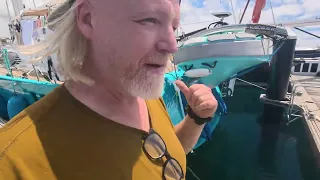
ABSOLUTE SAILBOAT PORN: Looking at my dream sailboat
Michael Potts lands in Ponta Delgada Marina in the Azores after a 19-day Atlantic crossing, inspecting bluewater yachts and discussing catamaran sail trim with Ability's skipper.
October 1, 2026
this boat must be ready by this time next year to go..