Sailing Aurora-with the hot chick and the engineer

In 2026, Sailing Aurora-with the hot chick and the engineer chronicles the technical refit and bluewater voyaging of Aurora, a 2004 Farr 56 Pilothouse Cutter. Helmed by an experienced mechanical engineer and his partner Kristen, the channel combines masterclass marine systems engineering, auxiliary generator overhauls, pneumatic air horn installs, and heavy ground tackle diagnostics with practical liveaboard seamanship along the US East Coast and Bahamas.
Channel Information:
Social Media Links:
Sailing Aurora-with the hot chick and the engineer Latest Episode
When an accomplished mechanical engineer and his partner Kristen took ownership of Aurora, a 2004 Farr 56 Pilot House Cutter, they bypassed the superficial vlog trends of glossy tropical sunsets to tackle the unvarnished engineering realities of managing a 56-foot bluewater thoroughbred. Operating under the channel banner Sailing Aurora-with the hot chick and the engineer (and known across digital platforms as Springline - Life By Design), this sailing campaign strips away maritime romanticism in favor of industrial-grade diagnostics, pneumatic horn fabrications, and deep engine room forensics. Their mission is as uncompromising as Bruce Farr's naval architecture: transforming a sophisticated transatlantic performance cruiser into an offshore passage-maker capable of surviving unforgiving ocean conditions through absolute mechanical self-reliance.
Key Takeaways
- Industrial Engineering Ethos: Helmed by a veteran mechanical craftsman and his partner Kristen, the channel delivers analytical overhauls of diesel propulsion, high-output 24V charging, and auxiliary generator machinery.
- The Vessel (Aurora): A 2004 Bruce Farr-designed Farr 56 Pilot House Cutter (Design #425) built by BSI Marine in Sweden, combining ocean racing naval architecture with heavy displacement cruising comfort.
- Cruising Grounds & Mission: Navigating the US Atlantic seaboard, from Annapolis and Newport down the Intracoastal Waterway to Fort Lauderdale, with active offshore passages into the Bahamas and the Caribbean.
⚓ Quick Specs & Channel Vitals
Understanding the operational parameters of Aurora requires examining both the vessel's technical specifications and the channel's media footprint across the maritime digital landscape.
| Metric | Detail |
|---|---|
| Vessel Name & Model | Aurora / 2004 Farr 56 Pilot House Cutter |
| Naval Architect & Builder | Farr Yacht Design (Bruce Farr #425) / BSI Marine (Sweden) |
| Flag & Home Port | United States / St. Louis, MO & Annapolis, MD |
| Length Overall (LOA) & Beam | 57 ft 9 in (17.60 m) / 16 ft 7 in (5.06 m) |
| Draft & Displacement | 8 ft 3 in (2.50 m) / 45,100 lbs (20,500 kg) |
| Propulsion & Aux Generator | Yanmar 4LHA-HTP 160 HP Diesel / Northern Lights 6 kW Generator |
| Primary Ground Tackle | Ultra Marine 45 kg (99 lb) Anchor with 328 ft (100 m) G43 Chain |
| Sailing Style | Offshore Bluewater Cruising & Coastal Passage-Making |
| Key Geographical Focus | US East Coast, Chesapeake Bay, ICW, Florida, and Bahamas |
| YouTube Focus & Vibe | Marine Mechanical Engineering, Systems Overhauls, and DIY Tutorials |
Meet the Crew and the Fleet
The Sailors Behind the Helm
The operational dynamic aboard Aurora is anchored by a complementary partnership balancing heavy industrial engineering with rigorous seamanship. Rather than relying on commercial boatyard technicians, the crew approaches vessel stewardship through direct hands-on troubleshooting, treating every mechanical failure as an engineering problem waiting for a permanent technical solution.
The Engineer
Serving as the chief engineer, skipper, and technical mind of the voyage, he brings decades of precision mechanical diagnostics into the marine environment. Before stepping aboard a 56-foot bluewater yacht, his professional career centered around high-performance mechanical design, motorsports engine building (including complete Porsche Boxster M96 engine tear-downs and IMS bearing retrofits), precision metal fabrication, and advanced electrical troubleshooting.
- Primary Expertise: Marine diesel mechanics, high-output alternator charging circuits, pneumatic compressors, plumbing hydraulics, and yacht machinery design.
- Certifications: Advanced Mechanical Engineering background, USCG Safety Protocols, high-performance mechanical endorsements.
- On-Camera Style: Methodical, analytical, and uncompromisingly transparent; disassembles complex failure modes on camera while exposing poor factory designs.
Origin Story & Professional Background
Originating from the American Midwest, his formative technical years were spent mastering precision tolerances in workshops and high-performance racing garages. He developed an acute eye for mechanical failure points, vibration harmonics, and fluid dynamics—skills that transitioned seamlessly to marine auxiliary systems where salt spray, galvanic corrosion, and constant vessel movement punish subpar machinery.
When the decision was made to acquire a serious bluewater cruising yacht, he selected the Farr 56 specifically for its naval architecture, dedicated walkthrough machinery spaces, and robust construction. Aboard Aurora, his daily routine involves fluid inspections, raw water impeller servicing, electrical busbar torque checks, and preventative overhauls that eliminate system downtime on open water.
Kristen
Kristen serves as the first mate, co-navigator, deck boss, and logistical commander of Aurora. Known affectionately in the channel title as the quick-witted counterpart to the engineer's analytical demeanor, Kristen plays an indispensable operational role in heavy-weather sail handling, anchor deployments, and tight-quarters maneuvering of their 45,000-pound yacht.
- Primary Expertise: Close-quarters yacht docking, line handling, deck operations, offshore provisioning, passage logistics, and media production.
- Certifications: Professional close-quarters boat handling under private instruction, coastal navigation, maritime safety.
- On-Camera Style: Engaging, authentic, humorous, and relatable; showcases the steep learning curve of commanding a 56-foot pilot house yacht with poise.
Seamanship & Onboard Responsibilities
Stepping aboard a vessel the size of a Farr 56 requires mastering immense line loads, windage, and prop walk. Kristen embraced this challenge by undertaking intensive close-quarters maneuvering instruction, learning to control Aurora in crowded marinas and swift cross-currents. In addition to helm watchkeeping, she oversees the domestic logistics required for long-distance cruising, from high-capacity watermaker schedules to provisions management.
| Crew Member | Primary Role | Core Technical Domain | Watchkeeping Profile |
|---|---|---|---|
| The Engineer | Skipper / Chief Engineer | Diesel Propulsion, 24V Electrical, Pneumatics, Mechanical Systems | Heavy Weather Helm, Technical Watch, Engine Room Log |
| Kristen | First Mate / Deck Officer | Maneuvering, Line Handling, Navigation, Cruising Logistics | Docking Helm, Anchor Watch, Offshore Watch Rotation |
⛵ Professional Fleet Forensics
A technical analysis of the channel must begin with the flagship itself. The Farr 56 Pilot House represents the pinnacle of late-1990s and early-2000s semi-custom European bluewater yacht construction, combining the slippery hull forms of America's Cup designer Bruce Farr with Swedish shipyard craftsmanship.
Aurora (2004 Farr 56 Pilot House Cutter)
Commissioned in 2004 by BSI Marine in Sweden, Aurora was engineered specifically for shorthanded transatlantic voyaging. Featuring an enclosed pilot house with inside steering, panoramic deck saloon windows, and a raised navigation station, she allows the watchstander to monitor radar and autopilot while remaining completely dry and sheltered from ocean spray.
Her hull design incorporates an efficient bulb keel and balanced spade rudder that dramatically reduce hydrodynamic drag compared to traditional heavy full-keel cruisers. The cutter rig allows flexible sail configurations, enabling the crew to douse the large roller-furling genoa and deploy a heavy Dacron staysail on an inner forestay as the wind builds beyond 25 knots.
| Vessel Metric | Engineering Specification | Cruising Impact |
|---|---|---|
| Naval Architect | Bruce Farr (Farr Yacht Design #425) | Low wetted surface, fast hull speeds, and exceptional upwind tracking. |
| Builder & Year | BSI Marine (Sweden) / 2004 | Hand-laid solid fiberglass hull with vacuum-bonded sandwich deck. |
| Length Overall (LOA) | 57 ft 9 in (17.60 m) | Generous waterline length providing hull speeds exceeding 9.5 knots. |
| Beam | 16 ft 7 in (5.06 m) | Exceptional initial form stability and cavernous interior machinery space. |
| Draft & Keel | 8 ft 3 in (2.50 m) / Lead Fin Keel | Deep hydrodynamic lift; limits shallow Bahamas anchorages without careful tide planning. |
| Displacement & Ballast | 45,100 lbs (20,500 kg) / 14,036 lbs (6,750 kg) | High ballast ratio (31%) yielding extreme righting moments in offshore squalls. |
| Main Engine | Yanmar 4LHA-HTP 160 HP Turbocharged | High-torque diesel capable of powering through adverse Gulf Stream conditions. |
| Fuel Capacity | 264 US Gallons (1,000 Liters) | Extended motoring range exceeding 850 nautical miles at cruising rpm. |
| Freshwater Capacity | 238 US Gallons (900 Liters) | Generous tankage supplemented by reverse-osmosis desalinators. |
🛠️ The Gear Locker: Crucial Hardware
The equipment choices on Aurora reflect an industrial mindset focused on oversized load ratings, fail-safe redundancy, and heavy-duty marine hardware capable of withstanding offshore cycling.
⚓ Ground Tackle: The 328-Foot Chain Philosophy
Ground tackle represents the ultimate life-insurance policy of a cruising yacht. In their detailed breakdown on Why do we need 328’ (100 meters) of chain on our sailboat?, the engineer explains the mathematical and physical necessity of carrying 100 continuous meters of high-tensile G43 galvanized chain. In their candid video Anchor Chain is Bloody Expensive!!!, the crew reveals the raw capital investment required to outfit a 56-foot vessel with premium ground tackle.
In exposed anchorages, sudden wind shifts and rolling ocean swells create massive cyclic shock loads on deck fittings. While nylon rodes stretch, they are vulnerable to coral abrasion and chafe against rocky seabeds. High-test G43 chain provides an enormous catenary curve: the suspended weight of the chain sags in a deep arc between the bow roller and the seabed, acting as a massive hydraulic dampener that keeps the pull on the anchor shank completely horizontal even in 45-knot squalls.
| Ground Tackle Item | Specification | Operational Philosophy & Features |
|---|---|---|
| Primary Anchor | Ultra Marine 45 kg (99 lb) Stainless Steel | Curved roll-bar-free shank with weighted tip for instant substrate penetration. |
| Anchor Rode | 328 ft (100 m) 3/8-inch G43 High-Test Chain | Heavy catenary curve absorbs shock loads in exposed roadsteads without stretching. |
| Snubber System | Mantus Heavy Duty Snubber & Hook | Custom bridle arrangement relieving strain from the electric Lofrans windlass. |
| Windlass | Lofrans 24V Horizontal Windlass with Capstan | High-torque dual-direction retrieval powered by independent 24V battery bank. |
Acoustic Safety: Kahlenberg Air Horn Installation
One of the most unique engineering upgrades documented on the vessel is showcased in Kahlenberg Air Horn Install on Aurora!. Standard electric yacht horns produce weak, tinny acoustic signatures that fail to penetrate thick sea fog or overcome the roaring engine noise of commercial container ships. To establish unmistakable auditory presence in commercial shipping lanes, the engineer engineered a complete pneumatic system featuring a commercial-grade Kahlenberg marine air horn, an engine-compartment 12V/24V high-pressure air compressor, and an aluminum reservoir tank producing over 130 decibels of sound output.
This pneumatic installation meets USCG Class II acoustic sound-signaling regulations for vessels up to 75 meters, giving Aurora commercial-grade auditory safety when navigating busy shipping channels, coastal inlets, and restricted visibility fog banks along Cape Hatteras and Long Island Sound.
📊 Vessel Systems Health Scorecard
A rigorous engineering audit of Aurora across four key maritime domains demonstrates an exceptionally robust platform engineered for autonomous voyaging.
| System Domain | Rating | Configuration, Architecture & Field Reliability |
|---|---|---|
| ⚡ Energy Autonomy | 9 / 10 | Mastervolt 24V 110A alternator, Northern Lights 6 kW auxiliary generator, and dedicated 24V deep-cycle house bank supporting heavy reverse-cycle AC and refrigeration loads. |
| 🛡️ Structural Integrity | 9 / 10 | Solid hand-laid GRP hull laminate built to CE Ocean Category A standards by BSI Marine, backed by deep transverse structural frames and a heavy lead keel. |
| 📡 Communication Grade | 8 / 10 | Comprehensive marine VHF with DSC, redundant AIS Class B transponders, Raymarine radar suite, and offshore satellite data routing. |
| 💧 Water Independence | 8 / 10 | 238 gallons (900 L) of baffled freshwater storage paired with onboard filtration, hot water heat-exchangers, and reverse-osmosis desalinator capability. |
Auxiliary Systems Architecture: Inside the Machinery Spaces
Unlike contemporary production sailboats where engines are shoehorned into claustrophobic spaces beneath companionway ladders, the Farr 56 features an authentic walk-in machinery room. In their comprehensive video Engine Room Part 2 - Generator Room Deep Dive on Aurora (2004 Farr 56), the engineer takes viewers through the mechanical layout that keeps the yacht operational far from shore.
Central to this layout is the Northern Lights 6 kW sound-shielded generator. The engineer details raw water heat exchanger maintenance, primary fuel-water separator manifolds, and sound dampening insulation that allows overnight generator runs without disturbing the aft master cabin. Crucially, auxiliary systems require clean fuel; before departing on coastal passages, the crew executed complete fuel polishing across their twin diesel tanks to purge accumulated sediment and microbiological growth.
Mechanical failures are addressed at the component level. In Sailing Aurora-Yanmar Mixing Elbow Replacement, the skipper documents replacing a corroded exhaust mixing elbow on their Yanmar diesel before dangerous pinhole leaks could dump raw saltwater into the turbocharger. Similarly, when the 24V house charging failed, the engineer diagnosed wiring defects in 24V 110A Mastervolt Alternator Not Working! But it is now!!!, restoring full battery charging capabilities without paying marina contractor markups.
Sanitation and climate systems receive the same rigorous treatment. The crew dismantled and overhauled their marine heads in The Dumbest, Most Horrible, Bad Design Ever Made for a Boat: The VacuFlush Head, replacing stiff duckbill check valves and tracing vacuum switches. In Installing a MarinAire marine AC into Aurora, they modernized their salon climate control with a self-contained reverse-cycle air conditioner, rewiring high-amperage breakers and raw water cooling plumbing.
Voyages, Destinations, and Local Waters
📍 Top Routes and Expeditions
The cruising track of Aurora spans the dynamic waters of the US Eastern Seaboard and the sub-tropical banks of the Bahamian archipelago. Commencing in the maritime hub of Annapolis, Maryland, the vessel underwent extensive autumn trials in the Chesapeake Bay before embarking south along the Atlantic Intracoastal Waterway (ICW) to Fort Lauderdale, Florida.
Navigating a 56-foot yacht with an 8-foot 3-inch draft and a towering 75-foot mast along the ICW presents severe tactical challenges. The crew must balance restrictive 65-foot fixed bridges, shifting shoals at Carolina inlets, and tidal gates through Georgia and Florida. These passages demanded vigilant sonar watchkeeping and meticulous tide calculation to prevent groundings in shallow waterways.
Beyond the ICW, the crew's offshore itinerary includes open-ocean hops around Cape Hatteras, Gulf Stream crossings to Grand Bahama and the Exumas, and summer blue-water passages northward to Newport, Rhode Island. In these expansive testing grounds, Aurora showcases the sea-kindly hull dynamics that Bruce Farr engineered into his ocean-crossing designs.
⏳ Voyage Milestone Timeline
The chronological progression of the vessel's acquisition, mechanical overhaul, and sea trials illustrates their methodical path toward bluewater self-reliance.
- October 2024: The crew completes the acquisition of Aurora, examining the logistical and survey complexities of buying a 60-foot class yacht in What’s it take to buy a 60’ sailboat - more than you would think..
- November 2024: First comprehensive vessel walk-through published in 2004 Bruce Farr 56 Sailboat Quick Walk Through, followed by their official channel mission in Sailing Aurora Introduction.
- November 2024: Kristen begins intensive close-quarters maneuvering instruction in Annapolis with delivery skipper James from Be The Captain in Kristen is learning to dock the boat!.
- February 2025: Preparations for heading south begin with critical engine maintenance in Sailing Aurora-Yanmar Mixing Elbow Replacement and high-output electrical repairs in 24V 110A Mastervolt Alternator Not Working! But it is now!!!.
- March 2025: Tank decontamination completed in Diesel Fuel Polishing before departing Annapolis waters on their southbound ICW voyage.
- November 2025: Climate control modernization completed with the removal of aging factory equipment and installation of modern systems in Installing a MarinAire marine AC into Aurora.
- February 2026: Sanitation overhaul tackling vacuum leaks and check valves documented in The Dumbest, Most Horrible, Bad Design Ever Made for a Boat: The VacuFlush Head.
- June 2026: Commercial-grade pneumatic sound system installed and tested in Kahlenberg Air Horn Install on Aurora!.
- July 2026: Auxiliary generator room deep dive published in Engine Room Part 2 - Generator Room Deep Dive on Aurora (2004 Farr 56).
- September 2026: Deep dive into heavy ground tackle, catenary physics, and anchor rode investments in Why do we need 328’ (100 meters) of chain on our sailboat? and Anchor Chain is Bloody Expensive!!!.
Navigating Regional Waters: Chesapeake to Florida
Sailing between Annapolis and South Florida subjects a crew to starkly different meteorological conditions. In the Chesapeake Bay, summer squalls generate steep chop in shallow water, while autumn nor'easters push cold fronts across Cape Hatteras with gale-force gusts. Further south, crossing the Gulf Stream toward the Bahamas requires waiting for wind windows that do not oppose the 3-knot northbound current—avoiding dangerous breaking waves.
In Bahamian waters, navigating shallow limestone banks with an 8-foot 3-inch draft demands visual piloting, reading sand colors under high noon sun, and anchoring in deep tidal channels where heavy ground tackle is strictly mandatory. The engineer's selection of an Ultra Marine 45 kg anchor backed by 328 feet of G43 chain provides peace of mind when holding in shifting tidal reversing currents.
The YouTube Journey and Financing the Dream
The digital presence of Sailing Aurora reflects high production clarity without scripted theatrics. Unlike lifestyle vloggers who monetize personal drama, their audience tunes in for precise mechanical troubleshooting, honest gear evaluations, and unscripted problem-solving.
🎥 Production Suite & Filming Tech
Filming inside cramped machinery spaces and on spray-swept decks requires durable equipment. The crew utilizes compact 4K action cameras mounted on magnetic brackets to capture tight mechanical clearances, high-CRI LED work lights to illuminate dark engine bilges, wireless lavalier microphones equipped with wind muffs, and DJI aerial drones for underway passage filming and masthead inspections.
Salt spray and tropical humidity present constant corrosion threats to sensitive filming optics. The crew protects camera sensors through watertight enclosures, silica gel desiccant storage packs, and routine freshwater wiping of optical lenses following wet offshore passages.
💸 Cruising Budget & Financial Blueprint
Maintaining a 56-foot luxury bluewater yacht demands disciplined financial planning. The engineer and Kristen manage their voyaging budget through professional remote engineering consulting, disciplined self-maintenance, and targeted community support.
| Financial Metric | Estimated Valuation & Range | Budgetary Basis & Allocation |
|---|---|---|
| Initial Vessel Purchase | $380,000 – $480,000 | Market valuation for 2000–2005 Farr 56 Pilot House yachts in prime condition. |
| Major Refit & Upgrades Spend | $55,000 – $75,000 | Yanmar mixing elbow, MarinAire AC units, Kahlenberg horn, G43 chain, and fuel polishing. |
| Annual Maintenance Budget | $18,000 – $28,000 | Haul-outs, antifouling paint, engine fluid changes, rigging inspections, and zincs. |
| Estimated Monthly Cruising Burn | $3,500 – $5,200 | Fuel, transient dockage, provisions, insurance, and marine communications. |
| Primary Funding Streams | Professional Engineering / AdSense | Remote engineering contracts, technical project revenue, and digital patronage. |
Top Episodes: Where to Start Watching
For viewers seeking technical substance and practical boat maintenance insight, these five essential episodes provide the perfect entry point into the channel's media archive:
- Why do we need 328’ (100 meters) of chain on our sailboat?: A masterclass in ground tackle physics, examining scope calculations, catenary damping, and why heavy chain is essential for anchoring a 45,000-pound yacht in exposed anchorages.
- Engine Room Part 2 - Generator Room Deep Dive on Aurora (2004 Farr 56): A thorough walk-through of the dedicated walk-in machinery room, analyzing their Northern Lights 6 kW auxiliary generator, raw water cooling circuits, and fuel delivery manifolds.
- Kahlenberg Air Horn Install on Aurora!: The complete engineering process of outfitting a sailboat with a commercial-grade pneumatic horn system, from compressor plumbing to pressure accumulator wiring.
- Anchor Chain is Bloody Expensive!!!: An honest financial audit of outfitting an offshore cruiser with 100 meters of high-tensile Grade 43 chain, exposing the real hardware costs of bluewater ownership.
- BreezaMAX is a SCAM!!! #facebookscam #scam #breezamax: An analytical engineering teardown exposing deceptive portable cooling gadget advertisements, demonstrating the engineer's sharp consumer advocacy.
Channels Similar to Sailing Aurora-with the hot chick and the engineer
Sailors and technical enthusiasts who appreciate in-depth boat refits, performance monohulls, and hands-on maintenance will also enjoy these kindred channels on WeBoating:
- Sailing SV Bohemian: Chronicles hands-on monohull voyaging and extensive marine DIY repairs, offering a kindred focus on keeping blue water yachts sea-ready through self-reliance.
- SV Yarreh: Follows a couple managing bluewater expeditions and equipment overhauls aboard a performance offshore cruiser with high technical transparency.
- Sailing SV Indigo: Documents liveaboard voyaging, close-quarters maneuvering, and coastal navigation along challenging tidal waterways with an analytical cruising style.
Community Impact and Future Horizons
Sailing Aurora has carved out a vital niche within the sailing community by countering the culture of disposable marine consumerism. By demonstrating how to rebuild raw water mixing elbows, trace elusive alternator excitation faults, and service complex VacuFlush sanitation systems, the channel demystifies large-yacht ownership for cruisers who lack seven-figure shipyard budgets.
Looking ahead, the crew is focused on completing offshore shakedown passages toward the Bahamas and Eastern Caribbean. As Aurora transitions from her intensive refit phase to extended bluewater cruising, their documentation will continue to showcase high-latitude navigation, ocean passage-making, and long-term systems reliability in remote anchorages.
Frequently Asked Questions about Sailing Aurora-with the hot chick and the engineer
The channel is hosted by a seasoned professional mechanical engineer and his partner Kristen. Transitioning from high-performance automotive mechanics and aviation-grade craftsmanship, the duo shares hands-on technical overhauls and liveaboard sailing aboard their 2004 Farr 56 pilothouse cutter.
Aurora is a 2004 Farr 56 Pilot House Cutter, designed by world-renowned naval architect Bruce Farr (Design #425) and built by BSI Marine in Sweden. Built with a solid fiberglass hull, lead fin keel, and cutter rig, she measures 57 feet 9 inches overall with a 16-foot 7-inch beam.
A 56-foot bluewater yacht displacing 45,000 pounds requires substantial anchoring scope and catenary damping. 328 feet of heavy Grade 43 galvanized chain allows the crew to safely anchor in 40 to 60 feet of water with a proper 5:1 or 7:1 scope in severe frontal passages without relying on chafe-prone nylon rodes.
Aurora is powered by a commercial-grade Yanmar 4LHA-HTP turbocharged diesel generating 160 horsepower. Auxiliary electrical generation is managed by a Northern Lights 6 kW sound-shielded marine diesel generator operating in a dedicated walkthrough generator machinery space.
To meet USCG Class II sound-signaling regulations for vessels between 20 and 75 meters and guarantee acoustic penetration in heavy fog and restricted visibility. The commercial Kahlenberg horn is paired with a dedicated 150 PSI pneumatic compressor and accumulator tank.
Upon purchasing Aurora, the 24V 110-amp Mastervolt house-bank charging system was inoperative due to neglected wiring by prior owners. The engineer traced the fault through the Alpha Pro external voltage regulator, rebuilt the excitation circuit, and restored high-amperage bulk charging.
The crew resolved chronic vacuum leaks, duckbill valve failures, and vacuum switch drift on the marine VacuFlush sanitation system, restoring reliable pneumatic sealing and waste discharge while isolating mechanical gremlins.
Aurora’s primary cruising route spans the US East Coast from Annapolis and Newport down the Intracoastal Waterway (ICW) to Fort Lauderdale, Florida, with bluewater crossings into the Bahamas and the Caribbean.
The crew removed a failing 21-year-old factory reverse-cycle unit and installed a modern, energy-efficient MarinAire self-contained marine AC unit, re-plumbing the raw water cooling circuit and ductwork.
Kristen completed intensive close-quarters docking, twin-line spring handling, and maneuvering training under professional yacht delivery skipper James from Be The Captain in Annapolis.
The channel films using high-resolution 4K action cameras, wireless lavalier microphones with acoustic wind filtering, Sony mirrorless cameras, and DJI camera drones for aerial mast inspections and underway passage tracking.
The voyaging campaign is self-funded through professional engineering consulting, technical investments, YouTube AdSense, and viewer patronage via digital community support.
Sailing Aurora-with the hot chick and the engineer Journey and Videos Locations
- (38.9784,-76.4922)
- (26.1224,-80.1373)
- (41.4901,-71.3128)
- (24.25,-76.5)
- (18.3419,-64.9307)
Support Sailing Aurora-with the hot chick and the engineer
At WeBoating.com, we profoundly acknowledge the unwavering dedication that Sailing Aurora-with the hot chick and the engineer invests in crafting each and every video or voyage. Their passion for delivering exceptional ocean content shines through every frame, and it's a labor of love that deserves your attention.
We invite you to watch their captivating videos here and actively engage with their content, including their social media links above. Liking, commenting, and sharing their work goes a long way in fueling their creative fire.
We're also inviting you to explore the gear, sponsorships, and boat partnerships highlighted in the videos descriptions, or directly on YouTube. By engaging with these offerings or purchasing services and items, you directly support Sailing Aurora-with the hot chick and the engineer, their collaborators, and the brands they're associated with.
To ensure you never miss an offshore update, consider visiting their official YouTube Channel to subscribe, like, and join their community directly.
If you have any feedback, corrections, or additional information about Sailing Aurora-with the hot chick and the engineer or their videos, please use the comment form below to share your thoughts with us.
Thank you for being a part of our community and supporting the creators we cherish. Your time and support truly matter!
Watch Sailing Aurora-with the hot chick and the engineer's Latest Videos
Catch up on the most recent updates. Browse the complete video archive and Follow the journey.
Why do we need 328’ (100 meters) of chain on our sailboat?
Scope explained.


Kahlenberg Air Horn Install on Aurora!
This thing is loud!!!
Whale Gulper 220 Repair Project – Grey Water Pump on Farr 56
Rebuilding a 22 year old Whale Gulper 220 grey water pump on our sailboat after the clamps broke.
Mantus Snubber & Shackles Review
Sorry about the wind noise - still figuring out this videography stuff!

Gelcoat Repair on Aurora Part 1
This old boat needs some love. We are DIY fiberglass and gelcoat newbies but know the basics. Join us as we spend a Saturday getting this project going. Part 1 of 2. More to come!
The Dumbest, Most Horrible, Bad Design Ever Made for a Boat: The VacuFlush Head
Warning: rant and I use the word “shit” a lot.
Replacing a 21 year old AC on Aurora
Replacing a 21 year old Dometic 7k btu with a 3 year old Dometic 8k btu in our bunk room. The old one was nasty!!!
Installing a MarinAire marine AC into Aurora
Taking a Dometic out and putting a MarinAire in. It’s straightforward but still takes the better part of my Saturday!

ICW Footprint Identification, raccoon or otter!?
We had a visitor on the dinghy last night! Can you tell what creature they belong to?
Trying to make a video about replacing the mixing elbow in the boat! We finally had success.
We caught a King Mackerel on our passage from Annapolis, MD to Florida!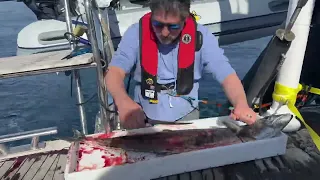
Fishing for and cleaning King Mackerel
We caught a King Mackerel on our passage from Annapolis, MD to Florida!
Washing clothes on a sailboat
Things we do while not on the boat! Tony is multitalented.
Pre-Passage Check In
We are getting ready to embark on a nearly 1k passage down the east coast of the USA! We have 4 people on board total, we’ve provisioned, planned and consulted experts. Follow along!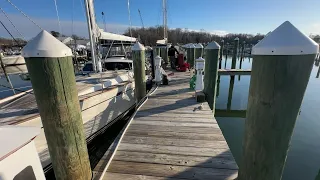
Diesel Fuel Polishing
We decided to have the fuel polished before our first passage since Aurora is new to us and we have no idea what's in the tanks!