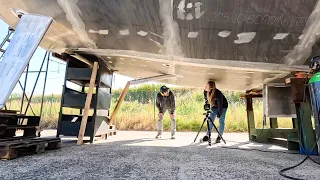
⛵️ Building an Aluminum Exploration Sailboat ain't easy!! Ep.389
Facing a firm late October shipping deadline to transport their custom 43-foot aluminum sailboat to the Caribbean, Duca and Roberta of Odd Life Crafting confront a high-stakes construction sprint inside their workshop in France. Before the hull can be transported to Martinique and motored south toward Grenada, the crew must install the twin rudder skegs, align the stern tube, and secure the bow thruster tunnel.
With only three weeks remaining before the planned splash date, the workshop environment demands non-stop effort. Professional French welder Mathieu has joined the project for a dedicated two-week block, applying his rapid and precise aluminum welding skills to the lifting keel and heavy hull structures while guiding Duca and build partner Pieter through the critical aft hull installations.
Establishing the October Deadline and Fabrication Scope
The timeline for completing the metalwork leaves zero margin for error. Ocean logistics dictate that the sailboat must be structurally sound and watertight to meet its scheduled departure window for the transatlantic crossing aboard a freight vessel. Once offloaded in Martinique, the yacht will enter the water and immediately undertake a passage under engine power to Grenada.
To achieve this milestone, Duca established a demanding weekly task schedule centered on three core structural installations: the twin rudder skegs, the stern tube for the propeller shaft, and the bow thruster tunnel. Welder Mathieu announced his strict timeline upon arrival: “I’m going to spend two weeks with you guys and I’m going to do as much as I can, but that’s what I can. I can only stay 2 weeks.” To maximize every hour of Mathieu’s presence, the builders divided their labor, working continuously on separate sections of the hull while Roberta assisted with workshop coordination and documentation.
Rudder Skeg Alignment and Hull Penetration Challenges
Positioning the twin rudder skegs accurately represents one of the most demanding fabrication tasks on the yacht. Each skeg provides structural support and protection for a rudder blade, requiring precise alignment with the hull framing, internal bulkheads, and transom. Duca began the layout work by constructing a custom template around the skeg profile to map the required cutout dimensions through the aluminum bottom plates.
After outlining the profile, Duca positioned the internal center frame designed to bridge both skegs and reinforce the stern section. Comparing the physical metal components to the design plans highlighted common discrepancies between computer models and actual fabrication. Because the real aluminum hull differs slightly from theoretical CAD drawings, Duca manually trimmed the internal framing members to achieve a flush fit against the plating before transferring the cutout markings onto the hull. Once marked, the team committed to the irreversible metal cutting, adhering to Duca’s rule: “trust your measurements and go for the cut.”
Resolving the Deck Hatch Clearance Impasse
With the initial hull penetrations cut, the crew encountered an unexpected mechanical clearance crisis. The rudder skeg assembly features a tapered geometry where the upper internal section is wider than the lower exterior fin. Consequently, the skeg cannot enter from the bottom under standard clearance, requiring insertion from above the deck.
However, because the aft deck and cockpit seating had been fully welded in place prior to a subsequent design modification, the interior hatch opening proved too narrow to allow the skeg to pass through. Attempting to slide the component through the cockpit hatch resulted in it jamming against the seating framework. Cutting away the finished deck would destroy completed cockpit structures and create extensive structural rework.
Analyzing the problem from beneath the hull, Duca formulated an alternative installation method. Rather than disassembling the deck, the team opted to widen the hull cutout itself. By enlarging the diameter of the hull opening by 4 cm all the way around, the wider upper portion of the skeg gained sufficient clearance to pass upward from beneath the boat. Once hoisted into its final internal position and welded, the resulting gap around the penetration would be permanently sealed with an aluminum closing plate.
Precision Welding Angles and Structural Integration
With the enlarged openings prepared, Duca and Pieter raised the first rudder skeg into position under the hull. The skeg required precise three-dimensional alignment: setting the vertical height against reference layout lines, maintaining the exact calculated distance between the port and starboard units, and locking in an outward angle of 12 degrees.
Because Mathieu was occupied with the complex welding requirements of the lifting keel, he delegated the skeg alignment to the crew, telling them: “Duca, you guys do that.” He coached Duca and Pieter through the geometric process, demonstrating how to reference dimensions from the structural frames, aft bulkhead, and transom. Guided by his instructions, Duca and Pieter successfully positioned and aligned the assembly, allowing Mathieu to step in, execute precise tack welds to fix the geometry, and weld the structural plate to seal the modified cutout.
Stern Tube Alignment and Galvanic Isolation
Following the rudder skeg fitment, attention shifted immediately to the propulsion system and the installation of the stern tube. The aluminum tube houses the propeller shaft and must be aligned through the skeg for the propeller at an exact 10-degree angle to maintain shaft collinearity with the engine mounts. Preparing for the test fit, Duca stated: “We need 10° and we’re good to go.”
Welding aluminum tube assemblies carries a high risk of heat-induced metal distortion, where localized expansion can warp the cylindrical pipe and bind the drive shaft. After Mathieu completed the full perimeter weld, Duca conducted a fitment test using an internal pipe. To prevent the heavy test pipe from sliding completely through the tube and dropping onto the workshop concrete, Duca secured safety tape across the forward end before testing clearances.
The test confirmed that the stern tube remained within workable tolerances. To address the long-term risk of galvanic corrosion between dissimilar metals, the engineering design incorporates dual-material isolation. A fiberglass tube will be bonded with epoxy inside the outer aluminum stern tube, providing a non-conductive barrier that isolates the aluminum hull from the stainless steel propeller shaft.
Critical Fabrication Specifications
The following table details the primary engineering angles, dimensional adjustments, and operational timelines recorded during this phase of the exploration sailboat build:
| Component or milestone | Value | Engineering detail |
|---|---|---|
| Rudder skeg angle | 12 degrees | outward hull angle relative to framing and transom |
| Stern tube angle | 10 degrees | shaft tube angle welded through the propeller skeg |
| Hull cutout expansion | 4 cm | radial clearance added around opening to insert skeg |
| Welder working window | 2 weeks | on-site assistance window provided by Mathieu |
| Countdown to launch | 3 weeks | time remaining in workshop before shipping deadline |
Final Workshop Sprint Toward Launch
Inside the boat, signs of substantial progress are visible even as heavy metal fabrication continues on the exterior. Resting on a newly installed saloon couch, Duca highlighted that hull glazing, cabin windows, and overhead deck hatches are already secured in place. Despite falling behind on video editing due to the continuous manual labor, the team maintains focus on completing the physical build.
With Mathieu scheduled to complete several additional unplanned welding tasks before finishing his two-week tenure, the crew prepares for another intensive work phase. Following Mathieu’s departure, a friend arriving from the US will provide two weeks of hands-on labor to complete the remaining systems. Facing the remaining countdown with determination, Duca affirmed their commitment: “I don’t know how, but we will make it.”
Frequently Asked Questions
The vessel must be structurally complete and watertight before being loaded onto a cargo ship to the Caribbean, where it will splash in Martinique and motor to Grenada.
The rudder skeg is wider at its internal top section than underneath, and existing cockpit seating and deck structures built prior to a design modification prevented it from fitting through the hatch opening.
They increased the diameter of the hull penetration by 4 cm all the way around, allowing the skeg to enter from beneath the boat before tack-welding it in place and sealing the enlarged opening with a closing plate.
The rudder skegs are aligned at a 12-degree angle relative to the hull framing, bulkheads, and transom.
The internal fiberglass sleeve isolates the aluminum stern tube from the stainless steel propeller shaft to prevent galvanic corrosion between the dissimilar metals.
The stern tube is aligned and welded at a 10-degree angle to accommodate the propeller shaft assembly.
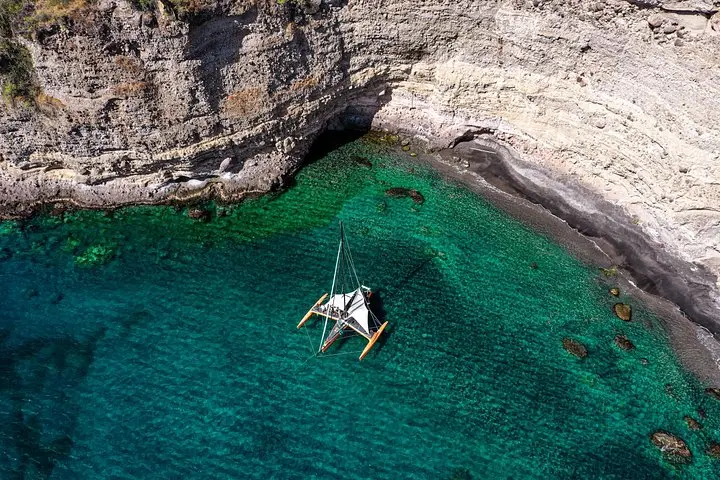
Book a trip where this was filmed — near Martinique
Support Odd Life Crafting
At WeBoating.com, we profoundly acknowledge the unwavering dedication that Odd Life Crafting invests in crafting each and every video or voyage. Their passion for delivering exceptional ocean content shines through every frame, and it's a labor of love that deserves your attention.
We invite you to watch their captivating videos here and actively engage with their content, including their social media links above. Liking, commenting, and sharing their work goes a long way in fueling their creative fire.
We're also inviting you to explore the gear, sponsorships, and boat partnerships highlighted in the "⛵️ Building an Aluminum Exploration Sailboat ain't easy!! Ep.389" video description, or directly on YouTube. By engaging with these offerings or purchasing services and items, you directly support Odd Life Crafting, their collaborators, and the brands they're associated with.
To ensure you never miss an offshore update, consider visiting their official YouTube Channel to subscribe, like, and join their community directly.
If you have any feedback, corrections, or additional information about Odd Life Crafting or their videos, please use the comment form below to share your thoughts with us.
Thank you for being a part of our community and supporting the creators we cherish. Your time and support truly matter!
They can't harm you, if they can't find you! Use code ODDLIFECRAFTING at the link below and get [60%]* off annual plans: https://incogni.com/oddlifecrafting
The countdown is ON! ⏳⛵ With just weeks left before shipping our aluminum sailboat to the Caribbean, we're racing against time to get everything ready.
This week, we're tackling some major projects: installing the rudder skegs, stern tube, and bow thruster tunnel. But as always, things don't go exactly as planned! With the help of an incredible French welder, we're making huge progress toward getting our boat in the water.
Will we make it in time? Let's find out! 🔥
___________________________________________________
Support our project:
► http://www.patreon.com/oddlifecrafting (Get instant access to extra content)
► donating through PayPal using: [email protected]
___________________________________________________
** Links and contact information **
For business inquiries: [email protected]
Our private email address: [email protected]
👨👩👦 We are Duca and Roberta, a Brazilian couple that during a sabbatical trip in 2016 decided to follow our dreams creating this youtube channel to document our journey.
The final dream was to build a metal boat to be able to travel the world taking our house with us, but we didn't have money for that. So, we started building a tiny shipping container house with no prior experience in building to gain some skills to build a boat. When we were almost finishing the house we found a boat that was neglected for over 22 years and we spent 2 years refitting her. We sailed for 2 years (exploring the Brazilian coast and part of the Caribbean). Then we sold our boat and we moved to Europe. Right now the dream is happening and we are building a new aluminum 43ft sailboat and a new life with our son Oli.
We hope to inspire others to follow their dreams.
SUBSCRIBE to our channel and join us every SUNDAY for a new episode of our journey!!
#boat # building #sailboat

Odd Life Crafting
From a steel 'Oddity' to the aluminum 'Pacific', Duca and Roberta of Odd Life Crafting define the technical pinnacle of DIY expedition boat building.
Channel Information:
Social Media Links:
⛵️ Building an Aluminum Exploration Sailboat ain't easy!! Ep.389 Location
- Boat Workshop, France (46.2276,2.2137)
- Fort-de-France Bay, Martinique (14.6033,-61.0733)
- St. George's, Grenada (12.0529,-61.7558)
Latest Episodes from Odd Life Crafting
Explore the most recent voyages. Subscribe to the channel to never miss an update!

New Antigravity A1 360 drone + Odd Life Crafting
Antigravity is now on sale for Black Friday! Check out with our link or use my code ODDLIFE to get up to 35% OFF (save up to $700) and a FREE battery for a limited time only! #360drone #AntigravityA1 #AntigravityRealReview
Antigravity A1 drone + Boat tour
Antigravity is now on sale for Black Friday! Check out with our link or use my code ODDLIFE to get up to 35% OFF (save up to $700) and a FREE battery for a limited time only! #360drone #AntigravityA1 #AntigravityRealReview
⛵️ A special tour of our sailboat using the new Antigravity A1 360 Drone!!
Duca uses the Antigravity A1 360 drone to provide a comprehensive aerial tour of the Pacific, highlighting the new stern arch, installed propeller, and the arrival of the mast in France.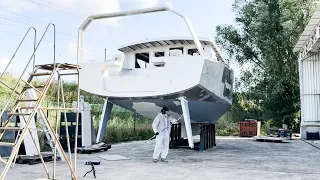
⛵️ Our Unfinished Sailboat Is Almost Ready to Splash! Ep.391
Racing against a six-week transport deadline in Belgium, Duca sandblasts the aluminum hull of Pacífico using crushed glass and rolls five protective coats of AkzoNobel Interprotect epoxy barrier primer.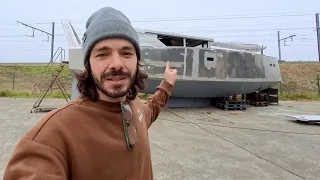
⛵️ The Most Important Step Before Shipping Our Boat! Ep.390
Duca and Roberta achieve a major build milestone on their custom 43-foot aluminum sailboat in France, finishing every weld below the waterline, installing standing pipes, and receiving their new Selden mast.