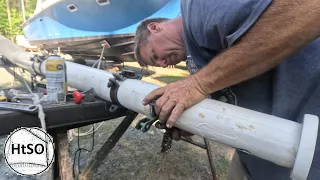
On Escaping the Heat and DIY Boatyards | Ep. 358
On Wednesday morning, June 10, 2026, Kevin Boothby weighed anchor aboard his cutter Ruth Avery inside Chisman Creek, Virginia, to reposition half a mile outside the Poquoson River entrance. Featured on How to Sail Oceans, the maneuver served two practical purposes: escaping shallow inshore waters where summer temperatures were rising, and finding cleaner water to test equipment for making fresh water. Morning rain swept across the bay as Kevin tacked the vessel, dragging the anchor briefly through the bottom silt before washing the heavy mud clear of the ground tackle.
With daylight breaking by 5:30 in the morning on Thursday, June 11, Kevin got underway from his temporary anchorage outside Poquoson Flats. Navigating around the shallows before the lower Chesapeake Bay winds turned light and variable, he plotted a course toward the Chesapeake Bay Bridge-Tunnel. Clearing the bridge structure and heavy commercial shipping lanes early was critical, allowing the boat to reach open Atlantic waters before the morning breeze decayed.
Clearing the Chesapeake Bay Bridge-Tunnel
By a little after 9 a.m. on June 11, the vessel approached the Chesapeake Bay Bridge-Tunnel, carrying an advantageous fair current of approximately 1 knot, and at times surging to a knot and a half through the channel. Kevin exited past the bridge structure shortly before 10 a.m. into the open ocean. To maintain forward momentum in offshore breezes forecast between 5 to 8 knots, he set his self-steering windvane and hoisted the Code Zero.
Lingering swell rolled beneath the hull from a system that had blown 25 to 30 knots the previous evening, but conditions soon settled into steady sailing. By 5:30 p.m. Thursday, wind speeds climbed to 8 to 10 knots. With forecasts calling for oppressive Virginia temperatures nearing 100 degrees Fahrenheit, Kevin seized the offshore window to transit north toward Buzzards Bay and Martha’s Vineyard. As the breeze backed more toward the southwest, he executed a starboard jibe, altering course from roughly 040 or 045 degrees to 060 degrees to align his heading with the wind and expose the deck solar panels for maximum battery charging.
24 Hours Offshore Toward Buzzards Bay
By noon on Friday, June 12, 2026, Ruth Avery was tracking approximately 20 miles east of Ocean City, Maryland. Weather forecasts indicated a weak cold front approaching for Friday evening, expected to bring winds of 20 to 25 knots before shifting northwest at 10 to 15 knots around midnight.
Exactly 24 hours had elapsed since passing the offshore turning point outside the Chesapeake Bay entrance. In that first full day at sea, the vessel logged roughly 100 miles, leaving 250 miles remaining to reach Buzzards Bay Tower. Under the pull of the new Code Zero, Kevin noted the progress: “we did just about 100 miles in our first day out.”
| Passage and yard parameter | Recorded value | Context and conditions | | — | — | — | | Departure current | 1 knot | Fair current exiting Bay Bridge tunnel | | First day run | 100 miles | Distance covered in first 24 hours offshore | | Remaining passage | 250 miles | Distance to Buzzards Bay Tower | | Prior offshore wind | 25 to 30 knots | Symmetrical roll from previous night blow | | Approaching front | 20 to 25 knots | Weak cold front passing off Maryland coast | | Haul-out duration | 1 month | Maintenance period on the hard | | Enterprise shuttle | 30-mile | Pick-up radius from Gloucester office | | Creek draft constraint | 7 ft | Depth limit entering creek channel |
DIY Realities at Jolly Skipper Boatyard
Cruising northward under sail, Kevin shared a detailed assessment of DIY boatyards, having relaunched Ruth Avery from the Jolly Skipper Boatyard in Deltaville, Virginia, just one week prior. The stay involved hauling out for about a month to pull the mast and complete extensive maintenance. The boatyard, previously known as True North under original owner John and operated by Carl the previous year, came under new ownership in the spring when Chris took over.
Chris had been actively upgrading the yard, repainting the travel lift, hiring crew, and removing derelict hulls taking up valuable real estate, hauling some away by truck and crushing abandoned boats into large dumpsters. Recognizing Kevin’s public sailing platform, Chris extended a commercial proposal: “if you spread the word, assuming you have something good to say about the yard, I’ll give you a discount.” Kevin accepted the arrangement, receiving a yard discount alongside promotional t-shirts and a hat.
For long-distance liveaboard cruisers, finding a yard that permits living aboard while working on the hard is essential. Kevin emphasized the independence that comes with maintaining his own vessel: “I’ve owned this boat for over 20 years now and you know, with few exceptions most of the work I can do myself.” Staying on the vessel saves cruisers from having to rent off-site apartments and cars, expenses that can easily triple a standard haul-out bill. Jolly Skipper accommodates this need by providing on-site showers and restrooms.
Deltaville Logistics and Operational Constraints
The boatyard’s location in Deltaville offers convenient proximity to essential marine services, placing Hurtt’s Hardware, West Marine, a sailmaker, a rigging shop, and the Deltaville Market grocery store within easy bicycling distance. Heavy supplies can also be shipped directly to the yard. When ground transport is necessary, Enterprise Rent-A-Car in Gloucester provides pick-up and drop-off service within its 30-mile operating boundary.
However, Kevin pointed out practical constraints. Mobile phone reception on T-Mobile is virtually non-existent in Deltaville, requiring the use of a Starlink satellite system for communication. Navigational access is limited by water depth inside the creek, where draft is restricted to approximately 7 feet, meaning deep-draft vessels face potential soft grounding at low tides. Additionally, the travel lift cannot accommodate wide-beam catamarans.
Despite these limits, the DIY accessibility provides an appealing base compared to locations like Finestkind Boatyard in Harpswell, Maine, where downtown Brunswick sits 15 miles away and demands dedicated vehicle access. Gliding northward under his new Code Zero sail, Kevin reflected on the passage: “so it doesn’t get much better than this, does it?”
Frequently Asked Questions
Kevin departed to escape extreme summer heat forecast to reach 100 degrees Fahrenheit with high humidity in Poquoson and Deltaville, Virginia, taking advantage of a sailing window toward cooler waters in Massachusetts.
Kevin hauled out for approximately one month at Jolly Skipper Boatyard in Deltaville, Virginia, where he pulled the mast and completed extensive refit and maintenance work before relaunching.
Yes, Jolly Skipper permits owners to live aboard their vessels on the hard and provides access to on-site showers and restrooms, avoiding the costly need for hotel rentals and rental cars.
The yard has a draft limitation of approximately 7 feet inside the creek channel, meaning vessels drawing seven and a half feet risk soft grounding at low tide, and the travel lift cannot haul large catamarans.
Because cellular coverage with carriers like T-Mobile is unreliable or absent in Deltaville, Kevin uses a Starlink satellite dish for mobile internet and voice communications while at the boatyard.
Book a trip where this was filmed — near Annapolis
Support How to Sail Oceans
At WeBoating.com, we profoundly acknowledge the unwavering dedication that How to Sail Oceans invests in crafting each and every video or voyage. Their passion for delivering exceptional ocean content shines through every frame, and it's a labor of love that deserves your attention.
We invite you to watch their captivating videos here and actively engage with their content, including their social media links above. Liking, commenting, and sharing their work goes a long way in fueling their creative fire.
We're also inviting you to explore the gear, sponsorships, and boat partnerships highlighted in the "On Escaping the Heat and DIY Boatyards | Ep. 358" video description, or directly on YouTube. By engaging with these offerings or purchasing services and items, you directly support How to Sail Oceans, their collaborators, and the brands they're associated with.
To ensure you never miss an offshore update, consider visiting their official YouTube Channel to subscribe, like, and join their community directly.
If you have any feedback, corrections, or additional information about How to Sail Oceans or their videos, please use the comment form below to share your thoughts with us.
Thank you for being a part of our community and supporting the creators we cherish. Your time and support truly matter!
It's early June and the summer heat is here. Fortunately, there's a sailing window to Buzzards Bay and Martha's Vineyard, and I'm not wasting it. I also discuss my experience with the Jolly Skipper Boatyard in Deltaville, VA, as well as boatyards in general.
SUPPORT HOW TO SAIL OCEANS ON PATREON: https://patreon.com/user?u=12372934
HOW TO SAIL OCEANS ON RUMBLE: https://rumble.com/c/c-1981134
HOW TO SAIL OCEANS TEE SHIRT: https://maritimetees.net/search?q=how+to+sail+oceans
DONATE: https://www.paypal.me/KevinBoothby
WEBSITE: https://www.kevinboothbysailing.com
VIDEO SOUNDTRACKS: https://soundcloud.com/user-177118317
CAMERAS:
Canon EOS R6 Mk II with RF 70-200mm L IS zoom lens
Go Pro Hero 9 Black
Go Pro Hero 12 Black
Go Pro Hero 13 Black
DRONE:
DJI Phantom 3 Professional
THE BOAT: Design: Gilmer 31; LOD 31', LWL 25', Beam 9.5', Draft 4.5', Displ. 13,600lbs
How to Sail Oceans
Kevin Boothby, PhD, documents the forensics of engineless blue-water voyaging. Join his 2026 Bahamas expedition aboard the Gilmer 31 cutter, Ruth Avery.
Channel Information:
Social Media Links:
On Escaping the Heat and DIY Boatyards | Ep. 358 Location
- Chisman Creek Anchorage, VA (37.1812,-76.3524)
- Chesapeake Bay Bridge-Tunnel, VA (37.0315,-75.9875)
- Offshore Ocean City, MD (38.3365,-74.6812)
- Jolly Skipper Boatyard, Deltaville, VA (37.5512,-76.3315)
- Buzzards Bay Tower, MA (41.3985,-71.0345)
Latest Episodes from How to Sail Oceans
Explore the most recent voyages. Subscribe to the channel to never miss an update!
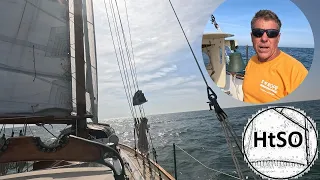
On Escaping the Heat and DIY Boatyards | Ep. 358
Kevin Boothby gets underway from Chisman Creek, Virginia, clearing the Chesapeake Bay Bridge-Tunnel to sail offshore toward Buzzards Bay and avoid extreme summer heat while reviewing DIY boatyard realities.
New sails, new toys, and splash! | Ep. 357
SV Ruth Avery finishes yard preparations with bolted pin rails, new Genoa tracks, and Sea Hawk antifouling before splashing into the water to unfurl a larger Code Zero.
The Haulout “Third Quarter” | Ep. 356
Working through the middle stretch of a boatyard haulout, Kevin Boothby refits the wooden spars and hull of the Gilmer 31 Ruth Avery, applying epoxy barrier coats, servicing rigging, and stepping the rig.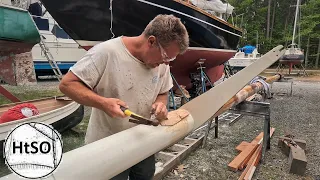
Much to do With Wooden Spars | Ep. 355
Kevin Boothby repairs rotted timber on the mast of Ruth Avery using a bi-directional scarf joint and shapes a new yard and jackyard for a larger gaff topsail.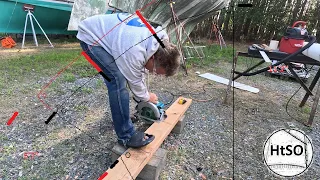
Grand Designs | Ep. 354
Kevin Boothby repairs lightning and rot damage on the mast of SV Ruth Avery and mills new Douglas fir spars for an expanded gaff topsail rig at Broad Creek Boatyard.