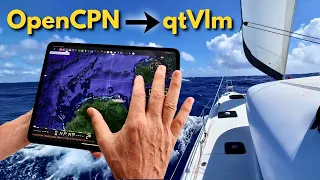
EXPECTATION vs. REALITY⛵️Sailing Across the Pacific Ocean
Anchor chain rumbles through the bow roller into clear water off the island of Tahuata, settling into clean sand on the very first attempt. After clearing customs and immigration at Hiva Oa following their 27-day crossing from Panama, Holly and Ray on their Lagoon 42 catamaran, SV Sabado (Holly and Ray), steered a few miles south to escape murky mountain runoff and secure a protected bay where they could rest and clean their hull.
The contrast between this quiet cove and the four previous Marquesan anchorages is immediate. Across the steep volcanic bays of the archipelago, depths frequently plunge past 100 feet over foul volcanic rock, forcing crews to deploy 200 to 300 feet of heavy chain only to reset repeatedly as the windlass strains under load. Here in Tahuata, the anchor holds firmly in shallow sand, allowing the crew to wash away the offshore salt crust, conclude their daily deck chores, and sit down in the cockpit for a thorough operational review of their 4,487-nautical-mile equatorial crossing.
Passage Metrics: 4,487 Miles Across the Pacific
Long-distance ocean passages rarely mirror promotional expectations, and crossing the Pacific Ocean double-handed delivered distinct technical insights for the crew of SV Sabado. Over 649 hours underway, the vessel maintained an average speed over ground of 6.2 knots, touching a peak surfing speed of 14.4 knots in heavy following seas. Yet the passage began with prolonged periods of calms that dictated heavy engine use.
| Metric | Passage Value | Operational Context | | — | — | — | | Total Distance | 4,487 nm | Passage from Panama to the Marquesas Islands | | Passage Duration | 649 hours | Just over 27 days underway across the Pacific | | Average Speed Over Ground | 6.2 knots | Sustained average through light and moderate airs | | Maximum Speed Over Ground | 14.4 knots | Peak recorded speed while surfing following seas | | Single-Day Distance Run | 196 nm | Highest daily distance logged during passage | | Engine Motoring Run Time | 186 hours | Seven days of continuous motoring to Galapagos | | Diesel Fuel Consumed | 90 gallons | Total burn across twin propulsion engines and generator | | Generator Operating Time | 9 hours | Three charging runs using roughly minimal diesel | | Fuel Remaining at Arrival | 110 gallons | Main tanks bolstered by mid-passage jerry can transfers | | Fresh Water Storage Capacity | 158 gallons | 600 liters conserved when watermakers could not run | | Starlink Priority Data Surcharge | $800 | Full-time connectivity maintained across the passage |
Ray highlighted the unexpected reliance on machinery during the opening stage: “Panama to Galapagos was pretty much all motoring for us”. In total, the yacht logged 186 hours of engine run time across the first 7 days to clear the doldrums. Despite the initial motoring, total diesel consumption across both propulsion engines and the onboard generator was held to 90 gallons. By transferring stored fuel from deck jerry cans into the main fuel tanks during week 2, SV Sabado reached the Marquesas with 110 gallons of diesel in reserve—a critical safety margin given that local islands lack dedicated fuel docks and require hauling jerry cans to roadside stations.
Sail Inventory Limitations and Rig Configuration
The primary operational frustration centered on sail selection. The catamaran carried an S3 symmetrical spinnaker that had only been hoisted twice prior to departure. When light downwind conditions persisted, the crew discovered that the sail profile was engineered for breezes of 10 to 25 knots and could not fly deeper than 140 degrees without collapsing.
Compounding this limitation is the structural specification of the Lagoon 42. Due to the builder’s aft-stepped rig design, Lagoon stipulates that the vessel must not fly a headsail without the mainsail hoisted to support mast column stability. Flying the mainsail downwind blanketed the headsail, creating rolling dynamics and preventing deep downwind angles. To eliminate this issue before subsequent ocean legs, the crew formulated a major refit plan for Australia, intending to install running backstays that will permit flying headsails alone, alongside an A2 asymmetrical spinnaker and Cyclops Marine rig monitors before SV Sabado turns 10 years old in 2027.
Rig preservation demanded constant vigilance throughout the transit. Ray performed twice-daily deck walk-arounds, physically checking hardware and inspecting lines for friction: “you need to protect against chafe your running rigging is going to be up and in use for almost 30 days”. This disciplined inspection routine caught mainsail halyard cover wear at the masthead early, preventing core failure before repairs could be completed at anchor.
Energy Generation and Galley Balances
Operating an offshore catamaran requires strict energy accounting. SV Sabado carries a 900 amp-hour 12V lithium house battery bank supported by nearly 2,000 Watts of rooftop solar panels. However, with the mainsail sheeted out on continuous downwind angles, sail shadows cut solar production by half compared to normal swinging at anchor.
The crew counteracted this deficit by running the onboard generator 3 times for a total of 9 hours, charging the lithium bank at 250 amps to reach full capacity within 3 hours. Continuous house loads ran at 28 amp-hours, driven by navigation electronics, refrigeration, autopilot actuators, and Starlink terminal hardware drawing 10 amps. To minimize unnecessary electrical loads, the crew bypassed their electric induction cooktop and relied exclusively on propane burners for meal preparation.
Despite the energy demands, overall vessel reliability remained high. Reflecting on the transit, Ray noted: “it was actually a very easy passage”. Systematic preparation prevented catastrophic equipment failures, with only an engine compartment blower motor failing on day 1 of the passage.
Watermaker Aeration and Tank Conservation
The most significant unforeseen operational hurdle was the complete inability to run either onboard watermaker while underway. SV Sabado carries two separate reverse osmosis units, including a Rainman backup system, yet neither unit could operate in offshore sea states.
At speeds of 8 knots and above, hull aeration introduced micro-bubbles into the intake lines, starving the high-pressure pumps. When speeds dropped in following seas of 9 to 10 feet, the sugar scoops pitched upward, pulling the aft intake through-hulls clear of the water surface. Rather than risking pump cavitation, the crew shut down both units and relied entirely on their 158-gallon (600-liter) freshwater tank. For future passages, Ray plans to plumb a dedicated watermaker supply to an unused through-hull positioned at the aft base of the keel where turbulent surface air cannot reach.
Double-Handed Watch Schedules and Offshore Living
Maintaining mental focus across 27 days required an uncompromised watch rotation. Holly and Ray adopted a strict schedule of 5 hours on and 5 hours off overnight, supplemented by flexible shorter rotations during daylight hours. Holly noted: “having 5 hours on 5 hours off overnight I think is perfect for two people”. This window provided sufficient uninterrupted time to enter deep REM sleep cycles, preventing the chronic exhaustion typical of shorter watches.
Offshore waste management also required disciplined routines. To prevent offensive odors in tropical heat, Holly hand-washed every plastic vacuum-seal bag with soap and water before stowing: “we made land with one bag of trash”. Organic waste was composted overboard, leaving the boat clean and odor-free upon landfall.
Full-time communication remained stable through Starlink Mobile Priority, which incurred an extra $800 in satellite data fees to stream real-time navigational updates and dispatch passage logs. Navigational routing combined professional shore-based forecasts with onboard qtVlm weather routing software connected to Saillogger instruments, successfully steering the vessel around convective lightning storms with only one lightning encounter.
As the crew relaxed at anchor in Tahuata, a large manta ray circled gracefully around the sugar scoops in the clear shallows, providing a fitting conclusion to their 4,487-mile transit.
Frequently Asked Questions
At sailing speeds above 8 knots, hull aeration introduced air bubbles into the watermaker intake lines. In following seas of 9 to 10 feet, the catamaran’s stern through-hulls repeatedly pitched clear of the surface, causing pump cavitation that forced the crew to conserve their 158-gallon freshwater tank.
The mainsail remained sheeted out across the cockpit roof throughout the downwind crossing, shadowing the rooftop solar panels and reducing normal solar generation by approximately half. The crew compensated by running their generator for 9 hours total and using propane cooking.
The S3 symmetrical spinnaker was designed for winds of 10 to 25 knots and could not fly at sailing angles deeper than 140 degrees. Because Lagoon 42 specifications require flying the mainsail to stabilize the aft mast, the mainsail blanketed the spinnaker on deep downwind runs.
The crew maintained a rigid schedule of 5 hours on and 5 hours off overnight, allowing each sailor to achieve restful REM sleep cycles. Daytime watches were kept more flexible with shorter rotations to manage sail changes and boat maintenance.
Twice-daily visual and tactile deck inspections were conducted across all hardware and control lines. This routine allowed the crew to detect mainsail halyard cover chafe at the masthead early and shift lines before any core damage occurred.
Support Holly and Ray
At WeBoating.com, we profoundly acknowledge the unwavering dedication that Holly and Ray invests in crafting each and every video or voyage. Their passion for delivering exceptional ocean content shines through every frame, and it's a labor of love that deserves your attention.
We invite you to watch their captivating videos here and actively engage with their content, including their social media links above. Liking, commenting, and sharing their work goes a long way in fueling their creative fire.
We're also inviting you to explore the gear, sponsorships, and boat partnerships highlighted in the "EXPECTATION vs. REALITY⛵️Sailing Across the Pacific Ocean" video description, or directly on YouTube. By engaging with these offerings or purchasing services and items, you directly support Holly and Ray, their collaborators, and the brands they're associated with.
To ensure you never miss an offshore update, consider visiting their official YouTube Channel to subscribe, like, and join their community directly.
If you have any feedback, corrections, or additional information about Holly and Ray or their videos, please use the comment form below to share your thoughts with us.
Thank you for being a part of our community and supporting the creators we cherish. Your time and support truly matter!
Join us for a short sail in the Marquesas Islands before sitting down to chat about the expectation vs. reality of our 27-day sail across the Pacific Ocean. 🐬 In this video, we discuss what went well and what we should’ve done differently to maximize our comfort and performance during our passage. We also talk about the changes this trip inspired us to make to our boat in the future! Stick around until the end to see a local visitor stop by- Holly’s favorite animal, a manta ray! 😍Thank you to our patrons for sending in these questions. 📝
———————————————————————
⛵️Join the Crew on Patreon:
https://patreon.com/HollyandRay
⚓️Check out our Blog:
https://www.svsabado.com
📸Follow us on Instagram:
@sv_sabado
🎁Our favorite products:
https://www.amazon.com/shop/hollyandray
**As Amazon associates, we earn commission from qualifying purchases**
💻Links mentioned in this video:
- South Pacific weather router https://coastalandoffshorecruising.com/ocean-tactics-2/
- Saillogger https://saillogger.com/accounts/login/?next=/
- Provisioning blog post https://www.svsabado.com/2024/05/19/provisioning-for-the-south-pacific-planning-shopping-meal-prep-and-more/
Holly and Ray have been #sailing together since 2020 on their #catamaran, Sabado. They have sailed the East Coast of the United States, the Bahamas, the Caribbean, and now the Pacific! They’re documenting #boatlife and their experiences as #liveaboard sailors. Subscribe to tag along on the adventure!
Music provided by Epidemic Sound:
https://www.epidemicsound.com/referral/ov4tmg/
Holly and Ray
Engineers turned sailors Holly and Ray are transforming their Lagoon 42, SV Sabado, into the ultimate off-grid voyager. Explore their New Zealand refit and technical journey.
Channel Information:
Social Media Links:
EXPECTATION vs. REALITY⛵️Sailing Across the Pacific Ocean Location
- Baie Hanamoenoa Anchorage, Tahuata (-9.9078,-139.1045)
- Port de Tahauku (Clearance Port), Hiva Oa (-9.805,-139.033)
Latest Episodes from Holly and Ray
Explore the most recent voyages. Subscribe to the channel to never miss an update!
This Is Why We Sailed to Vanuatu…
After hiking to the glowing crater rim of Mount Yasur in Vanuatu, Holly and Ray sail SV Sabado across open waters to New Caledonia, trimming sails and balancing weather helm.
2 People, 4 Days at Sea: Life on an Offshore Passage
Holly Hendricks and Ray Gordon navigate rough seas, escape hatch safety, and solitary watches during a four-day offshore passage aboard SV Sabado from Fiji to Port Resolution, Vanuatu.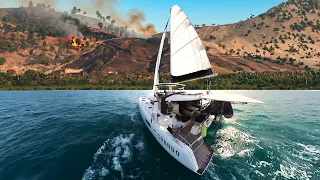
We’ve Got to Get Out of Here! Bad Weather & Worse Anchorages in Fiji
Facing sudden 22-knot wind shifts and dragging boats in Fiji, Holly and Ray test their custom Sereno anchor alarm before departing for Vanuatu.
Before You Buy More Solar or Batteries, WATCH THIS!
Holly and Ray break down how to design a balanced marine electrical system aboard SV Sabado, sharing their real-world offshore power data and free boat energy budget tool.
Sailing Fiji Hasn’t Gone to Plan…
Holly and Ray navigate into Port Denarau to restock provisions and wash sugarcane ash off SV Sabado before heading into remote Fiji coral reef anchorages.