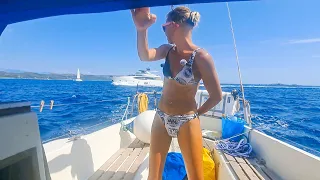
We TIMED IT WRONG leaving the marina.
Moored to the docks of Marina del Cormorano in Porto Torres, Sardinia, Lee and Karolina of Good Deeds Sailing begin maintenance aboard Good Deeds, their 1974 Westerly Berwick 31 ketch. Having secured dockage while waiting for replacement components to arrive in the post, the crew organizes an extensive refit agenda before heading toward the northwest Sardinian coastline. With incoming parcels expected by Friday, mechanical maintenance on the auxiliary propulsion system takes priority over coastal cruising.
The Westerly Berwick relies on an inboard Beta Marine 25 diesel engine for harbor maneuvers and calms. Setting out tools across the salon floor, Lee prepares replacement filters and fresh lubrication: “While we’re in the marina here in Cormorano in Porto Torres, we’re going to service the engine.” The overhaul includes fitting a MANN-FILTER WK 812 replacement, draining the sump, and inspecting the cooling circuit. To prevent oil leaks onto the cabin sole during the drain process, Lee fits two recycled plastic water bottles beneath the drain tap, bending the plastic to conform to the narrow hull pan. Before releasing the oil, he runs the diesel for 5 minutes to circulate and warm the lubricant, ensuring complete fluid extraction.
Alongside the oil change, Lee inspects the cooling system heat exchanger. Using a 17 mm socket, he unthreads the brass plug to extract the sacrificial pencil anode, replacing the eroded metal with a new zinc insert to protect internal engine alloys from galvanic corrosion. The engine intake air filter proves heavily fouled with soot and dirt. Lacking an immediate spare filter cartridge, Lee washes the mesh element in warm soapy water, sets it out under the Mediterranean sun to dry completely, and reinstalls the unit rotated 45 degrees so that intake airflow draws through the cleanest quadrant.
Addressing persistent air leaks in the diesel delivery lines, Lee dismantles the secondary bleed assembly: “It had a little silly oil ring on there, which just letting so much air gave us a lot of problems.” Removing the faulty rubber seal, he hand-crafts a replacement copper washer, bolting the fitting down to achieve an airtight seal before priming the fuel circuit.
Solar Panel Array Benchmarking and Reconfiguration
With engine servicing completed, the crew turns attention to the vessel’s charging capacity. Good Deeds previously carried three solar panels, but aging equipment caused a sharp decline in electrical generation. Testing the old panels under rising sunlight, Karolina and Lee measure output across the deck array. One midship panel produces between 0.5 and 0.7 amps, while an older forward unit yields between 0.8 and 0.9 amps at peak exposure.
Evaluating the deck footprint, the crew unpacks two replacement solar panels to integrate with their single functioning unit. However, dimensional differences create a rigging complication. Although manufactured by the same supplier, the older panels feature different lengths and widths than the newer hardware. Stacking the longer frame underneath would leave an exposed overhang where offshore wind gusts could catch underneath and stress the fasteners. Deciding that an extra two amps of charging does not justify aerodynamic risk, the crew discards both degraded panels, retaining only the wiring and spare solar controllers.
The team mounts the new panels directly onto the stainless steel cockpit rails and sprayhood framework using heavy-duty cable ties. Routing the output lines through the deck gland down to the charge controller, the reconfigured array delivers an immediate performance increase: “We have coming in 5.5 amps at the moment.” Even under overcast evening cloud cover, the upgraded array matches domestic battery consumption.
| Marine Equipment / System | Measured Specification | Refit Action Taken | | Heat Exchanger Anode | 17 mm socket | Replaced sacrificial pencil anode inside heat exchanger | | Fuel Bleed Assembly | Custom copper washer | Replaced leaking rubber seal to eliminate air ingress | | Forward Solar Panel | 0.9 amps max | Discarded panel due to frame length mismatch | | Midship Solar Panel | 0.5 to 0.7 amps | Decommissioned degraded panel producing weak current | | Upgraded Solar Array | 5.5 amps overcast | Installed two new panels on sprayhood and rail |
Refit Tasks and a Sardinian Excursion
Engine maintenance and electrical work formed part of a 10-item maintenance checklist drafted upon arrival. Within a day and a half, the crew finishes six tasks, including hanging a fallen head cupboard door, scrubbing the hull inside and out, doing laundry, and sourcing replacement flagpole bolts. The Westerly Berwick’s twin bilge-keel configuration proves advantageous inside the crowded marina; because the twin keels draw little water, marina personnel permit the yacht to occupy a shallow motorboat slip where dockage fees remain modest.
Taking advantage of their flexible schedule, the crew books an extra night to meet their friend Giacomo. Giacomo hosts a regional road trip across the Capo Caccia headland. The excursion provides panoramic views of coastal limestone cliffs, an exposed natural sea tunnel cutting through towering rock, and the steep cliffside staircase leading down toward the sea-level entrance of Neptune Caves.
Giacomo presents the crew with regional provisions, including fresh figs picked from his garden, traditional crisp Sardinian flatbread, and sweet breakfast pastries filled with apricot and peach. Returning to the marina, Karolina completes one final domestic task in the galley, boiling water on the marine stove to sterilize her dental instruments.
Sunday Marina Departure and Heavy Weather Reversal
On Sunday, August 23, following 6 nights tied to the pontoon, the crew prepares for sea. Having provisioned with fresh groceries, drinking water, sparkling water, and diesel fuel at Lidl, Lee and Karolina plan to sail north across the Gulf of Asinara toward Asinara National Park.
Unberthing proves challenging inside the marina basin. Strong water currents and crosswinds push Good Deeds toward the marina slip pilings as lines are dropped. Managing the tender and slackening stern warps, the crew coordinates line releases to clear the pontoon. Once clear of the inner basin, however, sea conditions deteriorate dramatically. Outside the shelter of the harbor breakwater, steep waves roll in from the open gulf. Wind gusts strike the Berwick broadside, preventing the yacht from answering her helm: “I can’t get more power. It won’t spin. It’s the wind. The wind keeps taking us. I can’t turn it anymore.”
As heavy breaking seas slam into the hull, the yacht rolls violently in the trough. With the vessel caught beam-to the swell, attempting a turn risks exposing the side to breaking waves and overstressing the steering assembly: “We can’t turn. These waves are too big. We’re going to be rolling all over the place. Cuz once we turn, we’re going to have this side on. It’s going to roll us right over.” Acknowledging that conditions threaten to damage the rudder, Lee makes the calculated decision to abort the passage and return to port. High engine revolutions hold the vessel on course as they maneuver back toward safety. Karolina confirms the wisdom of the decision: “It was a good test, especially that we are wobbling all over the place.”
Karolina leaps onto the pontoon to secure the bow lines, safely tying Good Deeds back to her berth.
Pilotage Tactics and Revised Departure Timing
Returning to the marina office to extend dockage, Karolina consults marinero Frederico. Recalling commercial seamanship training conducted in Malaysia under 5 meter sea states, Frederico shares a vital pilotage principle: “If you can’t turn around he said reverse.” Backing down into shelter prevents exposing a yacht’s beam to breaking waves when maneuvering in confined, turbulent harbors.
Frederico reviews maritime forecasts with the crew, noting that local sea states remain manageable in early morning hours around 8:00 or 9:00 AM when breezes blow at roughly 3 knots, before heavy thermal winds build in the afternoon. At 11:00 PM, Lee inspects the harbor seawall, watching foaming breakers strike the outer breakwater while anchored yachts roll their mastheads through severe arcs.
The following morning, sea conditions near the breakwater appear subdued. Lee observes the contrast: “Definitely best to leave in the morning.” However, updated meteorological data indicates strong gale-force winds returning by early afternoon. Rather than risking another mid-passage squall, Karolina visits the office for the 5th time, booking an additional night in Porto Torres and reserving an offshore mooring buoy in Asinara National Park for Tuesday morning. A refreshing rain shower sweeps over the harbor, cooling the deck as the crew finalizes their passage strategy.
Frequently Asked Questions
Outside the harbor breakwater, violent breaking seas and strong crosswinds hit the Westerly Berwick broadside, preventing the vessel from turning safely and threatening severe damage to the rudder assembly.
Lee replaced the fuel filter with a MANN-FILTER WK 812 unit, replaced the heat exchanger pencil anode using a 17 mm socket, cleaned and rotated the air filter 45 degrees, and crafted a copper washer for the fuel bleed assembly.
The older panels had mismatched dimensions and produced only 0.5 to 0.9 amps each, which would have created an irregular overhang and wind-catching hazard on the sprayhood frame.
Marinero Frederico recommended maintaining sternway and reversing back into harbor shelter rather than turning broadside into breaking swells when maneuvering in confined sea passages.
The shallow draft of the twin keels allowed the 31-foot sailboat to occupy an inexpensive motorboat berth that deeper fin-keel cruising yachts could not access.
Book a trip where this was filmed — near France
From Cagliari, Boat Tour to Tuerredda, Chia or Cala Zafferano
Sold by Blanco Tours Sardinia
Private Wakesurf Wakeboard & Boat Experience Saint-Tropez
Sold by Wakesurf Saint-Tropez
Support Good Deeds Sailing
At WeBoating.com, we profoundly acknowledge the unwavering dedication that Good Deeds Sailing invests in crafting each and every video or voyage. Their passion for delivering exceptional ocean content shines through every frame, and it's a labor of love that deserves your attention.
We invite you to watch their captivating videos here and actively engage with their content, including their social media links above. Liking, commenting, and sharing their work goes a long way in fueling their creative fire.
We're also inviting you to explore the gear, sponsorships, and boat partnerships highlighted in the "We TIMED IT WRONG leaving the marina." video description, or directly on YouTube. By engaging with these offerings or purchasing services and items, you directly support Good Deeds Sailing, their collaborators, and the brands they're associated with.
To ensure you never miss an offshore update, consider visiting their official YouTube Channel to subscribe, like, and join their community directly.
If you have any feedback, corrections, or additional information about Good Deeds Sailing or their videos, please use the comment form below to share your thoughts with us.
Thank you for being a part of our community and supporting the creators we cherish. Your time and support truly matter!
A lot is happening in this episode. We left the marina and had to turn back! Our Beta Marine 25 engine gets serviced, Good Deeds gets new solar panels and the crew gets treated to a great road trip and Sardinian treats.
Thank you to all our subscribers, our lovely Good Deeders :)
Please like, share, comment, we love your feedback.
please check out:
OUR APP- SAILORSBAY
https://www.sailorsbay.app
MAD ABOUT TEETH- Family Colouring Book is available on Amazon :D
Amazon UK
https://amzn.eu/d/ckXecDR
Amazon Polska
https://amzn.eu/d/85zD2wE
and other countries! :D
You can support us by:
buying us a coffee on :
https://ko-fi.com/gooddeedssailing
donating through PayPal:
https://paypal.me/gooddeedssailing
You can also join us and become a member to help us continue our journey, CHECK OUT our YouTube membership "In PJ's Memory" :D
Thank you for watching @gooddeedssailing and your support, we are so glad you enjoy our videos :)
Lee and Karolina :)

Good Deeds Sailing
Lee and Karolina: The British-Polish duo redefining budget cruising in the Mediterranean, currently navigating Sicily aboard their vintage Westerly Berwick.
Channel Information:
Social Media Links:
We TIMED IT WRONG leaving the marina. Location
- Marina del Cormorano, Porto Torres, Sardinia, Italy (40.837,8.4013)
Latest Episodes from Good Deeds Sailing
Explore the most recent voyages. Subscribe to the channel to never miss an update!
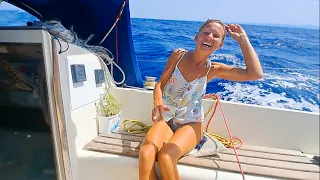
A SUMMER SAIL, Sardinia to Corsica. FASTEST speeds YET!
Good Deeds Sailing departs Asinara Island at dawn, sailing across to southwest Corsica aboard their Westerly Berwick 31 ketch, reaching speeds of 6.2 knots in 17 knots of wind before dropping anchor in 6 meters.
Walking among the RUINS of ASINARA: SKELETONS, wild donkeys and ABANDONED PRISONS.
Lee and Karolina of Good Deeds Sailing explore the abandoned penal colony and ossuary ruins on Asinara Island before setting sail on an early morning passage to Corsica.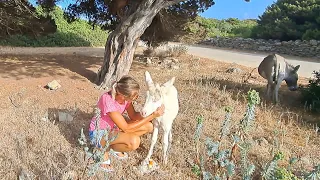
We sail to ABANDONED PENAL COLONY- ASINARA Island, home of the white donkeys.
Lee and Karolina sail their Westerly Berwick 31 from Porto Torres to Asinara Island in north Sardinia, picking up a national park mooring buoy to explore nine former prisons, Neolithic rock dwellings, and wild white donkeys.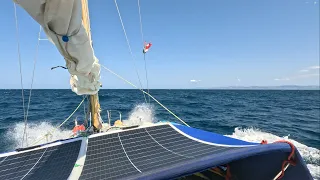
We TIMED IT WRONG leaving the marina.
Lee and Karolina service their Beta Marine 25 diesel, install upgraded solar panels, and face heavy breaking seas attempting to depart Marina del Cormorano in Sardinia.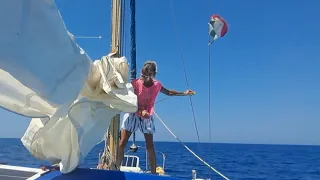
Sardinia BOATLIFE: SLEEPLESS ANCHORAGES & Coastal Towns.
Sailing west along Sardinia's north coast. We are trading sleep for swell at some very rolly anchorages, but that's all part of the upredictable boat life we love! Thank you to all our subscribers, our lovely Good Deeders :) Please like, share, comment, we love your feedback. please ch...