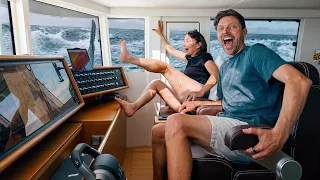
Sailing When We Never Thought We Could
Jason and Nikki Wynn of Gone with the Wynns navigate their HH44 catamaran, Curiosity, through the borderline doldrums of a 469-mile passage across the Sulu Sea. Facing light air and shifting tropical currents, the crew confronts an unexpected challenge across open water where calm conditions threaten to stall progress.
With forecasts predicting virtually zero wind and fifteen hours of continuous double motoring, the crew hoisted their sails into five to eight knots of breeze. By utilizing the catamaran’s slippery hull form and a specialized suite of composite sails, they managed to convert what should have been an exhausting engine slog into an eighty percent sailing day.
Turning Borderline Doldrums into an Eighty Percent Sailing Day
Setting out across the Sulu Sea, the forecast called for flat calms that typically require running both diesel engines for 15 hours straight. Instead, Jason and Nikki found enough puff in the five to eight knots of wind to shut down the engines and keep the hulls gliding at four knots under canvas.
Jason celebrated the unexpected progress as the catamaran maintained momentum through the quiet expanse: “turned a day that was supposed to be zero wind into a like 80% sailing day feels good man we thought it was going to be double motor 15 hour straight”. The crew attributed their ability to sail in near-calm waters to the HH44’s lightweight hull design and an engineered suite of performance sails.
Doyle Sails Factory Tour and Carbon Fiber Stratis Construction
To understand the engineering powering their light-wind capability, the Wynns reflected on their visit to New Zealand, home to the Doyle Sails headquarters and main loft. Expecting a traditional sailmaking loft filled with sewing machines and bolts of cloth, they were instead introduced to automated robotic gantries laying continuous yarn made of carbon fiber and Technora.
Watching the automated machinery lay fibers into custom Stratis membranes reminded Jason of Howard Hughes declaring the technology “the wave of the future.” Each sail membrane is engineered down to individual load paths, consolidating structural fibers directly into adhesive matrixes to eliminate excess weight while retaining strict aerodynamic shapes under load.
Mainsail Architecture and Carver Hook Reefing
Curiosity’s mainsail serves as the workhorse of the sail plan, standing as the first sail raised and the last stowed. Built from Doyle Stratis composite fabric and supported by C-Tech carbon fiber battens, the mainsail maintains a clean aerofoil profile across fluctuating breezes. For heavy weather, the sail features a Carver hook reefing system with three reef points rated to withstand up to 58 knots of wind.
This setup marks a substantial upgrade over the couple’s previous catamaran, which had only two reef points that required manual adjustments at the mast and was restricted to 40 knots of wind. The only current drawback identified on Curiosity is friction inside the headboard car when lowering the mainsail, which makes dropping the final section a physical challenge that the crew plans to address with HH at the factory.
Headsail Selection: Solent and Self-Tacking Staysail
For primary upwind work, Curiosity deploys a Doyle Stratis Solent headsail designed to handle wide angles and varied sea states. The inherent stiffness of the composite laminate prevents sagging even when breezes drop below working levels. Examining the headsail standing taut in faint air, Nikki observed: “Stratus for the win no wind and we still have shape it’s pretty crazy right just put it up it looks good even if it’s not filled with air”.
While the mainsail and Solent could handle standard cruising routes, the Wynns added specialized sails for unpredictable conditions. Their self-tacking staysail quickly became a favorite on board. Set on a curved foredeck traveler track, the staysail automatically trims to optimal angles through tacks. Capable of handling up to 37 knots of heavy weather, its compact footprint and self-tacking track prove especially valuable when maneuvering through congested waters in Southeast Asia where fishing buoys and pearl farms are common.
Reacher and Top-Down Furling Asymmetrical Spinnaker
When sailing off the wind, Curiosity switches to a colorful Doyle Stratis cableless reacher featuring a structured luff. The cableless engineering delivers high structural stability on beam reaches while allowing the lightweight sail to be furled and packed into an onboard storage bag far more easily than traditional sails with heavy torsion ropes.
For deeper downwind runs, the crew hoists an asymmetrical spinnaker mounted on a top-down Furler. Controlled entirely from the helm station, the system eliminates hazardous bow foredeck maneuvers. On their previous vessel, handling a free-flying spinnaker with a snuffer sock caused frequent mishaps, including an incident where a whipping line wrapped tightly around the radar dome during a sudden squall. The top-down Furler allows the crew to unfurl and douse the spinnaker with single-handed control from the cockpit.
Dodging Uncharted FADs and Navigating Without Radar Returns
Navigating the Sulu Sea presented severe hazards from unlit fish aggregating devices, known locally as FADs. The crew had initially debated making an overnight passage to maintain transit speeds, but chose to day-hop after discovering dense clusters of floating bamboo rafts and mooring buoys directly along their course line.
Nikki explained the extreme navigation risk these obstacles posed to the vessel: “they do not show up on the chart our radar does not pick them up it’ll pick up the boats the bunas all the little fishing boats but it doesn’t pick up those fads and they are certainly not on the chart and they are not reflective”. Because radar only picked up local fishing bankas while leaving the low-lying FADs invisible, running after dark would have risked high-speed collisions.
Hybrid Propulsion Troubleshooting and the J1 Headsail Gap
Late in the passage, mechanical issues required rapid helm intervention when the starboard diesel engine began running hot near the red line. Jason quickly adapted the catamaran’s hybrid drivetrain to prevent engine damage: “starboard engine started getting a little hot close to the red line so switch over electric over there generate over here”. By driving the starboard propeller with an electric motor while utilizing the port diesel engine to generate electrical power, Curiosity continued making steady way toward land.
Despite their versatile sail wardrobe, the Wynns recognized one remaining capability gap: a dedicated light-wind upwind headsail. Because the HH44 can begin sailing in five to six knots of breeze, Nikki noted that adding a specialized headsail would unlock complete sailing autonomy: “Curiosity has proved that she can get going with as little as 5 to six knots so Dear Santa all I want for Christmas is a J1”.
Coast Guard Encounter and Anchoring by Satellite Imagery
With the hybrid propulsion running one diesel engine and one electric motor, the navigation display showed an ETA of one hour and two minutes with an expected arrival time of 6:30 PM. As twilight faded, an open RIB carrying six to eight Coast Guard personnel approached the catamaran, circled the vessel, and waved before heading off into the dusk.
Curiosity arrived at the anchorage in total darkness, forcing the crew to abandon inaccurate official nautical charts and navigate solely using high-resolution satellite imagery across multiple tablet applications. Nikki highlighted the critical role of satellite maps in finding safe swinging room: “we anchored successfully in the dark I just cannot tell you how thankful I am for satellite imagery”.
While Jason handled the approach, Nikki prepared dinner in the galley to clear out provisions ahead of a scheduled two-week shipyard haulout. Cooking tom yum rice noodles with two tiny eggplants, peppers, onions, and wild-caught Filipino prawns, the crew sat down in the cockpit alongside crew member Joshua to celebrate the passage with pineapple beer: “thanks for all the hard work today Joshua team thanks for the great tuition”.
| passage metric | passage log |
|---|---|
| passage distance | 469 miles across the Sulu Sea |
| prevailing wind speeds | 5 to 8 knots in borderline doldrums |
| passage sailing ratio | 80% completed under sail |
| avoided motoring forecast | 15 hours continuous double motoring avoided |
| minimum sailing breeze | 5 to 6 knots |
| mainsail reefing points | 3 reef points rated to 58 knots of wind |
| previous boat mainsail limit | 2 reef points rated to 40 knots of wind |
| heavy-weather staysail limit | rated up to 37 knots of wind |
Frequently Asked Questions
Curiosity turned a day forecast for zero wind and 15 hours of straight double motoring into an 80 percent sailing day, maintaining four knots of boat speed in 5 to 8 knots of breeze.
Curiosity features a Carver hook reefing system with three reef points rated to withstand up to 58 knots of wind, compared to only two mast-operated reef points rated to 40 knots on the crew’s previous catamaran.
The Sulu Sea is heavily populated with unlit fish aggregating devices (FADs) that do not appear on charts, do not transmit AIS signals, and cannot be detected by radar.
When the starboard diesel engine ran hot near the red line, Jason switched the starboard drive to electric propulsion while running the port diesel engine to generate electrical power.
The crew identified a light-wind upwind J1 headsail as the primary missing piece in their sail inventory, noting that Curiosity can sail in as little as 5 to 6 knots of wind.
The crew navigated into the anchorage using satellite imagery across multiple mapping applications because official nautical charts and charted depths were completely inaccurate.
Book a trip where this was filmed — near El Nido

Support Gone with the Wynns
At WeBoating.com, we profoundly acknowledge the unwavering dedication that Gone with the Wynns invests in crafting each and every video or voyage. Their passion for delivering exceptional ocean content shines through every frame, and it's a labor of love that deserves your attention.
We invite you to watch their captivating videos here and actively engage with their content, including their social media links above. Liking, commenting, and sharing their work goes a long way in fueling their creative fire.
We're also inviting you to explore the gear, sponsorships, and boat partnerships highlighted in the "Sailing When We Never Thought We Could" video description, or directly on YouTube. By engaging with these offerings or purchasing services and items, you directly support Gone with the Wynns, their collaborators, and the brands they're associated with.
To ensure you never miss an offshore update, consider visiting their official YouTube Channel to subscribe, like, and join their community directly.
If you have any feedback, corrections, or additional information about Gone with the Wynns or their videos, please use the comment form below to share your thoughts with us.
Thank you for being a part of our community and supporting the creators we cherish. Your time and support truly matter!
Our 469 mile passage across the Sulu Sea has been an unexpected challenge. Because these border line doldrum, never-above-10-knots-of-wind days are putting CURIOSITY to the test.
https://www.gonewiththewynns.com/sail-plan
☝Behind the Scenes, Gear Guides & More
⛵Our Catamaran
https://www.gonewiththewynns.com/curiosity-sailboat
📷 Photo & Video Gear 📷
https://www.gonewiththewynns.com/photo-video-gear
📱Socials
INSTAGRAM: https://instagram.com/the_wynns/
FACEBOOK: https://www.facebook.com/GoneWithTheWynns
⚓JOIN THE CREW
http://bit.ly/gwtw-social
🎶 MUSIC for vids.
2 Months Free: https://bit.ly/artlist-GWTW
🎨 Creative Assets for Vids (SFX, Templates & Presets):
- https://bit.ly/motion-array-GWTW
🎽GET YOUR SWAG ON: https://gonewiththewynns.teemill.com/
--------------------------------------------------
We wanted a boat that would sail on the days we never could before (light wind). And surprisingly, we've been able to keep a decent pace on days we didn't think we would be able to sail at all (only 5-8 knots of wind). Which has made this whole passage with compromised engines, a lot less stressful.
We haven't talked much about performance, our sails or general setup yet. Mostly because we've been waiting until we had used everything (more than once). And we have been using every single sail we have. Sometimes, all in one day.
So, if you're ready for a deep dive into CURIOSITY'S sail plan, how it compares to our old boat and what we feel we're missing…this one is for you.
----------------------------------------------------------------------------------------------
WE’RE JASON AND NIKKI WYNN. A couple of explorers, modern-day documentarians, and cultivators of curiosity.
We’ve been chasing our curiosity around the world on wheels and keels since 2011. Why? Because curiosity is the key to unlocking life. It pushes us outside our comfort zone, softens our assumptions, and helps us embrace the great unknown. The more we let our curiosity lead the way, the more we discover about ourselves and the world around us.
Things We're Most Curious About...
GETTING OFF-GRID
Our home is also our transportation and we spend weeks away from civilization and sometimes land. So self-reliance and sustainable living are a must. We've learned heaps about renewable energy, managing waste, creating safe drinking water and foraging for food. We carefully manage our resources and we’re always looking for new and better ways to do so.
TALKING TO STRANGERS
People are busy (even on remote islands) and travelers are a dime a dozen. It takes time to talk to strangers, and even more time to have a real connection. Going the extra mile to get to know someone is a commitment.
Which is why these are our most treasured experiences. Setting off into the world with curiosity as our guide and nature as our compass. We talk to strangers and accept hospitality without fear or reservations. Both giving and receiving.
ALTERNATIVE LIVING
These are people who are doing things differently. Forgoing the mainstream, seeking freedom and living on the margins. Creative, unique and inspiring people who challenge our ideas of home and community.
Our journey is ever-evolving but the mission remains the same: #CultivateCuriosity
Timestamps if you like to Jump Around:
00:00 We Live By the Sea’s Rules
01:10 Sailing with No Wind
02:36 Doyle Sails Loft New Zealand
04:30 HH44 Mainsail Stratis
05:57 HH44 Solent (Genoa) Stratis
06:35 HH44 Self Tacking Staysail Stratis
07:10 HH44 Cableless Reacher Stratus
08:05 Launching the Spinnaker
09:09 Sailing & Stinkin FADs
11:40 HH44 Deep Spinnaker Sailing
12:42 Racing the Sunset
15:18 Missing One Sail, Light Wind Upwind J1
15:49 Anchoring at Night, Drinks & Dinner
----------------------------------------------------------------------------------------------
#BoatLife #Catamaran #Sailboat #Travel #LifeStyle
© Gone With the Wynns 2024
Gone with the Wynns
Jason and Nikki Wynn: The ultimate cultivators of curiosity navigating their aluminum explorer yacht, UNDRA, through the glaciers of Antarctica in 2026.
Channel Information:
Social Media Links:
Latest Episodes from Gone with the Wynns
Explore the most recent voyages. Subscribe to the channel to never miss an update!
Winter Is Coming. Our Boat Isn’t Ready.
Facing El Niño storms in Plymouth, Jason and Nikki Wynn begin winter boat haul out preparation aboard Indra before leaving the hard for two months.
We Had To Call An Ambulance From Our Boat
When acute pneumonia struck Nikki Wynn aboard Undra in southwest England, Jason organized an urgent kayak evacuation to meet emergency responders on shore.
Is England Beating France at Its Own Game?
Moored in Salcombe, Jason and Nikki Wynn trade their aluminum hull for boots to investigate England's booming wine industry. They discover how warming climates and chalk soils allow English sparkling wine to rival French Champagne in blind tastings.
Hiding From The Wind, Up a River
Jason and Nikki Wynn navigate cruising catamaran Curiosity II into a sheltered tidal river hurricane hole in Fiji, deploying dual storm ground tackle to withstand gale-force winds.
Fix One Thing, Break Another
A technical investigation into marine systems maintenance, reverse-osmosis watermaker servicing, and hybrid electrical troubleshooting aboard the HH44 catamaran Curiosity II with Jason and Nikki Wynn.