
Explaining What The 5th Crew Does on A America's Cup 75. Alinghi Crews. AC Media/World on Water
Across the azure waters of the Gulf of Pozzuoli, the architecture of Grand Prix yachting is undergoing a silent yet monumental revolution as international syndicates establish advance bases in Bagnoli, Naples, Italy, for the 38th America’s Cup in 2027. Beneath the breathtaking velocity of these 75-foot foiling monohulls lies a fundamental philosophical shift in naval engineering, energy storage, and crew workload. As reported by World On Water, the revised AC75 class rule radically alters the human interface of high-speed flight, creating a tactical battleground that may determine who hoists the oldest trophy in international sport.
During the 37th America’s Cup in Barcelona in 2024, an AC75 operated with an eight-person crew, four of whom were dedicated cyclors pumping hydraulic accumulators. For the 38th defense in Naples, stationary cyclists have been eliminated. Stored electrical energy and mechatronic logic controllers now actuate the towering double-skinned mainsails, composite foil cant arms, and trim tabs. In place of brute physiological wattage, the revised class rule mandates five active sailors housed across six recessed aerodynamic cockpits, introducing a guest racer station while bequeathing teams an enigmatic human asset: the fifth sailor, designated simply as Position 5 or P5.
This single additional sailor represents one of the most intriguing development races of the modern foiling era. While traditional stations of dual helmsmen and primary trimmers remain anchored to the deck geometry, governing class regulations leave the exact operational parameters of the fifth crew member open to tactical interpretation. Far from serving as a passenger, P5 emerges as a critical nexus connecting digital sensor telemetry, high-G flight stabilization, and tactical match racing at velocities eclipsing 50 knots.
Deck Architecture Revolution: From Barcelona Cyclors to Naples Mechatronics
In analyzing the structural transition from the 37th America’s Cup in Barcelona to the 38th Cup in Naples, World On Water highlights how the elimination of cyclors redefines the aerodynamic profile and mechanical systems of the AC75 foiling monohulls. During the 2024 campaign off Port Vell, teams like Alinghi Red Bull Racing, Emirates Team New Zealand, and Luna Rossa Prada Pirelli devoted four athletes entirely to stationary cycling pods to feed high-pressure hydraulic manifolds controlling mainsail twist and mast rotation.
For the 2027 regatta in the Gulf of Pozzuoli, that physical expenditure has been supplanted by sophisticated electro-hydraulic systems. High-density lithium battery banks now supply continuous electrical energy to hydraulic pumps, while automated programmable logic controllers (PLCs) govern the sequencing and safety parameters of foil cant, sail trim, and board deployment. This technological pivot removes over 400 kilograms of human ballast and pedaling hardware from the yacht, allowing naval architects to radically lower deck profiles, reduce freeboard, and eliminate aerodynamic drag over the deck-sweeping double-skinned mainsail.
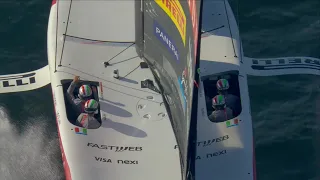
The physical cockpit arrangement has consequently been consolidated from eight pods down to six. Five pods are manned by active sailing personnel, while the sixth pod is designated for a guest racer, VIP stakeholder, or broadcast specialist behind aerodynamic fairings. For the five active athletes, eliminating physical grinding shifts the performance frontier entirely from cardiovascular endurance to cognitive processing speed, situational awareness, and split-second digital execution.
The Forensic Anatomy of Pod 5: Defining the Fifth Sailor (P5)
As design teams and sailing coordinators refine their crewing rosters in Bagnoli, World On Water reveals that the fifth sailor role aboard the AC75 foiling monohulls presents an unprecedented tactical puzzle with no standardized solution. While previous America’s Cup iterations strictly compartmentalized crew responsibilities into rigid silos, the modern P5 designation provides teams like Alinghi Red Bull Racing with operational flexibility. Alinghi leadership, including key decision-makers David and Glenn at the team’s European announcements, acknowledged that the Swiss syndicate has deliberately avoided locking down a fixed job description, recognizing that cockpit workflow in an automated foiler is an evolving discipline.
The most immediate operational doctrine for P5 centers on pure tactical navigation and macro-course strategy. Steering an AC75 at 50 knots is an all-consuming task. Dual helmsmen sit buried within carbon cockpits, strapped into harnesses with heads enclosed by helmets and headsets. With the immense double-skinned mainsail sweeping flush to the deck to generate an end-plate aerodynamic seal, cross-boat visibility is virtually nonexistent. Turning one’s head inside the aerodynamic pod offers at best 90 degrees of peripheral vision. Helmsmen have minimal cognitive bandwidth to scan for subtle pressure lines, localized wind shifts, or tidal eddies. A dedicated fifth sailor looking outside the cockpit provides a panoramic tactical radar, tracking breeze lines and opponent positioning.
This wide-angle perspective assumes existential importance with the introduction of fleet racing during the opening weekend of the Louis Vuitton Cup in Naples. Placing six AC75s on a single starting line converging on a windward gate at combined approach speeds exceeding 90 knots creates an entirely different tactical landscape from one-on-one match racing. Constant 360-degree situational awareness is mandatory to navigate disturbed air, hydrodynamic wakes, and high-speed crosses. P5 provides that indispensable external vigilance.
Mechatronic Integration and Telemetry Processing at 50 Knots
Beyond conventional course strategy, World On Water explores an engineering-centric doctrine where the fifth sailor operates as a mechatronic systems controller aboard the AC75 foiling monohulls. Insight from veteran Swiss Olympian and Alinghi Red Bull Racing sailor Nathalie Brugger indicates that internal syndicate discussions place heavy emphasis on high-speed data interpretation. An AC75 is outfitted with hundreds of fiber-optic strain gauges, pitot tubes, ride-height laser sensors, and hydraulic pressure transducers transmitting millions of telemetry packets every second.
In Grand Prix sailing, the barrier to performance is no longer data acquisition, but the latency of human comprehension. A helmsman or primary trimmer operating in a 50-knot apparent wind environment cannot digest multi-channel graphical telemetry streams while adjusting foil cant or mainsail traveler lines. If the yacht drops just 0.4 knots below its theoretical target polar curve, determining the root cause requires instant diagnostic correlation between aerodynamic twist, rudder rake, and foil ventilation.
In this configuration, P5 functions as a biological microprocessor bridging the yacht’s digital telemetry architecture with the human sailors driving the vessel. By filtering background sensor noise and isolating the critical metrics governing immediate velocity, the fifth sailor can feed concise verbal instructions or digital offsets to the steering and trim team. Furthermore, because battery power replaces manual grinding, P5 can physically manipulate fine-tuning controls—managing cunningham tension, outhaul flattening, or PLC overrides—without diverting primary trimmers from their core responsibilities.
Flight Control Distribution and High-G Maneuvering Workload
A third operational philosophy documented by World On Water focuses on deploying P5 to absorb high-stress flight control and foil trimming duties during dynamic maneuvers on the AC75 foiling monohulls across the Naples racecourse. In straight-line flight, stabilizing an AC75 ride height across calm Mediterranean waters is manageable for automated pitch-control systems. However, the operational equilibrium fractures the moment the yacht enters a high-speed tack or gybe.
Executing a foiling tack at 45 knots requires a staggering sequence of simultaneous mechanical actions within a three-to-four-second window. The new windward foil arm must be deployed into the water, engaging hundreds of thousands of Newton-meters of hydraulic torque. As the bow passes through the wind eye, aerodynamic lift collapses across the sails, requiring instant traveler re-centering and cunningham release. Steering authority must be handed over from the departing windward helmsman to the new windward rail, all while the rudder elevator and foil trim tabs are dynamically modulated to keep the hull airborne.
If any control input lags, the yacht crashes into displacement mode with an instantaneous velocity penalty of 20 to 30 knots. By inserting P5 into the maneuvering loop, syndicates can offload critical secondary functions during the turn. As Olympic gold medalist Jo Aleh of Emirates Team New Zealand summarized, the fifth sailor serves as ‘an extra set of hands and eyes’ providing operational elasticity when task-loading peaks. Intriguingly, teams are already diverging in deck geometry: Jo Aleh operates from starboard aboard the Kiwi defender, while French challenger Maylen Le Maitre (Orient Express) and Italian contender Marie Jubany (Luna Rossa) station their fifth sailor in port pods.
Female Sailor Integration: Breaking the America’s Cup Glass Ceiling
The revised AC75 class rules established for the 38th America’s Cup in Naples represent a historic regulatory milestone for gender equity, as World On Water emphasizes in its review of syndicate crew configurations. For the first time in the 176-year history of the regatta, every competing AC75 team, including Alinghi Red Bull Racing, is legally mandated to race with at least one female athlete among its five active crew members in the Gulf of Pozzuoli.
Crucially, the regulatory framework does not relegate the female sailor to a passive or predetermined role. Nothing in the class rules dictates that female athletes must occupy Position 5 or function merely as auxiliary strategists. Women sailors possess the skill, physiological agility, and technical competence to helm, trim, control flight, or direct overall navigation. The elimination of manual cyclor grinding has leveled the physiological playing field, elevating cognitive capability, lightning-fast reflexes, and aerodynamic intuition above brute physical mass.
Pioneering sailors like Jo Aleh for Emirates Team New Zealand, Marie Jubany for Luna Rossa Prada Pirelli, Maylen Le Maitre for Orient Express, and Nathalie Brugger for Alinghi Red Bull Racing demonstrate that female athletes are integral architects of boat speed. Whether commanding the steering wheel during high-speed pre-starts, regulating the double-skinned mainsail in gusty thermal winds, or orchestrating tactical defense as P5, these women prove that modern foiling monohulls demand cerebral mastery and precision teamwork.
Alinghi Red Bull Racing: AC40 Naples Training and Genoa Shipyard Refit
While theoretical cockpit layouts dominate design debates, World On Water highlights tangible progress on the water as Alinghi Red Bull Racing cements its operational footprint across the Gulf of Pozzuoli and Genoa, Italy. Following a competitive showing at the Naples preliminary regatta in September—where the Swiss syndicate, sailing under the Tudor banner, entered the final day in third position before contending with unforced tactical errors—the two-time America’s Cup champion (2003 and 2007) has maintained a continuous training presence in southern Italy.
Rather than packing up their facilities, Alinghi converted their base in Bagnoli into an intensive high-performance laboratory, assembling their youth and women’s development squads for a rigorous six-day training camp aboard the one-design AC40 foiling monohulls. Despite autumn thunderstorms claiming one day, the squad capitalized on four days of pristine conditions, logging extensive hours in 7 to 12 knots of sea breeze over flat water. Under the guidance of Nathalie Brugger and Jean-Sébastien Suc-Baud, developmental sailors progressed rapidly, with the youth crew driving the AC40 at foiling speeds entirely unassisted without onboard coaches.
For emerging Swiss talents Joshua Rigney and Lorraine Metroz, stepping into the Alinghi culture carries immense historical weight, motivating a new generation with the legacy of Switzerland’s victories in Auckland and Valencia. Simultaneously, the Swiss syndicate’s primary competitive asset—Boat 1 (BoatOne)—is undergoing extensive structural surgery at a marine shipyard in Genoa, Italy. Technicians are stripping out legacy cyclor cockpits, installing the six-pod layout, wiring programmable logic controllers, and integrating lithium battery architecture. Boat 1 will soon make the coastal passage from Genoa south to Bagnoli, Naples, joining the French Orient Express team and Britain’s INEOS Britannia (GB1) for Mediterranean winter training.
AC75 Crew Allocation & Pod Architecture: 37th vs. 38th America’s Cup
To evaluate the technical and operational transformation engineered between cycles, World On Water and marine data analysts compare the baseline configuration of the AC75 foiling monohulls raced by Alinghi Red Bull Racing and international syndicates across Barcelona and Naples.
| Feature / Parameter | 37th America’s Cup (Barcelona 2024) | 38th America’s Cup (Naples 2027) |
|---|---|---|
| Active Crew Size | 8 active sailors | 5 active sailors (+1 guest racer) |
| Cockpit Architecture | 8 recessed pods (4 per side) | 6 recessed pods (3 per side) |
| Hydraulic Power Generation | 4 stationary cyclors (human leg wattage) | Managed lithium battery packs & electric pumps |
| Systems Automation | Manual pilot hydraulic distribution | Programmable Logic Controllers (PLC) |
| Tactical & Control Positions | 2 Helmsmen, 2 Trimmers/Flight Controllers | 2 Helmsmen, 2 Trimmers, 1 P5 (Flexible Specialist) |
| Guest Passenger Integration | None permitted in race mode | 1 mandatory guest racer pod (media / VIP) |
| Mandatory Gender Diversity | No regulatory female quota | Minimum 1 female sailor mandatory in race crew |
| Racing Formats | One-on-one match racing exclusively | Opening weekend fleet racing + match racing finals |
| Primary Operating Venue | Port Vell, Barcelona, Spain | Bagnoli, Gulf of Pozzuoli, Naples, Italy |
| Refit & Modification Facilities | Syndicate satellite bases in Spain | Specialized Italian shipyards (Genoa & Naples) |
Frequently Asked Questions
Position 5 (P5 or SP5) is an adaptable crew role on the revised AC75 foiling monohull. Teams can deploy this fifth sailor as a dedicated racecourse strategist and tactician, a real-time telemetry and mechatronics data analyst, or an auxiliary flight controller to manage sail and foil trim during high-G tacks and gybes.
The 38th America’s Cup class rules replaced human grinding power with stored electrical energy from high-density battery banks and automated programmable logic controllers (PLCs). This technological change powers the hydraulic systems automatically, eliminating the need for four cyclors and reducing crew size from eight to five.
The revised AC75 deck architecture features six recessed pods: five are occupied by active sailing crew members, and the sixth is reserved for a guest racer, VIP stakeholder, or broadcast media specialist. The guest pod allows passengers to experience high-speed foiling without participating in boat operations.
Class rules mandate that every competing AC75 must race with at least one female sailor among its five active crew members. Female athletes are not restricted to Position 5; they can helm, trim sails, control foil flight, or manage tactical strategy based on team optimization.
Competing syndicates, including Alinghi Red Bull Racing, the French Orient Express Racing Team, and INEOS Britannia (GB1), have established advance operational bases in Bagnoli along the Gulf of Pozzuoli in Naples, Italy, taking advantage of flat water and steady 7- to 12-knot thermal sea breezes.
Alinghi’s AC75 race boat (Boat 1) is undergoing structural and systems modifications at a shipyard in Genoa, Italy. Shipwrights are reconfiguring the cockpit from eight pods to six, removing cyclor pedaling mechanisms, and installing new battery-powered electro-hydraulic systems and PLCs before shipping the yacht to Bagnoli.
Unlike traditional two-boat match racing, the opening weekend of the Louis Vuitton Cup in Naples features fleet racing with six 50-knot AC75s on the same course. This high-density traffic demands heightened 360-degree situational awareness to avoid dirty air and high-speed collisions, making a dedicated tactician in the P5 role critically valuable.
Support World On Water
At WeBoating.com, we profoundly acknowledge the unwavering dedication that World On Water invests in crafting each and every video or voyage. Their passion for delivering exceptional ocean content shines through every frame, and it's a labor of love that deserves your attention.
We invite you to watch their captivating videos here and actively engage with their content, including their social media links above. Liking, commenting, and sharing their work goes a long way in fueling their creative fire.
We're also inviting you to explore the gear, sponsorships, and boat partnerships highlighted in the "Explaining What The 5th Crew Does on A America's Cup 75. Alinghi Crews. AC Media/World on Water" video description, or directly on YouTube. By engaging with these offerings or purchasing services and items, you directly support World On Water, their collaborators, and the brands they're associated with.
To ensure you never miss an offshore update, consider visiting their official YouTube Channel to subscribe, like, and join their community directly.
If you have any feedback, corrections, or additional information about World On Water or their videos, please use the comment form below to share your thoughts with us.
Thank you for being a part of our community and supporting the creators we cherish. Your time and support truly matter!
Please Subscribe if you like our Global Sailing content, Like and Share. It helps us show our content to more sailors. Thank you.
Understand what the 5th crew does on a AC75. Alinghi crew announcements.

World On Water
Highlights in the sport of Sailing, Globally, in the past seven days.
Channel Information:
Social Media Links:
Explaining What The 5th Crew Does on A America's Cup 75. Alinghi Crews. AC Media/World on Water Location
- Bagnoli Base, Gulf of Pozzuoli, Naples, Italy (Team Bases & AC40 Training) (40.8167,14.1667)
- Genoa Shipyard, Liguria, Italy (Alinghi Boat 1 AC75 Modifications) (44.4056,8.9463)
- Port Vell, Barcelona, Spain (37th America's Cup Venue & Team Announcements) (41.3851,2.1734)
Latest Episodes from World On Water
Explore the most recent voyages. Subscribe to the channel to never miss an update!
Explaining What The 5th Crew Does on A America’s Cup 75. Alinghi Crews. AC Media/World on Water
World On Water examines the revolutionary AC75 deck layout for the 38th America's Cup in Naples, analyzing the crucial fifth sailor role, cyclor elimination, and Alinghi's Genoa refit.
America’s Cup Oct 11 Weekly Report on the Boats, the Kit and the Crews, From AC Media/World on Water
Please Subscribe if you like our Global Sailing content, Like and Share. It helps us show our content to more sailors. Thank you. 38th America's Cup weekly report released on October 11. It covers the boats, their technology and the crews.
2027 RORC Caribbean 600 Preview by the World on Water
Please Subscribe if you like our Global Sailing content, Like and Share. It helps us show our content to more sailors. Thank you.
America’s Cup 2026 Preliminary Regatta Naples Comprehensive Report on Finals by the World on Water
Please Subscribe if you like our Global Sailing content, Like and Share. It helps us show our content to more sailors. Thank you.
World on Water The 2026 Ocean Race Atlantic Finish Lorient. Report #4
Please Subscribe if you like our Global Sailing content, Like and Share. It helps us show our content to more sailors. Thank you.