
It's Over - Escape to the Ocean
The humid tropical air of Chaguaramas Bay hangs heavy with the scent of saltwater, resin, and bottom paint as Rob and Rachel Hamill push through an intensive refit period. Hauling out an offshore multihull demands unrelenting stamina, but for the New Zealand mariners behind The Cruising Kiwis, the work underway at Peakes Boatyard in Trinidad marks a vital milestone. Their 2001 Fountaine Pajot Belize 43 catamaran, Javelot, is undergoing structural composite rebuilds and systems overhauls before returning to sea.
While Rob battles rigid diesel exhaust lines in the engine compartment and local shipwright Nigel grinds into the starboard collision compartment, monumental news arrives from across the Atlantic Ocean. The Hamills’ teenage sons, Declan and Ivan, have completed an epic sixty-day passage aboard the 106-year-old traditional sailing cargo schooner Avontuur, delivering eighty tons of organic cargo to Europe entirely under sail. Seeking temporary reprieve from yard dust, Rob and Rachel make a forty-eight-hour overland journey to Grande Riviere, witnessing five-hundred-kilogram leatherback sea turtles nest along Trinidad’s wild Atlantic coast.
Structural Hull Surgery and Crash Box Reinforcement at Peakes Boatyard
Surrounded by the industrial activity of Peakes Boatyard in Chaguaramas, Trinidad, Rob and Rachel Hamill of The Cruising Kiwis oversee essential composite repairs on catamaran Javelot. Like many offshore voyaging multihulls, Javelot features dedicated forward crash boxes—watertight collision bulkheads engineered to absorb impact energy without breaching the main hull envelope. To repair impact damage on the starboard bow and forward keel shoe, local composite specialist Nigel undertakes an extensive structural rebuild using biaxial fiberglass cloth and high-strength epoxy resin.
With the exterior hull rebuild faired to original lines, Nigel applies a high-build epoxy barrier undercoat across the bow, keel, and topsides above the waterline. Because polyester or vinylester gelcoat cannot bond chemically over cured epoxy laminates, the surface must be sealed with epoxy primer in preparation for polyurethane paint and antifouling. Inside the forward starboard cabin, Nigel cuts an enlarged inspection portal through the interior crash box bulkhead. Crawling into the narrow void during a tropical downpour, he laminates heavy structural tabbing across the internal hull stringers, ensuring maximum rigidity for bluewater voyaging.
Mechanical Warfare: Rebuilding Javelot’s Inboard Exhaust System
While fiberglass dust settles across the deck in Chaguaramas, Trinidad, Rob and Rachel Hamill turn their attention to mechanical repairs aboard The Cruising Kiwis’ catamaran Javelot. Replacing aged marine diesel wet exhaust hoses is notoriously punishing work. The heavy-duty wire-reinforced hose resists thermal fatigue and exhaust pressure but offers virtually zero flexibility, turning installation inside a restricted engine compartment into an exhausting physical battle.
Working upside-down in the cramped starboard engine bay, Rob removes deteriorated hose and fits a custom-fabricated stainless steel connector joint sleeve. Cutting the unyielding wire-reinforced hose to its exact lead length requires careful alignment to prevent kinking at the hull discharge. Rachel assists by passing tools and stabilizing lines while Rob sorts through metric and imperial sockets, navigating the fit between eleven-millimeter and twelve-millimeter clamps. Once the hose is secured, Rob maneuvers the bulky waterlift exhaust bottle into its mounting bracket, locking down the dual clamps to safeguard against saltwater back-siphoning into the engine cylinders.
Transatlantic Under Sail: Declan and Ivan’s Historic Voyage Aboard the Avontuur
Amid the daily physical demands of boatyard life in Chaguaramas, Trinidad, Rob and Rachel Hamill of The Cruising Kiwis receive exhilarating news regarding family far from catamaran Javelot. Their sons, Declan and Ivan Hamill, have successfully completed a demanding North Atlantic passage aboard the historic 106-year-old sailing cargo ship Avontuur. The brothers had stepped off Javelot to join the two-masted gaff schooner in Mexico, committing to a traditional maritime expedition stripped of modern automation.
The Avontuur sailed completely under canvas, transporting eighty metric tons of organic coffee, cacao, and rum across the ocean with zero propulsion emissions. Life aboard was uncompromisingly traditional: hand-steering an unassisted wooden wheel in heavy weather, handling manual halyards without winches, coping with rationed tank water, and enduring two months at sea without internet or showers. Caught between two converging low-pressure systems, the vessel weathered severe gales and towering ocean swells. After calling at Horta in the Azores and discharging six tons of cargo in Amsterdam, the schooner arrived in Hamburg, Germany. There, Declan and Ivan spent grueling days in forty-degree hold heat unloading seventy tons of coffee sacks onto the quay before toasting their achievement with cold beers alongside family friend Andre.
Overland Passage to Grande Riviere: Trinidad’s Wild Atlantic Coast
Seeking a vital mental break from toxic epoxy fumes in Chaguaramas, Trinidad, Rob and Rachel Hamill of The Cruising Kiwis step away from catamaran Javelot for a forty-eight-hour overland escape. Joined by cruising friends Niels and Sonja and their dogs—fellow boatyard neighbors hauled out at Peakes whom they originally connected with in Brazil over a plastic recycling machine—the crew drives north toward Grande Riviere, an isolated settlement on Trinidad’s rugged, surf-pounded Atlantic coastline.
Accompanying the group is Martin, a friendly security guard at Peakes Boatyard who offered his personal eco-retreat property in Grande Riviere, a ten-year glamping project he has built by hand. Along the winding mountain highway, Martin introduces the sailors to local foraging customs: wild roadside fruit is shared freely by everyone in Trinidad. The road eventually terminates at the Grande Riviere river mouth, cut off from the western coast by an untamed rainforest corridor that preserves the village’s pristine coastal environment.
Night Watch with Giants: Nesting Leatherbacks and the Brutal Odds of Survival
Trading the industrial noise of Chaguaramas, Trinidad, for crashing Atlantic breakers, Rob and Rachel Hamill of The Cruising Kiwis gather on the beach far from catamaran Javelot to observe nesting leatherback turtles (Dermochelys coriacea). Guided by the Grand Riviere Nature Tour Guide Association, the group adheres to strict conservation protocols: white flashlights are banned, and only low-intensity red lights are permitted to prevent disturbing the prehistoric reptiles.
Under the stars, an enormous female weighing nearly five hundred kilograms and measuring six feet in length hauls out from the surf. Using broad, paddle-like rear flippers, she methodically excavates a three-foot-deep egg chamber in the damp sand before depositing her soft, leathery eggs. In an astonishing natural intersection, hatchlings from an adjacent nest laid months earlier simultaneously erupt through the surface, with several tumbling directly into the mother’s active chamber. Returning the next morning beneath tropical squalls, the crew witnesses a daytime emergence of tiny hatchlings sprinting toward the ocean, only to see predatory frigatebirds swoop down to pluck them from the water’s edge—a stark demonstration of the one-in-a-thousand odds sea turtles face to reach maturity.
Technical Ledger: Javelot Refit, Transatlantic Crossing, and Field Operations
During their extended maintenance period in Chaguaramas, Trinidad, Rob and Rachel Hamill of The Cruising Kiwis carefully track maintenance milestones, crew accomplishments, and environmental observations aboard catamaran Javelot. The following structured reference ledger outlines the composite repairs, mechanical upgrades, the historic Avontuur transatlantic cargo crossing, and conservation data recorded during the expedition.
| Operational Focus | System / Parameter | Forensic Ledger & Field Observations |
|---|---|---|
| Hull Composite Surgery | Starboard Bow & Crash Box | Nigel enlarged collision bulkhead access; laminated structural tabbing; applied epoxy barrier primer. |
| Marine Diesel Exhaust | Starboard Engine Exhaust Run | Fabricated stainless connector sleeve; fitted rigid wire-reinforced hose; installed waterlift muffler. |
| Transatlantic Vessel | Schooner Avontuur | 106-year-old gaff-rigged sailing cargo vessel; pure sail propulsion without winches, watermaker, or autopilot. |
| Transatlantic Route & Cargo | Mexico to Hamburg via Azores | 80 tons organic coffee, cacao, rum; 60+ days at sea; offloaded 6 tons Amsterdam, 70 tons Hamburg. |
| Transatlantic Crew Milestones | Declan & Ivan Hamill | Traditional ocean voyaging; manual helm, zero winches, no showers, no internet; navigated North Atlantic gales. |
| Field Expedition & Wildlife | Grande Riviere, Trinidad | 48-hour road trip to north coast terminus; observed 500kg nesting leatherbacks and frigatebird predation. |
Preparing for the Blue: Final Assembly and Sea Readiness in the Caribbean
Reinvigorated by their overland journey to Trinidad’s wild north coast, Rob and Rachel Hamill return to Chaguaramas, Trinidad, focused on launching The Cruising Kiwis’ catamaran Javelot. Haul-out exhaustion gives way to purposeful momentum as the final checklist items are tackled on the hardstand at Peakes Boatyard, clearing the way for the catamaran’s return to the sea.
On the hardstand, Nigel sands the cured epoxy barrier coat to a smooth fairing profile, priming the underwater hulls for dual coats of high-load antifouling paint. Inside, Rob torques down all engine hose clamps, inspects through-hull valves, and completes operational checks on the raw water cooling loops. With Declan and Ivan having conquered the North Atlantic under traditional sail and Javelot‘s bows reinforced for open-water voyaging, the Hamill family stands ready to cast off lines and resume their Caribbean journey.
Frequently Asked Questions
Rob and Rachel Hamill sail Javelot, a 2001 Fountaine Pajot Belize 43 catamaran (43.0 ft LOA, 23.0 ft beam, 4.3 ft draft). The hulls feature end-grain balsa core and glass-reinforced plastic (GRP) sandwich construction for high rigidity and bluewater durability.
Javelot was hauled out at Peakes Boatyard in Chaguaramas, Trinidad, to complete structural repairs to her starboard bow and keel shoe, replace diesel exhaust hoses, apply epoxy barrier coats, and prepare the hulls for antifouling south of the hurricane belt.
To restore structural integrity to Javelot‘s damaged starboard bow, shipwright Nigel enlarged an access hole through the collision bulkhead. This permitted laminating heavy fiberglass cloth and structural epoxy across internal stringers and the hull envelope from within the crash compartment.
Polyester-based gelcoat cannot bond chemically over cured epoxy due to amine blush and differing cure mechanics, causing adhesion failure. Epoxy repairs must instead be sealed with epoxy barrier undercoats and finished with marine polyurethane paint and antifouling.
Declan and Ivan Hamill sailed aboard the Avontuur, a 106-year-old two-masted gaff schooner. They delivered 80 tons of organic cargo from Mexico to Hamburg via the Azores and Amsterdam, voyaging sixty days without winches, autopilot, or satellite internet.
Grande Riviere is a remote village on Trinidad’s Atlantic shore, hosting one of the globe’s premier nesting sites for 500-kilogram leatherback sea turtles (Dermochelys coriacea). Beach visits are managed strictly under red-light guide protocols by the local conservation association.
Biologists estimate only one in one thousand (1:1,000) leatherback hatchlings survives to adulthood. Emerging hatchlings face heavy beach predation from frigatebirds and seabirds, followed by predatory marine life, offshore fishing gear, and ocean debris.
Support The Cruising Kiwis
At WeBoating.com, we profoundly acknowledge the unwavering dedication that The Cruising Kiwis invests in crafting each and every video or voyage. Their passion for delivering exceptional ocean content shines through every frame, and it's a labor of love that deserves your attention.
We invite you to watch their captivating videos here and actively engage with their content, including their social media links above. Liking, commenting, and sharing their work goes a long way in fueling their creative fire.
We're also inviting you to explore the gear, sponsorships, and boat partnerships highlighted in the "It's Over - Escape to the Ocean" video description, or directly on YouTube. By engaging with these offerings or purchasing services and items, you directly support The Cruising Kiwis, their collaborators, and the brands they're associated with.
To ensure you never miss an offshore update, consider visiting their official YouTube Channel to subscribe, like, and join their community directly.
If you have any feedback, corrections, or additional information about The Cruising Kiwis or their videos, please use the comment form below to share your thoughts with us.
Thank you for being a part of our community and supporting the creators we cherish. Your time and support truly matter!
It's Over - Escape to the Ocean
There's a lot going on this week on The Cruising Kiwis.
Javelot is slowly being put back together, Decland and Ivan have completed their sail across the North Atlantic on a 106 year old sailing cargo ship, and we've managed to escape the boatyard long enough for a road trip to Trinidad's wild north coast.
From fibreglass repairs to ocean crossings, and finally leatherback turtles nesting under the stars, it's been quite a mix. Tune in to see what we've been up to.
Music
Musicbed.com
The Flower duet - Lud and Schutts Musical Emporium
TIPJAR https://tipjar.thecruisingkiwis.com
SHOP Www.thecruisingkiwis.shop
PATREON Www.patreon.com/cruisingkiwis
PayPal using our email [email protected]
WEB SITE
www.thecruisingkiwis.com
SOCIAL MEDIA
Follow us on: Instagram: http://www.instagram.com/THECRUISINGKIWIS
Facebook: http://www.facebook.com/THECRUISINGKIWIS
Much love to you all,
Rob, Rachel, Finn, Declan, Ivan
https://www.patreon.com/CruisingKiwis
*****
Follow us in real time on Instagram and Facebook
@thecruisingkiwis
@finn_hamill
@declan_hamill
@ivanhamill
#sailing #boatlife #trinidad #TheCruisingKiwis

The Cruising Kiwis
Meet the Hamills: A New Zealand family of five retracing a poignant historical legacy aboard their Fountaine Pajot 43 catamaran, Javelot.
Channel Information:
Social Media Links:
It's Over - Escape to the Ocean Location
- Peakes Boatyard, Chaguaramas, Trinidad and Tobago (10.6833,-61.6333)
- Grande Riviere, Trinidad and Tobago (10.8294,-61.0506)
Latest Episodes from The Cruising Kiwis
Explore the most recent voyages. Subscribe to the channel to never miss an update!
Small Crack, Big Boat Job – An Insurance Dilemma
Small Crack, Big Boat Job - An Insurance Dilemma Welcome back to Trinidad, our catamaran and a new round of boat work. This week we're throwing ourselves into a big job to solve a small problem. During our insurance survey, cracks in the weld that hold the bushings in place for the cross bar w...
It’s Over – Escape to the Ocean
Rob and Rachel Hamill manage an intensive haul-out aboard catamaran Javelot in Chaguaramas, Trinidad, while their sons Declan and Ivan complete an Atlantic cargo voyage.
Fiberglass Repair | There’s a Hole in Our Boat
The Cruising Kiwis undertake a structural fiberglass hull repair on Javelot, executing a 12:1 scarf bevel and core restoration to ensure ocean readiness.
Repairs Start on Crash Damaged Catamaran
Repairs Starts on Crash Damaged Catamaran Our crash damaged catamaran has been hauled out of the water. Now we can get a much better look at what we are dealing with. The starboard bow took the main impact. And despite us sealing the damage with epoxy putty to keep the worst of the water out, seawa...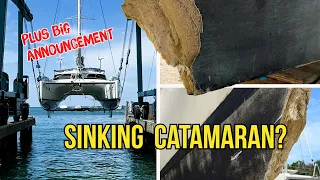
Releasing Gallons of Trapped Sea Water from our Damaged Boat | Rough Sail to Trinidad to Haul Out
Releasing Gallons of Trapped Sea Water from our Crash Damaged Boat | Rough Sail to Trinidad to Haul Out After winding our way through the Windward Islands of the Caribbean, we've finally arrived in Grenada for the final schlep of our journey to Trinidad, where our crash damaged catamaran, and ...