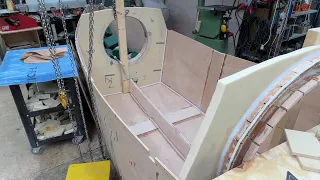
The First Molds Are Up.
Inside his Västervik workshop, Sven Yrvind began transferring reference lines to erect the primary molds for his next high-latitude cruiser. Sighting down a black layout line across the floor, he marked frame 21 as the widest section of the vessel, designating it as the maximum beam station before cutting station 27 lower down along the hull.
Aligning and Bracing the Stations
With the initial two stations cut out and hoisted upright, Yrvind evaluated their temporary bracing. Workshop mounting profiles previously used to support the frames had distorted under earlier fitting strain. Rather than relying on twisted metal runners, he chose to fasten vertical wooden struts directly to the concrete floor, noting that “well, this floor should be okay. At right angle to everything.”
Work moved briskly along the centerline as additional station bulkheads took shape. After securing three molds in place, a fourth frame stood positioned ahead. Yrvind tied off an angled brace down near station 39, establishing rigid alignment before preparing the stem and stern structures.
Divinycell Foam Core and Fiber Layup
Looking at the span between the forward stations, Yrvind evaluated whether the foam core would maintain its shape over the framework. Instead of following the traditional method of laying fiberglass over the outer face of the hull core, he decided to test an alternative building sequence by “putting the inside fibers first.”
The approach recalled a method he had implemented decades earlier. Back in 1986 on his Bree 720, Yrvind had tested internal lamination on a broader hull shape. However, that earlier craft relied on thicker structural core material, with Yrvind recalling that “the Divinycell was 50 mm instead of 30.” The current project uses a 30 mm Divinycell foam core, testing whether the composite sandwich delivers adequate rigidity across the mold stations before the outer hull skin is laminated.
| Construction Metric | Specification |
|---|---|
| Station 21 | Largest hull section (maximum frame) |
| Current hull foam core | 30 mm Divinycell foam |
| Bree 720 foam core (1986) | 50 mm Divinycell foam |
Frequently Asked Questions
Frame 21 forms the widest mold station and marks the maximum beam section of the boat.
Sven braced the frames directly to the floor because his metal mounting profiles had bent during previous fitting work.
The current build uses 30 mm Divinycell foam core, whereas his 1986 Bree 720 used 50 mm foam core.
Sven is testing an inverted composite sequence by applying the inside structural fibers first over the molds before laminating the external skin.
Support Sven Yrvind
At WeBoating.com, we profoundly acknowledge the unwavering dedication that Sven Yrvind invests in crafting each and every video or voyage. Their passion for delivering exceptional ocean content shines through every frame, and it's a labor of love that deserves your attention.
We invite you to watch their captivating videos here and actively engage with their content, including their social media links above. Liking, commenting, and sharing their work goes a long way in fueling their creative fire.
We're also inviting you to explore the gear, sponsorships, and boat partnerships highlighted in the "The First Molds Are Up." video description, or directly on YouTube. By engaging with these offerings or purchasing services and items, you directly support Sven Yrvind, their collaborators, and the brands they're associated with.
To ensure you never miss an offshore update, consider visiting their official YouTube Channel to subscribe, like, and join their community directly.
If you have any feedback, corrections, or additional information about Sven Yrvind or their videos, please use the comment form below to share your thoughts with us.
Thank you for being a part of our community and supporting the creators we cherish. Your time and support truly matter!
This Youtube channel is about me Sven Yrvind. I am87 year and 5 months old dyslectic solo sailor.
I am building a Divinycell and NM-epoxy high-latitude cruiser.
She is 5.6 meter 18 feet 4 inches long. Her beam is 1.45 meter. She is a three masted lugger with a total sail area of 9 square meter. She has a bow daggerboard. I am planning a cruise in the Southern Ocean to Dunedin NZ.
Subject to change.
Often the 22th every month I do a resume of the project.
I have an illustrated book with good reviews on Amazon. https://www.amazon.se/s?k=yrvind&crid=1549D6PR18BUJ&sprefix=%2Caps%2C112&ref=nb_sb_ss_recent_1_0_recent
If you’re interested in contributing to my experiments links are below.
https://www.paypal.com/donate/?hosted_button_id=53X8NVEA22MBL
Swish 0706200550
Also please subscribe - even if you are not interested in sailing.
For more see Yrvind.com
Sven Yrvind
At 86, Sven Yrvind is still pushing the limits of small-boat design. Discover the philosophy and technical grit behind his 'Exlex' series.
Channel Information:
Social Media Links:
The First Molds Are Up. Location
- Yrvind Workshop, Västervik, Sweden (57.7578,16.6378)
Latest Episodes from Sven Yrvind
Explore the most recent voyages. Subscribe to the channel to never miss an update!
More small compartments on the development boat.
Sven Yrvind works in his workshop to optimize the interior of his development boat, focusing on water bottle capacity and redesigning the dining and sleeping areas.
Another Wall for the Water Bottle Storage.
Sven Yrvind works on the Oceanic XLX prototype, crafting a specialized storage area for water bottles and provisions using plywood and fumed silica epoxy.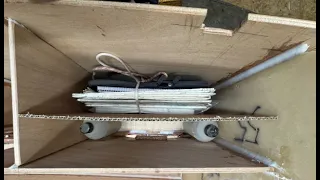
A Divider Between the Charts and Water Bottles.
Sven Yrvind returns to his workshop in the snow to install a custom wooden divider on the Exlex, ensuring a clean separation between paper charts and water bottles.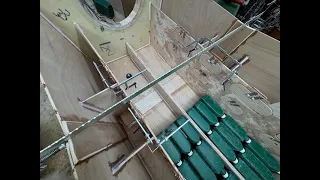
Vertical Dividers.
Sven Yrvind fits vertical subdivisions inside his 4.4-meter plywood test boat in Västervik, stiffening the hull structure and establishing interior storage layout for his high-latitude cruiser.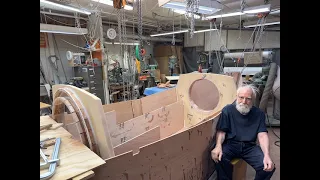
Monthly Update and Overview Nov 2026.
In his workshop on New Year's Eve, Sven Yrvind shortens his plywood test boat to 4.4 meters, loads 18 water jugs for ballast, and details his route to Dunedin and rudderless steering fins.