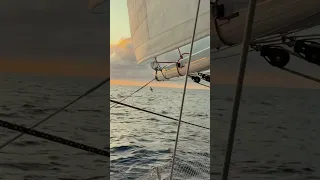
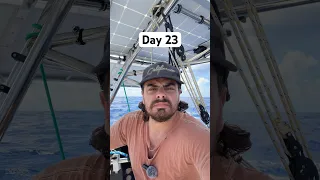
Day 8 sailing around the world without stopping. Shout out @ring for catching this on camera lol
Eight days after departing the Pacific Northwest to undertake a grueling 30,000-mile solo, non-stop circumnavigation of the globe, mariner Oliver Widger encountered an abrupt test of offshore seamanship. Sailing aboard his 1998 Pacific Seacraft 40 cutter, Phoenix do Mar, Widger documents the technical refits and solitary realities of ocean voyaging on his channel Sailing With Phoenix | Oliver. Having liquidated his corporate career and 401(k) following a life-altering spinal diagnosis of Klippel-Feil syndrome, the solitary navigator committed everything to circling the globe via the Southern Ocean without touching port or accepting outside assistance.
The opening stretch of a non-stop global voyage demands establishing ocean watchkeeping routines, monitoring hull motions, and fine-tuning self-steering gear. On Day 8, roughly 800 nautical miles offshore in the open Eastern Pacific Ocean, conditions appeared deceptively peaceful. Phoenix do Mar glided across an undulating, glassy swell under calm skies. However, deep oceanic basins produce unexpected wave trains. Without visual or acoustic warning, an isolated rogue sneaker wave steepened out of the calm surface and detonated across the boat, violently dousing the deck and putting Oliver Widger’s mechanical preparations to an immediate trial.
The Ambush: A Rogue Sneaker Wave in a Glassy Pacific Sea State
While navigating the offshore Pacific Ocean aboard his Pacific Seacraft 40 cutter SV Phoenix do Mar, Oliver Widger of Sailing With Phoenix was resting in the cockpit when the unexpected wave struck. Under light breezes and long-period swells, disparate wave trains can constructively align, producing an isolated, steep wall of water known as a sneaker wave. Without an audible breaking crest to signal its advance, the wave reared up from the glassy surface and slammed into the quarter, swamping the cockpit and sweeping across the vessel’s stern.
The sudden torrent struck Widger directly, drenching the helm station and submerging deck-level fittings. An onboard installation of Ring security cameras captured the entire impact in clear video. Without this automated documentation, Widger observed that he would have had no objective proof of how rapidly calm seas can generate extreme localized forces. The footage recorded the hydraulic crest dumping tons of water over the transom, immediately prompting a methodical damage assessment of the boat’s primary stern systems.
Forensic Damage Assessment: The Sacrificial Zip-Tie Strategy
Inspecting the cockpit in the offshore Pacific Ocean, Oliver Widger of Sailing With Phoenix performed a forensic damage audit on SV Phoenix do Mar, his Pacific Seacraft 40, to verify the integrity of the aft gear. For a solo circumnavigator, rigid stern fixtures represent serious vulnerabilities when heavy water crests over the stern. If an unyielding arch absorbs violent hydraulic shock loads, the kinetic tonnage can easily buckle structural stanchions, strip backing plates, or distort welded joints on the main radar arch.
Widger’s post-impact survey revealed that an intentional mechanical safeguard had operated exactly as planned: secondary equipment brackets on the stern arch were fastened with heavy-duty UV-rated zip ties rather than rigid metal U-bolts. Under the sudden hydraulic load of the sneaker wave, the zip ties snapped cleanly at their designed shear threshold. By yielding sacrificially, the brackets released, allowing the water pressure to dissipate before bending the heavy-gauge 316 stainless steel tubing. Widger noted that this calculated breakaway failure saved his vital structural arch from severe mid-ocean deformation.
Systems Integrity: Solar Array, Rivets, and Ocean Rigging
Continuing his technical inspection in the offshore Pacific Ocean, Oliver Widger confirmed that the solar array on SV Phoenix do Mar, his Pacific Seacraft 40 featured on Sailing With Phoenix, sustained no functional damage. Electrical independence is vital during an unassisted global circumnavigation, powering the Hydrovane self-steering, navigation electronics, and satellite communications. Although the wave’s force shifted one solar panel slightly along its mount, the structural rivets and anodized aluminum framework remained firmly anchored without cracking.
All electrical conduits, wiring harnesses, and marine junction seals retained their watertight integrity, preventing seawater intrusion from compromising the lithium battery banks. Below decks, the heavy displacement hull designed by William Crealock demonstrated its seaworthiness, shedding the boarding sea swiftly through cockpit scuppers. With the mast and standing rigging secure, Widger verified that Phoenix do Mar remained in prime condition to sustain its track toward the roaring Southern Ocean.
The Flying Squid: An Unexpected Pelagic Passenger
While clearing displaced gear in the offshore Pacific Ocean, Oliver Widger of Sailing With Phoenix came upon an unexpected marine creature on SV Phoenix do Mar, his Pacific Seacraft 40: an oceanic flying squid washed onto the deck. Carried over the bulwarks by the sneaker wave, the juvenile squid was Widger’s initial wildlife encounter of the circumnavigation. Pelagic squids are renowned for propelling themselves out of the water to escape predators, occasionally landing on low-profile offshore cruising sailboats.
The encounter held distinct personal significance for Widger. During his 2024 solo maiden passage from Oregon to Hawaii aboard his original Com-Pac 33, the very first oceanic creature to land aboard had also been a flying squid. Finding the same species on Day 8 felt like a welcome ocean greeting. Oliver examined the creature’s chromatophores before returning to his navigational duties, invigorated by the reminder of the wild marine life thriving across the open Pacific.
Day 8 Voyage & Incident Technical Specifications
The following technical summary outlines the Day 8 sea state encounter experienced in the offshore Pacific Ocean by Oliver Widger aboard SV Phoenix do Mar, his Pacific Seacraft 40 cutter on Sailing With Phoenix, documenting hardware response and incident parameters.
| Technical Parameter | Voyage & Impact Metric |
|---|---|
| Vessel & Rig | SV Phoenix do Mar / 1998 Pacific Seacraft 40 Cutter |
| Skipper & Campaign | Oliver Widger / Solo Non-Stop Circumnavigation (30,000 NM) |
| Voyage Progression | Day 8 of estimated 240+ days at sea |
| Geographic Location | Eastern Pacific Ocean (Approx. 800 NM West of US Coast) |
| Coordinates | 36°30’00″N, 135°12’00″W (36.5000, -135.2000) |
| Pre-Incident Conditions | Glassy, calm undulating swell under gentle breezes |
| Incident Phenomenon | Rogue sneaker wave boarding the cockpit and stern quarter |
| Visual Documentation | Onboard Ring marine camera security installation |
| Sacrificial Mechanism | Heavy-duty zip ties designed to shear before stainless arch failure |
| Damage Audit | Tubing intact; rivets held; solar panel angled; zero electrical shorts |
| Pelagic Encounter | Live oceanic flying squid washed onto foredeck |
Frequently Asked Questions
A sneaker wave is a disproportionately large oceanic wave formed when separate swells constructively align. It can rear up suddenly without visual warning even across an otherwise calm, glassy ocean surface.
Oliver utilized heavy-duty zip ties as deliberate breakaway points so they would fail under intense hydraulic shock, dissipating energy before the wave could bend or crack the expensive 316 stainless steel solar arch tubing.
The solar panels remained fully operational with sound aluminum rivets and sealed wiring. While the hydraulic impact angled one panel slightly upward, the charging system and lithium batteries remained completely undamaged.
Oliver Widger is sailing SV Phoenix do Mar, a 1998 Pacific Seacraft 40 cutter designed by William Crealock, known for its heavy displacement, seaworthy canoe stern, and reliability in harsh offshore conditions.
The breaking sneaker wave washed an oceanic flying squid directly out of the water onto the deck, echoing Oliver’s first squid discovery during his solo voyage from Oregon to Hawaii in 2024.
Oliver Widger is attempting an 8-month, 30,000-mile solo, non-stop circumnavigation departing from the US West Coast, sailing south across the Pacific to round Cape Horn, Africa’s Cape of Good Hope, and Australia’s Cape Leeuwin.
Support Sailing With Phoenix | Oliver
At WeBoating.com, we profoundly acknowledge the unwavering dedication that Sailing With Phoenix | Oliver invests in crafting each and every video or voyage. Their passion for delivering exceptional ocean content shines through every frame, and it's a labor of love that deserves your attention.
We invite you to watch their captivating videos here and actively engage with their content, including their social media links above. Liking, commenting, and sharing their work goes a long way in fueling their creative fire.
We're also inviting you to explore the gear, sponsorships, and boat partnerships highlighted in the "Day 8 sailing around the world without stopping. Shout out @ring for catching this on camera lol" video description, or directly on YouTube. By engaging with these offerings or purchasing services and items, you directly support Sailing With Phoenix | Oliver, their collaborators, and the brands they're associated with.
To ensure you never miss an offshore update, consider visiting their official YouTube Channel to subscribe, like, and join their community directly.
If you have any feedback, corrections, or additional information about Sailing With Phoenix | Oliver or their videos, please use the comment form below to share your thoughts with us.
Thank you for being a part of our community and supporting the creators we cherish. Your time and support truly matter!

Sailing With Phoenix | Oliver
From liquidating his 401(k) to solo global loops, join Oliver and his cat Phoenix as they prepare for a 30,000-mile non-stop circumnavigation.
Channel Information:
Social Media Links:
Day 8 sailing around the world without stopping. Shout out @ring for catching this on camera lol Location
- Day 8 Offshore Sneaker Wave Strike, Eastern Pacific Ocean (36.5,-135.2)
- Pacific Seacraft 40 Departure Port, Columbia River, Oregon (46.1878,-123.8313)
Latest Episodes from Sailing With Phoenix | Oliver
Explore the most recent voyages. Subscribe to the channel to never miss an update!