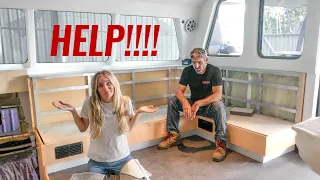
We're SO CLOSE.... Building Our Own Aluminum Catamaran Pt. 90
In the challenging arena of custom ocean yacht fabrication, few milestones rival the transformation of raw structural metalwork into functional living spaces. For more than fifteen years, the voyaging collective of Sailing SV Delos has shared global voyaging and mechanical lessons with sailors worldwide. Stationed on the hardstands of Whangarei, Northland, New Zealand, the crew—led by Brian Trautman and Karin Syrén alongside Sierra, Brady, and Alex—stands on the threshold of completing their generational platform: Delos 2.0, a custom 53-foot aluminum expedition catamaran.
Building an expedition catamaran from scratch is an exercise in endurance where monumental progress unfolds through thousands of daily technical steps. In Part 90 of the build, the echoing metal hulls give way to quiet living quarters as upholstered wall panels lock into the salon, freshwater manifolds and galley appliances come online, and 48-volt sail handling gear is mounted on the coachroof prior to launch.
Structural Integrity and Thermal Boundary Protection
Before interior joinery can line the accommodation spaces, Brian, Karin, Brady, and Alex of Sailing SV Delos must ensure that SV Delos maintains flawless thermal and structural boundaries throughout their aluminum catamaran boatbuilding project. Operating in Whangarei’s marine precinct, the crew inspected 5083-H116 aluminum plating and structural stringers, confirming impenetrable hull integrity capable of withstanding polar ice loads and tropical crossings.
Because marine aluminum conducts heat rapidly, bare metal hulls risk severe internal condensation when ambient air drops below dew point. To prevent sweating behind cabinetry, Karin meticulously applied a specialized ceramic anti-condensation coating directly to the aluminum hull surfaces and window reveals. This seamless thermal barrier prevents moisture accumulation, protecting insulation and interior timber veneers from rot during high-latitude voyaging.
Interior Joinery and Fastmount Panel Integration in the Salon
Executing interior joinery that balances aesthetics with offshore serviceability represents a major milestone for Brian, Karin, Brady, and Alex on Sailing SV Delos, proving that SV Delos achieves yacht-grade finish within an aluminum catamaran boatbuilding environment. The arrival of the salon sidewall panels transformed the central deckhouse from an industrial workshop into an inviting home. Fabricated from six-millimeter lightweight marine plywood, each panel was scribed to millimeter tolerances and sealed with a two-pack polyurethane moisture barrier.
Rather than gluing headliners permanently, the crew utilized Fastmount hidden clips, allowing panels to snap securely into structural grounds and detach cleanly for electrical inspections. Local upholsterer Michael covered the panels in durable neutral marine fabric using Tanara surgical-grade fluoropolymer thread, which resists UV decay and moisture. Michael eliminated bottom seams near the galley, creating a smooth wipe-clean margin that withstands heavy offshore cooking.
Galley Systems Commissioning and Starboard Master Suite Joinery
Commissioning domestic systems transitions a shipyard structure into an ocean-ready voyager as Brian, Karin, Brady, and Alex guide Sailing SV Delos through crucial fit-out stages aboard SV Delos, marking rapid progress in their aluminum catamaran boatbuilding schedule. In the main salon galley, collaborator Dan completed the plumbing beneath the twin stainless sinks, routing dedicated supply lines and greywater drainage manifolds.
The sink arrangement features a touch-activated mixer tap and an InSinkErator instantaneous boiling water unit for tea, reducing kettle energy consumption. Nearby, the stainless galley oven and front-loading refrigerators were energized successfully. Simultaneously, shipwright Stevie framed the sliding pocket door isolating the starboard master suite from the main deck companionway, resolving compound hull angles and stair clearances before timber veneers were dispatched for spray lacquer finishing.
Radar Keel Tank Calibration and Fresh Water Manifolds
Precise tank telemetry is indispensable for remote navigation, prompting Brian, Karin, Brady, and Alex of Sailing SV Delos to engineer advanced acoustic sensing for SV Delos, replacing traditional mechanical gauges in this aluminum catamaran boatbuilding program. Unlike deep-keeled monohulls with simple dipsticks, the catamaran’s 500-liter integral keel tanks feature shallow, asymmetrical contours with internal stiffeners that defy linear volume calculations.
Brian installed Safiery Safari non-contact radar level sensors atop the inspection ports, measuring fluid height via microwave time-of-flight without moving parts. To calibrate non-linear keel geometry, Brian metered fresh water in ten-liter increments through a catalytic carbon block filter, recording sensor percentages against real volume in a spreadsheet. Mapping the inflection where the keel transitions from narrow base to wide midsection, Brian programmed the offset curve directly into the Victron Cerbo GX system for pinpoint digital accuracy.
Harken Flatwinder Automation and Forward Cockpit Controls
Taming heavy sail loads without crew fatigue is central to short-handed passagemaking, inspiring Brian, Karin, Brady, and Alex from Sailing SV Delos to install push-button traveler controls on SV Delos, optimizing safety and sail control during aluminum catamaran boatbuilding deck installations. Delos 2.0 carries a massive one-hundred-square-meter mainsail, generating immense sheet loads that make manual traveler adjustments arduous in freshening breeze.
Brian mounted a 48-volt Harken Flatwinder 500 captive reel winch beneath the coachroof, enabling electric trimming of the continuous traveler line without manual line handling. Operating at 48 volts minimizes current draw across the vessel’s lithium house bank. In the forward cockpit, boatbuilder Bill helped evaluate switch ergonomics, prompting Brian to 3D print custom dual-arrow control bezels on the boatyard printer. Connected and powered, the Flatwinder smoothly walked the traveler across the car track with fingertip precision.
Custom Aluminum Expedition Catamaran Specifications and Milestones
Rigorous scantling verification and milestone tracking define the boatyard workflow as Brian, Karin, Brady, and Alex of Sailing SV Delos bring SV Delos toward completion, documenting key engineering metrics across this custom aluminum catamaran boatbuilding undertaking. The table below details the structural scantlings, operational machinery, and boatyard milestones achieved during the construction sprint in Whangarei.
| Engineering Category | Technical Specification & Scantling Scope | Boatyard Milestone Status |
|---|---|---|
| Vessel Model & Designer | Delos Explorer 53 (De Villiers 525 Design) | Naval architecture approved and structurally verified |
| Hull & Deck Material | 5083-H116 marine aluminum plating with 6082-T6 stringers | Structural welding certified; non-destructive testing complete |
| Principal Dimensions | LOA: 53.0 ft (16.15 m) | Beam: 26.5 ft (8.07 m) | Draft: 4.5 ft (1.37 m) | Hull lines confirmed; appendages aligned |
| Displacement Parameters | Lightship: ~36,000 lbs | Half-Load: ~45,000 lbs | Center of gravity and tankage stability verified |
| Thermal Management | Ceramic anti-condensation coating & acoustic core | Salon perimeter and window reveals fully coated |
| Interior Joinery Lining | 6mm lightweight marine ply, 2-pack sealed, Fastmount clips | Salon wall panels snapped in; master suite door hung |
| Upholstery Construction | Durable neutral fabric with Tanara UV fluoropolymer thread | Fabrication complete; seamless galley wipedowns executed |
| Galley Appliances | Dual stainless sinks, touch tap, InSinkErator boiling unit, oven | Plumbing manifold commissioned; appliances energized |
| Tankage & Monitoring | 500-liter integral keel freshwater tanks with Safiery radar sensors | Multi-point volumetric calibration programmed in Cerbo GX |
| Mainsail Handling | 100 m² mainsail with Harken Flatwinder 500 48V electric traveler | Coachroof mounting wired; forward cockpit push-buttons active |
| Auxiliary Propulsion | Dual Nanni N4.80 diesel hybrid engines with Vetus saildrives | Engine beds aligned; primary running gear installed |
| Build Location & Basin | Port Nikau Boatyard & Marine Basin, Whangarei, New Zealand | Final fit-out sprint nearing ceremonial splashdown |
Frequently Asked Questions
Cruising sailors following Brian, Karin, Brady, and Alex on Sailing SV Delos frequently inquire about the technical architecture and engineering choices behind SV Delos and their custom aluminum catamaran boatbuilding project in Whangarei.
The crew selected 5083-H116 marine aluminum for its unmatched impact resistance, puncture survivability, and ductility when navigating ice fields, remote coral reefs, and uncharted shallows. Unlike composite fiberglass, aluminum does not suffer from osmosis or delamination, and damaged plating can be repaired with standard welding equipment in commercial boatyards worldwide.
Delos 2.0 is a 53-foot expedition catamaran designed by Angelo Lavranos and Luc de Villiers (De Villiers 525). The vessel measures 53.0 feet LOA with a 26.5-foot beam, draws 4.5 feet, and has a half-load displacement of approximately 45,000 pounds. Her design features sacrificial keel shoes for grounding protection and high-buoyancy bow profiles.
The catamaran is powered by twin Nanni N4.80 marine diesel engines coupled to Vetus saildrives, integrated with a 48-volt secondary electric drive system. This hybrid configuration allows silent harbor maneuvering, hydrogeneration under sail, and efficient recharging of an extensive lithium iron phosphate battery bank.
The custom yacht is completing construction at the Port Nikau Boatyard and marine basin in Whangarei, Northland, New Zealand. Whangarei offers world-class marine trades and deep-water access. After commissioning, the yacht will launch into Whangarei waters before undertaking sea trials across Bream Bay and the Hauraki Gulf.
To eliminate condensation on conductive aluminum plating, the crew applies a ceramic thermal anti-condensation coating across internal hull plates and window frames. Coupled with acoustic insulation and air gaps behind Fastmount-secured panels, this barrier keeps surfaces above the dew point and prevents moisture accumulation.
Following sea trials in northern New Zealand, the crew will conduct proving voyages in the Southern Ocean before resuming global expedition cruising. Future itineraries for Delos 2.0 include South Pacific passages, transiting the Roaring Forties, and high-latitude voyages to Svalbard, Greenland, and Arctic waters.
Book a trip where this was filmed — near Paihia
Island Hopper- Sail to wildlife sanctuary – 6 hr – Bay of Islands
Sold by Barefoot Sailing Adventures
Support Sailing SV Delos
At WeBoating.com, we profoundly acknowledge the unwavering dedication that Sailing SV Delos invests in crafting each and every video or voyage. Their passion for delivering exceptional ocean content shines through every frame, and it's a labor of love that deserves your attention.
We invite you to watch their captivating videos here and actively engage with their content, including their social media links above. Liking, commenting, and sharing their work goes a long way in fueling their creative fire.
We're also inviting you to explore the gear, sponsorships, and boat partnerships highlighted in the "We're SO CLOSE.... Building Our Own Aluminum Catamaran Pt. 90" video description, or directly on YouTube. By engaging with these offerings or purchasing services and items, you directly support Sailing SV Delos, their collaborators, and the brands they're associated with.
To ensure you never miss an offshore update, consider visiting their official YouTube Channel to subscribe, like, and join their community directly.
If you have any feedback, corrections, or additional information about Sailing SV Delos or their videos, please use the comment form below to share your thoughts with us.
Thank you for being a part of our community and supporting the creators we cherish. Your time and support truly matter!
Head to https://drinkag1.com/svdelos and get a free Immune Support Bundle (Omega-3 Fish Oil + Vitamin D3+K2) with your first subscription order.
It's alllllll starting to come together after years of hard work. Building a boat is such a slow process, and each day you chip away at the tiniest little fraction of the whole project....but those microscopic fractions add up slowly over time, and one day you take a look at what you've made and it just hits you all at once, like WOW we're actually getting CLOSE 🤯 In this week's episode we tackle some very cool projects that really propel the build forward in a bunch of different areas- we put up the first wall panels in the salon, we get more of the sail hardware online, make progress with the water tanks, get the fridge and oven online, and lots of other very cool milestones that we can't wait to share with you! We hope you enjoy this one!
Our 3d printer we're obsessed with: https://amzn.to/45ONHxH
Check out these episodes for more on the panels and upholstery:
Fabric, style, and prepping: https://youtu.be/DYViuYYQIcQ
Port side transformation and panels going in: https://youtu.be/tw6iHas8F7c
In depth look at the fast mount system: https://youtu.be/ib_14R3h-CQ
Getting the gaps right and sealing the wood: https://youtu.be/vKUc7LdyC9Q
Interested in getting your own Delos Explorer 53?
https://svdelos.com/delos2
You can find all the camera gear we use, our must have cruising essentials, tools, recommended reading, safety gear, and more at our amazon storefront!
https://svdelos.com/amazon
Watch our 4 part docu-series:
https://80northseries.com
Protect yourself from the sun!
https://svdelos.com/rashguards
Support Our Videos- Send Us Love
http://svdelos.com/beer
http://patreon.com/svdelos
We're completing our sail around the world, so there's plenty more to see! Your support will fund better camera gear, internet to upload videos, and of course creative lubricants to smooth the editing process :)
http://svdelos.com/newsletter - Subscribe to our free newsletter
http://instagram.com/svdelos - Behind the scenes.
http://facebook.com/svdelos - Like us on Facebook
http://svdelos.com/gear/ - Support us buy a sweet Delos T-shirt!

Sailing SV Delos
Brian, Karin, and Sierra: The 'Delos Tribe' is pioneering the future of hybrid expedition sailing with Delos 2.0, a custom 53ft aluminum catamaran currently completing its build in Australia.
Channel Information:
Social Media Links:
We're SO CLOSE.... Building Our Own Aluminum Catamaran Pt. 90 Location
- Port Nikau Boatyard & Marine Basin, Whangarei, New Zealand (-35.733,174.338)
- Whangarei Town Basin Marina, Northland, New Zealand (-35.7275,174.3283)
Latest Episodes from Sailing SV Delos
Explore the most recent voyages. Subscribe to the channel to never miss an update!
FIRST SOLAR TEST….Too Good To Be True???
Watch the full episode here: This is an episode that I couldn't be happier to share with you guys. Our solar system has been one of my favorite projects of the whole build. I just find this technology so incredibly fascinating, and it's been such a joy to bring it all together. We'v...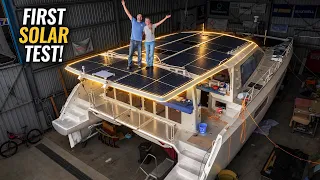
FIRST SOLAR TEST….Too Good To Be True??? (Pt. 2) Aluminum Catamaran Build 93
Brian Trautman, Karin, and Open Water Solar complete and test the 6,000-watt flexible solar roof on Delos 2.0, achieving 175 volts on bench testing and cutting array weight to 160 kilos.
You’ve NEVER Seen Solar Like This! INSTALL BEGINS 🛠️
Brian Trautman initiates the Delos 2 solar panel installation, outlining ambitious plans to maximize off-grid power on the catamaran roof without drilling mounting holes.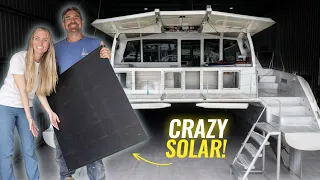
Our MASSIVE Solar Installation Begins! (Pt. 1) Aluminum Catamaran Build 92
Want to get behind the scenes of the build with early & ad free content, meetups, and more? Join the inner tribe at We've got a DOOZIE of a project for ya in this week's episode! I know that so many of you are curious about this topic, and it's one that I have THOROUGHLY geeked...
Salon TRANSFORMATION 🤯….BUT….
Watch the full episode here: This week's episode is another huuuuge milestone that feels pretty unreal. The salon is really passing the tipping point from construction site vibes to holy cow this is actually where we're going to live 🤯 We're starting to be able to picture a cozy nig...