Our MASSIVE Solar Installation Begins! (Pt. 1) Aluminum Catamaran Build 92
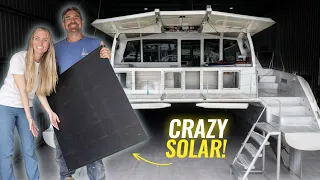
High above the boatyard dust at Redland City Marina in Queensland, Australia, Brian Trautman inspects the expansive bare coachroof of Delos 2.0, preparing the aluminum expedition catamaran of Sailing SV Delos for a massive custom solar array. Living off-grid as a family of three demands substantial electrical self-sufficiency, and while the crew relied heavily on solar during years of voyaging aboard their first vessel, the new 53-foot aluminum platform requires an entirely different scale of power generation. With plans to push electrical independence further than ever before, Trautman established three non-negotiable engineering constraints for the installation: no tripping hazards rising above the deck, no sacrifice of walkable roof area, and absolutely zero holes drilled through the aluminum roof.
Accomplishing those goals required custom engineering rather than off-the-shelf marine solar hardware. Over several months of planning, Trautman collaborated with Simon, founder of Open Waters Solar, to design an array specifically fitted to the catamaran’s deck geometry. As Trautman scours airborne grit from the coachroof with a broom and water bucket, Simon and his technician Nikki begin their journey to the Queensland boatyard to oversee the hands-on fit-out.
Airborne Freight and the Baggage Carousel Challenge
Transporting six kilowatts of high-performance solar panels halfway around the globe presented an immediate logistical hurdle. Conventional international air freight proved prohibitively expensive, prompting Simon and Nikki to hand-carry the entire array as personal baggage during a 14-hour direct flight from Vancouver to Australia. Packing the modules into six oversized containers, each pack weighed approximately 20 kilograms.
Navigating airport security in Canada with six identical, densely packed crates required extensive patience and documentation. Simon recounts the departure ordeal upon arriving in the yard: “Six boxes of solar panels and they’re light, but it’s six kilowatts. Yeah. So they’re still 20 odd kilograms per pack and, and yeah, the airport don’t normally handle stuff like that.” Security officials spent two hours opening the crates, inspecting the unusual composite laminate structures, and swabbing the packaging for contraband before clearing the cargo for the flight.
Once delivered to the boatyard, dry-fitting the first modules onto the coachroof confirmed that the custom manufacturing matched the catamaran’s curvature. Standard rectangular solar panels would have produced roughly three kilowatts by leaving wide, irregularly shaped deck perimeters vacant. By tailoring panels to match the contours of the roof, the team doubled the system’s capacity to 6,000 watts. Under favorable conditions, five peak sun hours can produce approximately 30 kilowatt-hours of electrical energy each day, matching the daily consumption of an average American residence.
Re-Engineering Marine Solar: Diodes, Real Estate, and Cell Fragility
The custom panels installed on Delos 2.0 originated from Simon’s earlier composite boatbuilding ventures in Canada. Setting out to build a transportable high-performance multihull, Simon conceived a vessel that could travel inside standard freight networks: “So I had this concept for a 40 foot carbon fiber sailing catamaran that was very high performance, that could fit inside a shipping container and travel very quickly.” The concept called for a vessel that an owner could ship to French Polynesia, assemble in three days, sail across an archipelago, and pack back into a container.
That experimental catamaran proved fast under sail, yet its all-electric auxiliary system suffered from catastrophic solar underperformance. Equipping the boat with 16 standard semi-flexible panels rated for 1600 watts, real-world output topped out at barely 800 watts. Analyzing the failure points over two years of research and development, Simon identified three distinct mechanical and electrical flaws common to commercial marine solar panels.
First, standard rectangular shapes waste significant usable surface area on curved vessel decks. Second, conventional panels incorporate only one or two bypass diodes, creating severe vulnerability to mast and rigging shadows. In a series-wired circuit, shaded cells drop output and throttle the entire string: “One cell gets shaded and we lose it down to two amps. So now you limit your entire array, that entire 150 volts to two amps.” By integrating bypass diodes that act as one-way electrical valves, shaded cell clusters are isolated with a loss of merely 2.4 volts, preserving current flow across the rest of the array. Third, standard semi-flexible panels suffer micro-fractures in their silicon cells under repeated deck movement, causing permanent efficiency loss within two to three seasons.
Solving Zero Roof Penetrations: Potting and Flat Cable Junctions
Drilling wiring holes through the coachroof of an aluminum expedition yacht introduces unacceptable risks of freshwater leaks, interior damage, and corrosion. Traditional marine solar installations rely on bulky junction boxes and protruding MC4 connectors that loop thick round cables across the deck before plunging through gland fittings. These assemblies create permanent tripping hazards and catch sail lines.
To satisfy Trautman’s zero-penetration mandate, Simon’s team fabricated ultra-low-profile junction boxes using heavy-gauge flat cables that run flush across the roof. Assembly begins by trimming the flat cable to length, stripping insulation, twisting the copper strands, and pressing a compressible tinned metal ferrule over each conductor. After sliding heat-shrink tubing over the wire, the technician tins the ferrule with solder.
On each solar panel, contact pads are prepped by scraping away composite material to expose clean copper. The tinned conductors are soldered directly onto the exposed copper pads. Once electrical continuity is verified, the junction box housing is filled with a specialized polyurethane potting compound. The liquid potting compound cures into a solid, fully waterproof seal that locks out saltwater and mechanical strain, interconnecting panels in series strings leading to dedicated charge controllers.
Mechanical Fastening Without Structural Strain: 3M VHB Mounting
Preparing the coachroof for permanent bonding required rigorous surface preparation. Trautman scuffed the painted aluminum roof with Scotch-Brite abrasive pads to establish mechanical tooth, followed by repeated alcohol wipe-downs to strip boatyard oil and dust. However, choosing the correct mounting compound required careful engineering.
Early in the development of the product, Simon attempted bonding solar modules using high-strength marine epoxy. That approach revealed an unexpected structural hazard on flexible boat decks. As the roof deflected under foot traffic, adding 18 ounces of fiberglass laminate from the solar panels stiffened the deck locally, forcing the boat’s structural flex directly into the silicon cells and causing cell-to-skin delamination. Subsequent trials with flexible marine adhesives like 3M 4200 provided higher elongation but still failed to isolate dynamic hull loads.
The permanent solution came through collaboration with industrial adhesive engineers: “So then we talked to 3M and we said, we need a solution that mechanically fastens the panels exceptionally well, but structurally disconnects them.” Using continuous 44-inch-wide rolls of 3M VHB double-sided acrylic foam tape, the team achieved robust mechanical adhesion while completely isolating the solar modules from hull deflection. In addition to structural decoupling, the continuous VHB layer provides a fully submersible moisture barrier that prevents saltwater from becoming trapped between the aluminum deck and the fiberglass panel backings. If a panel ever sustains physical damage, running an Olfa knife through the foam core allows replacement in 10 minutes.
Toughness, Walkability, and Electrical Verification
Because the coachroof of Delos 2.0 serves as an active working platform for sail handling and boom access, every square inch of the solar installation had to withstand foot traffic without cracking cells or creating slick footing. Simon detailed the panel laminate layup: “Well basically what we’ve done is we’ve taken the solar cells and basically encapsulated them in a completely balanced fiberglass laminate.”
Following composite encapsulation, each panel receives UV-protective coatings and a top layer of Awlgrip CS clear coat embedded with non-skid aggregate. The resulting hard, textured surface resists heavy deck shoes and abrasive grit. During bench testing, panels are evaluated under electroluminescence (EL) imaging while being flexed, confirming that the silicon cells remain unbroken under severe deflection. The embedded photovoltaic cells are Maxeon 125 mm by 125 mm (5 inches) units producing 3.7 watts each, boasting an average conversion efficiency exceeding 24%.
| Installation specification | Measured or design value |
|---|---|
| Total peak array capacity | 6,000 watts (6 kilowatts) |
| Standard rectangular panel capacity | 3 kilowatts |
| Estimated daily power generation | 30 kilowatt hours (5 peak sun hours) |
| Solar cell dimensions | 125 mm by 125 mm (5 inches) |
| Individual cell power output | 3.7 watts per cell |
| Average solar cell efficiency | Over 24% |
| High-TG modified epoxy rating | 125 degrees C |
| Standard solar panel heat rating | 80 degrees C |
| Operating temperature in a light breeze | 55 to 60 degrees C |
| Closed-cell foam deck insulation | Over 60 millimeters |
| Continuous adhesive sheet width | 44 inches (3M VHB) |
| Multimeter test voltage readings | 15.03 V, 29.57 V, and 30 V |
With several panels adhered to the coachroof, Trautman stepped out with a digital multimeter to test live output under direct sunlight in Australia. Connecting test probes to the soldered leads produced immediate open-circuit readings: 15.03 volts across a smaller forward panel, 30 volts across a connected series pair, and 29.57 volts on an outer panel, verifying that the laminated modules were generating clean DC power.
Thermal Dynamics and Deck Insulation
Operating high-capacity photovoltaic arrays on an aluminum expedition vessel raises practical questions regarding operating temperatures and cabin heat. Standard marine solar panels carry an operating limit of 80 degrees C. In tropical calms, dark solar surfaces quickly reach 80 degrees C, experiencing normal temperature-induced voltage degradation.
To prevent physical breakdown at elevated temperatures, the composite panels utilize a specialized high-TG resin matrix: “We use a very high TG modified epoxy, which is good for around 125 degrees C.” Even in baking conditions, an ambient breeze across the open deck rapidly pulls surface temperatures down from 80 degrees C to between 55 and 60 degrees C.
While the aluminum structure conducts thermal energy away from the modules, interior living spaces remain protected. Below the aluminum deck plate, Delos 2.0 is insulated with over 60 millimeters of closed-cell foam. This dense thermal barrier prevents heat from penetrating into the salon and cabins, allowing the exposed aluminum coachroof to radiate heat outward into the atmosphere while keeping interior temperatures stable.
Weekend Installation, Perimeter Caulking, and an Afternoon Squall
Working straight through Saturday and Sunday, Trautman, Karin Syrén, Simon, and Nikki completed the alignment and adhesion of the primary array across the expansive coachroof. With the modules firmly bonded on their VHB substrate, the final phase required edge-sealing every panel perimeter. Sealing the borders prevents water from wicking into raw fiberglass edges and stops moisture from reaching the VHB-to-deck bond.
The crew scuffed the perimeter edges with sandpaper and began applying blue painter’s tape along every seam. Young Sierra Trautman joined her parents on the coachroof, marveling that the solar panels “are everywhere” and helping press masking tape along the seams. Working at high speed to complete the caulking before Simon and Nikki caught their return flight to Canada, the team lined up straight caulk joints across the entire array.
Just as the final masking strips were secured, an unexpected afternoon thunderstorm swept over the boatyard, dumping rain across the deck. While the downpour provided an immediate test of the Awlgrip non-skid surface—which retained firm traction under wet deck shoes—the water ruined the tape adhesion. Rather than caulking against compromised, soggy tape that would produce ragged seals, Trautman and Simon decided to pull the wet tape, allow the roof to dry completely, and re-tape before applying perimeter sealant in Part 2.
Frequently Asked Questions
Conventional rectangular panels would have yielded only about 3 kilowatts of capacity due to wasted space on curved deck areas, whereas custom-shaped panels doubled capacity to 6,000 watts.
The team designed ultra-low-profile junction boxes utilizing flat cables soldered directly to copper contacts on the panels, sealed with waterproof polyurethane potting compound and run without deck holes.
Rigid epoxy transferred hull flexing directly into the solar cells and caused delamination, while 44-inch-wide 3M VHB sheets mechanically fasten the panels while structurally isolating them from deck movement.
The array incorporates integrated bypass diodes that act as one-way electrical valves, isolating shaded cells with only a 2.4-volt drop instead of throttling the entire series string down from 6 amps to 2 amps.
The panels utilize high-TG modified epoxy rated to 125 degrees C, ambient breezes cool dark panels to 55–60 degrees C, and over 60 millimeters of closed-cell foam insulation prevents heat transfer into the cabin.
Book a trip where this was filmed — near Gold Coast
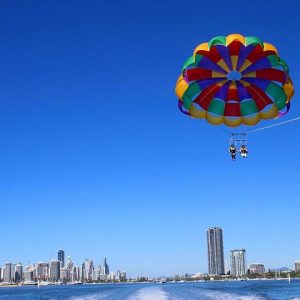
Parasailing on the Gold Coast, Fly solo, Tandem or Triple
Sold by Surfers Paradise Water Sports

Support Sailing SV Delos
At WeBoating.com, we profoundly acknowledge the unwavering dedication that Sailing SV Delos invests in crafting each and every video or voyage. Their passion for delivering exceptional ocean content shines through every frame, and it's a labor of love that deserves your attention.
We invite you to watch their captivating videos here and actively engage with their content, including their social media links above. Liking, commenting, and sharing their work goes a long way in fueling their creative fire.
We're also inviting you to explore the gear, sponsorships, and boat partnerships highlighted in the "Our MASSIVE Solar Installation Begins! (Pt. 1) Aluminum Catamaran Build 92" video description, or directly on YouTube. By engaging with these offerings or purchasing services and items, you directly support Sailing SV Delos, their collaborators, and the brands they're associated with.
To ensure you never miss an offshore update, consider visiting their official YouTube Channel to subscribe, like, and join their community directly.
If you have any feedback, corrections, or additional information about Sailing SV Delos or their videos, please use the comment form below to share your thoughts with us.
Thank you for being a part of our community and supporting the creators we cherish. Your time and support truly matter!
Want to get behind the scenes of the build with early & ad free content, meetups, and more? Join the inner tribe at http://patreon.com/svdelos
https://openwaterssolar.com We've got a DOOZIE of a project for ya in this week's episode! I know that so many of you are curious about this topic, and it's one that I have THOROUGHLY geeked out on 😂 We've mentioned our solar panels in a few episodes already, but today is the day we finally begin the exciting process of installing these bad boys. This is gonna be a two-parter as we have so much to cover. I hope you enjoy this deep dive as much as we did. Of course drop any questions you have below!
Our 3d printer we're obsessed with: https://amzn.to/45ONHxH
Interested in getting your own Delos Explorer 53?
https://svdelos.com/delos2
You can find all the camera gear we use, our must have cruising essentials, tools, recommended reading, safety gear, and more at our amazon storefront!
https://svdelos.com/amazon
Watch our 4 part docu-series:
https://80northseries.com
Protect yourself from the sun!
https://svdelos.com/rashguards
Support Our Videos- Send Us Love
http://svdelos.com/beer
http://patreon.com/svdelos
We're completing our sail around the world, so there's plenty more to see! Your support will fund better camera gear, internet to upload videos, and of course creative lubricants to smooth the editing process :)
http://svdelos.com/newsletter - Subscribe to our free newsletter
http://instagram.com/svdelos - Behind the scenes.
http://facebook.com/svdelos - Like us on Facebook
http://svdelos.com/gear/ - Support us buy a sweet Delos T-shirt!

Sailing SV Delos
Brian, Karin, and Sierra: The 'Delos Tribe' is pioneering the future of hybrid expedition sailing with Delos 2.0, a custom 53ft aluminum catamaran currently completing its build in Australia.
Channel Information:
Social Media Links:
Our MASSIVE Solar Installation Begins! (Pt. 1) Aluminum Catamaran Build 92 Location
- Redland City Marina, Thornlands, Queensland, Australia (-27.5768,153.2906)
Latest Episodes from Sailing SV Delos
Explore the most recent voyages. Subscribe to the channel to never miss an update!
Is This Completely Ridiculous?
Brian Trautman and Karin Syrén expand their custom lighting installation aboard Delos 2.0, balancing the KISS sailing mantra against playful design creativity.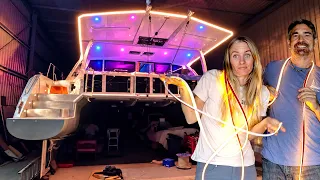
Is This Completely Ridiculous? Building Our Own Aluminum Catamaran Pt. 94
Brian Trautman and Karin Syrén advance the Delos 2.0 catamaran build in Queensland, Australia, installing addressable Lumitec RGBW lighting, custom 3D printed Starlink deck mounts, polished galley pot clamps, and Rutgerson escape hatches.
FIRST SOLAR TEST….Too Good To Be True???
Brian Trautman and the Sailing SV Delos crew conduct the first live electrical test of their high-capacity rooftop solar array on Delos 2.0 at Redland City Marina, generating roughly 6,000 watts.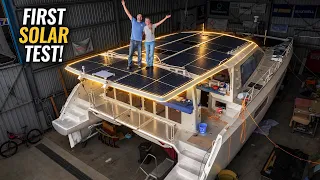
FIRST SOLAR TEST….Too Good To Be True??? (Pt. 2) Aluminum Catamaran Build 93
Brian Trautman, Karin, and Open Water Solar complete and test the 6,000-watt flexible solar roof on Delos 2.0, achieving 175 volts on bench testing and cutting array weight to 160 kilos.
You’ve NEVER Seen Solar Like This! INSTALL BEGINS 🛠️
Brian Trautman initiates the Delos 2 solar panel installation, outlining ambitious plans to maximize off-grid power on the catamaran roof without drilling mounting holes.