WE CAN'T SAVE IT 😢… SO WE RIP IT ALL APART! | S2.E211
Faced with a major structural hull puncture concealed behind galley joinery, Sarah prepared to dismantle the built-in refrigeration unit aboard Sailing SV CUBA. As part of the ongoing refit to resurrect the lightning-damaged sailboat, accessing the impact breach required cutting through heavy interior fiberglass and insulated liners rather than disassembling the entire port side cabinetry.
Initial plans considered removing the outer timber face to slide the appliance out, but the unit proved wider than the galley aperture. Extracting it intact would have meant unbolting the column partition, dismounting the gimballed galley stove, and unseating the countertop itself. Because the cold box was bonded directly into the laminate underneath the counter, full extraction risked splintering custom timber trim across the cabin.
“The hole is about that big on the outside. It’s one of the biggest holes that we have. And I already made a little pilot hole to see exactly where we are.”
Internal Chamber Disassembly and Partition Removal
Equipped with an oscillating multi-tool and a high-speed rotary Dremel, Sarah began dismantling the refrigeration box from within. Per their division of refit duties, Sarah handled demolition while Enrique took over sanding and fiberglass grinding. The split refrigeration system incorporated two distinct sections: a primary deep-freeze compartment and a secondary cool-storage vegetable chamber. Removing the heavy insulated lids required unscrewing structural brass hinges. Having previously mixed up fasteners when disassembling the forward bed frame, Sarah methodically rethreaded each screw directly back into its mounting hole to prevent hardware from scattering across the refit workspace.
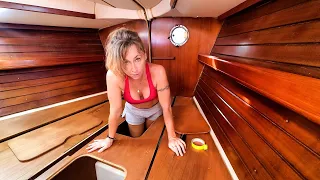
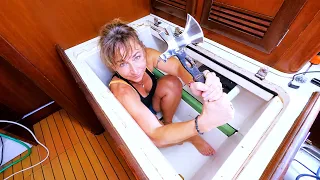
Inside the chest, a central dividing partition separated the temperature zones while securing the thermostat dial. Because the original boatbuilders installed the partition before laminating the countertop down, sliding the panel out intact proved impossible. Sarah measured clearance lines and cut through the divider to clear internal maneuvering room, joking that the cavernous empty chamber could almost serve as a bathtub or jacuzzi next to the stove:
“I’m still going to try and save the fridge, but for that I will probably just make a larger opening first, work my way through the insulation, and then try to make a smaller opening where we can then essentially work on the hole on the inside.”
Cutting Through Foam Insulation to the Outer Laminate
Climbing bodily inside the cleared cold box, Sarah donned protective eyewear and a dust mask, feeling akin to a dentist drilling through dense material. While oscillating multi-tool blades provided clean, straight guide cuts, tight corner clearances required switching back and forth with rotary Dremel cutting wheels:
“This is much easier. But I’m going to put a mask on and glasses because there’s quite some dust coming up. I do also feel a bit like I’m a dentist today because this the dentist”
Once through the inner fiberglass liner, the thick thermal barrier revealed dense polyurethane insulation foam rather than irritating raw fiberglass matting. Chipping away the compressed insulation exposed the inner surface of the vessel’s exterior hull:
“There’s just like one layer of fiberglass on the outside. I think I can see the hole. So, I’m making progress at least. On the outside, there’s actually no fiberglass. It’s the outside, guys. So, it’s just a insulation box now. I can see the liner from here.”
Excavating the foam revealed the locator dowel Sarah had pushed through her exterior pilot drill hole, confirming the exact axis of the hull breach. With access secured through the galley base, structural fiberglass grinding, core replacement, and laminate layups can proceed without compromising the surrounding cabinetry.
Beyond the galley demolition, the broader vessel restoration encompasses extensive systems overhauls across the hull. Future phases include replacing the standing rigging using mechanical Sta-Lok terminals, unstepping the mast for structural inspection, and executing a complete ground-up rewiring of the destroyed navigation electronics.
Frequently Asked Questions
A major hull impact puncture was located directly behind the lower galley refrigerator box, leaving no other physical angle to grind and patch the structural laminate.
The cold box was wider than the cabinet opening, glued directly into the countertop laminate, and mechanically tied to the support columns holding the gimballed stove.
Sarah utilized an oscillating multi-tool for straight plunge cuts and a high-speed Dremel rotary wheel to slice through the interior fiberglass partition.
The refrigeration chamber was lined with dense polyurethane insulation foam rather than raw fiberglass batting, allowing cleaner excavation down to the hull skin.
Book a trip where this was filmed — near Bocas del Toro


Support Sailing SV CUBA
At WeBoating.com, we profoundly acknowledge the unwavering dedication that Sailing SV CUBA invests in crafting each and every video or voyage. Their passion for delivering exceptional ocean content shines through every frame, and it's a labor of love that deserves your attention.
We invite you to watch their captivating videos here and actively engage with their content, including their social media links above. Liking, commenting, and sharing their work goes a long way in fueling their creative fire.
We're also inviting you to explore the gear, sponsorships, and boat partnerships highlighted in the "WE CAN'T SAVE IT 😢… SO WE RIP IT ALL APART! | S2.E211" video description, or directly on YouTube. By engaging with these offerings or purchasing services and items, you directly support Sailing SV CUBA, their collaborators, and the brands they're associated with.
To ensure you never miss an offshore update, consider visiting their official YouTube Channel to subscribe, like, and join their community directly.
If you have any feedback, corrections, or additional information about Sailing SV CUBA or their videos, please use the comment form below to share your thoughts with us.
Thank you for being a part of our community and supporting the creators we cherish. Your time and support truly matter!
Sometimes there's no other way… 😢 It's time to tear things apart and start over. This is going to get messy! 🪓💥 The SV CUBA rebuild continues…
Join us for another real life adventure! ❤️
Wish to support our journey so we can keep sharing the adventure?
Patreon: https://www.patreon.com/svcuba
Buy Salsa a Coffee☕🧡: https://ko-fi.com/salsa_cuba
PayPal: https://www.paypal.com/donate/?hosted_button_id=3GXD7XZH7DXX6

Sailing SV CUBA
Join Enrique and Sarah of Sailing SV CUBA as they document their high-authority transition from office jobs to a Western Caribbean odyssey aboard their Beneteau 461.
Channel Information:
Social Media Links:
WE CAN'T SAVE IT 😢… SO WE RIP IT ALL APART! | S2.E211 Location
- Bocas del Toro, Panama (9.34,-82.24)
Latest Episodes from Sailing SV CUBA
Explore the most recent voyages. Subscribe to the channel to never miss an update!
WE CAN’T SAVE IT 😢… SO WE RIP IT ALL APART! | S2.E211
Sarah and Enrique dismantle the galley refrigerator on SV CUBA to access and inspect a major hull impact breach following their lightning strike.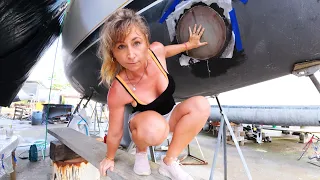
DID WE RUIN OUR FIRST HULL REPAIR?! 😳S2.E210
Enrique and Sarah begin their first fiberglass hull repair on SV CUBA, applying an eight-layer wet-on-wet epoxy laminate under the guidance of a naval architect to restore structural integrity after lightning damage.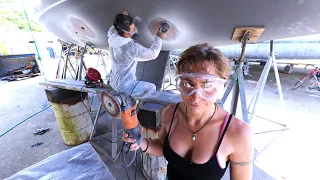
THE AFTERMATH OF A LIGHTNING STRIKE… Break to Fix | S2.E209
Following lightning damage along the Río Dulce in Guatemala, the crew of SV CUBA builds an interior containment tent and prepares stepped fiberglass repair patches.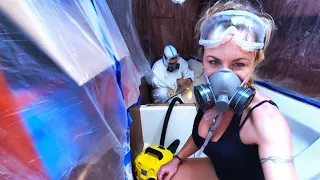
WE CUT INTO OUR HULL… DID LIGHTNING BURN EVERYTHING FROM THE INSIDE?! 😱⚡S2.E208
Enrique and Sarah cut through the interior cabin liner of SV CUBA to inspect core damage after a severe lightning strike, calculating a 12 to 1 structural bevel ratio for exterior 1708 biaxial fiberglass repairs in Rio Dulce, Guatemala.
What does a STRANDED Sailor Girl Do All Day? 😳 Boat Life in Central America S2.E207
Stranded in Rio Dulce, Guatemala after a catastrophic lightning strike on SV Cuba, the crew seals the cabin and hunts for fiberglass supplies to patch hull impact holes.