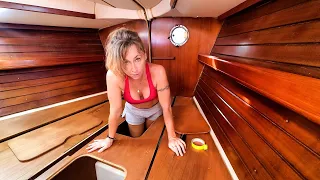
THE AFTERMATH OF A LIGHTNING STRIKE… Break to Fix | S2.E209
Following a devastating lightning strike hauled out along the Río Dulce in Guatemala, the crew of Sailing SV CUBA confronts structural hull damage aboard their Beneteau Oceanis 461. With electrical discharge puncturing the composite laminate, Sarah and Enrique begin a methodical repair operation requiring intrusive deconstruction of the saloon settee to access the exit breaches from the inside.
Before structural grinding and resin work can begin, the crew must isolate the interior cabin from toxic fiberglass dust. Working methodically through tight quarters, Sarah dismantles cabinetry and sets up controlled workshop containment before drafting precise lamination patterns underneath the supported hull.
Interior Saloon Dismantling and Bilge Isolation
The interior repair begins in the main cabin, where the settee locker conceals the two hull exit breaches caused by the lightning strike. To create sufficient maneuvering room, Sarah unbolts and extracts the central island seat. Relocating the main cabin table requires unscrewing the underlying floorboards, temporarily shifting the furniture back into the center aisle so the deep bilge void remains covered and safe to navigate.
Upon removing the cushions and opening the settee base, pilot holes drilled by Enrique reveal encouraging structural alignment. Rather than extending across multiple bulkheads, both strike exit points sit together within a single fiberglass locker. Measuring the interior access confirmed they required approximately 7 inches of working clearance. Realizing that further destructive cutting of adjacent joinery would be unnecessary, Sarah notes that this finding was “shaving at least half a day off my work” during the preparatory phase.
Dust Containment Chamber Setup
Grinding fiberglass releases fine glass dust that quickly ruins electronics and soft furnishings. To safeguard the living spaces aboard SV CUBA, Sarah constructs an airtight containment envelope. Suspending heavy plastic film from an overhead ceiling track originally installed for curtains, she tapes a protective isolation cell around the settee perimeter.
The completed enclosure thoroughly compartmentalizes the cutting area, leaving an open overhead deck hatch to provide controlled airflow in the tropical heat. Surveying the plastic barrier, Sarah jokes that “now it just looks like a crime scene” before handing the enclosed zone over to Enrique for grinding and perimeter beveling.
Under-Hull Workstation and Lamination Shading
Outside under the supported hull, Enrique grinds out damaged composite and shapes smooth tapered bevels around the puncture holes. Preparing to laminate requires strict temperature control, as intense tropical sunlight accelerates epoxy curing before composite layers can be fully wet out and compacted. The crew rigs an extensive tarpaulin under the hull to shield both the laminate and the crew from direct sunlight.
They also position a dedicated resin work table directly beneath the boat to minimize travel distance during the wet layup. Because mixed epoxy offers only a brief working window before exotherming in high ambient temperatures, organizing scissors, rollers, and laminate cuts in close proximity remains essential for structural integrity.
Precision Fiberglass Templates and Stepped Layup Discs
To recreate original hull strength, the crew prepares a progressive stepped laminate schedule consisting of 6 structural fiberglass layers per hole. Sarah tapes transparent plastic directly over the exterior beveled repair zone, tracing the exact contours of the central void and the outer ground edge. She establishes a dedicated witness mark at the top of the template to maintain alignment across asymmetrical bevels.
Transferring the pattern to flat workbench plastic, Sarah plots concentric rings expanding outward at 14 mm increments, with the initial disc cut at 14 mm and subsequent circles stepping out to 28 mm and beyond. Each circular fiberglass patch is carefully numbered. When transferring marks onto woven glass fabric, Sarah deliberately rotates the witness mark on each successive layer, offsetting fiber axes to maximize multidirectional tensile strength.
Interior Backing Plates and Storm Preparation
With afternoon darkness gathering and rain predicted across the Río Dulce basin, Sarah prepares internal backings to support the exterior lamination. Using peel ply combined with a stiff plastic spatula, she constructs temporary barrier plates taped securely against the inner hull over each hole. As Sarah explains, “this will be on the inside of the hole and it will make sure that no fiberglass and epoxy will go inside” while preventing sag and releasing cleanly once the structural epoxy cures.
With both labeled backing plates installed and staged for rapid application, the crew secures the worksite before evening rainfall sets in, ready to execute structural hull laminations under favorable ambient conditions.
Frequently Asked Questions
The crew confirmed that approximately 7 inches of interior clearance inside the saloon settee locker was required to access and work on both lightning impact holes.
Plastic sheeting was suspended from an existing ceiling curtain track to form a sealed containment tent around the settee, keeping dust isolated while an overhead deck hatch supplied ventilation.
Sarah taped transparent plastic over the beveled hull to mark the perimeter and center hole, drew a witness mark for orientation, and measured stepped circular discs starting at 14 mm with 14 mm intervals for six structural layers.
Peel ply and a plastic spatula were taped against the interior hull surface over the holes to prevent wet epoxy and fiberglass from sagging or sticking to the inside liner.
Book a trip where this was filmed — near Placencia

Support Sailing SV CUBA
At WeBoating.com, we profoundly acknowledge the unwavering dedication that Sailing SV CUBA invests in crafting each and every video or voyage. Their passion for delivering exceptional ocean content shines through every frame, and it's a labor of love that deserves your attention.
We invite you to watch their captivating videos here and actively engage with their content, including their social media links above. Liking, commenting, and sharing their work goes a long way in fueling their creative fire.
We're also inviting you to explore the gear, sponsorships, and boat partnerships highlighted in the "THE AFTERMATH OF A LIGHTNING STRIKE… Break to Fix | S2.E209" video description, or directly on YouTube. By engaging with these offerings or purchasing services and items, you directly support Sailing SV CUBA, their collaborators, and the brands they're associated with.
To ensure you never miss an offshore update, consider visiting their official YouTube Channel to subscribe, like, and join their community directly.
If you have any feedback, corrections, or additional information about Sailing SV CUBA or their videos, please use the comment form below to share your thoughts with us.
Thank you for being a part of our community and supporting the creators we cherish. Your time and support truly matter!
Our sailboat was badly damaged by a lightning strike, and now the real work begins. But before we can fix her, we have to keep grinding and cutting 😵💫 - this feels so WRONG.
Follow along as we take on the challenges of repairing a lightning-damaged sailboat and bringing SV CUBA back into the wild.
Patreon: https://www.patreon.com/svcuba

Sailing SV CUBA
Join Enrique and Sarah of Sailing SV CUBA as they document their high-authority transition from office jobs to a Western Caribbean odyssey aboard their Beneteau 461.
Channel Information:
Social Media Links:
Latest Episodes from Sailing SV CUBA
Explore the most recent voyages. Subscribe to the channel to never miss an update!
WE CAN’T SAVE IT 😢… SO WE RIP IT ALL APART! | S2.E211
Sarah and Enrique dismantle the galley refrigerator on SV CUBA to access and inspect a major hull impact breach following their lightning strike.
DID WE RUIN OUR FIRST HULL REPAIR?! 😳S2.E210
Enrique and Sarah begin their first fiberglass hull repair on SV CUBA, applying an eight-layer wet-on-wet epoxy laminate under the guidance of a naval architect to restore structural integrity after lightning damage.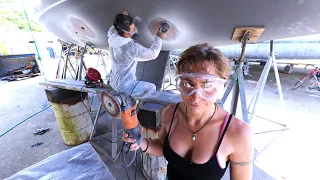
THE AFTERMATH OF A LIGHTNING STRIKE… Break to Fix | S2.E209
Following lightning damage along the Río Dulce in Guatemala, the crew of SV CUBA builds an interior containment tent and prepares stepped fiberglass repair patches.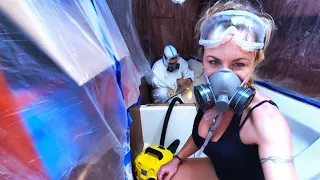
WE CUT INTO OUR HULL… DID LIGHTNING BURN EVERYTHING FROM THE INSIDE?! 😱⚡S2.E208
Enrique and Sarah cut through the interior cabin liner of SV CUBA to inspect core damage after a severe lightning strike, calculating a 12 to 1 structural bevel ratio for exterior 1708 biaxial fiberglass repairs in Rio Dulce, Guatemala.
What does a STRANDED Sailor Girl Do All Day? 😳 Boat Life in Central America S2.E207
Stranded in Rio Dulce, Guatemala after a catastrophic lightning strike on SV Cuba, the crew seals the cabin and hunts for fiberglass supplies to patch hull impact holes.