Ep 398 | DODGING SHIPS and Our First Belgian Beer Review, European Vacation
At kilometer mark 988 along the inland waterways of South Holland, Magnus and Wendy Eriksson steer their 29-foot Westerly Konsort Duo motorsailer Little Nutshell directly into one of Europe’s most congested river intersections. Crew planner Dennis had begun reviewing fairway charts and navigational timing at 2:00 in the morning to prepare for the relentless stream of commercial freight vessels. Operating aboard Life in a Nutshell, the crew faces an intense shipping corridor where massive steel cargo vessels transit at full cruising speed with minimal stopping distance.
Waiting along the channel boundary, Magnus studies the gaps between oncoming hulls to calculate a safe crossing trajectory. The commercial vessels show no signs of slowing down, forcing the small cruising yacht to commit decisively between approaching freighters. “They’re back to back. And they’re hooning,” Magnus observes as he identifies a narrow window behind one cargo ship while keeping ahead of another fast-closing vessel. Wendy watches the stern wave of the lead ship while monitoring the distance to the following freighter, urging focus during the crossing: “Don’t look back. No, don’t look back. It’s freaky.” Clearing the commercial channel without disrupting the commercial traffic allows the crew to breathe a sigh of relief as they reach the calmer margins of the junction.
Heavy Freight Barges and Free Canal Infrastructure
Navigating beyond the primary fairway, the scale of European inland transport becomes unmistakable. Magnus and Wendy pace alongside coupled commercial freight barges running in tandem along the deep-water channel. Sighting the immense articulated formation, Magnus notes the dimensions of the joined hulls: the rear vessel measures 110 meters while the forward section spans 68 meters. The immense mass of the combined vessels requires significant stopping distance, underscoring why small cruising craft must maintain strict vigilance and situational awareness.
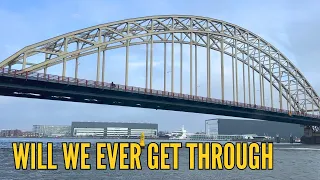
Approaching the next waterway junction, Little Nutshell pulls into a designated sidearm to wait for scheduled bridge operations. High vertical clearances allow low-profile workboats to pass beneath the fixed roadways without disruption, but the mast of the 29-foot Westerly motorsailer demands an opening span. Dutch bridge controllers manage the traffic with automated red-and-green light sequences, signaling when mariners should prepare their approach. To the crew’s delight, three separate bridges swing open in rapid succession solely to permit their passage into the interior canal system. Observing the smooth public operations, Wendy remarks, “This whole canal network is free.” The absence of transit tolls and the efficiency of the provincial waterway management demonstrate why cruising through the Netherlands remains a favored route for seasoned liveaboard cruisers.
Sunday Morning Ashore in Dordrecht
Mooring Little Nutshell at a quiet transit berth, the crew steps ashore around 9:00 on Sunday morning to explore Dordrecht, recognized as the oldest town in Holland. Having crossed into the province of South Holland after leaving Zealand, the crew finds the cobblestone streets nearly deserted during the early morning hours. Shuttered cafes and quiet brick facades provide a serene contrast to the intense industrial traffic of the river intersection.
Walking toward the town square, Wendy admires the traditional Dutch architecture, pointing out distinctive red-and-white window shutters and steep clay roof tiles. Local storefronts reveal quaint neighborhood character, showcasing antique curiosities including a vintage Cadillac Dinky diecast vehicle and collectible toy rabbits that catch the couple’s attention. A quiet tabby cat rests undisturbed in a shop window, while aromas from local bakeries begin drifting into the cold morning air. Before returning to their vessel, Magnus and Wendy locate an open supermarket to gather fresh vegetables and supplies for the upcoming transit days.
The Indefinite Failure of the SP Bridge
Reboarding Little Nutshell, the crew prepares to resume their journey toward the northern canal network. Passing beneath the historic Church bridge, Magnus guides the boat toward the designated bridge corridor to request an opening. A local pilot boat maneuvers alongside a large freight vessel, coordinating its transit through the narrow bridge span as Little Nutshell waits for the red-and-green signal sequence.
Routine navigation suddenly collapses when the crew contacts the bridge operator to confirm the schedule for the SP bridge. The controller issues a blunt advisory over the radio, informing the vessel that the bridge has suffered an operational breakdown and is out of order. Recent technical inspections had revealed severe mechanical faults, forcing provincial authorities to shut down the lifting mechanism immediately. As Wendy confirms after monitoring the situation, “So, we’ve hit a dead end. The bridge is closed indefinitely.” With their mast requiring 1 to 1.5 meters of additional clearance to pass beneath the closed span, Little Nutshell cannot proceed. Waiting for extreme spring tides would require at least a week with no guarantee of sufficient air draft, while an alternate repaired bridge further along the system opens for only 1 hour every Friday, leaving the crew stranded for 5 days unless they alter their plans.
Winter Currents and Reversing Course
Confronted with an impassable barrier, Magnus turns Little Nutshell around, retracing their entire morning course along the canal. The ebb tide creates a demanding counter-current along the channel, reducing their transit speed over ground. Monitoring the instruments as the engine works against the incoming rush of water, Wendy notes, “We’re now doing 2.7 to three knots against the tide.”
Motor-sailing against the swift flow requires patience and steady throttle management as commercial barges continue using the deep fairway. The detour forces the crew to re-evaluate their regional itinerary and seek out an alternate winter berth. Retracing the day’s journey highlights the unpredictable nature of cruising European inland waterways, where a single mechanical failure on a municipal bridge can halt progress across an entire province.
Technical Waterway and Transit Logistics
| Navigational Metric | Recorded Observation | Operational Context |
|---|---|---|
| Fairway Position | Kilometer mark 988 | High-density river intersection in South Holland carrying commercial freight |
| Tandem Freight Barges | 110 meters rear and 68 meters front | Coupled commercial cargo vessels transiting inland shipping fairway |
| Mast Clearance Deficit | 1 to 1.5 meters | Overhead air draft clearance deficit halting passage beneath closed bridge |
| Counter-Current Speed | 2.7 to 3 knots | Upstream vessel speed over ground against falling tide |
| Winter Chill Factor | 1 degree feels like minus 8 | Severe winter conditions requiring four layers of clothing |
| La Trappe Dubbel Specs | 8 percent ABV and 15 degrees Celsius | Bottle volume 330 ml served at calibrated temperature aboard Little Nutshell |
| Historical Profit Ale | 4 percent ABV | Standard monastic workers ale brewed for daily sustenance |
| Alternate Span Opening | 1 hour every Friday | Repaired bridge schedule requiring a 5 days waiting period |
| Sensory Score Evaluation | Eight and a half upgraded to 9 | Formal tasting score out of 10 points awarded by Magnus |
Sub-Zero Temperatures and Supermarket Discoveries
After hours of pushing against the current, Magnus locates a municipal marina offering temporary shelter for the night. Along the pontoons, maintenance workers systematically prune deciduous branches from the trees lining the basin. The bitter winter weather intensifies as dusk approaches, driving the apparent temperature down toward sub-zero levels. Wendy wraps herself in heavy thermal layers, observing, “It’s a four layer day. Not very often I have four layers on.” Magnus, who ventured out in only 2 layers of outerwear, quickly admits that he underdressed for the conditions as the cold begins numbing his fingers. He estimates the ambient chill: “one degree feels like minus 8.”
Despite the biting cold, signs of early seasonal change emerge along the quayside, where flowering daffodils bloom beside an outdoor cafe terrace. Seeking hot nourishment and winter provisions, the crew visits a local grocery store in town. While cruising in Belgium for 7 to 10 days prior to entering the Netherlands, Magnus had intentionally resisted sampling Belgian beers, fearing that the celebrated abbey ales might overshadow his long-standing preference for classic English bitters and porters. However, with local waterfront pubs shuttered for the winter season and Little Nutshell tied securely in South Holland, Magnus decides the time has come to conduct his very first review of a monastic Trappist ale.
Monastic Origins of the Trappist Brewing Tradition
Standing before the supermarket shelves, Magnus selects a bottle of Dutch La Trappe Dubbel. The purchase prompts a historical discussion regarding the strict legal criteria that define authentic Trappist monastic brewing. Authentic Trappist beer must be brewed within the physical walls of a Trappist monastery, either directly by monks or under their immediate supervision. The commercial brewing operation must remain strictly secondary to the religious life and spiritual duties of the monastic community. Thirdly, all proceeds generated from beer sales must go to the upkeep of the monastery, with any remaining funds donated to charity.
Magnus explains that only 14 certified Trappist breweries exist worldwide, with the vast majority situated in Belgium and a single historic foundation located in the Netherlands. The tradition traces its roots to French monks who fled political upheaval during the late 1700s and early 1800s, settling in the Netherlands in the 1820s to establish the brewery known as La Trappe. Monastic brewing originally developed around a low-alcohol table beer of 1.5 to 2 percent ABV, often referred to as liquid bread. As brewing practices evolved, monasteries began crafting a 4 percent ABV profit beer for local laborers, eventually expanding into rich, higher-gravity styles. Under monastic conventions, the terms Dubbel, Tripel, and Quadrupel do not describe color, but denote the progressive doubling, tripling, and quadrupling of raw ingredients. This scaling results in a Dubbel containing around 8 percent ABV, a Tripel ranging around 9 percent ABV, and a Quadrupel reaching 10 percent ABV.
Cabin Tasting and Infrared Temperature Evaluation
Back inside the warm saloon of Little Nutshell, Magnus carefully prepares the 330 ml bottle of La Trappe Dubbel for tasting. Because the ambient interior temperature had dropped during their day on the water, he rests the bottle in front of the cabin heater until it reaches an ideal serving temperature of 15 degrees Celsius. To confirm the reading, he employs a modern digital infrared thermometer, playfully dubbed the 21st century colonometer in memory of a vintage glass instrument gifted years earlier by an English friend named Colin.
Magnus unearths a heavy vintage steel bottle opener stamped “Made in England,” discovered onboard during their purchase of Little Nutshell, using its sturdy lever to uncap the bottle. Pouring the ale into an English pint glass while commercial ships churn past the cabin window, both Magnus and Wendy express surprise at its appearance. Rather than the opaque, dark porter they anticipated, the beer exhibits a lighter, amber-brown hue with a dense, persistent foam head produced by bottle fermentation. The aroma yields notes of dried figs, dates, bananas, and rich caramel reminiscent of banoffee pie. Upon tasting, Magnus discovers a pronounced roasted bitterness that cuts cleanly through the sweet malty bouquet. Wendy tastes notes of honey and chocolate, remarking on the brew’s clean finish and deceptively concealed 8 percent alcohol content. Impressed by its depth and drinkability, Magnus assigns the ale an initial score of eight and a half out of 10 before revising his judgment upward: “I’m going to go higher. I’m going to go nine.” Settling into their compact cabin as evening settles over the Dutch waterways, the crew reflects that despite frozen decks and unexpected detours, life aboard their 29-foot cruiser feels completely like home.
Frequently Asked Questions
The vessel encountered an indefinite closure at the SP bridge caused by a mechanical failure discovered during inspection, leaving the mast 1 to 1.5 meters too tall to pass beneath the closed span.
Magnus and Wendy had to navigate across a congested commercial shipping intersection where large cargo vessels, including coupled freight barges measuring 110 meters and 68 meters, travelled back to back at high speeds.
Monastic Trappist designations reflect multiplying the raw brewing ingredients rather than color alone, resulting in a Dubbel at 8 percent ABV, a Tripel at 9 percent ABV, and a Quadrupel at 10 percent ABV.
Magnus warmed the 330 ml bottle in front of the cabin heater to exactly 15 degrees Celsius, measuring it with an infrared digital thermometer, and awarded it an initial score of eight and a half before upgrading to 9 out of 10.
Book a trip where this was filmed — near Amsterdam
Support Life in a Nutshell
At WeBoating.com, we profoundly acknowledge the unwavering dedication that Life in a Nutshell invests in crafting each and every video or voyage. Their passion for delivering exceptional ocean content shines through every frame, and it's a labor of love that deserves your attention.
We invite you to watch their captivating videos here and actively engage with their content, including their social media links above. Liking, commenting, and sharing their work goes a long way in fueling their creative fire.
We're also inviting you to explore the gear, sponsorships, and boat partnerships highlighted in the "Ep 398 | DODGING SHIPS and Our First Belgian Beer Review, European Vacation" video description, or directly on YouTube. By engaging with these offerings or purchasing services and items, you directly support Life in a Nutshell, their collaborators, and the brands they're associated with.
To ensure you never miss an offshore update, consider visiting their official YouTube Channel to subscribe, like, and join their community directly.
If you have any feedback, corrections, or additional information about Life in a Nutshell or their videos, please use the comment form below to share your thoughts with us.
Thank you for being a part of our community and supporting the creators we cherish. Your time and support truly matter!
Sailing through South Holland turns into a full‑blown game of dodging ships, timing bridge openings, and navigating closures that stop us in our tracks. After threading our way through one of Europe’s busiest river intersections, we finally hit a dead end: a bridge closed indefinitely. So… back we go, retracing the entire day’s journey and waiting a few more days before we can continue along the canal.
It’s icy—proper “four‑layer weather”—but the scenery is gorgeous, the towns are sleepy and sweet, and the supermarket discoveries are fun. And to warm things up, Magnus does his very first Belgian beer review.
The Trappist Dubbel surprises us: lighter than expected, full of caramel and fruit on the nose, bitter on the palate, and honestly… it's Not Bad!
Hope you enjoy this episode of life afloat in the Netherlands.
Hope you enjoy the episode.
Until next time,
Wendy and Magnus
HYPE US!
If you’d like to give our channel a boost, tap the HYPE button. It’s a brand‑new YouTube feature that helps small creators like us rise above the noise and get discovered by more viewers. Every tap genuinely makes a difference for our little community.
——
VALKRY BBQ, SMOKER, ROTISSERIE
If you’d like to get your own VALKRY BBQ, you can use our link below. It won’t cost you anything extra, but it helps support our channel.
https://www.valkry.com/?sca_ref=10252671.3CPHxDmU43n4
LibertyKite, Australia
For more information:
www.navtrak.com.au
Wendy Eriksson’s Paintings
Art Lovers Australia: https://artloversaustralia.com.au/artist/wendy-eriksson
Bluethumb: https://bluethumb.com.au/artworks/popular/wendy-eriksson
Facebook: https://www.facebook.com/StudioWhitsunday/
Where’s Nutshell now:
See where we are in real-time
https://www.patreon.com/lifeinanutshell
If you’d like to keep us moving and support us, you can become a Patron for as little as $1 per month.
https://www.patreon.com/lifeinanutshell
Be up to date with what we’re up to and where we are. You can support our channel by simply liking us on Facebook!
www.facebook.com/nutshellliving
If you’d like to buy us a beer:
paypalme/lifeinanutshell.com
We’re on Instagram too!
https://www.instagram.com/nutshellliving/
Follow us on Twitter!
https://twitter.com/Nutshellliving
Epidemic Sound Music Credit:
Four Steps Ahead
Sidewalk
Green Trees
Anywhere
#SailingVlog #TheNetherlands #WesterlyDuo
SUBSCRIBE BUTTON CLICK link to http://www.anfx.co.
Life in a Nutshell
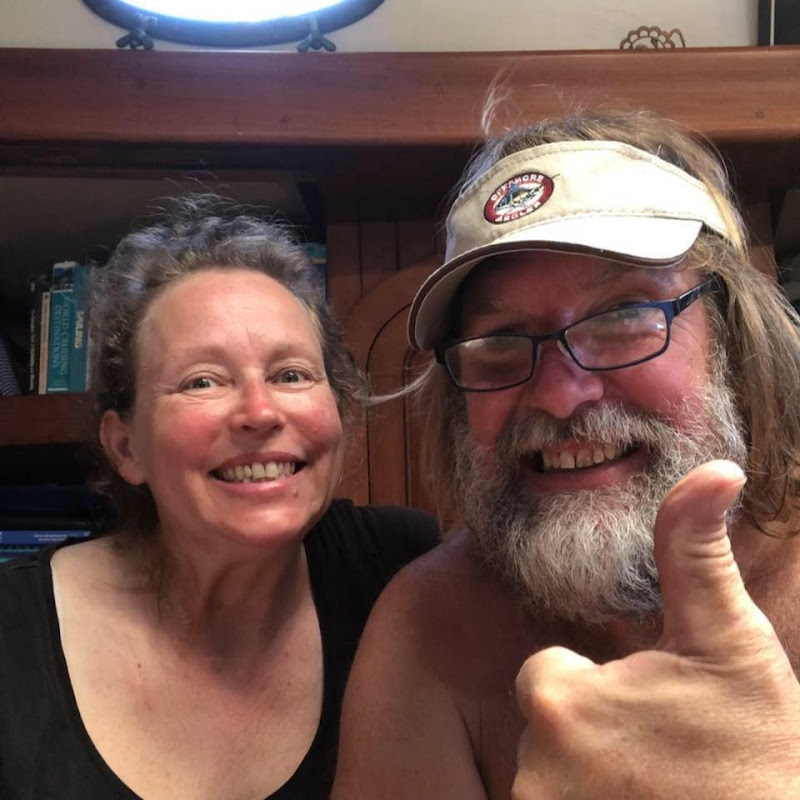
From the Kimberley wilds to the Dutch canals, Magnus and Wendy of Life in a Nutshell define the technical grit of slow, aesthetic offshore exploration.
Channel Information:
Social Media Links:
Ep 398 | DODGING SHIPS and Our First Belgian Beer Review, European Vacation Location
- Dordrecht, South Holland, Netherlands (51.8133,4.6739)
Latest Episodes from Life in a Nutshell
Explore the most recent voyages. Subscribe to the channel to never miss an update!
Ep 400 | Ships, Bridges and Holdups, European Vacation
Magnus and Wendy Eriksson pilot their Westerly Konsort Duo 29, Nutshell, across Rotterdam's shipping junction, past a 4-day bridge hold-up, into Gouda for a wheat beer review, and through 18 bridges toward Leiden.
Ep 399 | DODGY BEER, REVIEW and the OLDEST city in Holland, European Vacation
Magnus and Wendy navigate freezing canals around Dordrecht, review a 900-year heritage Grimbergen Triple, decipher Dutch waterway regulations, and source refit hardware.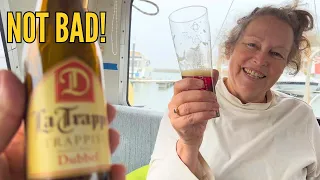
Ep 398 | DODGING SHIPS and Our First Belgian Beer Review, European Vacation
Magnus and Wendy navigate high-density commercial freight traffic across kilometer mark 988 in South Holland, encounter an indefinite bridge closure, and review an authentic Dutch Trappist Dubbel aboard Little Nutshell.
Live Stream Gota Canal Day 6 Sweden
Travel with us as we make our way along the Gota Canal in Sweden. The GÖTA CANAL is a historic 190 km waterway in southern Sweden. Built in the early 1800s, it features 58 locks and connects the Baltic Sea to Lake Vänern. It operates as an iconic leisure route, allowing travelers to cruise or bike ...
Live Stream Gota Canal Day 6 Sweden
Travel with us as we make our way along the Gota Canal in Sweden. The GÖTA CANAL is a historic 190 km waterway in southern Sweden. Built in the early 1800s, it features 58 locks and connects the Baltic Sea to Lake Vänern. It operates as an iconic leisure route, allowing travelers to cruise or bike ...