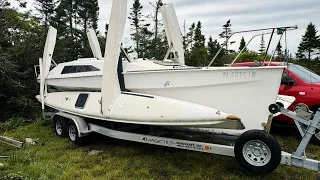
I MESSED UP Trying to Lift the Boat, so I Switch Gears for a Day | Learning the Lines
On their rural property and restoration yard, Jordan of Learning the Lines returned to the long-term restoration of their classic sailboat project, Desperado. Committed to advancing the vessel toward seaworthiness after years of relocations, the immediate objective centered on solving a perennial boatbuilder’s dilemma: lifting a multi-ton sailboat safely off its road trailer to access the entire underbody for bottom prep and barrier coat application.
Working without the heavy infrastructure of a commercial boatyard Travelift requires innovative, highly cautious rigging and shoring methods. Attempting to elevate a keelboat at four independent points requires balancing mechanical leverage, structural load paths, and safety margins against the ever-present danger of hull shifting or stand collapse.
Engineering DIY Wooden Boat Stands and Screw Jacks
Commercial marine jackstands can represent a significant expense for amateur boatbuilders. Jordan designed a budget-conscious, heavy-duty alternative using dimensional framing timber and mechanical heavy-equipment screw jacks. The plan involved constructing four matching pyramid-style timber support stands:
- Timber Staging Geometry: Utilizing laminated 2×4 framing lumber assembled with extensive structural fasteners to create broad, low-center-of-gravity bases capable of distributing vertical point loads across unpaved ground.
- Mechanical Screw Jack Integration: Mounting four heavy-duty acme-thread screw jacks on top of the timber pedestals to allow incremental, millimeter-level height adjustments beneath the hull chine.
- Trailer Clearance Strategy: Lifting the hull in alternating fractional stages—bow, stern, port, and starboard—to clear the trailer crossmembers and rollers, allowing the trailer to be rolled out from underneath.
Recognizing Safety Limits and Managing Tool Delays
During the fabrication process, Jordan encountered logistical friction due to essential tools being split between different work sites. Rather than rushing an unverified, incomplete lifting arrangement or compromising on structural fasteners, Jordan made the disciplined decision to halt the lift until the proper tools and secondary safety timbers were on hand.
Lifting a sailboat is an operation where zero compromises are permitted; an unstable jackstand or asymmetrical lift can easily tip a hull, causing catastrophic structural fiberglass damage or severe personal injury. Recognizing when to pause a high-risk maritime operation is a fundamental hallmark of seasoned seamanship and workshop safety.
Pivoting to Homestead Stewardship and Next Steps
Refusing to lose valuable work time, Jordan pivoted to land stewardship around their homestead and newly excavated pond. Managing overgrowth, preparing ground for tree planting, and establishing biodiversity corridors around the property reflect the dual lifestyle of rural homesteaders balancing extensive boat restoration with sustainable land management.
With tools consolidated and safety cribbing prepared, the next phase will see Desperado fully supported on its dedicated four-point stand system, clearing the way for extensive keel grinding, fairing, and epoxy barrier coat application before antifouling paint.
Project Desperado Lifting and Restoration Log
The technical parameters and staging plan for Desperado’s hull lifting project are summarized below:
| Project Element | Specification / Material | Restoration Role & Safety Objective |
|---|---|---|
| Vessel Project | Desperado (Classic Sailboat) | Long-term hull restoration and preparation for bottom coatings |
| Lifting Target | Four-Point Perimeter Support | Elevate hull off trailer bunks to expose keel and underwater profile |
| Stand Construction | Laminated 2×4 Timber Frames | Cost-effective wide-base pedestals with heavy screw fasteners |
| Jack Mechanism | Acme-thread mechanical screw jacks | Enables controlled, incremental lifting without hydraulic seal risk |
| Safety Protocol | Immediate Halt on Tool Discrepancy | Zero-tolerance safety pause preventing unstable or asymmetrical lifting |
| Upcoming Phase | Keel fairing and barrier coat | Epoxy moisture barrier protection prior to seasonal antifouling |
Frequently Asked Questions
Jordan is restoring Desperado, a classic sailboat undergoing bottom prep and eventual barrier coating.
He designed four custom wooden boat stands built from 2×4 lumber paired with mechanical screw jacks for incremental lifting.
Jordan stopped the lift because required tools were split across multiple locations, choosing safety over rushing an unverified lift.
Lifting the boat allows unobstructed access to the bottom for keel fairing, hull inspection, and applying an epoxy barrier coat.
Support Learning the Lines
At WeBoating.com, we profoundly acknowledge the unwavering dedication that Learning the Lines invests in crafting each and every video or voyage. Their passion for delivering exceptional ocean content shines through every frame, and it's a labor of love that deserves your attention.
We invite you to watch their captivating videos here and actively engage with their content, including their social media links above. Liking, commenting, and sharing their work goes a long way in fueling their creative fire.
We're also inviting you to explore the gear, sponsorships, and boat partnerships highlighted in the "I MESSED UP Trying to Lift the Boat, so I Switch Gears for a Day | Learning the Lines" video description, or directly on YouTube. By engaging with these offerings or purchasing services and items, you directly support Learning the Lines, their collaborators, and the brands they're associated with.
To ensure you never miss an offshore update, consider visiting their official YouTube Channel to subscribe, like, and join their community directly.
If you have any feedback, corrections, or additional information about Learning the Lines or their videos, please use the comment form below to share your thoughts with us.
Thank you for being a part of our community and supporting the creators we cherish. Your time and support truly matter!
I attempted DIY boat stands but ran into an issue with having tools in multiple locations. Not wanting to waste the limited time I had, I decided to work on prepping our property for tree planting.
A few years and another country later, we're back at the Desperado project and committed to at least getting her in the water in 2027. Follow along for the DIY boat work aboard this 1991 Corsair F-27 performance folding trimaran.
Used in the video:
https://s.vevor.com/QT1PAT

Learning the Lines
Join Jordan and Randi of Learning the Lines as they document their 2026 North Atlantic shakedown and trimaran restoration in Nova Scotia.
Channel Information:
Social Media Links:
I MESSED UP Trying to Lift the Boat, so I Switch Gears for a Day | Learning the Lines Location
- Learning the Lines Restoration Yard, Nova Scotia (44.682,-63.7443)
Latest Episodes from Learning the Lines
Explore the most recent voyages. Subscribe to the channel to never miss an update!
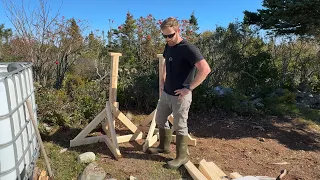
I MESSED UP Trying to Lift the Boat, so I Switch Gears for a Day | Learning the Lines
Jordan of Learning the Lines tackles DIY wooden boat stands and screw jacks to lift project sailboat Desperado off its trailer for hull barrier coating.
I MESSED UP Trying to Lift the Boat, so I Switch Gears for a Day | Learning the Lines
Jordan and Randi of Learning the Lines engineer DIY timber boat stands to lift their boat for bottom paint, navigating a tool logistical snag by pivoting to Nova Scotia land stewardship.
Why Are There So Many Holes in Our Boat? | Learning the Lines
Removing the seemingly infinite amount of deck hardware and sealing the boat again is a major task when there's this much deck hardware on a small boat. A few years and another country later, we're back at the Desperado project and committed to at least getting her in the water in 2027. F...
DON’T DO THIS With Your Marine Paint | Learning the Lines
I have to say that while I did literally close to everything wrong, the @TotalBoat paint still performed amazingly. If it performs this well when you do everything wrong, it must be a legendary product when you actually follow the instructions! I also went ahead and opened up the boat to prep Desp...
Sailboat ABANDONED for Years, What Are the Consequences Here? | Learning the Lines
The phrase of the day is "cautiously optimistic." A few years and another country later, we're back at the Desperado project and committed to at least getting her in the water in 2027. Follow along for the DIY boat work aboard this 1991 Corsair F-27 performance folding trimaran.