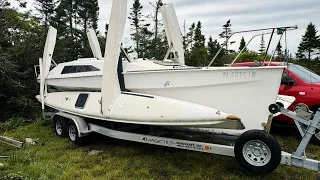
I MESSED UP Trying to Lift the Boat, so I Switch Gears for a Day | Learning the Lines
The daily reality of ambitious boat refits often pivots on unscripted logistical bottlenecks. For Jordan and Randi of Learning the Lines, restoring vessels and establishing a maritime homestead in Nova Scotia demands constant diagnostic agility. Facing the formidable task of elevating a multihull off its road trailer to execute essential hull leveling and bottom antifouling application, the refit itinerary meets an unexpected obstacle: fabricated timber boat stands, hydraulic lifting geometry, and tools stranded between workshop locations.
Rather than burning daylight to force an incomplete lift that could compromise hull safety, the crew makes an experienced boatyard calculation. Pivoting resources away from a stalled lift operation to land-based property cultivation illustrates the disciplined patience required for long-term boat ownership. Documenting this interplay between timber fabrication, mechanical rigging, and maritime homesteading, this episode captures the practical grit behind DIY vessel maintenance.
Engineering DIY Timber Boat Stands for Hull Leveling
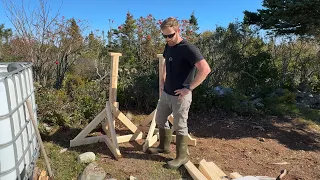
To prepare the vessel for bottom prep, scraping, and toxic antifouling painting, Jordan sets out to fabricate four custom heavy-timber boat stands. Commercial metal jack stands can be prohibitively expensive and often lack the wide footprint required on uneven gravel or soft turf. Utilizing dimensional structural timbers—reinforced upright posts, gusseted angle braces, and wide load-distributing base plates—Jordan constructs a set of four matching stands designed to support hydraulic bottle jacks beneath the hull’s primary structural bulkheads.
The objective is straightforward yet unforgiving: systematically raise the boat several inches off its trailer bunks, slide crossbeams underneath, and stabilize the craft at four level points. This clearance is vital to ensure full access to the keel bottom, skegs, and underbody surfaces covered by trailer rollers. Working with chop saws, heavy structural lag screws, and impact drivers, Jordan details the exact bracing geometry necessary to eliminate lateral racking under multi-ton dynamic loads.
The Tool Logistical Snag: Knowing When to Pause a Heavy Lift
As the lifting sequence commences, a critical logistical snag emerges for Learning the Lines. Undertaking complex mechanical operations across multiple work sites means vital specialized tooling—including specific hydraulic bottle jack extensions, leveling lasers, and high-torque socket sets—remains at a secondary property miles away. Attempting to lift a heavy marine hull using improvised shims or mismatched jacks introduces catastrophic tipping hazards that no prudent mariner should accept.
Recognizing that forcing the operation under compromised conditions invites structural damage to the hull or personal injury, Jordan makes the conscious decision to halt the boat lift. This tactical pause reflects an essential rule of the boatyard: never rush a critical rigging or lifting maneuver when safety margins cannot be verified with the correct equipment.
Maritime Homesteading: Pivoting to Nova Scotia Property Stewardship
Refusing to surrender productive daylight, Jordan and Randi redirect their energy toward essential property management on their Nova Scotia homestead. The maritime climate of Atlantic Canada offers fleeting windows of mild weather, making land cultivation, soil grading, and forestry preparation just as time-sensitive as fiberglass cure cycles. The team shifts from carpentry joinery to ground clearance, prepping garden tracts and earthworks for upcoming orchard and windbreak tree planting.
This dual identity—blending ocean voyaging skills with rural homesteading—characterizes modern cruisers who build shore-based support hubs. Planting deep-rooted trees along coastal perimeters buffers maritime gales, preserves topsoil against North Atlantic erosion, and provides long-term self-sufficiency that supports extended sea expeditions.
Boatyard Refit Specs & Timber Stand Engineering
| Refit Parameter | Technical Specifications |
|---|---|
| Channel | Learning the Lines |
| Project Leaders | Jordan & Randi |
| Project Location | Nova Scotia, Canada (Atlantic Coast) |
| Primary Task | Fabricating heavy-duty DIY timber boat stands & trailer lift |
| Stand Materials | Structural dimensional lumber, 45-degree gussets, lag bolts, base pads |
| Lifting Mechanism | Hydraulic bottle jacks at four balanced structural lift points |
| Maintenance Goal | Clearing trailer bunks for hull leveling, sanding & bottom antifouling |
| Secondary Workflow | Homestead windbreak tree planting & coastal terrain grading |
Frequently Asked Questions
The boat needed to be raised several inches off the trailer bunks and rollers to allow the hull to be leveled accurately and provide complete access for sanding and applying marine bottom antifouling paint.
The stands were built using heavy dimensional structural lumber featuring wide footprint base plates, vertical support uprights, and diagonal 45-degree gusseted bracing secured with heavy-duty structural lag screws.
Crucial hydraulic extensions and leveling tools were located at a secondary property. Rather than risking a dangerous lift with improvised equipment, Jordan paused the operation until the proper tools could be retrieved.
Jordan and Randi are based in Nova Scotia, Canada, where they combine coastal maritime homesteading with long-term boat restoration and North Atlantic cruising preparation.
They switched gears to clear terrain, grade soil, and prepare planting sites for orchard and windbreak trees, optimizing fair weather for their homestead before returning to the boatyard refit.
Support Learning the Lines
At WeBoating.com, we profoundly acknowledge the unwavering dedication that Learning the Lines invests in crafting each and every video or voyage. Their passion for delivering exceptional ocean content shines through every frame, and it's a labor of love that deserves your attention.
We invite you to watch their captivating videos here and actively engage with their content, including their social media links above. Liking, commenting, and sharing their work goes a long way in fueling their creative fire.
We're also inviting you to explore the gear, sponsorships, and boat partnerships highlighted in the "I MESSED UP Trying to Lift the Boat, so I Switch Gears for a Day | Learning the Lines" video description, or directly on YouTube. By engaging with these offerings or purchasing services and items, you directly support Learning the Lines, their collaborators, and the brands they're associated with.
To ensure you never miss an offshore update, consider visiting their official YouTube Channel to subscribe, like, and join their community directly.
If you have any feedback, corrections, or additional information about Learning the Lines or their videos, please use the comment form below to share your thoughts with us.
Thank you for being a part of our community and supporting the creators we cherish. Your time and support truly matter!
I attempted DIY boat stands but ran into an issue with having tools in multiple locations. Not wanting to waste the limited time I had, I decided to work on prepping our property for tree planting.
A few years and another country later, we're back at the Desperado project and committed to at least getting her in the water in 2027. Follow along for the DIY boat work aboard this 1991 Corsair F-27 performance folding trimaran.
Used in the video:
https://s.vevor.com/QT1PAT
Learning the Lines
Join Jordan and Randi of Learning the Lines as they document their 2026 North Atlantic shakedown and trimaran restoration in Nova Scotia.
Channel Information:
Social Media Links:
I MESSED UP Trying to Lift the Boat, so I Switch Gears for a Day | Learning the Lines Location
- Learning the Lines Boatyard & Homestead, Nova Scotia, Canada (44.682,-63.7443)
Latest Episodes from Learning the Lines
Explore the most recent voyages. Subscribe to the channel to never miss an update!
I MESSED UP Trying to Lift the Boat, so I Switch Gears for a Day | Learning the Lines
Jordan of Learning the Lines tackles DIY wooden boat stands and screw jacks to lift project sailboat Desperado off its trailer for hull barrier coating.
I MESSED UP Trying to Lift the Boat, so I Switch Gears for a Day | Learning the Lines
Jordan and Randi of Learning the Lines engineer DIY timber boat stands to lift their boat for bottom paint, navigating a tool logistical snag by pivoting to Nova Scotia land stewardship.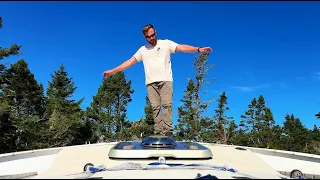
Why Are There So Many Holes in Our Boat? | Learning the Lines
Removing the seemingly infinite amount of deck hardware and sealing the boat again is a major task when there's this much deck hardware on a small boat. A few years and another country later, we're back at the Desperado project and committed to at least getting her in the water in 2027. F...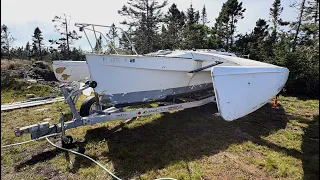
DON’T DO THIS With Your Marine Paint | Learning the Lines
I have to say that while I did literally close to everything wrong, the @TotalBoat paint still performed amazingly. If it performs this well when you do everything wrong, it must be a legendary product when you actually follow the instructions! I also went ahead and opened up the boat to prep Desp...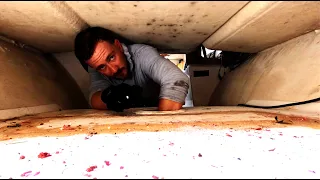
Sailboat ABANDONED for Years, What Are the Consequences Here? | Learning the Lines
The phrase of the day is "cautiously optimistic." A few years and another country later, we're back at the Desperado project and committed to at least getting her in the water in 2027. Follow along for the DIY boat work aboard this 1991 Corsair F-27 performance folding trimaran.