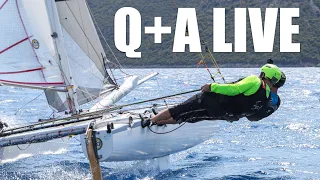
Hobie 16 Race Training — Just Two Boats and Two Buoys
Off the coast of Progreso near Merida, Mexico, Joe Bennett of Joyrider TV teamed up with local sailor Gerardo for a catamaran race training session aboard two Hobie 16 catamarans. Following earlier drills that focused strictly on start-line sequences, the two sailors anchored a windward mark to run complete two-lap sprint heats. Operating both beach catamarans solo without crew, each helm had to manage the mainsail, jib sheets, traveler, and trapeze unassisted while maintaining boat speed around the tight short course.
Starting in around 10 knots of wind, the session pushed both sailors into rapid two-minute countdown sequences. The short course left little margin for sluggish tacks, delayed mark roundings, or tangled control lines, turning each two-lap race into an immediate test of boat handling, positioning, and solo catamaran sail trim.
Race 1: Introducing the Windward Mark
To initiate the first heat, Joe set a two-minute countdown timer. Because he was sailing short-handed without a dedicated crew member to handle the foredeck, he hauled the jib sheet in tight before the start. Clearing the line on starboard tack, Joe monitored his approach to the upper turn, choosing not to push all the way to the port lay line to avoid exhausting his tactical options before the buoy.
As the boats converged on the windward mark, Gerardo rounded from the opposite approach with a clean jib setup. Bearing away onto the downwind leg, Joe evaluated sail adjustments. Rather than expending energy trimming the traveler lines while steering through chop, Joe decided to leave the car stationary, noting that “messing around doing things is going to hold us up more than the speed that we gain.” With Gerardo taking a wide exit off the lay line, both sailors completed their initial lap and established their upwind tracks.
Race 2: Close-Quarters Tactics and Rope Management
As light rain began falling across the race area, Joe delivered a sharp start off the pin, remarking on the improvement over previous sessions. Off the line, Gerardo held a tight position down to leeward, pinning Joe and preventing him from bearing away to release maximum hull speed. Joe maintained a defensive line before tacking across, noting that shorter and cheaper sheets would simplify line management during solo maneuvers.
Approaching the windward buoy, Joe un-cleated the mainsheet and traveler ready to bear away. To prevent being thrown forward off the platform during the transition, he secured his stance by gripping the toe strap and shifted his weight forward to drive deep downwind. With Gerardo holding the inside line, Joe looked for clear lanes, though tangled sheets proved troublesome: “That’s an example of messing around with ropes when we should have been messing around by course.” After a brief stall while tacking on the second beat, Joe bore off immediately to regain speed.
Race 3: Leeward Space and Trapeze Refinement
In the third heat, Joe adjusted his starting tactic by bearing away to the leeward side with 32 seconds on the clock to generate speed before the final countdown. Starting below Gerardo gave him clean air to accelerate upwind, prompting Joe to observe: “Always feels better having this space to leeward so we can bear away a bit, generate a little bit more power, a bit more speed.”
When Gerardo tacked off toward the right side of the course, Joe initiated a covering tack. He deliberately delayed adjusting the jib until the bows crossed through the wind, emphasizing that the “Jib does sit there acting like a brake on the exit of the tack.” Looking at deck ergonomics, Joe extended his reach forward to grab the jib sheet more rapidly and evaluated his trapeze options: “I’d do away with the helm’s trapeze altogether. Just use the crew’s one. Cuz it’s always in the same position.” Both boats rounded the mark and drove deep to cover downwind.
Race 4: Trapeze Timing and Texas Regatta Preparation
Entering the fourth start with 26 seconds remaining, Gerardo approached hot while Joe eased his traveler out and moved excess trapeze gear aside. Off the line, Joe climbed out onto the trapeze wire before pulling the mainsheet in tight, using his body weight on the wire to trim the sail unassisted. During an upwind tack, however, Joe tried to adjust the jib before completing the turn, causing the boat to lose speed.
Joe highlighted that refining these rapid maneuvers served as valuable practice for an upcoming solo 16 catamaran regatta planned in Texas. Bearing away around the upper buoy, Joe generated clear speed, snuck up inside Gerardo on the downwind leg, and initiated a gybe directly on top of his competitor to control the tactical lane into the mark.
Race 5: Pre-Tack Preparation and the Arrival of the Squall
For the fifth race, Joe introduced a pre-tack line-handling adjustment, pulling all jib sheet slack through the cleat before initiating the turn. He also chose to start away from the committee boat end of the line: “I don’t want committee boat position because it means you can’t bear away.” The leeward positioning allowed him to foot off for speed toward the windward mark, which sat at roughly a 2:00 angle off the bows.
Joking about the physical demands of trapezing and boat handling, Joe noted that “Gerardo’s 2 years younger, to be fair.” Moments later, a passing squall moved over the course, bringing heavier wind and rain. Bearing away downwind in the squall, Joe shifted his weight rearward on the hull to prevent pitch-poling, working to maintain control through the gusts without letting the boat pop unexpected wheelies.
Race 6: Wind Shifts and the Final Sprint
During the final two-minute sequence, Joe repositioned his drink on the trampoline and started without hooking into the trapeze. As the boats worked upwind, the wind shifted direction, swinging around behind the catamarans on the second leg. The shift forced both sailors to soak deep toward the mark in lightening breeze.
Approaching the final turn, Joe avoided an accidental gybe while Gerardo gybed early to establish inside rights at the mark. Carrying the tactical advantage around the buoy, Gerardo rounded cleanly and crossed the finish line to wrap up an demanding six-race training session off Progreso, Mexico.
| Training Parameter | Session Detail |
|---|---|
| Vessel Model | Hobie 16 beach catamaran |
| Fleet Configuration | 2 boats (single-handed solo sailing) |
| Course Setup | 2 buoys (leeward start line and windward mark) |
| Race Format | 2 laps per heat |
| Starting Countdown | 2-minute starting sequence |
| Initial Wind Speed | Around 10 knots |
| Total Practice Heats | 6 races |
Frequently Asked Questions
The training session took place off Progreso near Merida in Mexico.
The sailors set up a two-buoy course with a start line and an added windward mark, running two-lap sprint races with two-minute starting countdowns.
The session began in around 10 knots of breeze before rain and a passing squall moved across the course in the later races, shifting the wind direction.
Joe explained that fiddling with the travelers single-handed on a short course holds the boat up more than any speed gained from the adjustment.
Joe preferred using the crew’s trapeze wire instead of the helm’s wire because the crew trapeze consistently stays in the same position and is easier to grab.
Book a trip where this was filmed — near Tulum


Support Joyrider TV
At WeBoating.com, we profoundly acknowledge the unwavering dedication that Joyrider TV invests in crafting each and every video or voyage. Their passion for delivering exceptional ocean content shines through every frame, and it's a labor of love that deserves your attention.
We invite you to watch their captivating videos here and actively engage with their content, including their social media links above. Liking, commenting, and sharing their work goes a long way in fueling their creative fire.
We're also inviting you to explore the gear, sponsorships, and boat partnerships highlighted in the "Hobie 16 Race Training — Just Two Boats and Two Buoys" video description, or directly on YouTube. By engaging with these offerings or purchasing services and items, you directly support Joyrider TV, their collaborators, and the brands they're associated with.
To ensure you never miss an offshore update, consider visiting their official YouTube Channel to subscribe, like, and join their community directly.
If you have any feedback, corrections, or additional information about Joyrider TV or their videos, please use the comment form below to share your thoughts with us.
Thank you for being a part of our community and supporting the creators we cherish. Your time and support truly matter!
Two Hobie 16s. Two solo sailors. Two-lap races where one mistake can cost you the win.
Join Joe Bennett and Gerardo near Progreso, Mexico, for an intense catamaran race training session. After practising starts, we add a windward mark — putting boat handling, tactics and preparation under pressure.
Starting in around 10 knots, we work through getting space to accelerate, tacking without stalling, clean mark roundings and close downwind battles. Then a squall arrives and changes the game.
With simultaneous onboard views, you can follow both sailors through the same manoeuvres and see where time is gained and lost. Expect real mistakes, running commentary and adjustments as the session develops.
Settle in for the full session: this is practical Hobie 16 racing, with plenty to learn from both boats.
CHAPTERS
00:00 Two boats, two laps — the training setup
00:38 Race 1 — adding the windward mark
04:40 Race 2 — a strong start and close tactical battles
12:15 Race 3 — space to accelerate and covering tactics
20:03 Race 4 — messy tacks and opportunities to pass
27:02 Race 5 — better preparation, then the squall arrives
34:37 Race 6 — the final showdown
BUILD YOUR SAILING SKILLS
Joyrider Academy: The Classroom Series — 18 modules and 120 lessons, with lifetime access:
https://totaljoyrider.com/products/joyrider-academy-the-classroom-series
#Hobie16 #CatamaranRacing #SailingTips
Master Catamaran Sailing – Faster
Stop guessing. Start improving.
• 18 structured modules
• 120+ lessons
• From beginner to confident sailor
Boat handling. Power control. Racing. All explained clearly.
Get instant access:
YouTube Membership:
https://www.youtube.com/channel/UC1lH
Full Course (one-time):
https://totaljoyrider.com/products/joyrider-academy-the-classroom-series
Official Joyrider Hub
Merch, Speed Stick leaderboard, coaching and more
https://totaljoyrider.com](https://totaljoyrider.com
Gear I Use and Recommend
SunGod Sunglasses
https://www.sungod.co/s/eR4VYYu3/](https://www.sungod.co/s/eR4VYYu3/
Telemetry Overlay – add GPS data to your sailing videos
Use code JOYRIDERTV for discount
https://bit.ly/telemetryoverlay
Instamic Waterproof Audio
https://instamic.io/?aff=119
Xero Shoes
https://xeroshoes.com/go/joyridertv
Forward WIP – impact protection for sailing
@forwardwip
Want to be part of the action?
Upload your sailing videos to Joyrider Worldwide and get featured.
Get uploader access at https://totaljoyrider.com
About Joyrider TV
Joyrider TV is one of YouTube’s leading channels for catamaran sailing.
Videos include tutorials, maintenance guides, Q+As, race strategy and real-world sailing.
Whether you sail a Hobie, Nacra, A-Class, Prindle, Dart, Tornado, F18, F16 or more, you’ll find practical, no-nonsense advice to help you sail faster, safer and with more confidence.
---
#catsailing #sailboat #joyridertv

Joyrider TV
Joseph Bennett: The high-performance 'Joyrider' mastering 26-knot catamaran runs in Vassiliki, Greece, while redefining budget DIY racing for the global community.
Channel Information:
Social Media Links:
Hobie 16 Race Training — Just Two Boats and Two Buoys Location
- Progreso, Mexico (21.2822,-89.6637)
Latest Episodes from Joyrider TV
Explore the most recent voyages. Subscribe to the channel to never miss an update!
Too Much Power? Which Controls to Use and When | Q+A LIVE
How do you depower a beach catamaran when the wind picks up? In this Joyrider TV Live Q&A, I’ll break down the Cunningham (downhaul), mainsheet, traveller and steering. What does each one change, and which would I use first upwind or downwind? I’ll cover what I’d do in a gust and what I’d adjust...
1 Nautical Mile in 3 Minutes – Can We Do It?
Hobie 16, One nautical mile. Three minutes. Can we average 20 knots? Out sailing with Asker from the Netherlands, pushing the catamaran to see just how quickly we can cover a nautical mile. #JoyriderTV #CatamaranSailing #HobieSailing #SpeedSailing #Sailing #Shorts ➡️ Master Catamaran Sailing – F...
First Solo Sail in Stronger Wind | Hobie 16 Complete Guide
Joyrider TV shares an expert guide to solo Hobie 16 catamaran sailing in strong winds, detailing launch techniques, mainsheet trim, and beach landing skills.
How to Rig a 6:1 Downhaul Without Twists | Catamaran Sailing #Shorts
Joseph Bennett explains the sequence for reeving a 6:1 catamaran downhaul cleanly, aligning top and bottom blocks at 90 degrees to eliminate twists.
How to WIN a World Championship Race | Nacra 15 POV
What does it take to WIN a race at the Nacra 15 World Championships? Jump onboard FRA 362 with French sailors Anahita Fontanille and Léo Jean-Albert as they race to victory in Race 5 of the 2026 Nacra 15 World Championships in Plymouth, UK. But this isn't just onboard racing footage. Through...