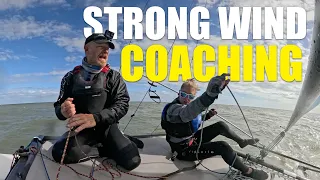
Hands-Free Waterproof Drone! | HOVERAir AQUA Catamaran Sailing Test
In the high-velocity arena of performance multihull racing, capturing high-definition aerial footage has long presented an insurmountable physical paradox for single-handed sailors. On the sheltered waters of Portland Harbour in Dorset, UK, professional multihull coach Joseph Bennett, the creator behind Joyrider TV, confronted this challenge by taking an autonomous robotic camera to sea. Driving an 18-foot Formula 18 (F18) Hobie Tiger catamaran solo requires total cognitive immersion. Between working the trapeze wire, sheeting the square-top mainsail, adjusting the traveler, and steering via an extended carbon tiller, there is zero margin to hold a drone controller. A single momentary lapse in helm concentration can cause the leeward bow to bury, resulting in an instant pitch-pole.
To resolve this operational dilemma, Joseph Bennett tested the HOVERAir AQUA, an autonomous waterproof camera drone engineered to operate in harsh marine environments without manual flight controls. Piloting his Hobie Tiger catamaran across Portland Harbour and Weymouth Bay in Dorset, UK, Bennett evaluated whether autonomous marine robotics can withstand the extreme dynamics of high-performance beach multihulls. Rather than relying on a chase boat or an onboard camera crew, the system utilizes an active wearable tracking beacon and computer vision algorithms to take off, track, and film entirely hands-free.
Autonomous Marine Robotics on the F18 Wire
Navigating an 18-foot Hobie Tiger catamaran single-handed across Portland Harbour in Dorset, UK, demands complete physical synchronicity, a challenge Joseph Bennett regularly explores through Joyrider TV. The Formula 18 class is traditionally optimized for a two-person crew, featuring a helm to steer and a forward crew to trim the downhaul, mast rotation, and 21-square-meter asymmetric spinnaker. Single-handing the platform forces the skipper to manage every control line while suspended over the windward hull on a trapeze harness. Under these high-workload conditions, attempting to operate a conventional drone transmitter while balancing on the wire would invite immediate capsize.
The HOVERAir AQUA eliminates this workload by transferring flight control to an automated flight stack. Equipped with a magnetic Lighthouse tracking beacon strapped to the sailor and integrated computer-vision target locking, the drone maintains relative distance and altitude without pilot intervention. For Bennett, this autonomy enables dynamic external filming during high-speed multihull runs, liberating the solo sailor to focus strictly on sail trim, wave angle, and boat velocity.
Water Takeoff and Lighthouse Beacon Telemetry
Launching an aerial drone directly from the waters of Portland Harbour in Dorset, UK, felt distinctly counterintuitive to Joseph Bennett as he readied his Hobie Tiger catamaran for the Joyrider TV sea trials. Standard consumer drones require flat launch pads or dangerous hand-launches, which are virtually impossible on a vibrating catamaran trampoline surrounded by high-tension wire stays and halyards. By contrast, the HOVERAir AQUA features a buoyant, sealed chassis engineered specifically for direct salt-water floatation.
Dropping the aircraft into the chop alongside the Hobie Tiger, Bennett monitored the system as it floated stably on the brine. Internal telemetry established an immediate RF handshake with the wearable transmitter, followed by synthetic voice telemetry announcing, ‘Lighthouse tracking signal restored. Start a takeoff.’ Upon confirmation, the enclosed ducted thrusters spun up to maximum velocity, generating instantaneous vertical lift directly from the sea surface and locking into a steady hover without requiring manual helm intervention.
Dynamic Orbit Tracking Under Asymmetric Spinnaker
Once airborne over Portland Harbour in Dorset, UK, Joseph Bennett engaged the mainsheet on his Hobie Tiger catamaran to test autonomous dynamic orbit tracking for Joyrider TV. Multihull acceleration is sudden and intense; as the twin hulls bite into the water, apparent wind shifts forward, drastically altering vessel speed relative to the drone. Bennett initiated the orbit program, prompting the camera drone to circle the moving catamaran continuously while keeping the rig centered in frame.
The primary technical risk during this orbital flight was the towering 30-foot mast and the billowing asymmetric spinnaker. Because the drone relies on beacon guidance and forward-facing visual tracking rather than 360-degree obstacle avoidance sensors, circling a sailing catamaran presents real hazards around the rig. As the drone arced around the leeward side, it passed cleanly behind the curved nylon spinnaker before re-emerging on the windward beam. The resulting footage captured an unprecedented vantage of sail draft, slot gap, and hull flying angle.
The Turtle Flip and Splashdown Recovery Challenges
Testing autonomous robotics across Portland Harbour in Dorset, UK, brought practical recovery challenges to the forefront for Joseph Bennett aboard the Joyrider TV Hobie Tiger catamaran. When Bennett executed a tack and issued a landing command, the drone descended toward the water. However, localized surface chop and hull wake caused the aircraft to land awkwardly and roll inverted in the brine, prompting an automated synthetic voice warning: ‘Device upside down.’
Immediately, the drone engaged its automated turtle-flip protocol, using differential thrust from its ducted propellers to right itself on the water surface and clear its optical lens. Retrieving the floating aircraft introduced a distinct multihull challenge: an F18 catamaran under sail cannot stop instantly. Bennett doused the spinnaker, rounded up to depower the main, and completed a disciplined recovery pass, retrieving the unit from the water without striking it with the daggerboards or rudders.
Technical Specifications and Marine Filming Matrix
Analyzing the operational envelope of the HOVERAir AQUA in Portland Harbour, Dorset, UK, provides Joseph Bennett and the Joyrider TV community with clear empirical guidelines for filming aboard a Hobie Tiger catamaran. While action cameras mounted to the masthead offer rugged reliability, their static angles cannot capture true hull flying attitudes. Conversely, manual aerial drones offer cinematic freedom but pose an unacceptable risk of immediate water destruction upon any splashdown.
The HOVERAir AQUA fills this niche through buoyant IP-rated marine enclosures, autonomous beacon telemetry, and self-righting capabilities. The comparative table below outlines the core specifications, flight envelopes, and operational parameters evaluated during Bennett’s sea trials.
| Feature / System | HOVERAir AQUA Drone | Manual Aerial Drone | Fixed Action Camera |
|---|---|---|---|
| Chassis Ingress Protection | Buoyant, salt-water submersible; automated turtle-flip self-righting | Non-waterproof; immediate total loss upon water surface contact | IPX8 waterproof to 10m; impervious to ocean spray and submersion |
| Control Interface | 100% hands-free tracking via wearable RF Lighthouse beacon | Requires two-handed dual-joystick transmitter | Fixed recording; passive continuous capture or wireless remote |
| Launch & Recovery | Direct water-surface takeoff and water splashdown recovery | Requires stable deck, landing mat, or hand capture on rolling trampoline | Rigid bracket mount to crossbeam, masthead, or helmet |
| Tracking Perspectives | Dynamic orbit, follow-me, and leeward fly-by tracking shots | Full free-flight 3D cinematic movement by dedicated pilot | Fixed wide-angle onboard viewpoint locked to boat structure |
| Catamaran Flight Matrix | Tested solo on Hobie Tiger F18 in Portland Harbour up to 15 knots | Impractical for solo sailor on trapeze; requires separate chase boat | Standard Joyrider TV baseline for rigging and sail trim tutorials |
Transforming Solo Sailing Training and Digital Production
For high-performance sailors like Joseph Bennett sailing Portland Harbour in Dorset, UK, the advent of autonomous marine drones aboard the Hobie Tiger catamaran offers profound advantages for Joyrider TV and modern multihull coaching. In competitive racing, third-person debriefing is essential for evaluating mast bend, sail twist, and hull balance. Historically, obtaining this perspective required an expensive coach boat and dedicated driver, putting high-level analysis out of reach for solo sailors.
Autonomous waterproof drones democratize performance debriefs. A solo skipper can deploy a buoyant drone directly from the water, execute maneuvers, and later analyze high-resolution footage to refine trapeze posture and traveler adjustments. Bennett’s sea trial confirms that hands-free marine robotics provide a viable, transformative tool for both sailing instruction and solo content creation.
Frequently Asked Questions
The following questions address the technical performance and handling procedures evaluated by Joseph Bennett of Joyrider TV while testing the HOVERAir AQUA autonomous drone on a Hobie Tiger catamaran in Portland Harbour, Dorset, UK.
The HOVERAir AQUA features a buoyant, sealed chassis with enclosed ducted propellers. Joseph Bennett places the drone directly into the water alongside the boat. Once telemetry links with the wearable Lighthouse beacon, the drone spins up and launches vertically from the sea surface without needing deck space or hand launching.
The turtle flip is an automated self-righting feature for water landings. If surface chop causes the drone to land upside down in salt water, onboard sensors detect the inversion. The drone uses differential reverse thrust to rotate itself upright, allowing drainage ports to clear the camera lens for subsequent retrieval or flight.
The drone relies on optical tracking and beacon telemetry rather than full 360-degree obstacle avoidance sensors. During Joseph Bennett’s test on the Hobie Tiger, the drone circled behind the spinnaker without incident, but solo sailors must configure conservative orbital radii to prevent entanglements with shrouds, stays, or sails.
Because a catamaran cannot stop instantaneously, recovering a floating drone requires deliberate seamanship. The sailor must douse the asymmetric spinnaker, head up into the wind to depower the mainsail, and perform a disciplined approach maneuver to retrieve the floating drone safely away from the daggerboards and rudders.
The Lighthouse beacon is a compact wearable device that transmits positional radio telemetry to the drone. Working alongside onboard visual tracking algorithms, it allows the drone to follow the sailor and execute dynamic orbital shots hands-free while the skipper keeps both hands on the tiller and mainsheet.
The Hobie Tiger is an 18-foot Formula 18 racing catamaran featuring symmetrical fiberglass hulls, daggerboards, kick-up rudders, a 30-foot rotating mast, and an asymmetric spinnaker. Built for two-person racing, it easily exceeds 20 knots, making solo sailing physically demanding and technically rigorous.
Portland Harbour and the Weymouth National Sailing Academy in Dorset, UK, provide flat, protected waters sheltered by breakwaters along with steady coastal winds. These conditions offer an ideal testing ground for evaluating high-speed racing multihulls and cutting-edge autonomous marine robotics under controlled conditions.
Water adventures near Lefkada
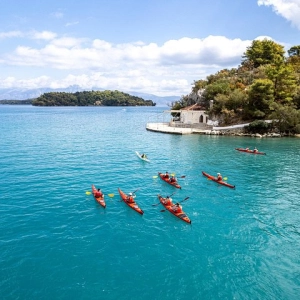
Lefkada Skorpios and Madouri Island-Hopping Kayak Tour with Lunch
Sold by TREKKING HELLAS
Marine Adventure Cruise Snorkeling and Swimming in Lefkada
Sold by Marine Adventure Lefkada
Support Joyrider TV
At WeBoating.com, we profoundly acknowledge the unwavering dedication that Joyrider TV invests in crafting each and every video or voyage. Their passion for delivering exceptional ocean content shines through every frame, and it's a labor of love that deserves your attention.
We invite you to watch their captivating videos here and actively engage with their content, including their social media links above. Liking, commenting, and sharing their work goes a long way in fueling their creative fire.
We're also inviting you to explore the gear, sponsorships, and boat partnerships highlighted in the "Hands-Free Waterproof Drone! | HOVERAir AQUA Catamaran Sailing Test" video description, or directly on YouTube. By engaging with these offerings or purchasing services and items, you directly support Joyrider TV, their collaborators, and the brands they're associated with.
To ensure you never miss an offshore update, consider visiting their official YouTube Channel to subscribe, like, and join their community directly.
If you have any feedback, corrections, or additional information about Joyrider TV or their videos, please use the comment form below to share your thoughts with us.
Thank you for being a part of our community and supporting the creators we cherish. Your time and support truly matter!
I sail the Hobie Tiger solo while the HOVERAir AQUA does the filming! This first light-wind test explores how a hands-free waterproof camera drone follows a sailing catamaran—and the footage it captures.
Part 2 of my HOVERAir AQUA sailing series, following the Fly More unboxing.
HOVERAir AQUA was supplied by @HOVERAir_official for testing.
FIND OUT MORE
https://hoverair.sjv.io/5k3LeN
Use my link to get a FREE wetsuit! Add it to your cart and use code AQK8M4ZX731 at checkout. Limited time only.
I may earn a commission from purchases through this link.
LEARN CATAMARAN SAILING
https://totaljoyrider.com/products/joyrider-academy-the-classroom-series
#HOVERAir #HOVERAirAQUA #HobieTiger #CatamaranSailing
➡️ Master Catamaran Sailing – Faster
Stop guessing. Start improving.
• 18 structured modules
• 120+ lessons
• From beginner to confident sailor
Boat handling. Power control. Racing. All explained clearly.
Get instant access:
YouTube Membership:
https://www.youtube.com/channel/UC1lH
Full Course (one-time):
https://totaljoyrider.com/products/joyrider-academy-the-classroom-series
Official Joyrider Hub
Merch, Speed Stick leaderboard, coaching and more
https://totaljoyrider.com](https://totaljoyrider.com
Gear I Use and Recommend
SunGod Sunglasses
https://www.sungod.co/s/eR4VYYu3/](https://www.sungod.co/s/eR4VYYu3/
Telemetry Overlay – add GPS data to your sailing videos
Use code JOYRIDERTV for discount
https://bit.ly/telemetryoverlay
Instamic Waterproof Audio
https://instamic.io/?aff=119
Xero Shoes
https://xeroshoes.com/go/joyridertv
Forward WIP – impact protection for sailing
@forwardwip
Want to be part of the action?
Upload your sailing videos to Joyrider Worldwide and get featured.
Get uploader access at https://totaljoyrider.com
About Joyrider TV
Joyrider TV is one of YouTube’s leading channels for catamaran sailing.
Videos include tutorials, maintenance guides, Q+As, race strategy and real-world sailing.
Whether you sail a Hobie, Nacra, A-Class, Prindle, Dart, Tornado, F18, F16 or more, you’ll find practical, no-nonsense advice to help you sail faster, safer and with more confidence.
---
#catsailing #sailboat #joyridertv

Joyrider TV
Joseph Bennett: The high-performance 'Joyrider' mastering 26-knot catamaran runs in Vassiliki, Greece, while redefining budget DIY racing for the global community.
Channel Information:
Social Media Links:
Hands-Free Waterproof Drone! | HOVERAir AQUA Catamaran Sailing Test Location
- Portland Harbour & Weymouth National Sailing Academy, Dorset, United Kingdom (50.575,-2.455)
- Weymouth Bay Coastal Fairway, Dorset, United Kingdom (50.61,-2.44)
Latest Episodes from Joyrider TV
Explore the most recent voyages. Subscribe to the channel to never miss an update!
Mid-Fleet? Where to Find the Biggest Gains | Q+A LIVE
Are you stuck in the middle of the fleet? What's really holding you back from getting better results in your catamaran racing? In today's LIVE Joyrider TV Q+A, we're looking at where sailors can make the biggest performance gains — and why improving your sailing skills is often far m...
Worried About Gybing? Try the Long Tack | Catamaran Sailing
Not confident gybing your catamaran in strong wind? The long tack takes you through the wind instead, turning from one broad reach onto the other without a downwind gybe. Onboard the Hobie 16, we look at the sequence: bring the traveller in, sheet in while keeping control of the steering, then tack...
Improving Race Starts | A Real Hobie 16 Training Session
Joseph Bennett of Joyrider TV joins Gerardo off Mexico's Yucatan Peninsula for a two-boat Hobie 16 race start training session in 12-knot winds.
Catamaran Tiller Arm Too Low? A Simple Fix
When a catamaran rudder is raised and the tiller arm drags on the deck, Joe Bennett from Joyrider TV shares a practical repair: rotate the tube upward and re-rivet it.
Lightweight Sailing Gear for Hot Weather What I Wear
Joseph Bennett from Joyrider TV details his lightweight catamaran sailing gear for hot weather on Mexico's Yucatan Peninsula, balancing impact protection and agility.