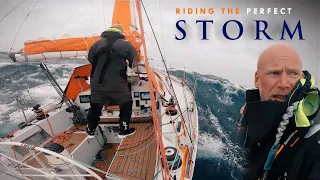
I was WARNED about crossing this OCEAN! - Chapter 2
A deep low-pressure system overnight transformed the remote anchorage at Halten into a windblown harbor with gusts peaking at 35 knots. With 60 nautical miles of open water stretching across Folda toward Rorvik, solo sailor Erik Aanderaa readied his 1976 Contessa 35, SV Tessie, for an unrelenting downwind storm passage. Forecasts warned of following seas between four and six meters and westerly wind gusts up to 40 knots. Before leaving the harbor, the deck was cleared and secured to settle pre-departure tension, because once clear of the sheltered sound, the open ocean lay immediately ahead.
Hoisting the Storm Jib Across Folda
The Norwegian coastline features seven notoriously exposed ocean stretches where westerly gales drive heavy seas directly onto rocky shores. Clearing the harbor, the diesel engine was shut down, leaving SV Tessie entirely under sail. Rather than hoisting the mainsail, propulsion was handed over solely to a small 13-meter storm jib set on the forestay. Sustained 34 to 35 knots of wind filled the canvas, lifting the 35-foot hull onto following swells. Offshore swell heights rapidly built from three meters to steep breaking crests as the vessel cleared coastal protection.
Steering Tactics and Avoiding Coastal Shoals
With the wind astern, the navigation plan called for diving back offshore whenever water depth shoaled to between 20 and 30 meters. Getting trapped too close to the rugged mainland presented a severe risk, as oceanic swells bouncing off sheer granite walls create violent, confused rebound waves. By bearing away on a broad reach downwind, Tessie maintained boat speed while keeping steady wind pressure across the sail. As Erik noted regarding rig management: “The most important trick in heavy weather sailing is to not have too much sail up. By this you’ll be surprised how much your boat can handle.”
Hydrovane Performance in Breaking Seas
As the crossing entered the open expanse of Haltenbanken, sea conditions deteriorated further, with steep breaking waves reaching heights of four to 5 meters. Below deck, the motion remained surprisingly manageable between bouts of securing loose gear and eating a quick energy cracker. On deck, observing the sea state from the mast offered a clear perspective of wave dynamics lifting the stern before surging under the bow. Despite violent pounding that jarred the vessel, the windvane steering gear held an unyielding course through every breaking crest.
Cockpit Security and Mechanical Redundancy
A quick inspection aloft revealed that one piston hank on the storm jib had worked itself unhooked from the forestay wire, though the remaining attachments held firm. Relieving the electronic autopilot in favor of windvane steering removed reliance on battery banks and fragile electrical components. As Erik emphasized while watching the stern gear: “I just once again have to say that I’m really impressed about the sterling of the hydro vein. It’s it’s just dead on course even in in these waves.” The compact, deep cockpit of the 35-foot Contessa provided immediate handholds and running checkstays, preventing dangerous falls that frequently threaten wider four-meter hulls in turbulent sea states.
Approaching Rorvik and Coastal Shelter
With 30 nautical miles behind the stern, the final leg brought a tactical gybe to align the approach toward the outer skerries of Rorvik. The steering wheel was untied from the windvane, the autopilot temporarily engaged to hold the heading, and the storm jib sheeted across to the opposite side to resume surfing northwards. Approaching the rocky archipelago, winds peaked at a fierce 38 knots, while an outbound commercial cargo vessel pounded into the head seas at 10 knots.
Passing the Nærøysund Sound
Six to seven nautical miles outside the archipelago, breaking ocean swells finally gave way to calm channels among sheltering islands. Rain poured steadily as Tessie motored under the 40-meter bridge clearance into the inner sound, exchanging nods with a Hurtigruten coastal express ship navigating outbound into the storm. After tying off lines safely to the town docks, Erik reflected on the completed crossing: “It was exactly as bad as I thought it was going to be and fun at the same time.”
Folda Passage Metrics
| Parameter | Recorded value | Operating context |
|---|---|---|
| Route distance | 60 nautical miles | Offshore passage from Halten to Rorvik |
| Departure wind | 35 knots | Steady westerly gale recorded at Halten |
| Working sail | 13 square meters | Solitary storm jib set on forestay |
| Wave crests | 5 meters | Steep breaking seas over Haltenbanken |
| Approach wind | 38 knots | Gale force winds near rocky headlands |
| Bridge air clearance | 40 meters | Overhead navigation mark at Rorvik sound |
Frequently Asked Questions
With winds sustained between 34 and 35 knots and gusts reaching 40 knots, the 13-meter storm jib provided ample power to drive the 35-foot vessel downwind without risking broaching or overstressing the rig.
The mechanical Hydrovane maintained a precise heading dead on course through steep breaking seas, allowing the skipper to turn off the electronic autopilot and eliminate reliance on electrical systems.
Shallow shoals between 20 and 30 meters caused incoming oceanic swells to bounce off the rocky mainland, creating hazardous rebound waves that required an offshore course on a broad reach downwind.
One piston hank on the storm jib detached from the forestay wire during heavy wave impacts, but the remaining attachments held the sail securely in place.
The bridge spanning the sound outside Rorvik provided 40 meters of vertical air clearance, allowing SV Tessie to safely pass underneath into protected moorings.
Support Erik Aanderaa
At WeBoating.com, we profoundly acknowledge the unwavering dedication that Erik Aanderaa invests in crafting each and every video or voyage. Their passion for delivering exceptional ocean content shines through every frame, and it's a labor of love that deserves your attention.
We invite you to watch their captivating videos here and actively engage with their content, including their social media links above. Liking, commenting, and sharing their work goes a long way in fueling their creative fire.
We're also inviting you to explore the gear, sponsorships, and boat partnerships highlighted in the "I was WARNED about crossing this OCEAN! - Chapter 2" video description, or directly on YouTube. By engaging with these offerings or purchasing services and items, you directly support Erik Aanderaa, their collaborators, and the brands they're associated with.
To ensure you never miss an offshore update, consider visiting their official YouTube Channel to subscribe, like, and join their community directly.
If you have any feedback, corrections, or additional information about Erik Aanderaa or their videos, please use the comment form below to share your thoughts with us.
Thank you for being a part of our community and supporting the creators we cherish. Your time and support truly matter!
Get 4 months extra on a 2 year plan here: https://nordvpn.com/erikaanderaa - It's risk-free with Nord's 30-day money-back guarantee!
Join this incredible ride in stormy conditions across the Folda Ocean! This is one of Norways most feared open coastlines. With westerly winds the Norwegian Sea is pumping up huge waves crashing into the rugged coastline. So I had to give it a go..! :)
Zhik OFS 800 jacket: https://zhik.com/eu/black-ofs800-jacket.html
Zhik OFS 800 salopette: https://zhik.com/eu/black-ofs800-salopette.html
Sail my boat "Tessie" in the sail simulator Sailaway III: https://sailaway.world/erikaanderaa
T-shirts and merch inside EU: https://shop.spreadshirt.no/nbjs-factory
US and everywhere else: https://shop.spreadshirt.com/nbjs-factory-usa/
Facebook: https://www.facebook.com/nobullshitjustsailing
Instagram: https://www.instagram.com/erikaanderaa/
Patreon: https://www.patreon.com/erikaanderaa
PayPal: https://www.paypal.com/paypalme/erikaanderaa
My website: https://nbjs.no/
Erik Aanderaa
Discover the 'No Bullshit' world of Erik Aanderaa as he documents his 2026 Arctic odyssey and solo circumnavigation of Svalbard aboard his Contessa 35.
Channel Information:
Social Media Links:
I was WARNED about crossing this OCEAN! - Chapter 2 Location
- Halten Lighthouse (Departure) (64.1736,9.4069)
- Folda Ocean Passage (64.6,10.7)
- Rørvik Harbor (Arrival) (64.8614,11.2375)
Latest Episodes from Erik Aanderaa
Explore the most recent voyages. Subscribe to the channel to never miss an update!
Sailing the NORTHERN coast of NORWAY! -Chapter 3-
Erik Aanderaa navigates SV Tessie along the Norwegian coast, fixing an anchor locker bilge leak and crossing the Arctic Circle toward Svalbard.
Surfing down the hills!
A cut from my latest video, surfing some real big ones off the open coast of Norway🌊🤓
Why this boat is not an offshore sailor😇
Erik Aanderaa inspects a 1945 wooden double-ender in Norway, explaining why loose cockpit boards and direct bilge flooding keep it strictly inshore.
Sailing this treasure to its new owner❤️
Leg 2 of sailing this beautiful 1945 wooden double ender to it’s lucky new owner😀 A 145 nm trip. Listen to that single cylinder ticking just under the cockpit floorboards⛵️
Check out this amazing boat!
Erik Aanderaa navigates a 140 NM delivery run along the coast of Norway, hand-steering a classic 1945 31-foot wooden double ender with no modern equipment en route to its new owner in Haugesund.