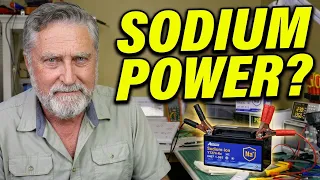
Acoucou Sodium Battery Review. Will this start a Big V-Twin
Clark set the Acoucou sodium-ion starter battery on his laboratory workbench to begin a hands-on technical evaluation of emerging sodium chemistry. Supplied directly by Acoucou for review, the compact unit represents Clark’s first direct experience with sodium-ion technology. Sold on Amazon for $50, the pack is marketed as an ultralight starter battery for small engines such as motorcycles, garden tractors, and snowmobiles. Its factory specifications claim an output of 200 cold cranking amps, a cycle life of 3,000 cycles, and an operating temperature range extending from 40 below zero up to 176 degrees Fahrenheit.
Clark observed that sodium chemistry offers distinct thermal advantages over lithium and lead-acid, remaining functional down to -40 degrees where Fahrenheit and Celsius scales intersect. While Clark noted his summer Florida workbench prevented testing at 40 below, the high-temperature threshold of 176 degrees Fahrenheit makes the unit suitable for hot engine compartments. Regarding the $50 purchase price, Clark remarked: “If this does the job it needs to do for 50 bucks, I’d be happy with it.”
Electronic Load Discharge and Capacity Verification
The factory specifications rate the Acoucou starter pack at 3.4 amp hours with a charge and discharge rate of 3C, equivalent to roughly 10 amps entering or leaving the cells. Clark initiated testing by charging the unit at 10 amps until it reached the manufacturer-specified termination voltage of 14.8 volts. He also completed an additional low-amperage charge cycle to observe cell behavior across differing input rates.
To evaluate stored energy under controlled conditions, Clark connected the fully charged pack to his bench electronic load. During the first discharge cycle down to a standard 10 volts, the electronic load measured only 2.5 amp hours rather than the rated 3.4 amp hours. Clark recharged the battery and repeated the discharge run, allowing cell voltage to drop all the way down to 8 volts. This deeper discharge yielded 2.9 amp hours, still falling short of the manufacturer’s advertised figure.
Clark analyzed the voltage discharge curve, noting that while 10 volts serves as a common lower boundary for other battery chemistries, sodium exhibits a steady downward voltage slope. However, Clark warned against pulling power beneath the 8-volt floor during starter duty. He stated: “I don’t think there’s any good work going to be done below eight.” Clark explained that attempting to crank an engine at depressed voltage forces excessive amperage through the starter motor windings to satisfy the required wattage, risking starter motor burnout.
Acoucou Sodium Battery Technical Specifications
| Parameter | Manufacturer Specification | Lab Measurement or Field Observation |
|---|---|---|
| Advertised Capacity | 3.4 Ah | 2.5 Ah (to 10 V) / 2.9 Ah (to 8 V) |
| Cold Cranking Power | 200 CCA | Cranks 1.7 L high-compression V-twin |
| Maximum Charge Rate | 3C (approx. 10 A) | Bench charged at 10 A to 14.8 V |
| Operating Temperature Floor | -40 degrees | Functional down to 40 below zero |
| Operating Temperature Ceiling | 176 degrees Fahrenheit | Suitable for hot vehicle engine bays |
| Cycle Life Rating | 3,000 cycles | Factory rated service life |
Field Trial: Cranking a 1.7L V-Twin Engine
To test high-current delivery under real mechanical load, Clark moved beyond bench testing and connected the pack to his Road Star Warrior motorcycle. The motorcycle features a high-compression 1.7 L V-twin engine that requires substantial cranking energy. Due to the high compression of the twin cylinders, the motorcycle has no manual kickstarter. Clark disconnected the large lithium battery he had been using in the motorcycle, inserted the compact Acoucou sodium unit, and engaged the ignition.
The tiny battery turned the starter over immediately. Clark recorded: “I took out the much larger lithium battery I’ve been using, put this in there, and hit the button. It started up.” The sodium unit cranked the 1.7 L engine as effectively as the original AGM lead-acid batteries Clark had used when first purchasing the motorcycle, or even better. While it did not spin the motor with the aggressive velocity of the oversized lithium pack, it delivered sufficient power to fire the cylinders cleanly. Had the starter battery faltered, Clark planned to test it on his father’s riding lawnmower, but the successful ignition of the 1.7 L V-twin confirmed its high-current capability.
Voltage Characteristics and Alternator Matching
Examining the operating curves in detail, Clark noted key differences between sodium-ion and lithium chemistries. While lithium maintains a flat discharge voltage in the low 13s around 13.2 volts until nearly depleted, sodium drops rapidly into the 12s under load and continues a linear decline toward 8 volts. Charging at 14.8 volts and discharging at lower voltages also introduces round-trip voltage inefficiency, causing energy loss beyond cell heating.
Charging compatibility on the motorcycle presented an additional engineering consideration. The Acoucou specifications caution against charging the small 3.4 amp-hour pack at rates exceeding 10 amps. However, the Road Star Warrior stator is rated to produce 31 amps at 14 volts, creating a potential threefold overcharge current for a battery of this scale. While an alternator warming under operation reduces output toward 20 amps or 30 amps, Clark noted that a properly sized starter battery would provide greater buffer against high stator current.
Marine and Off-Grid Energy Perspectives
As an electrical engineer and solo mariner documenting energy forensics on Emily & Clark’s Adventure aboard his 1967 Creekmore 45 sloop SV Temptress, Clark evaluated whether sodium-ion technology is ready for broader marine service. While the low $50 price point and rugged thermal tolerance make it an appealing starter option, Clark cautioned against deploying sodium for primary energy storage.
Summarizing his findings, Clark noted: “I think this is a great little lead replacement. I’m not convinced it’s good for prime storage on a boat or a house yet” To make sodium viable for house banks, Clark suggested that specialized battery management systems with switching power supplies would be necessary to stabilize working voltages. For low-cost engine starting, Clark gave the Acoucou unit favorable marks while awaiting long-term durability data over the coming couple of years.
Frequently Asked Questions
Yes. Clark installed the battery into his Road Star Warrior with a 1.7 L V-twin engine, and the unit started the high-compression motorcycle cleanly.
No. When discharged through an electronic load, the battery produced 2.5 Ah down to 10 volts and 2.9 Ah down to 8 volts, remaining below the rated 3.4 Ah.
The manufacturer rates the battery to operate from 40 below zero (-40 degrees) up to 176 degrees Fahrenheit, offering superior cold-weather resilience compared to lithium.
Sodium chemistry exhibits a steep voltage drop under load and round-trip voltage inefficiency between 14.8 volts charging and discharge, making it better suited for starter duties than sustained energy storage.
Book a trip where this was filmed — near Hilton Head Island











Support Emily & Clark’s Adventure (Clark’s Adventure)
At WeBoating.com, we profoundly acknowledge the unwavering dedication that Emily & Clark’s Adventure (Clark’s Adventure) invests in crafting each and every video or voyage. Their passion for delivering exceptional ocean content shines through every frame, and it's a labor of love that deserves your attention.
We invite you to watch their captivating videos here and actively engage with their content, including their social media links above. Liking, commenting, and sharing their work goes a long way in fueling their creative fire.
We're also inviting you to explore the gear, sponsorships, and boat partnerships highlighted in the "Acoucou Sodium Battery Review. Will this start a Big V-Twin" video description, or directly on YouTube. By engaging with these offerings or purchasing services and items, you directly support Emily & Clark’s Adventure (Clark’s Adventure), their collaborators, and the brands they're associated with.
To ensure you never miss an offshore update, consider visiting their official YouTube Channel to subscribe, like, and join their community directly.
If you have any feedback, corrections, or additional information about Emily & Clark’s Adventure (Clark’s Adventure) or their videos, please use the comment form below to share your thoughts with us.
Thank you for being a part of our community and supporting the creators we cherish. Your time and support truly matter!
This Acoucou Sodium is the first Sodium (Na) battery I've had in my hands. In this video I review the battery and see if it can start my BIG v-twin motorcycle and talk about Sodium Batteries in general.
Amazon Affiliate Link: https://amzn.to/4z1ZmWK
Have questions or comments? Leave them below! We do our best to read and answer all comments on our channel.
-----------
LINKS TO PRODUCTS WE LOVE (Affiliate links to things we actually own, use, and recommend. We are almost never paid by companies to endorse products. If we are, we will tell you in the video): https://www.amazon.com/shop/emilyclarksadventure
PLEASE SUBSCRIBE and click the BELL to see new videos every week, and more content like this.
CONNECT & SUPPORT OUR CHANNEL
Patreon: https://www.patreon.com/emilyandclark
PayPal: https://www.paypal.me/emilyandclark
Buy S/V Temptress shirts and swag: https://teespring.com/stores/emily-clarks-sailboat-swag
Check out our favorite products on Amazon: https://www.amazon.com/shop/emilyclarksadventure
#emilyandclark #emilyandclarksadventure #svtemptress

Emily & Clark’s Adventure (Clark’s Adventure)
Join Clark of Clark’s Adventure as he documents his 2026 return to solo offshore racing following a successful recovery from cancer aboard his Creekmore 45.
Channel Information:
Social Media Links:
Acoucou Sodium Battery Review. Will this start a Big V-Twin Location
- St. Simons Island, Georgia (31.1444,-81.3853)
Latest Episodes from Emily & Clark’s Adventure (Clark’s Adventure)
Explore the most recent voyages. Subscribe to the channel to never miss an update!
BLUETTI Apex 200 Review: The Best Power Station for RVs & Home Backup?
Clark from Emily & Clark’s Adventure reviews the Bluetti Apex 200 power station, evaluating its 3,600 W inverter, camper air conditioning loads, AC charging speeds, and 48 V bench solar input.
WirenTech 100ah 48v Rack Mount Review (second look)
Clark tests the WirenTech 48-volt 100Ah server rack battery in Florida, teardown inspecting REPT cells, verifying UL 1973 certification, diagnosing BMS balancing rates, and confirming 105.6Ah capacity under load.
WirenTech 100ah 48v Rack Mount Review
Clark puts two WirenTech 48V 100Ah rack mount lithium batteries through forensic bench testing, uncovering Grade B cells and slow balancing despite solid build quality.
DatouBoss 5500 watt Inverter Review
Clark reviews the DatouBoss 48V 5500W off-grid solar inverter in his Florida laboratory, examining specs, pricing, and wiring capabilities.
Lab: Balancing a BIG Battery
In this video we actually go through the process of Balancing a 16 cell 48V Battery. For our subject we will use the WirenTech 48V 100ah Rack Mount Battery. Amazon Affiliate Links: WirenTech 48V 100ah Battery Not the ones I actually have but the closest by the same company and available now. ...