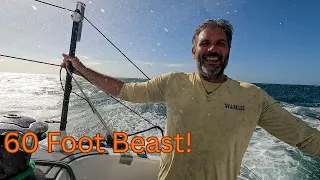
Episode 17: Life Update: What's Next for Calico Skies?
When Australian immigration authorities approved a one-year stay for Bill Heaton extending through April 15, 2027, the bureaucratic victory arrived with a critical maritime catch. In the Southern Hemisphere, cyclone season officially runs through May 15th. For Calico Skies Sailing – New Horizons, whose 1985 Sabre 36 is berthed in Brisbane, insurance regulations establish strict latitude limits, requiring the vessel to remain south of designated cyclone boundaries throughout the active storm months. With an official departure deadline set for April 15th, Bill must navigate Calico Skies out of Australian waters one full month before cyclone season concludes, eliminating the traditional northern coastal route through the Great Barrier Reef and Indonesia.
The forced calendar window leaves a demanding blue-water alternative: an immediate 1,000-mile ocean passage eastward across the Coral Sea toward Vanuatu or New Caledonia. Setting out in mid-April means contending with the tail end of cyclonic activity while navigating directly into prevailing south and southeast trade winds. Before undertaking a non-stop offshore passage of that scale, the vessel requires rigorous mechanical preparation, beginning with a complete forensic inspection of its standing and running rigging.
Preparing Calico Skies for the Coral Sea
A passage of 1,000 nautical miles across open ocean leaves no margin for deferred maintenance. While safe harbor provisions exist under maritime law if an active tropical cyclone directly threatens life and vessel, navigating offshore demands total structural confidence. Calico Skies carries a complex rod rigging package that is now 10 years old, having logged approximately 40,000 nautical miles since its last refit in California back in 2016. Unlike standard 1×19 wire rigging that can be swaged or repaired with mechanical compression fittings in remote anchorages, rod rigging requires specialized hydraulic cold-heading equipment available almost exclusively in major industrial ports across Australia, New Zealand, and the US.
Joining Bill for the upcoming Coral Sea voyage is his partner, Lisa. An American who relocated to Australia 15 years ago to raise her two sons, Lisa has embraced liveaboard life aboard the 36-foot sloop despite having only a single overnight offshore passage in her sailing logbook. Reflecting on the sudden change of pace, Lisa shared how her teenage son reacted to the transition: “wow, mom, your life has gotten a lot cooler and way more interesting since meeting Bill.”
Addressing the reality of facing a multi-day ocean passage with limited offshore experience, Lisa remains clear-eyed about the challenge: “Well, it’s going to be an adventure. I’m sure it’s going to be scary moments, but I trust you.”
Professional Rigging Inspection with Darren
To determine whether the rod rigging requires full replacement or modification before leaving Australia, Bill brought in Darren, an experienced commercial rigger who previously managed the rig overhaul on SV Delos in Australia. The inspection began with a comprehensive dockside aloft check to identify any micro-cracks, metal fatigue, or alignment flaws that would require custom machining prior to stepping the mast down.
The forensic check quickly revealed several mechanical wear points across the mast:
- Darren inspected the masthead halyard exits, where sharp aluminum casting edges had repeatedly chafed running rigging. Bill had shredded three separate halyards despite fitting custom chafe guards over the lines. Darren explained that chafe guards merely absorb damage rather than preventing it, advising that the aluminum edges be smoothed down with a die grinder to permanently eliminate sharp chafe points.
- The Sabre 36 chainplates pass through the deck fiberglass into internal bulkheads. Because stainless steel relies on continuous oxygen exposure to maintain its passive chromium oxide protective layer, trapped moisture in enclosed spaces induces crevice corrosion—forming invisible pitting that can trigger sudden structural failure. Bill planned to extract all chainplates during the unstepping process for professional dye-penetrant testing.
- Bill had previously addressed looseness in the gooseneck before crossing the Pacific by machining custom high-density polyethylene bushings from a plastic bucket while anchored in Mexico. The inspection confirmed only minimal residual play in the fitting.
- At the forestay toggle, Darren discovered that the clevis pin had rotated freely under uneven cyclic loads, distorting the split ring and dragging it into the shackle opening. Darren identified the root mechanical cause as a lack of uniform distributed load across the fitting: “So we’ll put spacers on each side of that to lock it in to correctly get UDL because the center of the pin is the strongest point and we want both cheeks of the toggle taking the load.”
Discovering a Severely Overloaded Masthead Shackle
The most critical defect surfaced at the masthead crane, where the halyard block for the Code Zero was attached. Specialized light-air reaching sails like a Code Zero generate tremendous halyard tension, operating under continuous high load at both the masthead and the deck tack point, unlike free-floating symmetrical spinnakers.
Upon close inspection of the Code Zero attachment hardware, Darren pointed out visible physical deformation on the connecting shackle: “Look you can see the bend in that shackle that’s well overloaded.”
The unrated stainless steel shackle exhibited a severe bend along both its bow and its threaded cross pin. Darren noted that if the vessel were undergoing a formal pre-purchase marine survey, the deformed hardware would constitute an immediate structural failure. Darren recommended replacing generic commercial shackles with certified high-load marine hardware or fabricated Dyneema soft shackles, which eliminate metal-on-metal chafe against soft aluminum mast extrusions while delivering far superior tensile strength.
A Cruising Case Study: Joe’s Rigging Failure in the Gulf of Carpentaria
The urgency of replacing damaged masthead hardware was underscored by an offshore emergency experienced by fellow cruiser Joe. Sailing solo across northern Australia toward Langkawi, Malaysia, Joe was transiting the Gulf of Carpentaria on a four-day passage when his masthead failed without warning.
On the first afternoon of the passage, while running before 15 to 20 knots of wind that soon built to 25 knots, the mast crane U-bolt securing his Code Zero halyard block fractured under tension. Recalling the immediate moment of failure, Joe noted: “I heard a loud bang, kind of an explosion.”
With the halyard block gone, halyard tension vanished instantly, making it impossible to operate the furler. The massive sail dropped onto the foredeck, slid over the lifelines, and was drawn directly under the hull. The sail wrapped around the keel and hull bottom, threatening the propeller, shaft, and rudder. For six exhausting hours in deteriorating sea conditions, Joe fought to protect the vessel: “I think all in all it was under the boat for maybe six hours.”
Collaborating via satellite comms with Bill, Gary, and Brian, Joe slowed the boat to 1 to 2 knots to reduce hydrodynamic pressure. Around 9:00 PM, he crawled over the pitching bow in darkness and cut the tack free. The sail trailed astern held only by a sheet wrapped loosely around a cockpit winch. At 1:00 AM, a severe shock load slammed into the winch, threatening to tear the stern pulpit and outboard engine off the transom. Joe was forced to sever the sheet, watching the 10,000 Australian dollar sail sink into the sea.
Masthead Overhaul and Dyneema Redundancy
Determined to prevent a similar failure aboard Calico Skies, Bill ascended aloft to overhaul the Code Zero attachment gear. Working at the masthead, he unbolted the compromised shackle assembly from the cast aluminum masthead crane. Inspection on deck confirmed that both the upper pin and the lower shackle body suffered structural deformation with visible stress fatigue.
Bill installed a heavy-duty 8 mm forged Harken shackle boasting an engineered working load limit of one ton, securing the existing Harken 57 turning block. To ensure total redundancy against unexpected hardware shear, Bill seized a length of 3 mm (1/8-inch) Dyneema twine around the cast masthead crane. Rated for a breaking strength of approximately 1,500 kilograms—matching the working strength of the steel shackle itself—the Dyneema loop acts as a failsafe tether. In the event of primary hardware failure, the synthetic loop will catch the block, allowing the crew to douse the sail safely on deck rather than trailing it beneath the keel.
Following the masthead overhaul, Lisa took her first turn on the mast climber harness at the dock, practicing ascending techniques with mechanical foot loops and chest ascenders. Working her way up to the first spreader, Lisa familiarized herself with aloft operations and offshore equipment handling.
Rigging Hardware Specifications and Inspection Findings
| Rigging Component | Inspection Observation | Corrective Engineering Action |
|---|---|---|
| Standing rod rigging | 10 years old with 40,000 miles logged since 2016 | Scheduled for mast unstepping and dye-penetrant evaluation |
| Masthead halyard exits | Sharp aluminum edges chafed and destroyed 3 halyards | Rigger advised die-grinding aluminum smooth to eliminate chafe |
| Buried deck chainplates | Encapsulated in fiberglass deck with crevice corrosion risk | Scheduled for extraction and dye-penetrant testing during unstep |
| Forestay toggle and clevis pin | Clevis pin rotated and split ring deformed without UDL | Install custom spacers to center pin and balance shear across toggles |
| Code Zero masthead shackle | Generic unrated stainless steel shackle severely bent under halyard load | Replaced with forged 8 mm Harken shackle rated for 1 ton working load |
| Code Zero block crane | Cast aluminum masthead crane vulnerable to single-point hardware failure | Lashed redundant 3 mm Dyneema twine backup rated at 1,500 kg breaking strength |
| Masthead turning block | Existing Harken 57 block maintained in sound condition | Cleaned and reinstalled with high-strength forged attachment hardware |
Frequently Asked Questions
Bill Heaton’s Australian visa requires the vessel to exit the country by April 15th, whereas the Southern Hemisphere cyclone season runs through May 15th. Marine insurance mandates staying south of Brisbane during storm season, preventing a northward coastal transit and forcing an eastward passage across the Coral Sea.
Darren identified sharp aluminum halyard exit boxes that chewed through three lines, rotated clevis pins on toggles lacking uniform distributed load, buried chainplates requiring crevice corrosion testing, and a severely bent masthead shackle supporting the Code Zero halyard block.
While sailing solo on a four-day passage in 15 to 25 knots of wind, Joe suffered a masthead U-bolt fracture that dropped his Code Zero into the ocean. The sail remained pinned beneath the hull for six hours, forcing Joe to cut the 10,000 Australian dollar sail free to protect his rudder and propeller.
Bill replaced the bent unrated hardware with a forged 8 mm Harken shackle rated for a one-ton working load and installed a redundant safety tether using 3 mm Dyneema twine rated at 1,500 kg breaking strength lashed around the cast aluminum masthead crane.
Book a trip where this was filmed — near Gold Coast
Support Calico Skies Sailing – New Horizons
At WeBoating.com, we profoundly acknowledge the unwavering dedication that Calico Skies Sailing – New Horizons invests in crafting each and every video or voyage. Their passion for delivering exceptional ocean content shines through every frame, and it's a labor of love that deserves your attention.
We invite you to watch their captivating videos here and actively engage with their content, including their social media links above. Liking, commenting, and sharing their work goes a long way in fueling their creative fire.
We're also inviting you to explore the gear, sponsorships, and boat partnerships highlighted in the "Episode 17: Life Update: What's Next for Calico Skies?" video description, or directly on YouTube. By engaging with these offerings or purchasing services and items, you directly support Calico Skies Sailing – New Horizons, their collaborators, and the brands they're associated with.
To ensure you never miss an offshore update, consider visiting their official YouTube Channel to subscribe, like, and join their community directly.
If you have any feedback, corrections, or additional information about Calico Skies Sailing – New Horizons or their videos, please use the comment form below to share your thoughts with us.
Thank you for being a part of our community and supporting the creators we cherish. Your time and support truly matter!
Join the crew on Patron:https://www.patreon.com/c/CalicoSkiesSailing_NewHorizons
0:00 – Visa update, cyclone season & our next 1,000-mile passage
1:47 – Meet Lisa!
3:57 – Preparing Calico Skies to go offshore again
4:37 – Professional rig inspection & what we found
11:52 – Joe’s offshore rigging failure story
17:16 – Going aloft to fix the issue (and Lisa tries the mast climber!)
21:27 – Bloopers: Lisa’s first time on camera
This is my new channel where I will continue the story aboard Calico Skies, but with a fresh perspective, new adventures, and the same passion for sailing, discovery, and storytelling that has always been at the heart of my journey. Please Subscribe and continue with the journey of Calico Skies!

Calico Skies Sailing – New Horizons
Bridge the gap from couple-cruising to solo circumnavigation with Bill Heaton as he launches Calico Skies Sailing – New Horizons from Brisbane, Australia.
Channel Information:
Social Media Links:
Latest Episodes from Calico Skies Sailing – New Horizons
Explore the most recent voyages. Subscribe to the channel to never miss an update!
Episode 17: Life Update: What’s Next for Calico Skies?
Facing an Australian visa cutoff ahead of cyclone season, Bill Heaton conducts a comprehensive mast inspection on Calico Skies, uncovers severely bent halyard shackles, and prepares for a 1,000-mile passage across the Coral Sea.
Episode 16: We Weren’t Expecting 40+ Knots! (Calico Skies Sailing – New Horizons)
This is my new channel where I will continue the story aboard Calico Skies, but with a fresh perspective, new adventures, and the same passion for sailing, discovery, and storytelling that has always been at the heart of my journey. Please Subscribe and continue with the journey of Calico Skies! Ov...
Episode 15: The Problem That May Have Put me On The Reef (Calico Skies Sailing – New Horizons)
Get your Stainless Steel Chain Anchor from cromox! This is my new channel where I will continue the story aboard Calico Skies, but with a fresh perspective, new adventures, and the same passion for sailing, discovery, and storytelling that has always been at the heart of my journey. Please Subsc...
Episode 14: How I Turned a 36ft Coastal Cruiser into a Bluewater Sailboat (40,000 Miles Later)
This is my new channel where I will continue the story aboard Calico Skies, but with a fresh perspective, new adventures, and the same passion for sailing, discovery, and storytelling that has always been at the heart of my journey. Please Subscribe and continue with the journey of Calico Skies! Ov...
Calico Skies Live: Update from Australia -Boat Projects, Sailing Plans & Whats Next?!
After completing my longest solo sail to date from Vanuatu to Australia, I’m now settling into Brisbane and getting to work on a few boat projects while planning the next sailing adventures ahead. Grab a drink and come hang out! I always enjoy connecting with you all and hearing your questions and ...