Year in Review - What Will 2024 Bring? (Part 2)
Staged in Miami, Florida, aboard their catamaran Barefoot 2.0, Davy and Erica of Barefoot Travels prepared to return to the Bahamas when mechanical and electrical breakdowns interrupted their departure schedule. While staging for the crossing, the crew discovered that steering and cooling systems both required urgent troubleshooting before the vessel could venture offshore.
Behind the helm station, the autopilot had stopped functioning because the wiring harness connected to the electronic control unit pulled loose. During steering maneuvers in the Intracoastal Waterway, extending the autopilot ram through rudder angles of 10 to 15 degrees had placed excess tension on the harness cables, gradually disconnecting one terminal. After contacting Paul in Garmin technical support to trace the issue, Davy reconnected the terminal and re-routed the wiring harness with additional slack to prevent repeated strain.
Port Engine Raw Water Pump Failure in Miami
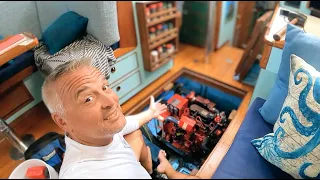
A second issue surfaced when the port engine room bilge pump began cycling unexpectedly. Davy inspected the machinery space and found water pooling beneath the engine, with rust trails indicating leakage from the raw water pump. Disassembling the pump revealed that the impeller had lost one of its fins and the internal water seal had failed.
Finding a replacement seal proved problematic. The first spare seal aboard did not match the pump housing, while a second spare had a damaged lip that distorted when pressed into place. Reluctant to cross the Gulf Stream without a dependable engine cooling system, the crew contacted their friend Chris in South Florida to track down a replacement unit. Davy noted their predicament: “otherwise we’re stuck here in Miami for about another week”
The search required waiting one week in Miami for the replacement pump to arrive. Once delivered, Davy performed minor modifications to the mounting setup so the new unit would fit the engine bracket, finally clearing the catamaran for departure.
Gulf Stream Crossing and Great Harbour Cay Arrival
Departing Miami early in the morning, Davy and Erica set a course eastward across the Gulf Stream. Underway, an offshore fish struck their trolling line mid-body, but the catch broke free in the propeller wash before it could be secured on deck. Reaching the western fringe of the archipelago, the crew cleared customs and immigration in Bimini.
From Bimini, the passage continued to Great Harbour Cay in the Berry Islands to rendezvous with their friend Brian. The catamaran arrived at sunset, facing a narrow channel cut that leads into the protected inner harbor. Erica explained the navigation challenge of the approach: “trust your charts it is there you will find it”
Once through the cut, the crew found ample swinging room inside the sheltered anchorage and noted the convenience of the local marina. After dropping anchor, they took their dog Foxy ashore to run along the beach.
Navigating Shallow Banks to Hoffman’s Cay
Continuing south through the Berry Islands required negotiating skinny water over the shallow banks. Cruising friends aboard another catamaran had transited the passage two weeks prior and shared their recorded track data. Davy noted their navigation briefing: “Lonnie said there was only one spot that he had to hold his breath”
To minimize the risk of grounding, Davy and Erica timed their transit across the shallowest sand bank to coincide with a rising tide. Crossing without incident, they arrived at Hoffman’s Cay to explore the deep sinkhole at Hoffman’s Blue Hole. Using their hookah diving rig, the crew tested diving down to 30 feet depth while Davy surveyed the submerged terrain with a handheld metal detector. Returning to the boat, they prepared fresh mahi-mahi caught along the transit for dinner.
Mangrove Rapids, Mooring at Warderick Wells, and Farmer’s Cay
Moving into the Exumas, Erica and Brian launched stand-up paddle boards to explore the tidal mangrove creeks at Shroud Cay. The excursion led them into a tidal passage known as The Rapids and the Whirlpool, where fierce rushing water required heavy paddling against the current.
The voyage continued south to Warderick Wells Cay in the Exuma Cays Land and Sea Park. The crew picked up a mooring ball in the protected channel, where swift tidal flow and central sandbanks dictate careful handling, noting that vessels visiting during high season should call ahead on VHF radio to check mooring availability. To cool off from the Caribbean sun, Davy and Erica took their Highfield dinghy on a circumnavigation around the perimeter of the key. Farther down the island chain at Farmer’s Cay, they took a dive light into a cavern to explore an interior pool of cool water.
Tropical Heat, Air Conditioning Troubles, and Onboard Upgrades
Sustained calm conditions and high humidity brought interior cabin temperatures to uncomfortable levels. Although the vessel carried sufficient electrical capacity to operate its onboard air conditioning system, the unit had never been plumbed into an operational raw water circulation circuit. Lacking the necessary cooling pump, Davy conceded: “we don’t have a water pump so basically we’re shelving that idea and going to melt”
The heat sparked discussion about boat design. Erica maintained that painting the catamaran hull sides gray had noticeably increased heat absorption below deck, while Davy remained unconvinced that the color choice made a measurable difference.
Between passage legs, the crew turned their attention to ongoing maintenance projects. Having installed collection gutters along the hardtop, they tested their rainwater harvesting setup during a rain shower, collecting 20 gallons in one storage tank and 5 gallons in another. Davy also rebuilt the helm seating module and tested a freshwater washdown hose to confirm it reached the onboard laundry equipment: “it does just reach it just reaches and I’ll be able to fill up the washing machine just like that success”
They also demolded newly cast composite parts as they concluded their review of 2023 and looked forward to the cruising season of 2024.
Frequently Asked Questions
The autopilot ram placed excessive tension on the wiring harness at rudder angles of 10 to 15 degrees in the ICW, pulling a terminal loose from the electronic control unit behind the helm.
The port engine raw water cooling pump developed a leak with rust streaks beneath the housing, caused by a failed water seal and an impeller that had lost one fin.
The crew waited one week in Miami to source a replacement raw water pump, which Davy then modified to fit the existing engine bracket.
They followed a GPS route shared by cruising friends two weeks prior and timed their crossing over the shallowest sandbank to coincide with a rising tide.
The rain test collected 20 gallons in one container and 5 gallons in another from the hardtop catchment system.
Although the catamaran had sufficient electrical power, the air conditioning system lacked an operational seawater cooling pump to circulate water through the unit.
Book a trip where this was filmed — near New Providence Island
Support Barefoot Travels
At WeBoating.com, we profoundly acknowledge the unwavering dedication that Barefoot Travels invests in crafting each and every video or voyage. Their passion for delivering exceptional ocean content shines through every frame, and it's a labor of love that deserves your attention.
We invite you to watch their captivating videos here and actively engage with their content, including their social media links above. Liking, commenting, and sharing their work goes a long way in fueling their creative fire.
We're also inviting you to explore the gear, sponsorships, and boat partnerships highlighted in the "Year in Review - What Will 2024 Bring? (Part 2)" video description, or directly on YouTube. By engaging with these offerings or purchasing services and items, you directly support Barefoot Travels, their collaborators, and the brands they're associated with.
To ensure you never miss an offshore update, consider visiting their official YouTube Channel to subscribe, like, and join their community directly.
If you have any feedback, corrections, or additional information about Barefoot Travels or their videos, please use the comment form below to share your thoughts with us.
Thank you for being a part of our community and supporting the creators we cherish. Your time and support truly matter!
Barefoot Travels
In 2026, Barefoot Travels documents Davy and Erica as they execute the comprehensive structural restoration of Barefoot 2.0, a hurricane-damaged Fountaine Pajot cruising catamaran. Based in Luperon, Dominican Republic after cruising the Bahamas aboard their legacy Catalina 36, the Canadian couple shares master-level composite repairs, gelcoat peeling, and multihull seamanship without artificial melodrama.
Channel Information:
Social Media Links:
Year in Review - What Will 2024 Bring? (Part 2) Location
- Great Harbour Cay, Berry Islands, Bahamas (25.76,-77.85)
- Miami, Florida, United States (25.7743,-80.1309)
- Bimini, Bahamas (25.7275,-79.2975)
- Hoffman's Cay, Berry Islands, Bahamas (25.6133,-77.7467)
- Shroud Cay, Exuma Cays, Bahamas (24.5333,-76.7833)
- Warderick Wells Cay, Exuma Cays, Bahamas (24.3986,-76.6342)
- Farmer's Cay, Exuma Cays, Bahamas (23.9619,-76.3267)
Latest Episodes from Barefoot Travels
Explore the most recent voyages. Subscribe to the channel to never miss an update!

5 Must Have Products on a BOAT!
In this week's episode of Barefoot Travels we talk about our 5 must have items on a boat! Use our discount code Barefoot Travels for 16% off your own SET POWER fridge/freezer Below are som Amazon links to our other must have items Our collapsible Tupperware Our favourite Sun Shades: ...
SET POWER all the way!! Keep COLD this SUMMER! #setpower #keepcold #icecold
Barefoot Travels shares the secrets of keeping things ice-cold on their boat, including their essential set power refrigerators.
BOAT TOUR – Sabre 425 – Come Join the Salt Life
Join Barefoot Travels on a captivating boat tour of the impressive Sabre 425 'Yafa'. Dive into its superior qualities, spacious interiors, and top-notch amenities. Why should you consider this yacht for your coastal or offshore cruising adventures? Find out now!