The Ocean Race IMOCAs will use Auto Pilots for 99.9% of race. Leg 1 Preview, 5 Teams, more
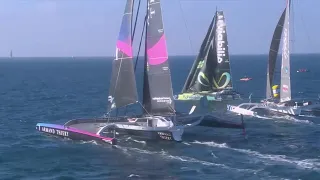
At the team docks along the waterfront in Alicante, preparations for the start of The Ocean Race 2023 marked an unprecedented technical shift as five international crews readied their foiling IMOCA monohulls. Reporting for World On Water, technical dispatches confirmed that the transition to the new class introduces the smallest crew rosters in the event’s history, placing just four sailors aboard each boat to navigate the grueling six-month course toward the finish port at Genoa.
Unlike previous editions contested aboard one-design Volvo Ocean 65s where manual helming decided offshore legs, these high-speed foiling machines rely almost entirely on automated navigation. British solo sailor Sam Goodchild, joining skipper Kevin Escoffier aboard Team Holcim-PRB, confirmed the reality of the technological change: “the pilot we’ll be doing the work for 99.9 of the time over the next 32 000 nautical miles.”
Autopilot Calibration and the New Trimming Discipline
Rejecting suggestions that automated steering diminishes seamanship, Goodchild outlined the operational reality facing crews dockside in Spain. Traditional hand-steering has given way to active sensor monitoring, sail trim calibration, and foil angle management. Goodchild noted: “you could have Peter Burling the New Zealand America’s Cup winning Skipper driving 24 hours a day but if you go the wrong way or put the wrong sale up he’s not going to do much good for you.”
Enclosed cockpits and extreme boat speeds make manual helming impractical, as crews cannot see oncoming swells from conventional positions. Instead of gripping a wheel, watchstanders concentrate on programming compass headings, wind angles, and target heel angles. Goodchild explained: “we spend much more time and energy if not more trimming our pilot as we did driving before so the skill set has changed as opposed to disappeared.”
Dynamic Foiling Loads and Keypad Helm Control
Underway downwind at 30 knots in the Southern Ocean, foiling creates violent apparent wind shifts that overpower manual reaction times. When hydrofoils lift the hull, the apparent wind angle shifts forward by 10 to 15 degrees during sudden acceleration, before snapping back 20 degrees when striking a wave. Trimming through this cycle requires setting average parameters on the autopilot, as Goodchild pointed out: “you can’t possibly ease two meters of traveler and main sheet every time you come into a wave and then winch it all back on again as you pick up speed.”
Fellow British sailor Will Harris on Team Malizia emphasized that automated steering requires continuous human intervention rather than passive trust. Operating modern hydrofoils demands active control adjustments via deck interfaces, as Harris remarked: “the keypad is effectively our tiller now and it’s not like we push the on button and it goes off on its own it’s not like that at all.” Crew members tune algorithmic responses to ensure the system steers as well as an expert sailor.
Five International Syndicates and Southern Ocean Engineering
Five elite campaigns enter the competition across seven demanding legs. The American-flagged 11th Hour Racing Team, led by skipper Charlie Enright in his third attempt, features three previous race winners. Team Holcim-PRB brings proven resilience under skipper Kevin Escoffier, who survived abandoning his sinking yacht in the Southern Ocean during the 2020 Vendée Globe.
Germany’s Team Malizia, skippered by Boris Herrmann alongside French navigator Nicolas Lunven and Dutch sailor Rosalin Kuiper, campaigns a bespoke hull optimized for Southern Ocean sea states. Kuiper, who lived in her camper van for two months in Arradon while building the boat, welcomed the extended voyage: “if I think about being offshore for more than five weeks I feel super good super happy you can see the stars every day the sun coming up the sun going down and for me after a couple of days I feel more relaxed being offshore.” Guyot Environnement – Team Europe and Biotherm complete the competitive lineup.
Navigating the Strait of Gibraltar and the Trade Wind Sprint
Leg 1 begins on the 15th with a tactical departure from Alicante across the Mediterranean. Navigators anticipate two to four days of tricky coastal racing before negotiating the narrow Strait of Gibraltar, where adverse currents and light winds threaten to stall competitors. Escaping into the Atlantic Ocean toward Cabo Verde rewards whichever team first hooks into the steady Northeast trade winds.
Frequently Asked Questions
IMOCA boats rely on autopilots for 99.9% of the race because high-speed foiling generates violent apparent wind shifts that exceed human reaction times, and enclosed cockpits restrict external visibility from manual helm positions.
Each IMOCA yacht is sailed by a crew of four sailors, representing the smallest crew size in the history of the fully crewed round-the-world race.
Leg 1 involves two to four days in the Mediterranean before navigating the Strait of Gibraltar, where light winds and strong opposing currents can trap boats before reaching the Northeast trade winds.
Crews control the boat through computer keypads that act as tillers, constantly adjusting autopilot software parameters, compass headings, and heel angles.
Book a trip where this was filmed — near Alicante

Support World On Water
At WeBoating.com, we profoundly acknowledge the unwavering dedication that World On Water invests in crafting each and every video or voyage. Their passion for delivering exceptional ocean content shines through every frame, and it's a labor of love that deserves your attention.
We invite you to watch their captivating videos here and actively engage with their content, including their social media links above. Liking, commenting, and sharing their work goes a long way in fueling their creative fire.
We're also inviting you to explore the gear, sponsorships, and boat partnerships highlighted in the "The Ocean Race IMOCAs will use Auto Pilots for 99.9% of race. Leg 1 Preview, 5 Teams, more" video description, or directly on YouTube. By engaging with these offerings or purchasing services and items, you directly support World On Water, their collaborators, and the brands they're associated with.
To ensure you never miss an offshore update, consider visiting their official YouTube Channel to subscribe, like, and join their community directly.
If you have any feedback, corrections, or additional information about World On Water or their videos, please use the comment form below to share your thoughts with us.
Thank you for being a part of our community and supporting the creators we cherish. Your time and support truly matter!

World On Water
World On Water (WoW TV / Boats on TV) is the premier weekly sailing news show hosted by Geoff Waller from Sydney Harbour. Explore in-depth coverage of America's Cup, Rolex Sydney Hobart, Vendée Globe, and grand prix regattas.
Channel Information:
Social Media Links:
The Ocean Race IMOCAs will use Auto Pilots for 99.9% of race. Leg 1 Preview, 5 Teams, more Location
- Port of Alicante, Spain (38.3415,-0.4815)
- Strait of Gibraltar (35.96,-5.5)
- Mindelo, Cabo Verde (16.885,-24.995)
Latest Episodes from World On Water
Explore the most recent voyages. Subscribe to the channel to never miss an update!
Report #2 2027 America’s Cup Naples. The whole picture. Prepared by the World on Water
World On Water analyzes the 2027 America's Cup in Naples, examining AC75 hydrofoil dynamics, flight control systems, and challenger match-racing tactics.
Francesca Clapcich of 11th Hour Racing awarded Winner of 2026 IMOCA Globe Series World on Water
Francesca Clapcich wins the 2026 IMOCA Globe Series championship, becoming the first female sailor to claim the title after an eighth place finish in the Route du Rhum.
The IMOCA Podium 2026 Route du Rhum Guadeloupe World on Water
Corentin Horeau captures IMOCA victory in the 2026 Route du Rhum aboard MACSF, with Boris Herrmann and Élodie Bonafous completing the podium at Pointe-à-Pitre.
(English) SVR Lazartigue Spectularly Wins Route du Rhum in Record Style. Tom Laperche Champion!
Tom Laperche guides the Ultim multihull SVR Lazartigue across the Route du Rhum finish line off Pointe-à-Pitre, Guadeloupe, establishing a new transatlantic race record of six days, thirteen hours, twenty-seven minutes, and forty seconds.
Route du Rhum Fleet Still CRASHING Through the Atlantic Headed West. EXCLUSIVE from World on Water.
The 2026 Route du Rhum turns into a battle of survival across the Atlantic as severe gale-force squalls trigger dismastings, cockpit injuries, and retirements across the IMOCA and Class 40 fleets while leaders push toward Guadeloupe.