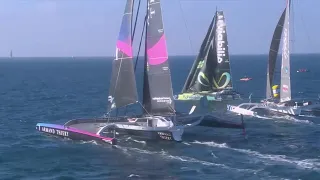
Sailing World on Water Nov 22.24 Vendee and OZ Special. Hobart preview, 18's Mayhem, Boris/Sam/Pip
Preparations for the 79th Rolex Sydney Hobart Yacht Race gather pace as offshore fleets tackle demanding waters, from the southbound course to the high-wind chop of Sydney Harbour covered by World On Water. With the annual 628-nautical-mile sprint to Tasmania approaching its December 26 start, attention turns to the tactical challenges awaiting 100 crews negotiating Bass Strait, while thousands of spectators prepare to line the foreshore beneath the Sydney Opera House and Harbour Bridge.
At the same time, the Vendée Globe enters its second week of solitary racing, where variable conditions test patience and equipment. From technical skiff handling in Australia to single-handed offshore endurance in the trade winds, tactical decisions on the water dictate whether teams maintain pace or suffer costly stalls against their rivals.
The 79th Rolex Sydney Hobart Offshore Challenge
The 2024 edition marks the 79th running of the 628-nautical-mile, 1,163-kilometre passage from Sydney Harbour to Hobart, the capital of Tasmania. Organized by the Cruising Yacht Club of Australia in collaboration with the Royal Yacht Club of Tasmania, the race begins traditionally on December 26 amid the Australian summer. Partnered by Rolex for the past 22 years, the contest has built a reputation across its near 80-year history as one of the most demanding offshore tests in international sailing.
Competitors emphasize the unpredictable nature of the racecourse, where Bass Strait presents extreme weather systems and steep waves that test boat structures and crew endurance:
“you have to do the rolex sydney hobart race to me it probably is the hardest race in the world you never go in thinking that it’s going to be an easy ride you know that anything could come at you you got to prepare for that it’s a really dynamic challenging racetrack”
While 100-foot Super Maxi yachts compete at the front of the 100-strong fleet for line honours, the majority of the fleet consists of skilled Corinthian sailors campaigning classic and modern cruiser-racers. These teams contend for the Tattersall Cup, awarded to the overall winner on handicap, where disciplined seamanship and perseverance across Bass Strait decide the outcome.
Vendée Globe Week 2: Boris Herrmann on Malizia – Sea Explorer
Following the opening week of the Vendée Globe, German skipper Boris Herrmann navigates his IMOCA yacht, Malizia – Sea Explorer, through shifting conditions. By Day 5, Herrmann found himself sailing in company with Yannick Bestaven and Justine Mettraux in bright daylight, but the fleet soon faced a forecast showing nearly 5 days of light winds.
During this passage through the trade winds, Herrmann took advantage of calm sea conditions to deploy scientific ocean monitoring equipment. Herrmann launched an autonomous drifter buoy, one of 8 drifter buoys scheduled for release between 24 North and 19 North during the Vendée Globe:
“this is one of the only ways to get permanent atmospheric pressure measurements because satellites can’t measure air pressure”
The instrument, bearing the message “there is no Planet B”, provides continuous barometric data to international meteorological networks for weather prediction and climate studies across its estimated 5-year operating lifespan.
Tactical progress grew frustrating when a calm dead zone trapped Malizia – Sea Explorer around 1:00 AM. While other competitors continued moving at speeds between 10 and 15 knots, Herrmann drifted at barely 3 knots in changing directions as the sails flapped in the dark. Reflecting on the mental pressure of losing distance to rivals, Herrmann noted the psychological discipline required in solo ocean racing:
“I think we have this culture of being race sailor and mentally being the race. I physically feel it when I’m better positioned or worse.”
Maintaining focus through morning mindfulness, Herrmann awaited freshening breezes as blue skies returned and the foil generated lift to accelerate the boat back up to speed.
Australian 18 Footers League: Heavy Air on Sydney Harbour
In Sydney Harbour, the Australian 18 Footers League fleet took to the water in challenging conditions, with a solid nor’easter blowing between 25 and 30 knots. Racing encompassed Heat 5 of the Spring Championship and Heat 3 of the Club Championship, testing three-person skiff crews to their handling limits on the tight harbour course toward Bradley’s Head and Point Piper.
The heavy wind took an immediate toll on the fleet, with only 7 skiffs making the starting line on time, several rigged with deep reefs in their mainsails and small jibs. Harry Price, Max Paul, and Finn Rodowicz aboard Rag & Famish Hotel continued their dominant form, engaging in a tight battle with Yandoo and Finport across the opening legs:
“Certainly can’t wait for a flat spot to jibe in today because there’s no flat spots”
Crews contended with sudden gusts and ferry wash that lifted hulls out of the water downwind. While Rag & Famish Hotel secured the victory, the young crew of Hugh Stoner, Hugo Leeming, and Daniel Watson aboard Oak Double Bay-4 Pines earned strong recognition from supporters by fighting through the heavy breeze to secure fourth place behind the leading contenders.
Vendée Globe Skippers Short Reports
The episode concludes with dispatches from three additional Vendée Globe competitors managing their yachts through week two. British skippers Sam Davies aboard Initiatives-Cœur and Pip Hare aboard Medallia deliver updates on sail configurations and boat speed, while Alan Roura shares operational observations from aboard Hublot as the solo skippers work southward.
Offshore and Regatta Performance Metrics
The following table summarizes the key numerical benchmarks, distances, and operational measurements recorded across the regattas and passages:
| Metric | Details | Notes |
|---|---|---|
| Sydney Hobart course | 628 nautical miles | passage length from Sydney to Hobart (1,163 km) |
| Sydney Hobart fleet | 100 yachts | fleet size at the Sydney Harbour start |
| Title sponsorship | 22 years | continuous partnership with Rolex |
| Skiff starters | 7 skiffs | boats starting on time in 25 to 30 knots |
| Drifter buoys | 8 buoys | instruments deployed between 24 and 19 North |
| Light air stall speed | 3 knots | Boris Herrmann speed during calm (fleet: 10 to 15 knots) |
Frequently Asked Questions
The Rolex Sydney Hobart Yacht Race covers a distance of 628 nautical miles (1,163 kilometres), starting in Sydney Harbour and finishing in Hobart, Tasmania.
While line honours winners receive public acclaim, the majority of the fleet competes on handicap for the Tattersall Cup.
Competitors deploy scientific drifter buoys between 24 North and 19 North to measure permanent atmospheric pressure for weather forecasting and climate research, which satellites cannot measure directly.
The fleet raced in a strong nor’easter of 25 to 30 knots, which limited the on-time starting fleet to 7 skiffs carrying small jibs and deep mainsail reefs.
Rag & Famish Hotel, sailed by Harry Price, Max Paul, and Finn Rodowicz, claimed victory, while Oak Double Bay-4 Pines sailed by Hugh Stoner, Hugo Leeming, and Daniel Watson finished fourth.
Book a trip where this was filmed — near Sydney
Support World On Water
At WeBoating.com, we profoundly acknowledge the unwavering dedication that World On Water invests in crafting each and every video or voyage. Their passion for delivering exceptional ocean content shines through every frame, and it's a labor of love that deserves your attention.
We invite you to watch their captivating videos here and actively engage with their content, including their social media links above. Liking, commenting, and sharing their work goes a long way in fueling their creative fire.
We're also inviting you to explore the gear, sponsorships, and boat partnerships highlighted in the "Sailing World on Water Nov 22.24 Vendee and OZ Special. Hobart preview, 18's Mayhem, Boris/Sam/Pip" video description, or directly on YouTube. By engaging with these offerings or purchasing services and items, you directly support World On Water, their collaborators, and the brands they're associated with.
To ensure you never miss an offshore update, consider visiting their official YouTube Channel to subscribe, like, and join their community directly.
If you have any feedback, corrections, or additional information about World On Water or their videos, please use the comment form below to share your thoughts with us.
Thank you for being a part of our community and supporting the creators we cherish. Your time and support truly matter!
This is your weekly Global Sailing Highlights show, the World on water, November 22, 2024.
It's this time of the year, when we have Black Friday Sales, we buy Christmas trees, and, for sailors, talk turns to the Rolex Sydney to Hobart Race.
The 2024 edition, will be the 79th of the 628-nautical mile, 1,163 kilometre-race, from Sydney Harbour to Hobart, the state capital of Tasmania. The start, as ever, on the 26th of December, takes place in the heart of the Australian summer, the mood is festive as crowds line Sydney's spectacular harbour, eager to be part of this celebratory occasion. This year will be no different.
Here is Rolex's preview.
The first week of the Vendee Globe is over and we have a report of week 2 from the ever popular German, Boris Herrman, who is sailing his Imoca, Malizia, Sea Explorer. As always he is very pumped.
Three of the best teams in the Australian 18 Footers League’s 2024 2025 season flee,t put on a great exhibition of power, speed racing in a 25 to 30 knot nor’easter on Sydney Harbour last Sunday with only a few seconds separating them for more than two-thirds of the long course, but it was the team which finished fourth behind the ‘stars,’ that became the story of the day.
While the Rag & Famish Hotel team of, Harry Price, Max Paul, and Finn Rodowicz, continued its domination of both the club championship, and Sixt, the spring champions, it was the young Oak Double Bay-4 Pines team, of Hugh Stoner, Hugo Leeming, and Daniel Watson, which won the hearts of supporters.
To end this week's show we have a series of "Short Reports" from three of the Vendee Globe Skippers, Brits, Sam Davies of Initiatives Couer, Pip Hare of Medallia, along with Alan Roura sailing HUBLOT.

World On Water
World On Water (WoW TV / Boats on TV) is the premier weekly sailing news show hosted by Geoff Waller from Sydney Harbour. Explore in-depth coverage of America's Cup, Rolex Sydney Hobart, Vendée Globe, and grand prix regattas.
Channel Information:
Social Media Links:
Sailing World on Water Nov 22.24 Vendee and OZ Special. Hobart preview, 18's Mayhem, Boris/Sam/Pip Location
- Sydney Harbour, New South Wales, Australia (-33.8568,151.2153)
- Hobart, Tasmania, Australia (-42.8821,147.3272)
Latest Episodes from World On Water
Explore the most recent voyages. Subscribe to the channel to never miss an update!
Report #2 2027 America’s Cup Naples. The whole picture. Prepared by the World on Water
World On Water analyzes the 2027 America's Cup in Naples, examining AC75 hydrofoil dynamics, flight control systems, and challenger match-racing tactics.
Francesca Clapcich of 11th Hour Racing awarded Winner of 2026 IMOCA Globe Series World on Water
Francesca Clapcich wins the 2026 IMOCA Globe Series championship, becoming the first female sailor to claim the title after an eighth place finish in the Route du Rhum.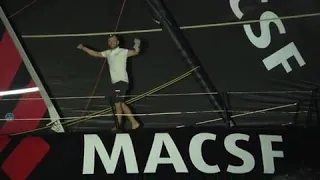
The IMOCA Podium 2026 Route du Rhum Guadeloupe World on Water
Corentin Horeau captures IMOCA victory in the 2026 Route du Rhum aboard MACSF, with Boris Herrmann and Élodie Bonafous completing the podium at Pointe-à-Pitre.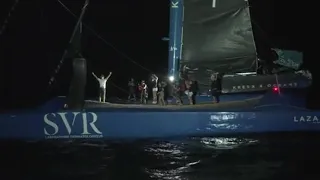
(English) SVR Lazartigue Spectularly Wins Route du Rhum in Record Style. Tom Laperche Champion!
Tom Laperche guides the Ultim multihull SVR Lazartigue across the Route du Rhum finish line off Pointe-à-Pitre, Guadeloupe, establishing a new transatlantic race record of six days, thirteen hours, twenty-seven minutes, and forty seconds.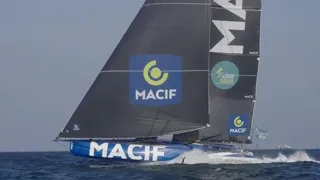
Route du Rhum Fleet Still CRASHING Through the Atlantic Headed West. EXCLUSIVE from World on Water.
The 2026 Route du Rhum turns into a battle of survival across the Atlantic as severe gale-force squalls trigger dismastings, cockpit injuries, and retirements across the IMOCA and Class 40 fleets while leaders push toward Guadeloupe.