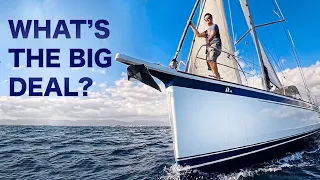
NEEL 47 REVIEW - The Best Way to Judge a Boat
Nick and Megan O’Kelly step aboard a NEEL 47 trimaran alongside owners Joran and Simone for an offshore sea trial designed to evaluate the multi-hull design under real working conditions. While maintaining their own Leopard 46 catamaran, SV Clarity, the mariners from The O’Kelly’s had previously walked through the trimaran at dockside exhibits but held back from forming conclusions until taking the helm in open water.
The vessel carries an overall length of 47 feet paired with an expansive 27-foot beam and a draft of 5.4 feet on its central keel. With gusty offshore conditions presenting a steep chop, the rendezvous offers a direct comparison between the motion of a three-hulled platform and the familiar seakeeping characteristics of their cruising catamaran.
Evaluating Multihull Dynamics Under Sail
When assessing long-distance cruising platforms, displacement, sail area, and hull geometry dictate daily passage comfort. Joran and Simone had evaluated several performance craft, including performance catamarans in the 45-foot range, before selecting the NEEL 47 for shorthanded voyaging. Underway, the trimaran behaves similarly to a monohull by settling into a gentle heel of only a few degrees, avoiding the snap roll common to wider platforms while tracking cleanly through rolling seas.
During their initial delivery along the eastern seaboard, the owners tested the trimaran across heavy offshore weather. Joran explained the speed potential they unlocked once the gale passed:
“When we sailed down from Virginia to Fort Lauderdale that was a five-day sail. We had some big winds off the coast from Georgia, but the day after it was like 20 knots of wind and we were just doing like the 10 to 12 knots consistently. We did over 200 miles in 24 hours.”
Logging 200 miles in 24 hours under working canvas confirmed that the platform maintains high average speeds without requiring constant athletic intervention from a crew of 2.
The Solent Rig and Deck Management
The sail configuration centers on a versatile solent rig rather than a standard cutter arrangement. While a traditional cutter features a fixed inner forestay with a furler that obstructs the primary headsail during short tacks, the NEEL 47 utilizes a removable inner stay. This stay supports a self-tacking solent sail that operates without dedicated sheet adjustments during maneuvers.
When navigating light conditions, the crew drops the solent sail to leave the foretriangle unobstructed, allowing the outer furling jib to tack cleanly across the foredeck. When offshore winds build toward 20 knots, hoisting the self-tacking solent gives the helm a compact, inboard headsail designed for heavy air work.
All halyards, reefing lines, and control sheets lead aft to a raised bulkhead helm station equipped with 2 primary winches and dedicated line clutches. Centralizing the running rigging keeps the wide side decks clean and free of loose lines, eliminating the tripping hazards common on vessels where cords trail across wet walking areas. The helm enclosure provides a 360-degree vantage over the deck and surrounding horizon, allowing the watchkeeper to adjust autopilot headings and monitor instruments while staying dry behind the composite windshield.
Fine Entry Hulls and Head Sea Seakeeping
Heading upwind against an opposing wave set reveals the sharpest contrast between the NEEL trimaran and a production catamaran. On SV Clarity, the hulls feature flared bows starting 3 feet aft of the stem to generate reserve buoyancy, preventing the bows from digging in when meeting steep chop. That forward volume, however, causes the catamaran to pitch and decelerate when slamming into head seas, dropping boat speeds when encountering heavy wave sets.
The NEEL 47 relies on narrow, fine-entry reverse bows that slice directly through swells rather than riding over them. Underway in bouncy conditions, the trimaran maintains forward momentum and preserves boat speed where wider hulls would hesitate. The trade-off for that wave-piercing efficiency is water across the deck: fine bows throw significantly heavier salt spray over the forward trampolines and deckhouse, creating a wetter ride that demands reliable foul-weather enclosure.
Single-Level Living and Centralized Machinery
Inside the vessel, the interior layout departs radically from standard multi-hull architecture. The master stateroom sits directly on the main deck level alongside the salon and galley, eliminating the need to descend into a narrow hull. Large surrounding windows offer panoramic sightlines across the water, allowing the off-watch crew to monitor anchored anchorages or sail trim directly from bed. Joran described the peace of mind this layout offers during rough nights:
“Last night we were at anchor, the wind starts blowing 20 knots and we are in bed, and all you have to do is lift your head, look around, see how everybody is doing, okay we are still in the right spot, and you keep on sleeping.”
Adjacent to the master cabin, the galley features generous counter space, pull-out drawer refrigeration, and an open transition into the aft cockpit lounge. Guest staterooms are physically isolated in the outer amas, accessible only via exterior companionways. While this arrangement prevents shared living quarters inside the main superstructure, it creates complete acoustic and visual privacy between owners and visitors. Joran recalled his initial reaction to the concept:
“When we looked at this boat I was not sure about that whole concept with the separate amas, and was one of the things I was like that is weird because guests have to go outside and then into their own ama, but it really is very nice, it is one of the pluses because it is so private.”
Beneath the main salon floor lies a central machinery room inside the main hull bilge. Unlike catamarans where engines and auxiliary systems are split across twin aft compartments, the NEEL concentrates the single main diesel engine, generator, battery bank, and watermaker into a single accessible service bay. Propulsion relies on a single shaft and propeller aided by a forward bow thruster, delivering straightforward dockside maneuvering for a platform spanning a 27-foot beam.
Ground Tackle and Transom Practicalities
Inspecting the exterior deck hardware highlights several practical considerations for ocean voyaging. To keep the anchor clear of the vertical reverse bows, the yard installed a heavy fixed bowsprit that extends forward of the stem. While this rigid sprit serves as a sturdy tack point for flying a code zero or asymmetrical spinnaker without the flexing associated with articulating dolphin strikers, it places the anchor roller further out, making the attachment of anchor snubbers and bridles more awkward to access from the foredeck.
At the stern, the dinghy is suspended on transom chocks using a dedicated lifting bridle run from the main boom. In following seas, low-slung tender chocks can catch trailing swells, suggesting that ocean passage-makers may choose to stow the tender on deck during heavy offshore crossings. A dedicated life raft cradle is mounted low on the transom near the water, ensuring immediate deployment in the rare event of severe distress.
After concluding their offshore evaluation, Nick and Megan reflected on the design trade-offs while anchored aboard Clarity in shallow anchorages like Prime Cay. While a draft of 5.4 feet requires slightly more caution when navigating coral heads than their catamaran’s four and a half foot keel, the NEEL 47 proves that modern trimaran architecture delivers exceptional passage speeds, responsive helm control, and true shorthanded capability for ocean cruising.
Frequently Asked Questions
The NEEL 47 slices directly through head seas without the pitching or slamming common to cruising catamarans because its fine-entry bows lack flared forward buoyancy, though this finer profile throws noticeably more salt spray onto the decks.
The trimaran features a solent rig with a removable inner forestay flying a self-tacking solent sail alongside a furling outer jib, allowing the crew to tack cleanly in light air and hoist a smaller inner sail when winds build to 20 knots.
The master stateroom is located directly on the main deck level adjoining the galley and salon with panoramic views, while guest staterooms reside in the outer amas with private access exclusively from the exterior deck.
The boat uses a single main diesel engine paired with a bow thruster for maneuvering, centralizing the engine, batteries, generator, and watermaker in a dedicated walk-in machinery bilge beneath the center salon floor.
Book a trip where this was filmed — near Fort Lauderdale

Support The O'Kelly's
At WeBoating.com, we profoundly acknowledge the unwavering dedication that The O'Kelly's invests in crafting each and every video or voyage. Their passion for delivering exceptional ocean content shines through every frame, and it's a labor of love that deserves your attention.
We invite you to watch their captivating videos here and actively engage with their content, including their social media links above. Liking, commenting, and sharing their work goes a long way in fueling their creative fire.
We're also inviting you to explore the gear, sponsorships, and boat partnerships highlighted in the "NEEL 47 REVIEW - The Best Way to Judge a Boat" video description, or directly on YouTube. By engaging with these offerings or purchasing services and items, you directly support The O'Kelly's, their collaborators, and the brands they're associated with.
To ensure you never miss an offshore update, consider visiting their official YouTube Channel to subscribe, like, and join their community directly.
If you have any feedback, corrections, or additional information about The O'Kelly's or their videos, please use the comment form below to share your thoughts with us.
Thank you for being a part of our community and supporting the creators we cherish. Your time and support truly matter!
The O'Kelly's
From Leopard 46 catamaran voyaging to a high-authority monohull reset. Join professional meteorologist Nick O'Kelly and content architect Megan O'Kelly as they manage their 2026 search for the ultimate offshore flagship in Spain.
Channel Information:
Social Media Links:
NEEL 47 REVIEW - The Best Way to Judge a Boat Location
- Fort Lauderdale, Florida, USA (26.1224,-80.1373)
- Prime Cay, Berry Islands, Bahamas (25.5333,-77.8333)
Latest Episodes from The O'Kelly's
Explore the most recent voyages. Subscribe to the channel to never miss an update!
They Reinvented the Performance Cruising Catamaran
Nick and Megan O'Kelly visit the Windelo catamaran shipyard in Canet-en-Roussillon, France, exploring basalt fiber composite hulls, electric propulsion, and taking an upwind sea trial in 30-knot gusts.
MEXICO SAIL – THIS BOAT IS LOADED!
Banderas Bay is a sailor's paradise, especially sailing aboard a catamaran. In this video we check out the beautiful Lindenberg 65, Force, and go for a sail aboard a Leopard 48. We sailed here in 2003 when we were "baby cruisers" and got married. We'll recap everything we've...
We Chased a Boat to Indonesia
You just never know where the path will lead. Indonesia was not on our bucket list, but when a very cool boat appeared to be for sale in Lombok, we jumped on a plane to have a look. While the boat didn't work out (spoiler), the trip was transformative for us. Find the O'Kelly Annex here: ...
SPAIN – we should move here!
Finishing our circumnavigation by airplane, we find ourselves in La Cruz, Mexico within sight of where we were married in 2004. Join us for an epic roadtrip through Spain and Portugal: Santa Pola, Osuna, Alvor, Sevilla, Grenada, Valencia, and then on to Madrid before we fly out to Bali. Exclusive $3...
4 Years to find their DREAM BOAT – Hammerhead 54 Trimaran
Patience and hard work pay off! This Chris White's Hammerhead 54 trimaran has been transformed over the last year by a couple of the most knowledgeable and accomplished sailors you will ever meet. It was a pleasure to hang out on Spirit XL in the Whitsundays to see what she can really do! We we...