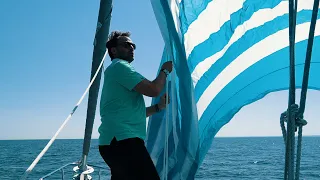
Sailing Vlog 29 Time for a new Dinghy? What should we get? | ⛵ The Foster Journey
In Deltaville, Virginia, the crew of The Foster Journey hauled their Achilles rigid inflatable tender ashore to pinpoint recurring tube deflation. Named Cadence, the tender had logged extended service across coastal passages and Bahamas anchorages, but three separate air leaks now compromised the hypalon tubes.
With haul-out scheduled in two weeks to apply bottom paint to both their sailboat and the tender, locating every puncture was an essential preliminary step. Armed with a spray bottle filled with a simple mixture of Dawn dish soap and water, the crew systematically coated the inflatable collars. Escaping air quickly exposed the damage, creating active clusters of suds across the tube seams. As the crew explained the diagnostic process, “when there’s a hole you spray it if there’s not a hole it just kind of soaps up the boat you got to get a little wash in but if there’s a hole it bubbles” under pressure.
The inspection quickly isolated three distinct leaks across the tender’s three independent buoyancy chambers. The most severe puncture was an elongated gash along the tube shoulder where the tender rested against the davit supports. Over seasons of offshore passage-making, constant friction combined with intense solar degradation and salt air had abraded the hypalon down to raw backing fabric. Another leak, first detected by ear while swimming past the hull in the Bahamas, was successfully tracked down on the forward tube collar.
Foredeck Dimensions and Tender Trade-offs
Evaluating whether to repair or replace the tender prompted a practical look at sailboat deck geometry. While a 10 or 10-and-a-half-foot inflatable would offer expanded interior volume and comfort for three crew members, deck architecture imposes an unyielding boundary. On their sailboat, the distance from the forward pulpit to the mast babystay measures exactly 10 feet. As the skipper observed regarding deck space constraints, “from the bow pull pit to the baby stay is only 10 ft so a 9 and a half dingy fits there” without encroaching on rigging.
Beyond storage restrictions, hull construction plays a decisive role in rough-water performance. The Achilles features a heavy double-layered fiberglass bottom equipped with an integrated bilge sump and flat interior sole. While that additional fiberglass weight demands extra effort during stowage and limits outright speed, it provides vital stability in challenging seaways. Entering exposed anchorages like Spanish Wells in the Bahamas, lightweight tenders tend to bounce violently across cresting chop. By contrast, the heavy fiberglass deadrise sliced through incoming waves to deliver a significantly drier transit, proving that “we just cut right through it no big deal” even in heavy harbor chop.
With all three tube punctures accurately marked, the crew prepared their repair inventory, ready to bond permanent hypalon patches once the mothership reaches the boatyard.
Frequently Asked Questions
Spraying a mixture of Dawn dish soap and water onto the inflated hypalon tubes causes escaping air to produce visible soap bubbles at the exact leak location.
Their sailboat foredeck clearance from the bow pulpit to the mast babystay is 10 feet, which restricts the dinghy length to nine and a half feet.
Continuous friction where the tender rested against the davits, combined with sun exposure and salt air, wore the hypalon down to raw fabric.
The double-layered fiberglass hull with an integrated bilge adds weight that cuts cleanly through rough harbor chop, delivering a drier ride than lightweight inflatables.
Book a trip where this was filmed — near USA

Support The Foster Journey
At WeBoating.com, we profoundly acknowledge the unwavering dedication that The Foster Journey invests in crafting each and every video or voyage. Their passion for delivering exceptional ocean content shines through every frame, and it's a labor of love that deserves your attention.
We invite you to watch their captivating videos here and actively engage with their content, including their social media links above. Liking, commenting, and sharing their work goes a long way in fueling their creative fire.
We're also inviting you to explore the gear, sponsorships, and boat partnerships highlighted in the "Sailing Vlog 29 Time for a new Dinghy? What should we get? | ⛵ The Foster Journey" video description, or directly on YouTube. By engaging with these offerings or purchasing services and items, you directly support The Foster Journey, their collaborators, and the brands they're associated with.
To ensure you never miss an offshore update, consider visiting their official YouTube Channel to subscribe, like, and join their community directly.
If you have any feedback, corrections, or additional information about The Foster Journey or their videos, please use the comment form below to share your thoughts with us.
Thank you for being a part of our community and supporting the creators we cherish. Your time and support truly matter!
Do we still like our Achilles dinghy? How do you find a leak in the dinghy Hypalon? Let's talk about the dink.

The Foster Journey
In 2026, Matt, Nancy, and Olivia Foster continue their full-time family voyaging aboard Cadence, their 2004 Catalina 387 sloop. Balancing professional remote careers and child homeschooling with coastal seamanship, the family has explored from Texas and the Bahamas to New York Harbor and Long Island Sound. Their channel offers a realistic blueprint for working families seeking sustainable maritime nomadism.
Channel Information:
Social Media Links:
Sailing Vlog 29 Time for a new Dinghy? What should we get? | ⛵ The Foster Journey Location
- Deltaville (37.5531008,-76.3402874)
Latest Episodes from The Foster Journey
Explore the most recent voyages. Subscribe to the channel to never miss an update!

End of Long Island Sound Sailing: Fishers Island from Port Jeff (Ep.203) | ⛵ The Foster Journey
Sailing the Length of Long Island Sound: Port Jeff to Fishers Island (Ep.203) Join us on SV Cadence, our Catalina 387, as we tackle a 55nm trek across the Long Island Sound! We’re wrapping up our time in Port Jefferson and heading East toward the beautiful Fishers Island. In this episode: Anchoring...
Why We Slowed Down, Patience is Pleasure. Sailing Vlog 36
Sailing Long Island to Port Jefferson, we decided to have a little chat about our new view on sailboat travel. *Sorry it's been a while since we posted - life happens, responsibilities and all, but we're glad to share this one with you!! Thanks for watching.