Weather, temperature and gales near Cape Horn also more on the mowing lead
The US have pilot charts, the UK have routing charts. Their purpose is to help the navigator to plan his passage.
The US ones used to be very good. I did study them a lot befere my 1969 sail to Rio de Janeiro. There is no copyright on US govement publications. The idea is that if anyony can copy and sell them cheaper than the gouvernment very good, but somehow it seams that the US have lost interest in them.
Admirality UK on the other hand have improved their routing charts a lot. They are now superior although they are not as complete as the US in some respects.
The prudent navigator like me study them boath.
Here is the January weather, air temperaturre and gales for Cape Horn.
A quick look confirms that it is no trade wind sailing.
It is however an in interesting problem.
50° south in the Atlantic to 50° south in the Pacific is the traditional norm for a Cape Horn passage, a Cape Horn doubling.
Also spliced is me moving the lead whights in the boat. The work position is very comfortable. I get a good grip on the lead also a good grip on the string.
Now in the beginning my making the knot is very clumsy but I will learn. With training I will get good at it.
Also it is not something neccesary it is an extra
For more see Yrvind,com There you can support my project with donations via Pay pal and Swish 0706 200 550
Support Sven Yrvind
At WeBoating.com, we profoundly acknowledge the unwavering dedication that Sven Yrvind invests in crafting each and every video or voyage. Their passion for delivering exceptional ocean content shines through every frame, and it's a labor of love that deserves your attention.
We invite you to watch their captivating videos here and actively engage with their content, including their social media links above. Liking, commenting, and sharing their work goes a long way in fueling their creative fire.
We're also inviting you to explore the gear, sponsorships, and boat partnerships highlighted in the "Weather, temperature and gales near Cape Horn also more on the mowing lead" video description, or directly on YouTube. By engaging with these offerings or purchasing services and items, you directly support Sven Yrvind, their collaborators, and the brands they're associated with.
To ensure you never miss an offshore update, consider visiting their official YouTube Channel to subscribe, like, and join their community directly.
If you have any feedback, corrections, or additional information about Sven Yrvind or their videos, please use the comment form below to share your thoughts with us.
Thank you for being a part of our community and supporting the creators we cherish. Your time and support truly matter!
Sven Yrvind
At 86, Sven Yrvind is still pushing the limits of small-boat design. Discover the philosophy and technical grit behind his 'Exlex' series.
Channel Information:
Social Media Links:
Latest Episodes from Sven Yrvind
Explore the most recent voyages. Subscribe to the channel to never miss an update!
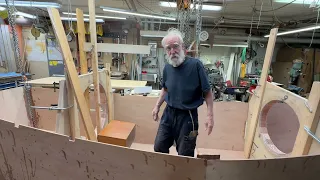
Mockup – No Ballast, Deckhouse Buoyancy for Self Righting
This Youtube channel is about me Sven Yrvind. I am 87 and a half years old dyslectic solo sailor. I am building a plywood test boat for a Divinycell and NM-epoxy high-latitude cruiser. She will be about 4.5 meter or 14 feet and 9 inches long, the beam 1.36 meter, 4 feet 6 inches. She is a two mas...
The two bulkheads weakly installed.
This Youtube channel is about me Sven Yrvind. I am 87 and a half years old dyslectic solo sailor. I am building a plywood test boat for a Divinycell and NM-epoxy high-latitude cruiser. She will be about 4.5 meter or 14 feet and 9 inches long, the beam 1.36 meter, 4 feet 6 inches. She is a two mas...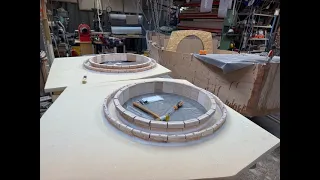
The Outer Coaming and Fiberglassing the Inner One.
Sven Yrvind fits the outer spray skirt coaming and laminates fiberglass onto the inner coaming in his workshop, refining his rope attachment setup and filleting the joint defenses.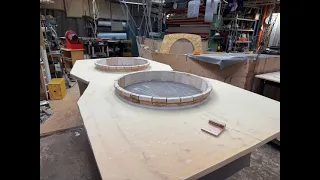
Starting the Inner of Two Spray Skirt Coamings.
Sven Yrvind works in his workshop cutting and fitting inner and outer spray skirt coamings, detailing kerf measurements and fiberglass reinforcement.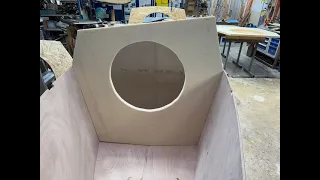
Cutting the Divinycell Bulkheads.
In his Västervik workshop, Sven Yrvind shapes composite bulkheads and constructs rounded hatch coamings with dual spray protection for his compact ocean cruiser, verifying hull symmetry and deck crown alignment.