A rough provisional estimation of the itinerary for my Cape Horn doubling.
Doubling the Horn
Provisional itinerary
Doubling the Horn entails sailing nonstop from a point above the 50th parallel in the Atlantic, down around the Horn and back to a point above the 50th parallel in the Pacific. Only this near 1,000-mile passage is considered a genuine Cape Horn rounding.
According to legendary author and seaman, Alan Villiers, “nothing else counted as a rounding, for the eastward passage before westerly gales was reckoned no rounding at all.”
Why do I have this desire to doubling the Horn?
Nothing could be more difficult for a small boat and so far no solo sailor have done it in a small boat.
For me the easy life is not satisfying.
Also the European recreational boating directive have outlawed sales of small ocean going boats arguing that they are not safe. I do not deny that it would please me to prove them wrong, but the voyage for me is mostly about the lore of the Horn.
Here is some of the distances and my estimated speed.
Departure from Ålesund Norway will be more or less beginning of June. The distance to Horta Azores is 2100 miles.
The estimated duration of the passage is 60 days.
Average speed, 1,5 knots.
Departure from Horta Azores will be more or less beginning of September. The distance to Stanley Falkland is 6500 miles
The estimated duration of the passage is 90 days.
Average speed, 3 knots.
Departure from Port Stanley, Falkland Islands will be more or less beginning of January to a point north at latitude 50° south then turning south towards Cap Horn then towards Isla Chiloe Chile. That distance is about 2300 miles.
The estimated duration of the passage is 80 days.
Average speed, 1.2 knots.
Being a solo sailor I do my best to avoid areas with much shipping. My previous plan was too provision in Uruguay. Unfortunately there is a lot of trafic coming out of the la Plata river from Buenos Aires and Montevideo.
I dit not consider the Falkland Island as a place to provision as their position is more south than latitude 50° south.
Then I got the idea that when leaving Stanley I will sail north passing 50° latitude south.
This is vanity, still the lore is tempting me.
1980 I cruised the Falkland Islands for four months in my 19 feet boat. The winds was often strong on three different occasions it blew more than 100 knots.
Had my boat had less draft much had been gained. I decided that my next boat would be a shallow draft boat that could take the ground.
With the help of John Letcher in Maine I designed a twin keeled double ender.
I started to build her in the early 1980-s eventually but she was replaced by the the bow centerboarder Bris Amphibie.
Now I combine bow centerboard and bilge keels. Each of these two elements fills its own unique purpose.
It would be interesting to return to the Falklands and see how my ideas works out.
When will I start? Not this year 2022 , not next year 2023, the year 2024 is possible but unlikely as I like to conduct sea trials both inshore and offshore before setting off. Maybee the year 2025 will be my year of departure.
Fate do interfere with even the best laid plans. We just had the Corona pandemic now we have Putins war and who knows what that will lead to.
For more see Yrvind.com
There you can also support my project on Pay pal and Swish 0706 200 550
Support Sven Yrvind
At WeBoating.com, we profoundly acknowledge the unwavering dedication that Sven Yrvind invests in crafting each and every video or voyage. Their passion for delivering exceptional ocean content shines through every frame, and it's a labor of love that deserves your attention.
We invite you to watch their captivating videos here and actively engage with their content, including their social media links above. Liking, commenting, and sharing their work goes a long way in fueling their creative fire.
We're also inviting you to explore the gear, sponsorships, and boat partnerships highlighted in the "A rough provisional estimation of the itinerary for my Cape Horn doubling." video description, or directly on YouTube. By engaging with these offerings or purchasing services and items, you directly support Sven Yrvind, their collaborators, and the brands they're associated with.
To ensure you never miss an offshore update, consider visiting their official YouTube Channel to subscribe, like, and join their community directly.
If you have any feedback, corrections, or additional information about Sven Yrvind or their videos, please use the comment form below to share your thoughts with us.
Thank you for being a part of our community and supporting the creators we cherish. Your time and support truly matter!
Sven Yrvind
At 86, Sven Yrvind is still pushing the limits of small-boat design. Discover the philosophy and technical grit behind his 'Exlex' series.
Channel Information:
Social Media Links:
Latest Episodes from Sven Yrvind
Explore the most recent voyages. Subscribe to the channel to never miss an update!
Mockup – No Ballast, Deckhouse Buoyancy for Self Righting
This Youtube channel is about me Sven Yrvind. I am 87 and a half years old dyslectic solo sailor. I am building a plywood test boat for a Divinycell and NM-epoxy high-latitude cruiser. She will be about 4.5 meter or 14 feet and 9 inches long, the beam 1.36 meter, 4 feet 6 inches. She is a two mas...
The two bulkheads weakly installed.
This Youtube channel is about me Sven Yrvind. I am 87 and a half years old dyslectic solo sailor. I am building a plywood test boat for a Divinycell and NM-epoxy high-latitude cruiser. She will be about 4.5 meter or 14 feet and 9 inches long, the beam 1.36 meter, 4 feet 6 inches. She is a two mas...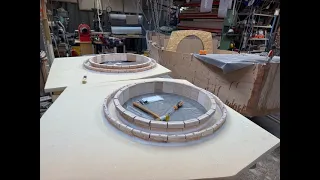
The Outer Coaming and Fiberglassing the Inner One.
Sven Yrvind fits the outer spray skirt coaming and laminates fiberglass onto the inner coaming in his workshop, refining his rope attachment setup and filleting the joint defenses.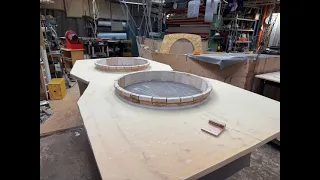
Starting the Inner of Two Spray Skirt Coamings.
Sven Yrvind works in his workshop cutting and fitting inner and outer spray skirt coamings, detailing kerf measurements and fiberglass reinforcement.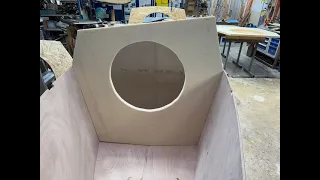
Cutting the Divinycell Bulkheads.
In his Västervik workshop, Sven Yrvind shapes composite bulkheads and constructs rounded hatch coamings with dual spray protection for his compact ocean cruiser, verifying hull symmetry and deck crown alignment.