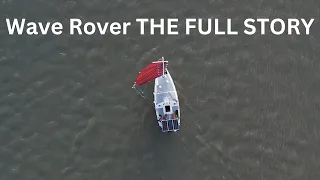
S2E111 Wave Rover Performance and Review// Naval Architect goes for a Sail on Wave Rover
A few days after bringing Wave Rover II alongside at a boatyard on Bear Creek, Alan Mulholland of Sailing Wave Rover met up with naval architect Andy Dize to evaluate the completed 21-foot pocket cruiser in person. Having collaborated closely through the design phase of the Wave Rover 650, Dize stepped aboard the prototype to examine how his lines had translated into timber and composite structure. The initial walk-through inside the cabin confirmed the pocket cruiser’s practical interior volume, with Dize noting that the fit and finish exceeded his expectations for room and functional capability.
With the dockside inspection complete, the pair prepared to cast off into Bear Creek off the Patapsco River to put the twin-keeled pocket cruiser through a sea trial. After sitting through flat calms the previous day, conditions on the creek settled into a light breeze between 7 and 10 knots, providing just enough air to hoist the junk rig and measure how the boat handled under sail.
Sea Trial Under Junk Rig on Bear Creek
Casting off their dock lines, Alan and Andy raised the junk sail on a broad reach as they steered into the creek. Andy took the helm immediately to evaluate the balance and responsiveness of the design under sail. With the sail pulling cleanly in the light breeze, the naval architect assessed the initial handling:
“everything is working perfectly very well balanced helm not a lot of pressure on the sale it’s kind of light at the moment um but the boat’s performing very well even with the twin keels it’s tracking very well”
As a competitive racing sailor with 55 years of experience in the Soling class, Andy brought a racer’s eye to the helm, constantly adjusting the mainsheet to trim for minor shifts in apparent wind. Alan observed that Andy trimmed the sheet a dozen times in the same span of time he would typically set it once for offshore cruising. Accustomed to his 2200 lb Soling, Andy remarked on the substantial feel of the 21-foot pocket cruiser:
“used to my Soling which is you know 2200 lb very light very maneuverable but this feels like you know 30ft boat 32ft boat”
The hull’s freeboard, stability, and added buoyancy contributed to a steady, solid motion underway, tracking straight on its twin keels without displaying excessive tenderness in gusts.
Navigation Challenges and Junk Rig Aerodynamics
Sailing through Bear Creek required tight maneuvering, including navigating directly under a local highway bridge. The pair cleared the bridge span with approximately 3 inches to spare. Shortly after clearing the span, breeze picked up into gusts measuring over 10 knots, filling the junk sail and pressing the flags ashore straight out.
With the breeze building, Andy and Alan monitored the aerodynamic behavior of the junk sail. Andy noted that the bottom two panels took on shape as the sail drew, while the fan section scalloped out in higher velocity air to provide additional aerodynamic lift. Alan explained that trimming the junk sail approximately 10 degrees off center represents the standard recommendation for optimal efficiency.
To address potential friction and chafe between the sail and the spar, Alan pointed out carpet patches he had sewn onto the sail cloth during a stop in Stonington. On one tack, clearance remains between the sail and the wooden mast; when tacking over, the wooden battens press directly against the spar, and the carpet patches slide smoothly without causing fabric wear.
Light-Air Handling, Roll-Tacking, and Full-Time Cruising
Having lived aboard Wave Rover II full-time for 4 months spanning August, September, October, and November, Alan reflected on the vessel’s cruising capabilities. While initially skeptical of shallow-water gunkholing, extensive exploration throughout the Chesapeake Bay had demonstrated the versatility of the twin-keel configuration for accessing shallow anchorages and small coastal harbors.
In light conditions, maneuvering a lightweight pocket cruiser requires deliberate helmsmanship. Alan explained that while heavy displacement yachts carry enough momentum to glide through tacks, a light hull requires specific boat speed management:
“I do find when conditions get a little light I’ve started to roll tack to get through the wind”
By bearing off slightly before initiating a turn, the helmsman generates sufficient boat speed to keep water flowing over the twin keels, enabling the keels to assist the rudder as crew weight shifts across the deck. Alan contrasted this with a 40-footer sailing alongside the prior weekend, whose heavy displacement easily carried it through tacks without kinetic assistance.
Alan also defended the choice of a flat-cut junk sail over a cambered version. During a recent junk rig gathering, Wave Rover II sailed neck and neck against an identical-sized boat equipped with a cambered sail while working upwind against current. While acknowledging that a cambered sail would provide an edge in very light winds, Alan emphasized that flat-cut junk rigs have a proven offshore pedigree, referencing Blondie Hasler’s triumphs in the 60s during the OSTAR and Jester Challenge. For ocean cruising, the simplicity, low cost, and ease of depowering make the flat-cut sail highly practical.
Underway Reefing and Post-Sail Sea Trial Debrief
Before returning to the dock, Alan demonstrated the reefing process of the junk rig. Releasing a single line allowed the wooden battens and sail cloth to drop instantly into the lazy jacks, reefing the rig without leaving the cockpit or struggling with winches.
Docking back at the yard, Alan and Andy conducted a detailed debrief to determine refinements for the Wave Rover 650 construction plans:
- **Twin keel ballast:** The prototype will receive an additional 200 lb of lead ballast in the twin keels to enhance offshore stability and righting moment. Alan stated: “I would take this boat to sea tomorrow without that extra ballast but that extra ballast will help a lot”.
- **Mark III windvane trim tab linkage:** The rope-lashed rudder hinge, derived from Alan’s experience on a James Wharram 26 catamaran, completed 1500 miles of sailing with zero chafe and steered reliably through 30 knot winds on a beam reach off the New Jersey coast. However, applying the same rope lashing to the underwater trim tab introduced rolling friction that restricted downwind self-steering, necessitating a pivoting mechanical linkage.
- **Deck hardware and ventilation:** Proposed plan additions include bow and stern pulpit rails, welded secondary safety rails, and opening low-profile deck hatches or scoop vents to provide cabin airflow when cruising warm waters such as the Caribbean.
- **Cockpit and plan variants:** To accommodate diverse builders, the plans will offer two variants: an offshore version featuring the flush deck and enclosed sea hatch built on Wave Rover II, and a classic coastal cruising variant featuring a traditional cockpit footwell and sliding companionway hatch.
Inside the cabin, the layout demonstrated its capacity when Alan hosted 6 people simultaneously with ample space for social dining, confirming the interior volume of the 21-foot Sharpie hull.
Sea Trial Performance and Design Specifications
| Sea trial and technical metric | Observed performance and specification |
|---|---|
| **Vessel design** | Wave Rover 650 (21-foot junk-rigged pocket cruiser) |
| **Trial location** | Bear Creek off Patapsco River (Chesapeake Bay) |
| **Sea trial wind speed** | 7 to 10 knots with gusts exceeding 10 knots |
| **Naval architect racing experience** | 55 years (Soling racing class) |
| **Soling comparison weight** | 2200 lb (feels like 30ft to 32ft boat) |
| **Bridge clearance on creek** | 3 inches |
| **Junk sail trim angle** | 10 degrees off center |
| **Full-time living aboard duration** | 4 months (August through November) |
| **Planned additional keel ballast** | 200 lb of lead in twin keels |
| **Mark III rudder lashing proven distance** | 1500 miles without chafe |
| **Heavy weather beam reach testing** | 30 knot winds off New Jersey coast |
| **Interior cabin guest capacity** | 6 people |
Frequently Asked Questions
Andy Dize stated that the interior fit and finish far exceeded his expectations, noting that the cabin was very roomy, capable, and surpassed what he had anticipated from his original lines.
After waiting through calm conditions the prior day, Alan Mulholland and Andy Dize tested the boat in a breeze of 7 to 10 knots, with gusts measuring over 10 knots in Bear Creek off the Patapsco River.
Because the 21-foot pocket cruiser is light and lacks the heavy displacement momentum of a 40-footer, Alan bears off slightly to build boat speed and water flow over the twin keels before throwing his body weight across to bring the boat through the eye of the wind.
During a junk rig gathering, Wave Rover matched a similar-sized boat carrying a cambered sail while sailing upwind against current. Alan noted that while a cambered sail would provide better speed in light air, the flat-cut sail is inexpensive, durable, and ideal for depowering in ocean conditions, following Blondie Hasler’s precedent from the 60s.
Based on sea trials, the design plans will incorporate an additional 200 lb of lead ballast in the twin keels for offshore stability, redesigned trim tab linkages on the Mark III windvane to eliminate rolling friction, bow and stern pulpit rails, opening deck ventilation for warm climates, and an optional classic coastal variant featuring a cockpit footwell and sliding hatch.
The Wharram-style rope lashing on the main rudder proved completely chafe-free over 1500 miles and steered effectively through 30 knot winds on a beam reach off the New Jersey coast. However, the trim tab lashing caused rolling rather than pivoting, creating excess friction that hindered downwind self-steering.
Book a trip where this was filmed — near Annapolis
Support Sailing Wave Rover
At WeBoating.com, we profoundly acknowledge the unwavering dedication that Sailing Wave Rover invests in crafting each and every video or voyage. Their passion for delivering exceptional ocean content shines through every frame, and it's a labor of love that deserves your attention.
We invite you to watch their captivating videos here and actively engage with their content, including their social media links above. Liking, commenting, and sharing their work goes a long way in fueling their creative fire.
We're also inviting you to explore the gear, sponsorships, and boat partnerships highlighted in the "S2E111 Wave Rover Performance and Review// Naval Architect goes for a Sail on Wave Rover" video description, or directly on YouTube. By engaging with these offerings or purchasing services and items, you directly support Sailing Wave Rover, their collaborators, and the brands they're associated with.
To ensure you never miss an offshore update, consider visiting their official YouTube Channel to subscribe, like, and join their community directly.
If you have any feedback, corrections, or additional information about Sailing Wave Rover or their videos, please use the comment form below to share your thoughts with us.
Thank you for being a part of our community and supporting the creators we cherish. Your time and support truly matter!
#Waverover #Forgeyourownadventure
In this video, I meet up with Andy Dize, the Naval Architect who designed Wave Rover. We get his initial thoughts after seeing Wave Rover II for the first time. Then we untie Wave Rover and go for a sail. "Forge Your Own Adventure"
[ SUPPORT MY VIDEOS - PATREON ]
Head over to my Patreon Page where you can contribute to the making of these videos.
https://www.patreon.com/bePatron?u=27867459
[WAVE ROVER 650 BUILDING PLANS]
https://www.etsy.com/listing/1118440237/wave-rover-650-construction-plans?ref=listings_manager_grid
[ MAKE A ONE TIME OR MONTHLY CONTRIBUTION ]
https://www.paypal.com/donate?hosted_button_id=QD67PHV6AM3J4
[ ROVERCOIN available via paypal (still 12 available)]
https://www.paypal.com/donate/?hosted_button_id=QZ24K5TZRS4MY
[MK3 WIND VANE SELF STEERING PLANS]
The digital building Plans (DIY), including 12 pages of high quality drawings, critical instructions, and links to 3 unlisted videos are included. The Plans can be purchased through my Etsy Shop by following the attached link:
https://www.etsy.com/ca/listing/1000498117/similar?ref=listings_2&from_external=1
[ BUILD YOUR OWN SCARFING JIG]
https://www.etsy.com/ca/listing/1105488141/wave-rover-scarfing-jigs?ref=shop_home_active_1
[For up to date progress, check out my instagram posts]
https://www.instagram.com/alanbmulholland/?hl=en
If you are wondering what I've been up to when not sailing Wave Rover check out my other channel: Rover's Rest: https://www.youtube.com/channel/UC9k8PCCTlNyDzvYaef3Jekg
Thank you and fair winds
Sailing Wave Rover
Discover the legacy of Alan Mulholland. After four solo ocean crossings, the Wave Rover mission has retired to a homestead chapter on Prince Edward Island.
Channel Information:
Social Media Links:
S2E111 Wave Rover Performance and Review// Naval Architect goes for a Sail on Wave Rover Location
- Bear Creek, Dundalk, Maryland, United States (39.2353,-76.4975)
Latest Episodes from Sailing Wave Rover
Explore the most recent voyages. Subscribe to the channel to never miss an update!
After Crossing 4 Oceans I’m Done
In this video I explain what has happened to Wave Rover 2 and the future of this channel. "Forge Your Own Adventure" [ SUPPORT MY VIDEOS - PATREON ] Head over to my Patreon Page where you can contribute to the making of these videos. [ MAKE A ONE TIME OR MONTHLY CONTRIBUTION ] [MK3 ...
Wave Rover is Back \ Crossing the North Atlantic on the Queen Mary 2 in November
In this video, my wife (Mrs Rover) and I enjoy crossing the North Atlantic in style onboard the Queen Mary 2 from South Hampton to New York. "Forge Your Own Adventure" [UPDATED BUILDING PLANS FOR WAVE ROVER 2] [ SUPPORT MY VIDEOS - PATREON ] Head over to my Patreon Page where you can ...
Wave Rover’s Holiday in Cork
Wave Rover has crossed the Atlantic. And now we are coastal sailing Ireland's South coast. In this video, my wife (Mrs Rover) and I enjoy the hospitality of fantastic friends that I had met during my time sailing up the coast of Ireland. We get a great tour of Cork, Kinsale and a number of inte...
Mrs Rover Arrives for our Dublin Holiday
Wave Rover has crossed the Atlantic. And now we are coastal sailing Ireland's South coast. In this video, my wife (Mrs Rover) arrives for a brief holiday. We meet some of my relatives, tour Dublin city, tour the maritime museum and see Mrs Rover's favourite ... the botanical gardens. "...
Sailing to Dublin for the 3 Bridges Festival and Junk Rig Gathering
Wave Rover has crossed the Atlantic. And now we are coastal sailing Ireland's South coast. In this video, I was invited to participate in the 3 Bridges Festival on the River Liffey in the Heart of Dublin. I also had the opportunity to sail with the French SV Paradox and her friendly crew. This ...