Prism Reviews: Kingston Quickset Vs. Spade Anchor Pt.1
With a gleaming 50-pound Kingston Quickset resting on the foredeck of SV Prism, Jon set out to evaluate whether the plow could solve recurring ground tackle frustrations along the East Coast. Cruising aboard their Hans Christian 33 cutter with partner Shannon, Jon had spent years trusting a 55-pound Spade anchor. While chronicling their refits and voyages for [Sailing Vessel Prism], the crew questioned whether an alternative anchor design could deliver better holding in stubborn soft mud while ending persistent galvanizing breakdown.
To understand why a new anchor was sitting on deck, Jon pulled out their galvanized Spade S120 to examine its track record and physical condition. The concave anchor had performed remarkably in extreme conditions, once holding Prism safely in breaking surf off a lee shore during an abrupt wind switch in Mexico. As Jon acknowledged, “performance wise it is bar none one of the best performing anchors anyone that has this anchor will probably tell you a similar story it’s just good it works fairly pretty much every time.” Cruising the East Coast, however, revealed a distinct vulnerability in fine sediment.
Ground Tackle Frustrations in East Coast Soft Mud
Despite proven holding power in sand and heavy bottoms, the Spade repeatedly faltered when dropped into thin, silty mud. In several anchorages, the crew had to veer over 10 to 1 scope just to achieve an initial bite, finding that the concave blade pulled through soupy bottoms too easily under engine load.
The issue escalated into two serious dragging episodes. The first occurred when the anchor dragged more than a quarter mile overnight while the crew slept, plowing across the seabed before Prism drifted clear into deeper water. The second incident unfolded in Solomons Island, an anchorage known for challenging holding. When a severe thunderstorm rolled through with an abrupt wind shift, the Spade dragged straight back across the harbor, requiring quick crew intervention to avoid colliding with a dock.
Compounding these setting failures was early galvanizing breakdown. Within the first year of ownership, the zinc coating failed across the forward fluke tip. As Jon observed, “minus the dragging issue that we have in the mud here that really isn’t issue anywhere else the problem is within the first year of owning this anchor the galvanizing started failing.” Jon attempted to remediate the corrosion by sandblasting the steel and applying two-part epoxy paint, but the coating failed to bond permanently. Maintenance defaulted to frequent touch-ups with $7 cans of cold-galvanizing zinc spray paint. While Spade offered a $1,000 credit toward a replacement, upgrading to a stainless Spade would still require an out-of-pocket expense of $1,300.
Questioning the Swivel and Shank Geometry
Before condemning the anchor design, Jon investigated the ground tackle hardware connected ahead of the shank. Several years earlier in Costa Rica, Jon had installed a 5-pound Mantus anchor swivel. Upon flaking out the ground tackle after a full year of cruising, Jon discovered severe twists remaining in the 5/16 chain that repeatedly bound up in the windlass before passing through the hawsepipe.
Beyond failing to eliminate rotational twists, the heavy hardware introduced an unfavorable mechanical penalty. Modern anchor designers keep shank weight minimal so the center of gravity concentrates on the penetrating toe. Bolting a 5-pound steel assembly to the shank tip effectively lengthened the lever arm, lightening the relative tip weight and degrading the blade’s initial penetration in soft mud. To eliminate this variable, Jon decided to retire the swivel and shackle the chain directly to the anchor using a 3/8 Crosby shackle.
Fluke Architecture: Quickset vs Spade and CQR
Seeking alternatives without exceeding their budget, Jon initially researched the Sarca Excel following independent tests by Steve on SV Panope. However, discovering Kingston Anchors—a company that began fabricating ground tackle in the 70s for Olympic sailing events in Canada—opened an unexpected avenue. Kingston introduced their fixed-shank Quickset plow design in the mid 80s, asserting their engineering preceded competing commercial plows like the Delta. After speaking with the company, Jon noted, “after talking on the phone for about an hour with the people they said let’s just send you some and see how you like the anchor because they were they’re exceptionally confident that this anchor will outperform the spade.”
In a local boatyard, Jon compared fluke tracings of their 55-pound Spade against a 45-pound CQR built in Scotland and the Kingston Quickset. While the traditional CQR relied on a convex shape with minimal upward blade area, the Kingston combined a convex spine with flared, nearly flat wings. Unlike the Delta, which features elevated ears prone to plowing through soft mud, the Quickset’s smooth leading edges act like a bayonet to encourage deep seabed burial. Crucially, Kingston eliminated the structural crossbar between the fluke wings found on most plow anchors, substituting a heavy ballast plate filled with lead that runs up the spine to provide rigidity while reducing seabed drag.
For a vessel equipped with a bobstay like Prism, dimensions proved decisive. The Mantus M2 fluke spans 23 inches across, and the Spade measures 17 inches wide, frequently striking the bobstay wire during retrieval. The 50-pound Quickset measures under 16 inches wide, allowing clean passage alongside the bowsprit rigging without gouging decks.
Scale Measurements and Comparative Economics
To test manufacturer specifications against physical reality, Jon rigged a scale on deck to measure total weights and tip-weight ratios on a level plane. Kingston also provided a smaller 15-pound commercial-finish version to demonstrate fabrication differences across their product line.
| Ground Tackle Model | Total Weight | Tip Weight | Tip Ratio | Fluke Dimensions | Construction Material |
|---|---|---|---|---|---|
| Spade S120 | 55 lb | 22 lb | 40% | 17 in width, concave blade | Galvanized steel with lead ballast |
| Kingston Quickset QS50 | 50 lb | 14 lb | 28% | 25 in fluke, 25 in shank | 304L stainless steel |
| Kingston Quickset Demo | 15 lb | 6 lb | 40% | 15 in fluke, 19 in shank | 304L stainless steel |
The measurements revealed that the 50-pound Quickset maintains an even 50/50 distribution between its 25-inch fluke and 25-inch shank, yielding 14 pounds of tip weight (a 28 percent tip ratio). In contrast, the 15-pound model features a 15-inch fluke and 19-inch shank with 6 pounds of tip weight, achieving a 40 percent ratio that mirrors the Spade’s 22 pounds of tip weight. This structural divergence indicated that Kingston engineers each weight class independently rather than scaling geometry linearly.
Economic differences proved equally striking. Fabricated from American-sourced 304L stainless steel with a 5/8 inch thick shank and backed by a 20-year corrosion warranty, the Kingston Quickset retailed at Defender for $550 in a brushed commercial finish, or between $750 and $850 with high-polish mirror buffing. Compared to $2,000 for a stainless Spade or Ultra anchor and $2,400 for a stainless Mantus M2, the Canadian-built plow offered an accessible path to stainless ground tackle. Jon planned to conduct extensive underwater camera sets and shock-load pull tests in East Coast waters to determine if real-world holding matches its benchtop promise.
Frequently Asked Questions
While the 55-pound Spade S120 performed reliably in sand and held Prism off a lee shore in Mexico, it repeatedly struggled in soft silty mud along the East Coast, dragging twice, and suffered galvanizing failure near the fluke tip within its first year.
On SV Prism’s scale, the 50-pound Kingston Quickset measured exactly 50 pounds total with 14 pounds on the tip, yielding a 28 percent tip-to-total weight ratio, compared to 22 pounds of tip weight (40 percent) on the 55-pound Spade.
Jon discovered that the 5-pound swivel failed to eliminate chain twist after a year of cruising and suspected that adding 5 pounds of weight to the shank lever arm degraded setting performance in soft mud.
The Kingston Quickset is fabricated from American 304L stainless steel with a 20-year corrosion warranty, priced around $550 in a commercial finish at Defender, compared to over $2,000 for stainless versions of Spade, Ultra, or Mantus M2 anchors.
Book a trip where this was filmed — near New York City




Support Sailing Vessel Prism
At WeBoating.com, we profoundly acknowledge the unwavering dedication that Sailing Vessel Prism invests in crafting each and every video or voyage. Their passion for delivering exceptional ocean content shines through every frame, and it's a labor of love that deserves your attention.
We invite you to watch their captivating videos here and actively engage with their content, including their social media links above. Liking, commenting, and sharing their work goes a long way in fueling their creative fire.
We're also inviting you to explore the gear, sponsorships, and boat partnerships highlighted in the "Prism Reviews: Kingston Quickset Vs. Spade Anchor Pt.1" video description, or directly on YouTube. By engaging with these offerings or purchasing services and items, you directly support Sailing Vessel Prism, their collaborators, and the brands they're associated with.
To ensure you never miss an offshore update, consider visiting their official YouTube Channel to subscribe, like, and join their community directly.
If you have any feedback, corrections, or additional information about Sailing Vessel Prism or their videos, please use the comment form below to share your thoughts with us.
Thank you for being a part of our community and supporting the creators we cherish. Your time and support truly matter!
Sailing Vessel Prism
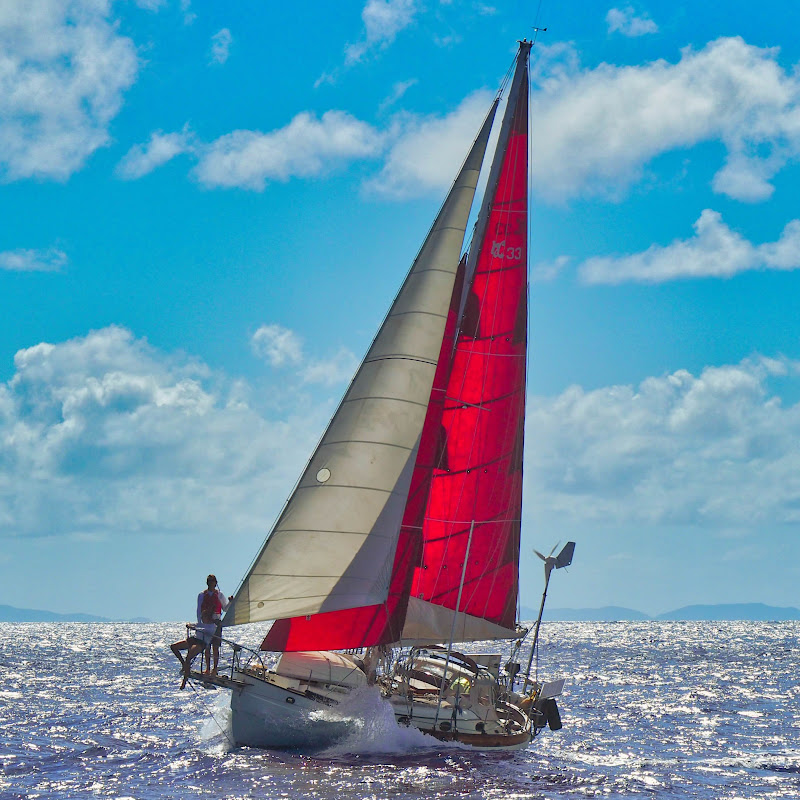
In 2026, Jon and Shannon continue their maritime journey aboard SV Prism, a classic 1983 Hans Christian 33 cutter designed by Harwood Ives. From San Francisco through Mexico, the Panama Canal, and the US East Coast, their channel documents the authentic realities of traditional heavy-displacement cruising, brightwork preservation, and anchorage camaraderie.
Channel Information:
Social Media Links:
Prism Reviews: Kingston Quickset Vs. Spade Anchor Pt.1 Location
- Solomons Island Anchorage, Maryland (38.318,-76.458)
- Port Washington Anchorage, New York (40.831,-73.704)
Latest Episodes from Sailing Vessel Prism
Explore the most recent voyages. Subscribe to the channel to never miss an update!

Boat Wreck Bonfire
Wreckage of a fellow cruisers boat fuel the fire this night.
La Cruz Market – 2016 – SV Prism
@SailingVesselPrism Goes to the legendary La Cruz farmers market on a hot day from 2016. This channel conicals new episodes from a decades worth of footage never before seen.
Voyage of the Interlude – Filming Summer 2026 #sailing #ocean #STEM #education #seaofcortez
Please share: If you or anyone that you may know might be interested or if you would like to volunteer, please reach out!
Cruising Before Starlink | La Cruz, 2016
Please Share and go to If you want to support this channel, support this project.
EP.35 SV Prism Sails ON! Sailing to Banderas Bay
Thank you everyone who has come back. For real time updates check in over on instagram @svprism To get more infroamtion about Voyage of the Interlude or to share it to someone else go to this link: Thank you, Jon