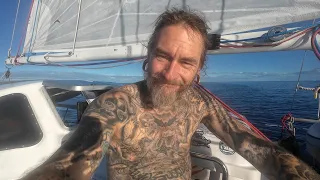
Sailing to Mitsio Island in Remote Madagascar
Under clear morning skies, James Frederick weighs anchor aboard his 61-year-old sloop SV Triteia to begin a 35-mile passage heading north across the Indian Ocean to Nosy Mitsio, Madagascar. The ocean conditions offer calm seas and gentle morning breezes as the vessel settles into an easy pace. James observes the coastal traffic of artisanal wooden dugouts setting out for their daily routines, observing that “Fishermen are going out for their day’s work.” Sailing in loose company with his cruising friends Lisl and Andy aboard SV Ancala, who are making the same northbound passage, Triteia glides at 5 knots across open water before turning into the protected anchorage at Nosy Mitsio.
Dropping Anchor in Nosy Mitsio Bay
Upon entering the sheltered bay on Nosy Mitsio, James maneuvers Triteia into position to establish a reliable hold in the sandy anchorage. Checking his depth sounder while lowering the ground tackle, he confirms the vessel’s sounding and chain deployment: “Dropped the hook in 17 ft of water.” With the anchor dug into the seabed, the boat settles securely in 15 ft of water on 5 scope, providing a stable platform alongside SV Ancala.
| Passage & Anchorage Parameter | Recorded Metric |
|---|---|
| Distance to Nosy Mitsio | 35 miles |
| Underway Sailing Speed | 5 knots |
| Initial water depth | 17 ft |
| Resting water depth | 15 ft |
| Scope deployed | 5 scope |
Exploring Nosy Mitsio: Baobabs, Goats, and Wildlife
Once both vessels are anchored, James joins Lisl and Andy for a shore walk to explore the interior terrain and coastlines of Nosy Mitsio. Their initial walk takes them past an empty, quiet resort property where paths remain well-tended without any guests in residence. The only person encountered is a local groundskeeper who does not speak English, alongside a herd of grazing goats roaming the manicured grounds. Watching the herd trim the lawns, James jokes, “This is the Madagascar version of a robot lawn mower.”
Continuing past the grounds, the crew encounters practical agricultural boundaries, including a living fence crafted from wooden pegs driven into the soil that have rooted into growing hedges to protect vulnerable saplings from hungry livestock. Leaving the cultivated grounds behind, they reach an untracked beach laden with shells before heading inland toward an expansive baobab grove. Having read about baobabs in magazines during childhood, James examines the massive, swollen trunks and hanging seed pods up close for the first time.
While following narrow trails through the bush, Andy spots a snake basking near the path that suddenly raises its forebody in defense, prompting the crew to halt as they notice its flared neck hood. The party watches the animal with cautious curiosity before giving it a wide berth, while overhead, kestrels and a long-tailed kingfisher-type bird move through the canopy. The group concludes the cross-island hike by traversing an expansive dry lagoon bed that leads directly back to the sandy bay where their boats swing at anchor.
Seamanship Technique: Dropping the Mainsail Without Lazy Jacks
Back aboard Triteia, James demonstrates his practical method for controlling and dropping a traditional mainsail single-handed without relying on lazy jacks. While many offshore sailors view lazy jacks as standard equipment, James finds that fixed jack lines often complicate sail management on vintage rigs, explaining that “So, any boat under 36 ft, there’s not really enough sail to worry about.” In practice, fixed lines frequently snag batten pockets and sail fabric during hoisting or dropping, demanding constant cockpit adjustment.
To drop the sail smoothly without sail spillage across the coachroof or cockpit, James uses an integrated reefing technique worked directly from the mast: “Basically, I just reef the sail as I’m lowering it, and there’s certain benefits to that.” Holding the first reefing line together with the mainsheet in one hand, he releases the mast halyard clutch, eases a section of the mainsail halyard, and immediately pulls the first reef line snug. He flakes the lowered canvas over the boom before easing more halyard to haul in the second reef line, and finishes by taking down the third reef line to cinch the entire sail bundle firmly against the spar.
This reef-down procedure keeps the heavy sail fabric gathered and restrained against wind gusts without requiring overhead cradle lines. An operational benefit surfaces when anchoring overnight: if squalls or rising winds develop before morning departure, the vessel is already tucked into three deep reefs, allowing the sailor to get underway in rough weather without struggling on deck at dawn. Documented as part of his long-distance voyage aboard SV Triteia on Sailing Triteia, this manageable routine offers vintage boat owners an alternative to complicated sail-handling gear.
Frequently Asked Questions
James Frederick sailed SV Triteia 35 miles heading north across the Indian Ocean from his previous anchorage to reach Nosy Mitsio, Madagascar, averaging roughly 5 knots in calm morning sea conditions.
SV Triteia dropped its anchor in 17 ft of water, settling in 15 ft of depth with 5 scope deployed in the protected northern bay alongside SV Ancala.
For boats under 36 ft, James Frederick considers lazy jacks an unnecessary complication that can snag sailcloth and battens. Instead, he drops the sail in stages at the mast while pulling reefing lines to bundle the canvas securely.
While trekking across Nosy Mitsio, the crew spotted a defensive snake with an expanding hood, wild kestrels, a long-tailed bird resembling a kingfisher, and grazing goats, alongside mature baobab trees bearing seed pods.
Support Sailing Triteia
At WeBoating.com, we profoundly acknowledge the unwavering dedication that Sailing Triteia invests in crafting each and every video or voyage. Their passion for delivering exceptional ocean content shines through every frame, and it's a labor of love that deserves your attention.
We invite you to watch their captivating videos here and actively engage with their content, including their social media links above. Liking, commenting, and sharing their work goes a long way in fueling their creative fire.
We're also inviting you to explore the gear, sponsorships, and boat partnerships highlighted in the "Sailing to Mitsio Island in Remote Madagascar" video description, or directly on YouTube. By engaging with these offerings or purchasing services and items, you directly support Sailing Triteia, their collaborators, and the brands they're associated with.
To ensure you never miss an offshore update, consider visiting their official YouTube Channel to subscribe, like, and join their community directly.
If you have any feedback, corrections, or additional information about Sailing Triteia or their videos, please use the comment form below to share your thoughts with us.
Thank you for being a part of our community and supporting the creators we cherish. Your time and support truly matter!
Episode 506 : Goats, Snakes and Baobab Trees
Hello Friends,
On this episode I haul up and head North 35 miles to Nosy Mitsio and anchor in its protected bay. my friends Lisl and Andy of @ancalasjourney made the passage up as well and we explored the island together.
If you enjoy the channel please "Like" the videos and Subscribe so you don't miss any future episodes.
If you find the videos helpful or entertaining and would like to contribute you can become a Patron at: https://www.patreon.com/sailorjames
Other Ways to Support the Channel:
PayPal: https://www.paypal.com/paypalme/jamesthesailorman
Venmo: https://venmo.com/u/sailorjames
Cash App: https://cash.app/$triteia
Bitcoin: https://cash.app/$triteia
Fair Winds,
James
Website:
http://svtriteia.com
https://linktr.ee/sailor_james
Instagram:
http://www.instagram.com/james.the.sailor.man
#madagascar #vlog #travel
Sailing Triteia
Meet Sailor James Frederick: A solo voyager redefining the Alberg 30 legacy with technical grit, from a rudderless Hawaii crossing to his current 2026 refit in Thailand.
Channel Information:
Social Media Links:
Sailing to Mitsio Island in Remote Madagascar Location
- Nosy Mitsio Protected Anchorage (-12.881119,48.600655)
Latest Episodes from Sailing Triteia
Explore the most recent voyages. Subscribe to the channel to never miss an update!
Leaving Nosy Be, Meeting New lemurs and Visiting Honey River in Madagascar
Episode 509 : Goodbye Nosy Be and Hello New Lemurs! Hello Friends, On this episode we depart Nosy Be and make our way to Nosy Antsoa for a day stop to meet a two new species of Lemurs After visiting the lemurs we hauled up and headed on for our anchorage fro the night up Honey River where we h...
Sailing Dhows of Madagascar, Visiting a Remote Anchorage on Mainland and Amazing Snorkeling
James Frederick observes traditional wooden sailing dhows in Madagascar before navigating SV Triteia into a secluded mainland anchorage and snorkeling the marine reserve of Nosy Tanikely.
MEETING LEMURS in Madagascar!!!
One of my favorite things in the world is getting to see and meet wildlife! watch the complete episode of me meeting lemurs for the first time! If you enjoy the channel please "Like" the videos and Subscribe so you don't miss any future episodes. If you find the videos helpful or ...
Meeting the Famous Lemurs of Madagascar on Nosy Komba
After a 38-mile passage plagued by an erratic autopilot, James Frederick anchors SV Triteia off Nosy Komba and heads ashore to feed bananas to Madagascar's famous lemurs.
SAILOR JAMES IN CAPE TOWN – MEETUP NOVEMBER 7 2026 – HOUT BAY YACHT CLUB
I will be having a Meetup this coming Saturday at Hout Bay Yacht Club near Cape Town - Pop by and say hello! Hout Bay Yacht Club Hout Bay, Cape Town, South Africa 4-6pm - November 7th 2026 If you enjoy the channel please "Like" the videos and Subscribe so you don't miss any future ...