First Look at Renogy’s New Flexible Solar Panel for Our New Boat
Returning to their newly acquired 48-foot catamaran after heavy rainfall, Ryan from Sailing Sunday discovered completely discharged house batteries, a failed marina dock pedestal, and one inboard engine sitting partially submerged. Without electrical power, the automatic bilge pumps failed to activate, creating an urgent need to overhaul the vessel’s charging systems before continuing off-grid cruising.
The incident highlighted the inadequacy of the vessel’s legacy charging setup and initiated an extensive electrical refit. Rather than reinstalling flat rigid solar panels, Ryan started evaluating Renogy’s newer solar and charging hardware designed specifically to accommodate curved coachroof lines and manage alternator loads safely.
Evaluating Flexible Solar Panels for a Curved Coachroof
The primary vulnerability during the marina flooding was the complete loss of 12-volt domestic power, prompting the realization that “we got no batteries, therefore we got no bilge pumps.” To establish dependable autonomous charging on the water, the crew chose to test Renogy’s 200-watt ShadowFlux flexible solar panel on the multihull’s forward cabin top.
Rigid solar arrays on multihulls often require bulky mounting racks that protrude awkwardly past the cabin sides. The 200W flexible panel bends smoothly across the curved fiberglass surface, allowing a low-profile installation that follows the vessel’s lines. Beyond fitment, marine solar arrays constantly encounter partial shading from the mast, boom, sails, and standing rigging throughout the day. The ShadowFlux engineering incorporates internal bypass diodes that divert electrical current around shaded solar cells, maintaining charging output from unshaded portions of the array.
After dry-fitting the test panel against the coachroof curve and confirming how cleanly it conformed, Ryan resolved to “line that whole roof through there with the 200 W flexible shadow flux panels” during the complete solar overhaul.
Swapping PWM for a Compact MPPT Charge Controller
Down in the navigation station locker, the catamaran relied on an older Renogy Adventurer charge controller. This legacy unit used pulse-width modulation (PWM), an architecture that forces solar panel voltage down to the battery bank’s resting voltage during charging cycles, leaving usable solar wattage unharvested.
Ryan replaced the Adventurer with the newer Renogy Rover 2 maximum power point tracking (MPPT) regulator. Despite handling a 20-amp charging capacity, the hardware is remarkably small: “fits in the palm of my hand.” Unlike older PWM units, the MPPT controller allows solar panels to operate at their peak power voltage before converting that harvested energy into optimal charging current for the house batteries.
The Rover 2 integrates internal Bluetooth connectivity, transmitting real-time telemetry straight to the mobile phone app without needing an external plug-in dongle. The casing also retains an LCD screen for physical status checks and is engineered to deliver full charging output up to 45° C in hot engine spaces. Upon wiring the replacement unit to the depleted bank, the display registered an initial 10.9 volts, beginning the slow recovery of the house system.
Dual-Engine DC-DC Charging for Future Lithium Banks
The next phase of the catamaran’s electrical overhaul involves transitioning to a high-capacity lithium battery bank. Because lithium cells accept charging current aggressively with very low internal resistance, connecting them directly to standard marine engine alternators can quickly cause alternator overheating and electrical failure.
To eliminate this risk, the refit plan incorporates two Renogy Pro 50-amp DC-to-DC chargers. Ryan selected the hardware to “limit the output of our alternator to 50 amps so we don’t burn it out the lithium batteries.” Featuring robust aluminum cooling fins for passive heat rejection, each charger will dedicate regulation to one inboard diesel engine.
When operating both auxiliary engines during harbor departures or passage maneuvering, the dual-charger arrangement will “pump 100 amps into our batteries per hour just from cruising in and out of anchorages.” Built with an IP67 waterproof enclosure and internal Bluetooth monitoring, the chargers establish a controlled power bridge between propulsion alternators and the planned lithium storage.
Refit Hardware Specifications
| Hardware Component | Technical Specification |
|---|---|
| Flexible Solar Panel | Renogy 200W ShadowFlux with integrated bypass diodes |
| Solar Charge Controller | Renogy Rover 2 20A MPPT rated to 45° C |
| Engine DC-DC Chargers | Dual 50A Renogy Pro units (100A total output) |
| Initial Battery Voltage | 10.9V recorded at charge controller connection |
Frequently Asked Questions
The 48-foot catamaran features a curved coachroof, allowing 200W flexible ShadowFlux panels to conform closely to the fiberglass curves without bulky protruding brackets.
The panels feature integrated bypass diodes that route current around shaded cells, preserving solar harvest even when shadows fall across sections of the array.
The 20A Rover 2 MPPT operates panels at their peak voltage and converts it efficiently, whereas the PWM unit pulled panel voltage down to battery voltage and wasted solar capacity.
The chargers protect engine alternators from overheating when feeding lithium batteries, while delivering a combined 100 amps per hour into the battery bank while running both motors.
Book a trip where this was filmed — near Vancouver






Support Sailing Sunday
At WeBoating.com, we profoundly acknowledge the unwavering dedication that Sailing Sunday invests in crafting each and every video or voyage. Their passion for delivering exceptional ocean content shines through every frame, and it's a labor of love that deserves your attention.
We invite you to watch their captivating videos here and actively engage with their content, including their social media links above. Liking, commenting, and sharing their work goes a long way in fueling their creative fire.
We're also inviting you to explore the gear, sponsorships, and boat partnerships highlighted in the "First Look at Renogy’s New Flexible Solar Panel for Our New Boat" video description, or directly on YouTube. By engaging with these offerings or purchasing services and items, you directly support Sailing Sunday, their collaborators, and the brands they're associated with.
To ensure you never miss an offshore update, consider visiting their official YouTube Channel to subscribe, like, and join their community directly.
If you have any feedback, corrections, or additional information about Sailing Sunday or their videos, please use the comment form below to share your thoughts with us.
Thank you for being a part of our community and supporting the creators we cherish. Your time and support truly matter!
Looking at solar panels for your boat? We try the new Renogy 200W Flex ShadowFlux flexible solar panel on our catamaran’s curved roof, the new Renogy Rover 2 MPPT charge controller and Renogy PRO 50A DC-DC chargers. We introduce our plans for a major solar powered electrical refit for our new Catamaran.
After returning to dead batteries and a partly submerged engine, we’re rethinking how we power our 48 foot sailing catamaran. This is the beginning of our biggest off-grid electrical refit yet.
In this video, we look at how these flexible ShadowFlux panels fit our curved roof, why shading from sails and rigging matters, and the difference between PWM and MPPT solar charging. We also show the compact Rover 2 Charge Controller and explain where engine charging fits into our future lithium battery system.
The DC-DC chargers and lithium battery upgrade are planned for the upcoming refit. this episode covers first impressions, the roof fit check and the controller swap.
We’ve shared solar installations on our previous boat living off grid and our fifth wheel that took us across America. Subscribe to Sailing Sunday to follow the next build: more solar, more lithium batteries, more charging from both engines and a complete rethink of life off-grid on the water. We’ll share the installation and what we learn along the way.
Would you choose flexible panels, rigid panels or a combination for your boat? Tell us your setup in the comments.
#Renogy #BoatSolar #SailingSunday
PRODUCTS:
Renogy 200w ShadowFlux Flexible panel: https://link.amazon/B03nM30tm
Renogy 100w ShadowFlux Flexible Panel: https://link.amazon/B0bjDw8k9
Renogy 200w ShadowFlux Rigid Panel: https://link.amazon/B0blZBC8X
Renogy Rover 2 MPPT Charge Controller: https://link.amazon/B0dGmnpLH
Renogy Pro DC-DC Charger: https://link.amazon/B0bSrDy0D
*Links above are amazon affiliate links which earn me up to 3% commission from Jeff B, and it costs you nothing! Please help support me making these videos by using these links to purchase any products you like.
Patreon: https://www.patreon.com/sailingsunday
Instagram: @sailing_sunday
Website: https://www.svsunday.com

Sailing Sunday
Ryan and Brittni: The 'Jackson's Treats' duo who sailed 35,000 NM with their rescue dog, currently navigating a major life transition from their Beneteau 46 to a new family vessel.
Channel Information:
Social Media Links:
First Look at Renogy’s New Flexible Solar Panel for Our New Boat Location
- Burrard Inlet, West Vancouver, British Columbia, Canada (49.3211,-123.1451)
Latest Episodes from Sailing Sunday
Explore the most recent voyages. Subscribe to the channel to never miss an update!
I Finally Arrive to our New Catamaran… But with No Keys and No Power. | Sailing Sunday
Ryan drives down the East Coast to Key West to reach the newly acquired Salina 48 catamaran, hauling boat gear in a rental truck and arriving after dark to dead house batteries and an inverter fault.
We Had a Baby… Then I Flew Across the Country for Our New Boat!
Two weeks postpartum, Ryan flies across America to the Annapolis Boat Show to source refit gear for Sailing Sunday's new 48-foot Fountaine Pajot catamaran.
NEW Renogy ShadowFlux Solar Panel #Renogy
The Start of our Massive Solar Refit with Renogy. Today we check out the new renogy 200w flexiblle shadowflux solar panel for our boat.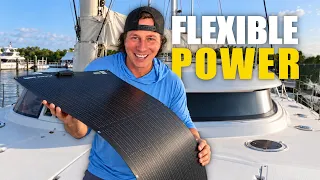
First Look at Renogy’s New Flexible Solar Panel for Our New Boat
Ryan from Sailing Sunday tests Renogy 200W flexible solar panels on his 48-foot catamaran curved roof, swaps in a compact Rover 2 MPPT controller, and plans a dual 50A DC-DC charging refit.
Our Baby Girl Is Finally Here! | Birth Vlog 325
At 39 weeks pregnant on her birthday, Brittni Moffatt and Ryan Weepers of Sailing Sunday head to the hospital in White Rock for a planned C-section to welcome their daughter, Harlow Lily.