Our Review of Outboard Engines on our 1160 Seawind Lite - Yamaha 25hP High Thrust
For blue water cruisers, auxiliary propulsion defines vessel maintenance, sailing performance, and long-distance logistics. Aboard the 38-foot cruising catamaran Sea Moon, Scott and Sandy of Sailing Sea Moon chose a distinct departure from traditional marine diesels: twin Yamaha 25HP High Thrust four-stroke outboards mounted in dedicated transom wells. After logging thousands of nautical miles across Australian coastal waters, the Indian Ocean, Southeast Asia, and the Mediterranean, Scott conducted a technical review evaluating whether outboards can reliably power an ocean cruising catamaran.
The Seawind 1160 Lite optimizes multihull performance through weight discipline. While conventional catamarans carry heavy inboard diesels, sail drives, and raw-water through-hulls aft, the Lite variant replaces that machinery with outboards and carbon fiber crossbeams. This engineering assessment analyzes the hydrodynamic benefits, fuel curves, electrical tradeoffs, and reliability encountered by the crew during years of continuous passagemaking.
The Naval Architecture of Lightweight Outboard Catamaran Propulsion
When Scott of Sailing Sea Moon commissioned the Seawind 1160 Lite catamaran SV Sea Moon Catamaran in Australia, opting for twin Yamaha 25HP High Thrust outboards over conventional inboard diesels marked a deliberate engineering departure tested thoroughly across Sydney, Pittwater, and coastal New South Wales. The naval architectural rationale focuses on weight reduction. In cruising multihulls, concentrated weight in the hull ends induces hobby-horsing and increases pitching resistance. By eliminating twin 30-horsepower diesels, sail drive legs, cast-iron engine blocks, and heat exchangers, the Seawind 1160 Lite sheds over 400 kilograms (880 pounds) aft.
Seawind molded dedicated fiberglass wells directly into the bridgedeck inboard of the twin spade rudders. Transom brackets secure each outboard, while helm tilt switches activate electro-hydraulic lift actuators. When raised, the cowlings tuck beneath flush deck hatches while the lower gearcases, propellers, and saltwater intakes clear the waterline entirely. This retraction eliminates underwater parasite drag, prevents marine biofouling at anchor, and preserves clean laminar flow across the hulls.
Hydrodynamics, Dual-Thrust Propellers, and Rough Sea Telemetry
During extensive bluewater sea trials conducted by Scott of Sailing Sea Moon aboard the Seawind 1160 Lite catamaran SV Sea Moon Catamaran—originating from the sailing grounds of Sydney, Pittwater, and coastal New South Wales, Australia—the twin Yamaha 25HP High Thrust outboards proved that gear reduction is paramount for multihull propulsion. Standard outboards utilize high-speed gear ratios unsuited for displacement hulls. The Yamaha T25 incorporates a 2.08:1 reduction gearcase paired with an oversized, low-pitch Dual-Thrust propeller, generating substantial bollard pull to arrest forward momentum and push into steep head seas.
The primary challenge arises in short-period chop or confused ocean swells. Despite extra-long shaft legs, pitching can cause propellers to cavitate near the surface as sterns lift. To counter aeration, Scott adopts an active motor-sailing strategy. By hoisting the mainsail and steering 20 degrees off the true wind angle, the sail generates aerodynamic lift, dampens pitching, keeps the leeward propeller submerged, and prevents cavitation in turbulent sea states.
Fuel Consumption Curves, Safe Storage, and Passage Range
Analyzing fuel consumption telemetry recorded by Scott of Sailing Sea Moon aboard the Seawind 1160 Lite catamaran SV Sea Moon Catamaran across Australia—from Sydney Harbour to the sheltered reaches of Pittwater in New South Wales—reveals distinct operational profiles between motoring and motor-sailing with twin Yamaha 25HP High Thrust engines. Under calm conditions, running a single outboard at 3,000 to 3,500 RPM yields 5.0 knots with a fuel burn of 5.0 liters per hour (1.0 liter per nautical mile). When motor-sailing with the mainsail drawing, fuel consumption drops to 2.5 liters per hour at the same speed.
Gasoline containment aboard a fiberglass vessel demands strict isolation. Seawind positioned the primary 270-liter roto-molded tank forward of the mast base at the vessel’s center of buoyancy. An adjacent ventilated locker holds five 20-liter jerry cans (100 liters reserve). Rigid fiberglass conduits route fuel lines safely through the bridgedeck to aft engine lockers, isolating fumes from living quarters. For ocean passages, six additional 20-liter cans on deck rails raise total fuel capacity to 490 liters, providing a motoring range of nearly 500 nautical miles.
Auxiliary Electrical Systems, Alternator Tradeoffs, and Marina Handling
Executing close-quarters maneuvers and managing auxiliary electrical loads aboard the Seawind 1160 Lite catamaran SV Sea Moon Catamaran has presented Scott of Sailing Sea Moon with distinctive engineering challenges from Sydney, Pittwater, and New South Wales, Australia, to international cruising grounds. Powered by twin Yamaha 25HP High Thrust outboards spaced across a 21-foot beam, differential throttle control allows the skipper to pivot the boat on its axis without helm input. However, because outboards sit inboard of the rudders without wash deflected across the foils, firm throttle bursts are required to initiate rotation in heavy crosswinds.
Electrical management represents another divergence from diesel auxiliaries. Each Yamaha T25 internal charging coil produces only 15 to 16 amps at cruising revolutions. To satisfy domestic electrical loads, Scott relies on an extensive rooftop solar array paired with a lithium iron phosphate (LiFePO4) battery bank. When cloud cover or heavy navigation loads deplete reserves, the crew deploys a portable Yamaha 2kVA generator stored forward, bridging charging deficits while preserving the vessel’s lightweight advantages.
Routine Maintenance Protocols, Haul-Out Logistics, and International Spares
Executing routine maintenance and long-term mechanical upkeep aboard the Seawind 1160 Lite catamaran SV Sea Moon Catamaran has presented Scott of Sailing Sea Moon with practical lessons since departing Sydney, Pittwater, and coastal New South Wales, Australia, with twin Yamaha 25HP High Thrust outboards. Daily inspections diverge from diesel routines; with raw-water cooling, the primary pre-departure check consists of visually verifying a strong cooling telltale stream upon startup. Because four-stroke powerheads do not consume oil under normal operation, dipstick checks are conducted periodically within the compact nacelles.
Scheduled 100-hour servicing centers on lower gearcase lubricant renewal and water pump impeller replacement. In regions with large tides, such as parts of northern Australia, catamarans can dry out on firm sandbanks between tides to access gearboxes. In micro-tidal waters like the Mediterranean, full lower-unit maintenance requires an annual haul-out or complete engine removal, which takes roughly two hours of mechanical labor per side.
Cruising internationally highlighted the global ubiquity of the Yamaha commercial network. Throughout Southeast Asia and remote archipelagos, small shops consistently stocked genuine Yamaha spark plugs, impellers, and fuel filters due to widespread adoption by local fishing fleets. The vessel carries dedicated spark plug sockets, replacement propellers, fuel primer assemblies, and a spare tilt motor, ensuring mechanical self-sufficiency on remote passages.
Comparative Engineering Telemetry & Long-Term Cruising Economics
Comparing empirical telemetry collected by Scott of Sailing Sea Moon aboard the Seawind 1160 Lite catamaran SV Sea Moon Catamaran across Australia—from Sydney Harbour to the offshore waters of Pittwater in New South Wales—illustrates the operational contrasts between twin Yamaha 25HP High Thrust outboards and traditional twin inboard diesel sail drives. The following engineering matrix summarizes weight distribution, hydrodynamics, electrical generation, and long-range cruising telemetry.
| Engineering Metric | Seawind 1160 Lite (Yamaha T25 Outboards) | Standard Seawind 1160 (Twin Inboard Diesels) | Operational Cruising Impact |
|---|---|---|---|
| Propulsion Units | Twin Yamaha 25HP High Thrust 4-Stroke (T25) | Twin 29HP Inboard Diesels (Yanmar / Volvo Penta) | Saves ~400 kg (880 lbs) of machinery weight aft |
| Lower Unit Configuration | Extra-Long Shaft Outboard Leg (2.08:1 Ratio) | Sail Drive Lower Leg with Through-Hull Diaphragm | Outboards tilt clear of water; zero sailing drag |
| Propeller Dynamics | Large-Diameter Low-Pitch Dual-Thrust Aluminum | 2-Blade or 3-Blade Folding / Feathering Bronze Props | Dual-Thrust delivers high reverse bite; diesels resist stall |
| Cruising Speed (Flat Water) | 5.0 knots @ 3,200 RPM (Single Outboard) | 6.2 knots @ 2,200 RPM (Single Diesel Engine) | Diesels offer higher displacement hull speed |
| Fuel Consumption Rate | 5.0 L/hr motoring (~2.5 L/hr motor-sailing) | 2.2 L/hr motoring (~1.2 L/hr motor-sailing) | Diesels are 50% more fuel efficient per nautical mile |
| Auxiliary Electrical Output | 16A Internal Alternator per Outboard (12V) | 80A to 125A High-Output Alternators with Regulators | Outboards require expanded solar arrays & generator |
| Total Usable Fuel Storage | 490 Liters (270L Tank + 220L Jerry Cans) | 360 Liters (Twin 180L Polyethylene Tanks) | Outboard range ~490 NM; Diesel range ~800–1,000 NM |
| Capital Repower Cost | Low (Twin outboards cost less than one diesel) | High (Complex engine haul-out and alignment) | Outboards allow modular dockside replacement |
The financial reality of long-term ownership favors the outboard configuration. Replacing both Yamaha T25 outboards with brand-new engines costs significantly less than purchasing and installing a single marine diesel engine and sail drive. With expected powerhead lifespans between 1,500 and 2,000 engine hours, cruisers who primarily sail achieve 5 to 7 years of service before repowering. By eliminating sail drive diaphragms, heat exchangers, and shaft alignments, the outboard catamaran represents an accessible, high-performance pathway to global ocean cruising.
Frequently Asked Questions
Addressing common technical inquiries, Scott of Sailing Sea Moon details how twin Yamaha 25HP High Thrust outboards perform aboard the Seawind 1160 Lite catamaran SV Sea Moon Catamaran, reflecting on sea trials and ocean passages originating from Sydney, Pittwater, and New South Wales, Australia.
Seawind selected twin Yamaha 25HP High Thrust outboards to shed over 400 kg of machinery weight from the aft hulls, eliminate sailing drag by tilting engines completely out of the water, and simplify ongoing mechanical maintenance.
In steep head seas, catamaran pitching can cause outboard propellers to cavitate near the surface. The crew mitigates this by motor-sailing at least 20 degrees off the true wind angle, using the mainsail to dampen pitching and stabilize water flow over the propellers.
Tilting the outboards fully clear of the water eliminates underwater parasite drag from lower legs and propellers, increasing boat speed under sail by up to 1.0 knot while preventing marine biofouling and growth at anchor.
Gasoline is stored in a 270-liter roto-molded main tank positioned forward of the mast base, with fuel lines routed through sealed fiberglass conduits directly to the engine lockers to keep hydrocarbon vapors entirely outside the living quarters.
Because Yamaha T25 alternators produce only 15 to 16 amps each, the crew relies on an expanded solar photovoltaic array, a large lithium iron phosphate battery bank, and a portable Yamaha 2kVA generator for backup charging during extended cloudy periods.
With engines spaced across a 21-foot beam, the catamaran spins easily on its axis using differential throttles. Because outboards sit inboard of the rudders, skippers use firmer, deliberate throttle bursts rather than relying on propeller wash against rudder blades.
Routine servicing includes daily telltale water flow verification, 100-hour lower-unit gear oil renewals to check for emulsion, impeller replacements, and annual haul-outs or engine unbolting for thorough mechanical inspections.
Support Sailing Sea Moon
At WeBoating.com, we profoundly acknowledge the unwavering dedication that Sailing Sea Moon invests in crafting each and every video or voyage. Their passion for delivering exceptional ocean content shines through every frame, and it's a labor of love that deserves your attention.
We invite you to watch their captivating videos here and actively engage with their content, including their social media links above. Liking, commenting, and sharing their work goes a long way in fueling their creative fire.
We're also inviting you to explore the gear, sponsorships, and boat partnerships highlighted in the "Our Review of Outboard Engines on our 1160 Seawind Lite - Yamaha 25hP High Thrust" video description, or directly on YouTube. By engaging with these offerings or purchasing services and items, you directly support Sailing Sea Moon, their collaborators, and the brands they're associated with.
To ensure you never miss an offshore update, consider visiting their official YouTube Channel to subscribe, like, and join their community directly.
If you have any feedback, corrections, or additional information about Sailing Sea Moon or their videos, please use the comment form below to share your thoughts with us.
Thank you for being a part of our community and supporting the creators we cherish. Your time and support truly matter!
What’s it really like having outboards on a 38ft cruising catamaran?
Sea Moon, our Seawind 1160 Lite, is powered by twin Yamaha 25HP High Thrust outboards. After sailing thousands of nautical miles with this setup, Scott sits down for a Tech Talk to give you our real-world review.
We cover how the engines are mounted, offshore performance, fuel consumption, manoeuvring, maintenance and servicing, and the spare parts we carry onboard.
We also get into some of the lessons we've learned while cruising internationally — including differences we've encountered between Yamaha motors in different markets, sourcing parts away from home, problems we've experienced and what our options would be if we eventually needed to replace the engines.
Finally, Scott runs through the pros and cons and gives his recommendation for anyone considering outboards on a cruising catamaran.
Subscribe to Sailing Sea Moon for our cruising adventures, Coffee with Sandy and Tech Talk with Scott.
CHAPTERS
00:00 Introduction
00:13 Our Boat
00:56 Can We Go Offshore?
01:35 Where Are the Engines?
04:04 Performance
07:08 Fuel
10:09 Manoeuvring
13:06 Maintenance & Servicing
18:43 Spare Parts
20:59 USA vs European Yamaha Motors
21:57 Issues We've Experienced
23:37 Replacement
27:38 Pros & Cons
32:54 Scott's Recommendation
⛵ Welcome Aboard Sailing Sea Moon
Hi, we're Scott & Sandy.
Five years ago we matched on Tinder. Today we're living aboard our Seawind 1160 Lite catamaran, Sea Moon, sailing full-time around the world.
Every week we share honest sailing adventures, cruising guides, boat projects, tech tips, destination guides and the realities of life aboard. From hidden anchorages and unforgettable experiences to the challenges that come with living at sea, we bring you along for the journey.
If you've ever dreamed of sailing, travelling full-time or living life differently, we'd love to have you aboard.
🔔 Subscribe and join the adventure!
📅 New Videos Every Week
Wednesday (Alternating)
• Sea Moon Tech with Scott
• Coffee with Sandy
Sunday - Mixture of;
• Sailing adventures, destination guides and life aboard Sea Moon
🌐 Follow Our Journey
📺 YouTube
https://www.youtube.com/@SailingSeaMoon
https://www.instagram.com/sailingseamoon
https://www.facebook.com/SailingSeaMoon
⛵ Our Boat
SV Sea Moon
Seawind 1160 Lite Catamaran
Twin Yamaha 25hp Outboards
🎥 Our Gear
Cameras
• DJI Action 4
• iPhone 17 Pro
• DJI Mini Drone
Audio
• DJI Mic
Editing
• Movavi Video Editor
• Canva Pro
🎵 Music
Music created using the built-in music library in
- Movavi Video Editor
- YouTube Studio
Other
- Google Earth
- Google Earth Pro
📧 Business Enquiries
Sailing Sea Moon
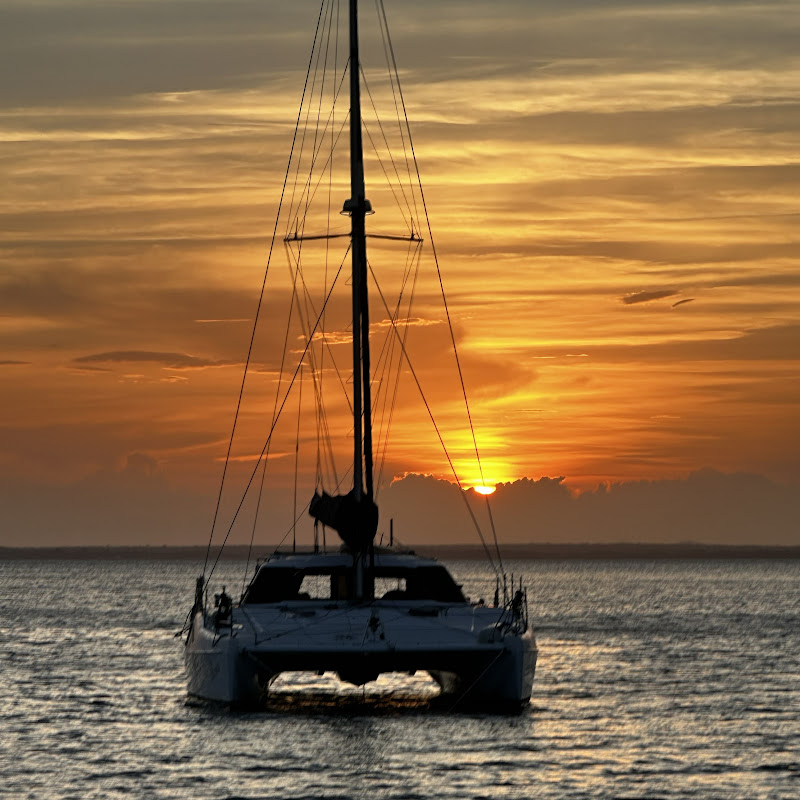
Five years ago, we matched on Tinder. Now we’re sailing around the world aboard 'Sea Moon' — our Seawind 1160 catamaran — chasing weather windows, freedom, and a life we once only talked about over drinks on a first date. Three years on, we feel it's time to share our stories and help others find their pathway to freedom and adventure. If you’ve ever wondered whether a different kind of life is possible, you’re in the right place. What will we share? Adventures, stories, tech tips…it’s all In our greater plan to share with you all. Please SUBSCRIBE and LIKE (on YouTube)and tell your friends ☺️. This helps us reach more people and share more stories. Let our adventures continue! Scott and Sandy Sailing Sea Moon CREDITS Video equipment used - iPhone 17 Pro, DJI Action 4, DJI Mini 3 - Video editing tool- Movavi - Music - Movavi music
Channel Information:
Social Media Links:
Our Review of Outboard Engines on our 1160 Seawind Lite - Yamaha 25hP High Thrust Location
- Pittwater Cruising Fairway, New South Wales, Australia (-33.6,151.3)
- Sydney Harbour Maritime Fairway, New South Wales, Australia (-33.85,151.25)
Latest Episodes from Sailing Sea Moon
Explore the most recent voyages. Subscribe to the channel to never miss an update!
Boat Show Cleopatra Marina Preveza Greece
A unique Boat Show | A Cruising Sailor's Perspective Welcome to a slightly different episode of Sea Moon Tech Talk with Scott! We've hauled Sea Moon out of the water for the winter at Cleopatra Marina near Preveza, Greece, and with hundreds of boats surrounding us, Scott couldn't re...
Did we push our sailing season too far? – Cruising The Mediterranean
After months of exploring the Mediterranean aboard our Seawind 1160 catamaran, Sea Moon, the seasons are changing — and so is life onboard. The warm summer days, calm anchorages and endless sunshine are giving way to colder temperatures, unsettled weather, strong winds and some rather uncomfortable...
10 Things I Wish I Knew Before We Set Sail | Coffee with Sandy ☕⛵
After sailing 14,000 NM from Australia to the Mediterranean aboard Seawind 1160 Sea Moon, Sandy shares 10 essential cruising truths on maintenance, weather, and life at sea.
Time to depart Lefkada through one of the two bridges that connect Greece’s Islands
Scott and the crew of Sailing Sea Moon navigate their Seawind 1160 catamaran through the narrow Lefkada Canal and the Santa Maura floating swing bridge into the Ionian Sea.
Boats, Bridge and Birthdays – Sailing Lefkada Greece
Scott and Sandy aboard the Seawind 1160 Lite catamaran Sea Moon navigate the historic Lefkas Canal floating bridge, berth at Lefkada, and explore the Ionian Sea.